Politics
Wisconsin consultants label GOP's redistricting map proposals as gerrymanders


- Consultants hired by the Wisconsin Supreme Court identified the Republican Legislature and a conservative law firm’s maps as partisan gerrymanders.
- The consultants noted key criteria for map improvement, including political neutrality, compactness, contiguity and preserving communities of interest.
- The battleground state of Wisconsin, where Republicans control the Legislature despite Democratic wins in statewide elections, faces significant political implications.
Consultants hired by the Wisconsin Supreme Court to examine maps redrawing state legislative districts said Thursday that plans submitted by the Republican Legislature and a conservative law firm are partisan gerrymanders, but they stopped short of declaring the other four maps constitutional.
Only the court can make the determination of whether any of those four plans from Democratic Gov. Tony Evers, Democratic lawmakers and others are constitutional, wrote Jonathan Cervas, of Carnegie Mellon University in Pittsburgh, and Bernard Grofman, of the University of California, Irvine.
Any of those maps could be improved based on criteria the court identified as being important, including political neutrality, compactness, contiguity and preserving communities of interest, the consultants wrote.
WISCONSIN REPUBLICANS WOULD MAINTAIN MAJORITY IN PROPOSED LEGISLATIVE MAPS, BUT WITH REDUCED DOMINANCE
They declined to draw their own maps, but said they could do so quickly if the court instructed them to.
The Wisconsin state Capitol is seen on Oct. 10, 2012, in Madison, Wisconsin. Consultants hired by the Wisconsin Supreme Court to examine maps redrawing state legislative districts said on Thursday that plans submitted by the Republican Legislature and a conservative law firm are partisan gerrymanders. (AP Photo/Scott Bauer, File)
The political stakes are huge in the battleground state where Republicans have had a firm grip on the Legislature since 2011 even as Democrats have won statewide elections, including for governor in 2018 and 2022. Four of the past six presidential victors in Wisconsin have been decided by less than a percentage point.
Evers hailed the report as confirmation that the Republican maps are gerrymandered.
“The days of Wisconsinites living under some of the most gerrymandered maps in the country are numbered,” Evers said in a statement. “While this is just one step in this process, today is an important day for the people of Wisconsin who deserve maps that are fair, responsive, and reflect the will of the people.”
Under maps first enacted by Republicans in 2011, and then again in 2022 with few changes, the GOP has increased its hold on the Legislature, largely blocking major policy initiatives of Evers and Democratic lawmakers for the past five years.
The victory last year by a liberal candidate for Wisconsin Supreme Court, who called the current Republican maps “rigged,” cleared the path for the court’s ruling in December that the maps are unconstitutional because districts are not contiguous as required by law.
The court ordered new maps with contiguous districts, but also said they must not favor one party over another. Republicans have indicated that they plan an appeal to the U.S. Supreme Court, arguing due process violations, but it’s not clear when that would come.
The consultants reviewed proposed maps submitted by Evers, fellow Democrats, Republicans, academics and others that would reduce the Republican majorities that sit at 64-35 in the Assembly and 22-10 in the Senate.
The consultants on Thursday called the maps from the Legislature and the conservative Wisconsin Institute for Law and Liberty “partisan gerrymanders.” The Legislature’s map was virtually unchanged from what the current boundaries are.
The consultants rejected Republican claims that their majorities in the Legislature are due to Democratic support being concentrated in cities, while the GOP had broader support in a larger geographic area.
“That kind of insulation from the forces of electoral change is the hallmark of a gerrymander,” they wrote. “To put it simply, geography is not destiny.”
Cervas and Grofman wrote that the four Democratic maps were similar on most criteria and from a “social science point of view,” are “nearly indistinguishable.”
Rick Esenberg, president of the law firm whose map was deemed to be a partisan gerrymander, blasted the consultants’ findings.
“The report hides its bias behind a fog of faux sophistication,” Esenberg said in a statement. “Let’s be clear, our maps have been rejected for one reason and one reason alone, they don’t produce the partisan outcomes the experts or many on the Court want.”
It ultimately will be up to the Wisconsin Supreme Court, with a 4-3 liberal majority, to decide which maps to enact. The state elections commission has said that must be done by March 15 to meet deadlines for candidates running in the fall.
Evers on Tuesday vetoed a last-ditch effort by Republicans to enact new lines to avoid the court ordering maps. Republicans largely adopted the Evers maps but moved some lines to reduce the number of GOP incumbents who would have to face one another in the new districts.
WISCONSIN REPUBLICANS HASTILY APPROVE NEW LEGISLATIVE MAPS
Evers rejected it, calling it another attempt by Republicans to gerrymander the districts in their favor.
Under most of the newly proposed maps, Republicans would retain their majorities in the Legislature, but the margin would be significantly tightened, judging by an analysis by a Marquette University researcher.
The Wisconsin Supreme Court has also been asked by Democrats to take up a challenge to the state’s congressional district lines. That lawsuit argues the court’s decision to order new state legislative maps opens the door to challenging the congressional map. Republicans hold five of the state’s eight congressional seats.
The moves in Wisconsin come as litigation continues in more than dozen states over U.S. House and state legislative districts that were enacted after the 2020 census.

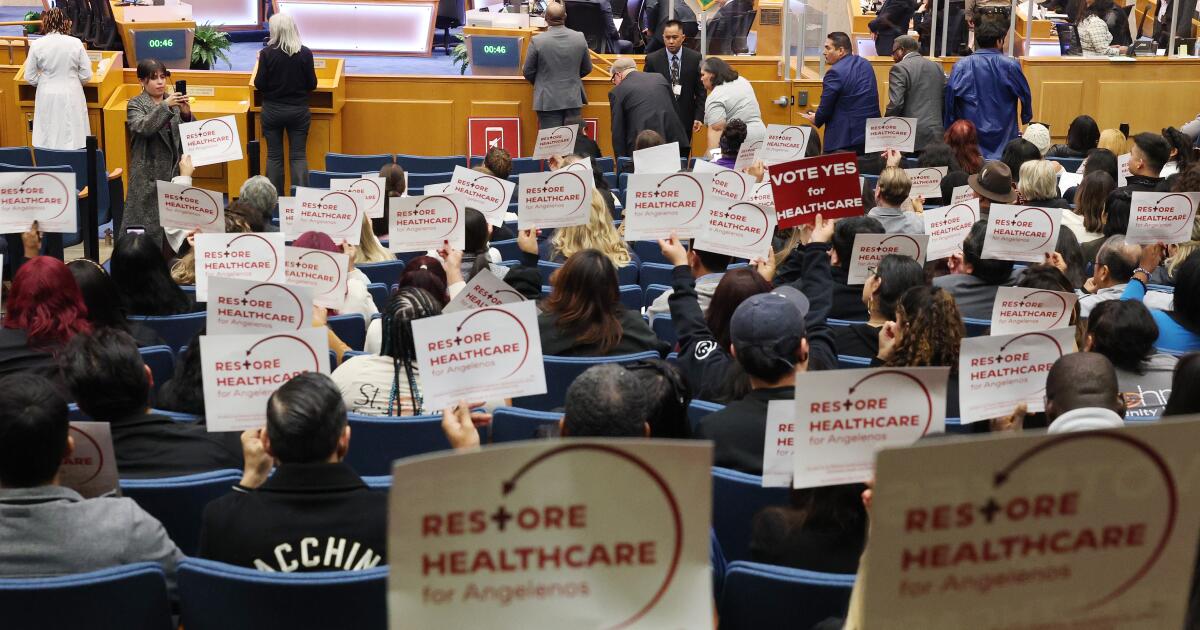
Los Angeles County’s half-cent sales tax to fund healthcare services was trailing Tuesday, with early returns showing a majority of voters rejecting the measure.
The tax — a half-penny of every dollar spent in the county — is meant to prop up local hospitals and clinics that are hemorrhaging funding after recent federal cuts.
The sales tax, which needs a simple majority to pass, would take effect Oct. 1 and last five years. Officials say it would pull in $1 billion annually to help plug the budget holes hitting local hospitals and clinics.
L.A. County health officials anticipate the One Big Beautiful Bill Act, signed into law by President Trump last summer, will slash more than $2 billion from the county’s health services budget within the next three years. Due to eligibility changes, the county will no longer be able to get reimbursements for many Californians who have lost Medi-Cal.
The measure was championed by a coalition of healthcare advocates called Restore Healthcare for Angelenos who warned that mass layoffs and emergency room closures could be imminent if new funding didn’t come fast. The Department of Public Health recently closed seven clinics — a grim sign, supporters said, of service cuts to come.
Voters haven’t rejected a sales tax hike since 2012, when a transportation measure fell just short with 66.1% support. It needed 66.7% to pass.
A majority of county supervisors had supported the new tax proposal, voting 4 to 1 this February to put it on the ballot. But the measure faced significant opposition from local cities, with opponents arguing the sales tax hike would unfairly burden the poorest county residents and encourage people to spend their dollars across the county line.
Supervisor Kathryn Barger, the board’s lone opponent of the tax, said she was concerned it was a “general” tax, meaning the money wouldn’t be earmarked for healthcare costs. Instead, she argued, politicians would have final say over how the money gets spent.
The supervisors have created a plan for spending the tax money, with the largest chunk of the money meant to cover the costs for patients without insurance. The measure also asked voters to sign off on a nine-member oversight committee.
The county currently has a base sales tax rate of 9.75%, and cities impose local taxes on top of that.
Politics
DOJ expands indictment against SPLC, alleging $4M secretly funneled to KKK and extremist groups

NEWYou can now listen to Fox News articles!
The Department of Justice last month announced an indictment against the Southern Poverty Law Center (SPLC), alleging that the civil rights nonprofit defrauded donors by secretly paying informants associated with extremist organizations, including the Ku Klux Klan.
A federal grand jury in the Middle District of Alabama returned an 11-count indictment in April charging the SPLC with six counts of wire fraud, four counts of making false statements to a federally insured bank and one count of conspiracy to commit concealment money laundering, according to the Justice Department.
The superseding indictment retains those charges while expanding on the alleged misconduct.
According to the DOJ, the SPLC “secretly funneled” more than $3 million in donor funds between 2014 and 2023 to numerous individuals associated with extremist organizations, including the Ku Klux Klan, United Klans of America, the National Socialist Movement, participants in the Unite the Right rally and the Aryan Nations-affiliated Sadistic Souls Motorcycle Club.
NEO-NAZIS, ‘SADISTIC’ BIKERS AND CHARLOTTESVILLE ORGANIZER: 5 OF THE MOST SHOCKING SPLC INFORMANTS
The Southern Poverty Law Center has widespread influence in education. FILE: Acting Attorney General Todd Blanche, left, and SPLC interim President and CEO Bryan Fair are shown in a split image as the Justice Department pursues charges against the Southern Poverty Law Center. (Nathan Posner/Anadolu via Getty Images; USA TODAY Network via Imagn Images)
The original indictment alleged approximately $3 million in payments between 2014 and 2023.
“The SPLC’s paid informants (‘field sources’) engaged in the active promotion of racist groups at the same time that the SPLC was denouncing the same groups on its website,” the indictment states.
Prosecutors further allege the SPLC opened bank accounts tied to fictitious entities in order to conceal donor funds that were allegedly routed to confidential sources.
MIKE DAVIS: SOUTHERN POVERTY LAW CENTER: A TALE OF A RACISM SCAM
The Southern Poverty Law Center (SPLC) building seen in March 2020 in Montgomery, Alabama. (Barry Lewis/InPictures via Getty Images)
According to the indictment, the SPLC began operating a covert informant network in the 1980s, and between 2014 and 2023 allegedly paid those sources in a clandestine manner.
The DOJ alleges an SPLC employee instead encouraged the pair to remain involved and offered them a monthly salary of $1,200.
The two subsequently agreed to remain in the organization, according to the indictment.
DR. BEN CARSON: I KNOW HOW BAD THE SPLC WAS, IT CAME AFTER ME AND PUT ME AT RISK
Acting Attorney General Todd Blanche spoke during a press conference alongside FBI Director Kash Patel at the Department of Justice on April 21, 2026, in Washington, D.C., following the indictment of the Southern Poverty Law Center. (Nathan Posner/Anadolu via Getty Images)
Prosecutors allege an SPLC employee instructed the individuals to claim they worked for a company called Rare Books and helped college students with research and writing assignments if anyone questioned the source of their income.
The indictment alleges donor funds were used to pay both individuals through SPLC accounts.
According to prosecutors, the pair were also reimbursed for expenses related to Ku Klux Klan activities, including cross-burning events and associated costs such as wood and fuel.
One of the individuals is also accused of recruiting new members using donor-funded payments. The indictment further alleges the SPLC knew donor funds were used to purchase materials for Ku Klux Klan garments.
In a statement to Fox News Digital, attorney Abbe Lowell, who represents the SPLC, denied the allegations.
A composite image shows Acting Attorney General Todd Blanche overlaid on photographs of the Department of Justice and FBI headquarters in Washington, D.C. (Valerie Plesch/Bloomberg via Getty Images; Graeme Sloan/Bloomberg via Getty Images)
“This apparent superseding indictment attempts to shore up the flaws in the initial charges, but it changes nothing,” Lowell said.
“The SPLC did not lie to its donors, it did not mislead banks it did business with, and its informant program prevented violence and saved lives,” he continued.
“It appears the Justice Department shared the indictment with media before it was unsealed by the court – another example of the government’s troubling handling of this case.”
“We will be addressing these irregularities with the court and look forward to presenting the truth at trial,” he added.
NONPROFIT REVENUE TOTALS SURGE AMID GROWING SCRUTINY AFTER MAJOR FRAUD CASES
SPLC interim President and CEO Bryan Fair speaks during a wreath-laying ceremony at the Southern Poverty Law Center Civil Rights Memorial in Montgomery, Ala., on March 5, 2026. (Jake Crandall/Advertiser / USA TODAY NETWORK via Imagn Images)
The superseding indictment also notes that the SPLC’s reported revenue increased from roughly $38.7 million in 2010 to more than $129 million in 2023, an increase of approximately 233%.
According to the filing, the organization’s net assets grew from approximately $238 million to nearly $787 million during the same period.
The SPLC is a longtime nonprofit organization that says it combats white supremacy and extremism through research, reporting and monitoring efforts intended to assist law enforcement and the public.
During a news conference announcing the original indictment, Acting Attorney General Todd Blanche alleged the SPLC paid members of extremist groups so it could generate “work product” documenting their activities.
CLICK HERE TO DOWNLOAD THE FOX NEWS APP
“To that end, [SPLC] was doing the exact opposite of what it told its donors it was doing – not dismantling extremism but funding it,” Blanche said.
Fox News Digital’s Alexandra Koch, David Spunt, Jake Gibson and Alec Schemmel contributed to this report.
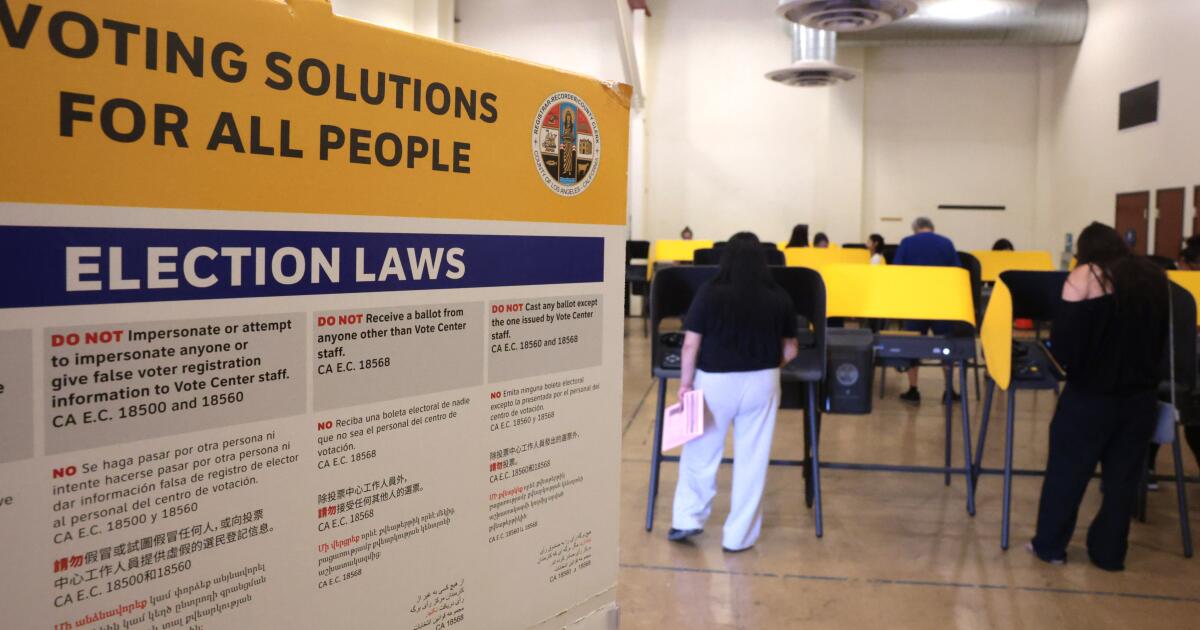
Buoyed by a new Congressional map favoring their party, California Democrats were eyeing Tuesday’s primary elections as a critical first step toward flipping a handful of House seats and taking back power in Washington.
Results from California’s massive and slow-moving election process were not immediately clear late Tuesday, as polls closed and mail ballots continued to be processed and counted. Still, Democrats were bullish about their chances of advancing candidates to November’s general election in all five districts that were redrawn in their favor as a result of last year’s Proposition 50 ballot measure.
“The path to winning back the House starts with voting in the June 2nd primary,” the California Democratic Party posted online Monday.
Meanwhile, California Republican Party Chairwoman Corrin Rankin urged Republican voters to make their own voices heard too.
“Like President Trump said, we need to make it too big to rig,” Rankin said on “The Benny Show.” “We need to swamp the vote.”
One of the most closely watched races was in the redrawn 22nd Congressional District in the Central Valley, where incumbent Rep. David Valadao (R-Hanford) is facing challenges from moderate Assemblymember Jasmeet Kaur Bains (D-Delano) and progressive college professor Randy Villegas.
Another closely watched race was in the redrawn 48th Congressional District in San Diego and Riverside counties, where Rep. Darrell Issa (R-Bonsall) decided to retire rather than run for reelection, and where Republican San Diego County Supervisor Jim Desmond — who is endorsed by Trump — is running against a pack of Democrats.
Prop. 50 — which Californians passed with nearly 65% of the vote a year ago — was California Democrats’ response to Texas Republicans redrawing their state’s Congressional maps in the GOP’s favor, at President Trump’s behest. It was also the only major Democratic counterpunch in the wider mid-decade redistricting brawl that has spread across the country in the last year.
Experts expect the redistricting battle to deliver a net gain of a handful or more House seats to Republicans. But Democrats could gain even more ground given Trump’s lousy approval ratings and the long history of midterm election losses for the president’s party.
Combined, those factors make the battle for control of the House incredibly close, which in turn makes the five seats up for grabs in California pivotal — and potentially decisive.
Tuesday’s primaries won’t determine if any of those five seats will indeed flip parties in November. However, the primaries will define those head-to-head races to come and better inform the odds of Democrats toppling Republican incumbents, experts said.
In addition to flipping the seats currently held by Valadao and Issa, Democrats are hoping to pick up three additional seats.
In the 1st Congressional District — which after Prop. 50 lost rural reaches of northeast California and picked up liberal North Bay communities — various candidates were vying for the seat long held by the late Rep. Doug LaMalfa (R-Richvale), who died in January. They include Democratic state Sen. Mike McGuire and Republican Assemblymember James Gallagher, who is endorsed by Trump.
Voters from the existing district are also voting in a special election Tuesday to fill the remainder of LaMalfa’s term.
In the 3rd Congressional District, which lost an eastern rural stretch along Nevada and now holds more tightly to the Sacramento suburbs, Rep. Ami Bera (D-Elk Grove) — who currently represents a different district — is running to remain in Congress in a new seat.
Meanwhile, the 3rd Congressional District’s incumbent, Rep. Kevin Kiley (I-Rocklin), is seeking to do the opposite. He quit the Republican Party, became an independent and is now running for Bera’s current seat in Congressional District 6, which includes the city of Sacramento and Placer County suburbs.
In the 41st Congressional District, which became more liberal after Prop. 50 by losing voters in Riverside County and gaining them in Los Angeles County, a slate of candidates — including Rep. Linda Sánchez (D-Whittier), who currently represents a different district — are running to replace Rep. Ken Calvert (R-Corona). Calvert, a 17-term incumbent, decided to run in the neighboring 40th Congressional District instead.
In the 40th Congressional District, which covers a swath of inland Orange County and portions of San Bernardino and Riverside counties, incumbent Rep. Young Kim (R-Anaheim Hills) is now going head-to-head with Calvert, while also facing several Democratic challengers.
Other districts that were not part of the Prop. 50 shuffle are also attracting attention.
In the 11th Congressional District in San Francisco, several Democratic candidates are vying to replace Rep. Nancy Pelosi (D-San Francisco), the retiring former House Speaker, including state Sen. Scott Wiener; tech millionaire and Democratic political operative Saikat Chakrabarti; and Connie Chan, a member of the San Francisco board of supervisors who Pelosi endorsed.
Democrats are also closely watching several races where younger Democrats and progressives are challenging older incumbent Democrats, and where newer Democratic incumbents are seeking to hold onto their seats in relatively competitive districts.
-
 Entertainment5 minutes ago
Two of music’s most powerful executives maxed out donations to Spencer Pratt
-
 Lifestyle8 minutes ago
Vintage-obsessed millennial parents are driving L.A.’s booming kids’ clothing resale market
-
Politics13 minutes ago
Early returns indicate L.A. County voters have doubts about healthcare sales tax measure
-
 Sports23 minutes ago
Nelly Korda, Michelle Wie West and more: Who to watch at U.S. Women’s Open
-

 World35 minutes ago
EU launches major tech push to break US and China dependence
-
 News58 minutes ago
California’s primary for governor is undecided as candidates vie to be in the top two
-

 Los Angeles, Ca2 hours ago
California primary election results: governor and L.A. mayor races
-

 Detroit, MI3 hours ago
Another bribery scandal hits Detroit. It involves the People Mover

