Politics
What Past Polling Misses Can Tell Us About the 2024 Election


Note: Arrows show the weighted national polling average margin compared with the final national popular vote margin.
Every cycle, the polls diverge from the election results to some extent. It’s inevitable when pollsters can only make estimates about who will show up to vote, some people only make up their minds in the voting booth, and bombshells may drop late in the race.
Data from the past four decades shows that the polls do not always bias one party over the other, and that past performance can’t predict how the polls will do the next time around. The polls in the 2022 midterms, for example, were some of the most accurate in years.
To judge the accuracy of presidential polls, the charts in this article show averages that combine many polls into one estimate for each election. Between 1988 and 2020, the final national polling average was off by an average of 2.3 percentage points.
Some years were better than others: In 2008, the national polling average missed the final result for Barack Obama by less than one percentage point on average; in 1996, it overestimated the support for Bill Clinton by almost four points.
State-level polls haven’t performed quite as well. Since 2000, polls in close states have been off by an average of 3.1 points. In 2016 and 2020, nearly all of the state-level polling averages underestimated support for Mr. Trump, sometimes by a wide margin.
Wisconsin had one of the biggest polling misses in recent cycles, overstating Mr. Biden’s support by 9 points.
Several states that Mr. Trump ultimately won had polling averages showing Mrs. Clinton in the lead. State polling misses in presidential elections with Trump
The state polling misses have been magnified in the last two presidential elections — two very close races that heightened the importance of the Electoral College. But the polls’ performance in those two years was not entirely unusual. A look at state polling misses since 2000 shows that polls of older elections did about as well as today’s polls.
State polls underestimated Mr. Obama, with the exception of South Carolina, which Mitt Romney won.
Polls showed John McCain leading in Indiana, but Mr. Obama won the state. Polls were more of a mixed bag, with some underestimating George W. Bush, and others John Kerry.
Al Gore won the popular vote but lost the election. Polls showed Mr. Bush leading in Florida, but the results were razor thin.
State polling misses in presidential elections
State polls have missed in both directions over the years. But if pollsters underestimated Mr. Trump in the last two elections, are they doomed to do so again this year? Should you, as some poll watchers claim to do, mentally add a boost for Mr. Trump to any poll numbers you see?
Pollsters believe they have largely identified what caused the polling misses in 2016. A major culprit was the failure to account for voters’ education levels, according to a report from a professional organization of public pollsters. State level polls in particular that year overrepresented college-educated respondents and undercounted respondents without a college degree.
This was less of a problem in past elections, when vote choice did not cleave so sharply along educational lines. But in 2016 and thereafter, non-college-educated voters have largely supported Republicans, especially Mr. Trump.
By 2020, nearly all pollsters had begun accounting for education. But polls still underestimated Mr. Trump. This time, the cause of the error was less clear-cut. One theory, presented by a report evaluating 2020 polls, is that Trump supporters were less likely to respond to surveys. As a result, “even if you control for white non-college male, the ones that answer the survey are more Democratic than the ones who don’t,” said Chris Jackson, who heads U.S. public opinion research for Ipsos. Others have posited that Biden voters were more likely to stay at home during the pandemic, giving them more time and opportunity to respond to polls.
Yet another challenge that year: the record turnout. About a quarter of voters in 2020 had not voted in 2016, according to estimates by the Pew Research Center. And polling had indicated that any new 2020 voters would mostly be Biden supporters. In fact, they were divided between Mr. Biden and Mr. Trump, according to the Pew study.
So, what about this year? Polling in seven swing states is extremely close — in most of these states, Mr. Trump and Kamala Harris are essentially tied. While the polls in these states underestimated Mr. Trump’s support in the last two cycles, historically, they have a mixed track record, with misses on both the left and right, and some years better than others.
Years in bold indicate those in which the polling leader lost in that state. Note: Averages not available for some states in some years.
Most pollsters have made some changes to their methodology, partly in response to the 2020 misses, and the accurate 2022 midterm polls gave pollsters some optimism.
But one key difference between the midterms and the last two presidential elections is that Mr. Trump was not on the ballot. Ultimately, there may be something about Mr. Trump’s supporters that makes them especially difficult to measure in polls. “There’s a real possibility that having Trump on the ballot makes it hard to poll for whatever reason,” said Berwood Yost, the director of the Franklin & Marshall College Poll of Pennsylvania.
“But the other possibility is that we’ve made all these adjustments to correct the error. And perhaps we’ve overcorrected,” he added. “I don’t know which it is.”
Past polling misses in presidential elections for battleground states



Politics
Dem senators dodge crucial question on illegal alien accused of killing Chicago college student

NEWYou can now listen to Fox News articles!
While Republican senators, like Texas’ Ted Cruz and Florida’s Rick Scott, were quick to condemn the policies that kept the illegal immigrant killer of 18-year-old Sheridan Gorman from being deported, Democratic senators dodged questions on whether Gorman’s killer should have previously been deported prior to this month’s murder.
Gorman, who was a student at Loyola University of Chicago at the time of her death, was allegedly killed by an illegal immigrant from Venezuela, Jose Medina, 25. Medina was apprehended by U.S. Border Patrol on May 9, 2023, but was subsequently released into the U.S. under the Biden administration, according to Trump’s Department of Homeland Security.
A short time later, Medina was arrested for shoplifting in Chicago, but was again released on June 19, 2023, DHS said. A judge put a warrant out on Medina after he failed to appear in court for his shoplifting charge, which was still active at the time of Gorman’s killing, according to the Chicago Sun Times.
“Shoplifting in and of itself is not a violent crime. It’s not an indicator of a person that’s leaning toward violent crime,” said Sen. Dick Durbin, D-Ill., when asked about Medina’s case and whether he should’ve been deported prior to Gorman’s murder.
ILLEGAL IMMIGRANT ACCUSED OF KILLING CHICAGO COLLEGE STUDENT TO FACE COURT AFTER TUBERCULOSIS DELAY
Sheridan Gorman (L) was allegedly murdered by Jose Medina (R) (Sheridan Gorman/Instagram and Cook County Sheriff’s Office)
“You’re asking me to speculate on a bunch of things and I can’t answer that,” said Sen. Catherine Cortez-Masto, D-Nev., when asked if Gorman’s killer, and other illegal immigrant murderers who had significant criminal records at the time of their arrests, should have been deported before people got hurt. “I don’t know the cases. I trust our justice system to do the right thing and hold people accountable.”
Sen. Tammy Duckworth, D-Ill., responded that the Trump administration’s broad deportation crackdowns have prevented federal law enforcement from targeting genuinely dangerous people, an argument pushed by other top Democrats in Congress. “I think that if Trump cleared out Chicago and if ICE did their job, he wouldn’t be here, right?” Duckworth said as she got onto an elevator on Capitol Hill. “But they deported people who are not… [unintelligible].”
Meanwhile, Sen. Elissa Slotkin, D-Mich., offered a more judicious response, but also suggested the style by which the Trump administration is deporting people is problematic.
“Do I think violent criminals should be deported? Yes,” Slotkin said, adding it is an “easy” call to deport someone who has been “accused and properly prosecuted.” But, Slotkin added, “Innocent civilians who are protesting their government and using their freedom of speech should not be fingered and booted out.”
Democrats who spoke with Fox News Digital did quickly agree that violent criminals who entered and are residing in the country unlawfully should be deported.
From left to right: Sen. Elissa Slotkin, D-Mich., Sen. Dick Durbin, D-Ill., Sen. Tammy Duckworth, D-Ill., and Sen. Catherine Cortez Masto, D-Nev. (Getty Images)
SHERIDAN GORMAN’S UNIVERSITY NEWSPAPER TOUTS ICE TRACKER AFTER FRESHMAN ALLEGEDLY MURDERED BY ILLEGAL ALIEN
“Anybody who violates, or creates crime in this country – particularly kills somebody – should not only be held accountable in the United States, but, yes, there should be immigration enforcement against that individual,” Cortez-Masto said.
“Every community deserves to feel safe, and I think people who commit violent crimes should not be allowed to either be in our country, or to be among our communities,” added Sen. Angela Alsobrooks, D-Md.
Durbin, meanwhile, qualified his comments about Medina’s shoplifting charge by admitting “We ought to do a careful examination of people coming into this country and those who want to stay in this country,” adding that, “If they are dangerous to the community, they need to be denied entry or taken out of the country later.”
But Republican Senators Cruz and Scott were quick to bash Democrats for allegedly caring more about illegal immigrants than American citizens.
Sen. Ted Cruz (R-TX) holds a press conference with families who lost loved ones in the January 29, 2025 DCA plane crash on December 15, 2025 at the U.S. Capitol in Washington, DC. (Heather Diehl/Getty Images)
CLICK HERE TO DOWNLOAD THE FOX NEWS APP
“It’s tragic and it was avoidable,” Cruz said when approached about Gorman’s death and Medina not being deported. “The Democrats are so radical they prioritize illegal immigrants over American citizens.”
“It’s disgusting that these people say, ‘Oh, they act like they care about Americans.’ But then you look at their actions – they care about people who are here violently hurting Americans,” Scott complained.
Politics
DHS attorney said agents in Los Angeles should have ‘started hitting’ protesters, emails show
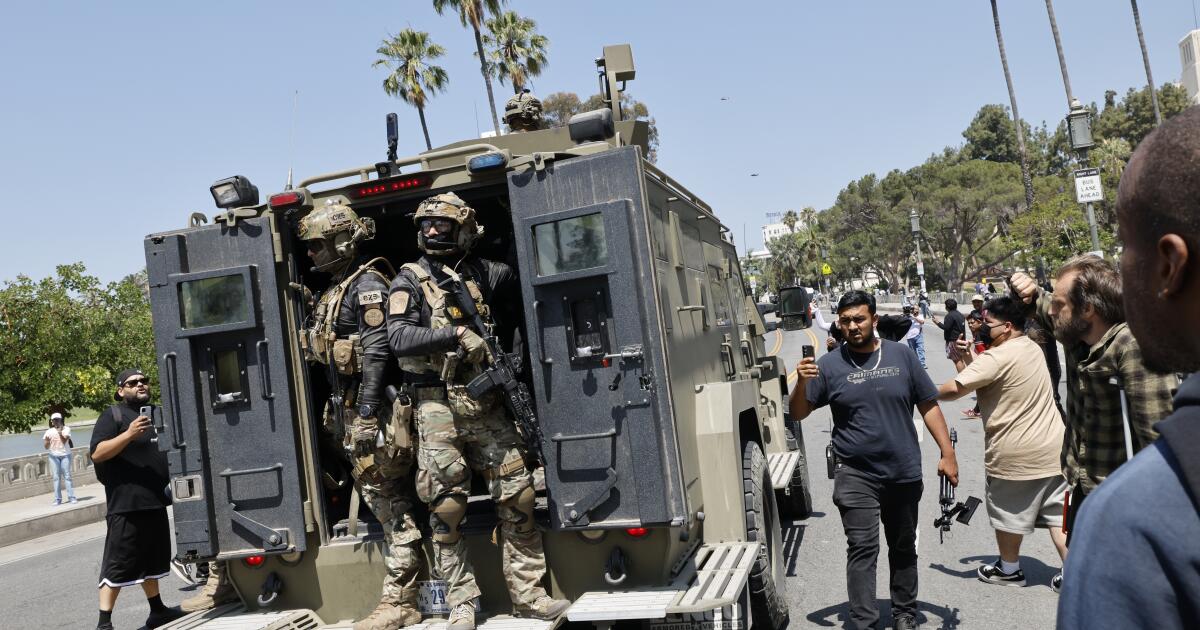
WASHINGTON — A lead attorney for the Department of Homeland Security suggested that federal agents should have “just started hitting the rioters and arresting everyone that couldn’t get away” during an anti-ICE protest in Los Angeles last June, internal emails show.
The note was in an email chain obtained by the nonprofit watchdog group American Oversight through the Freedom of Information Act and shared exclusively with The Times.
In it, attorneys for Homeland Security appear to be discussing the June 9 lawsuit filed by California Gov. Gavin Newsom over President Trump’s deployment of thousands of California National Guard troops to Los Angeles.
Under the subject line “California DOD Lawsuit,” officials coordinated legal filings defending the Trump administration and included a draft declaration by the Los Angeles field office director of Immigration and Customs Enforcement supporting the deployment of military forces.
The final email in the thread was from Joseph Mazzara, then-acting DHS general counsel, and he appears to be referring to an incident in which protesters tried to breach a protective line at a federal building.
On June 11, he wrote: “Every time I read about the battering ram incident I’m just floored at how wild that is.”
Referring to law enforcement as “they,” he continued: “They should have, when they brought the line in, just started hitting the rioters and arresting everyone that couldn’t get away from them. No one likes being hit by a stick, and people tend to run when that starts happening in earnest.”
The Department of Homeland Security didn’t respond to requests for comment.
Mazzara was later appointed deputy commissioner of U.S. Customs and Border Protection.
Politico reported that Mazzara is among 10 staffers who followed former Homeland Security Secretary Kristi Noem to the State Department after she was fired this month from DHS and given a new role as special envoy for the Shield of the Americas.
The battering ram incident Mazzara referred to is detailed in court documents for the lawsuit.
A June 19 order from a panel judges from the 9th Circuit Court of Appeals states that Trump administration attorneys presented evidence of protesters interfering with federal officers. The protesters threw objects at ICE vehicles, “pinned down” several Federal Protective Service officers and threw “concrete chunks, bottles of liquid, and other objects,” the order said.
Protesters also “used ‘large rolling commercial dumpsters as a battering ram’ in an attempt to breach the parking garage of a federal building,” the order states.
Mazzara’s comment in the email thread with other Homeland Security attorneys was given to American Oversight with a watermark showing the agency had intended to withhold it. American Oversight also received a version of the documents with that statement redacted.
Chioma Chukwu, executive director of American Oversight, said it’s no wonder the administration wanted to keep Mazzara’s comments hidden.
“They reveal a level of hostility toward protesters that is deeply at odds with the government’s obligation to protect civil liberties — and there’s no FOIA exemption that justifies hiding them,” she said.
Kerry Doyle, the former top ICE attorney during the Biden administration, said Mazzara’s comments show a shocking carelessness about the potential for harm against both the general public and the officers he was employed to protect.
The email, she said, “seems to encourage, or, at the very least, support constitutional violations by the operators that are supposed to be getting legal counsel from him to avoid violating the law.” Plus, commenting on operational strategy is outside the scope of his responsibilities, she said.
“He’s doing a disservice to the people that are on the front line, that rely on him and his colleagues to give them the parameters of what they can and can’t do,” Doyle added. “If you give them bad legal advice, you are setting them up for liability.”
Noem’s removal came amid backlash against an escalation of violence during Trump’s crackdown on immigration, including the shooting deaths of U.S. citizen protesters by immigration agents.
Doyle said part of the secretary’s job is to set the tone for the agency so the rank and file know what is expected of them. Mazzara’s comments, she said, show how that tone has permeated all facets of the agency.
After the U.S. Supreme Court cast doubt on the Trump administration’s legal theory for using troops in domestic law enforcement operations, the president in December began removing the National Guard from Los Angeles and other Democratic-led cities.
The protests last summer caused significant property damage in a small section of downtown Los Angeles. But grand juries refused to indict many demonstrators accused by federal prosecutors of attacking agents, and a Times review of alleged assaults found that most incidents resulted in no injuries.
Politics
WATCH: Senate hearing goes silent after Angel Father confronts top Dem over daughter’s death

NEWYou can now listen to Fox News articles!
A Senate hearing got tense and quiet after Illinois father Joe Abraham confronted retiring Sen. Dick Durbin, D-Ill., for not acknowledging his daughter, Katie, who was killed by an illegal immigrant drunk driver.
After Sen. Ted Cruz, R-Texas, expressed his condolences to Abraham, the grieving father thanked him and then proceeded to drill into Durbin.
“I appreciate it. I also appreciate Ranking Member Welch and Mr. Padilla for recognizing that. What I don’t understand is why my senator of Illinois, Mr. Durbin, [I] haven’t heard two words from him toward me,” he said, pointing in Durbin’s direction.
“It’s kind of amazing,” Abraham added.
ILLEGAL IMMIGRANT ACCUSED OF KILLING CHICAGO COLLEGE STUDENT TO FACE COURT AFTER TUBERCULOSIS DELAY
Sen. Dick Durbin, D-Il., (left) was confronted by Angel father Joe Abraham (right) over the killing of his daughter, Katie, by an illegal immigrant. (Demetrius Freeman/The Washington Post via Getty Images; U.S. Senate Committee on the Judiciary official website livestream)
In the suddenly quiet hearing chamber, Cruz said, “I think it is a fair question to ask.” Abraham answered, “Kind of happy he’s calling it quits.”
After the tense exchange, Abraham again called out Durbin, writing, “You had the chance to show basic humanity, to acknowledge Katie’s life and death, as other senators in your own party did. Instead, silence. Not a call, not a statement, not even basic human acknowledgment.”
Abraham stated that “silence in the face of tragedy isn’t neutrality. It’s indifference.”
“You’re retiring, but for many of us, that comes 30 years too late. And whoever you choose to endorse should be rejected just as quickly, because Illinois cannot afford more of the same,” he added, writing, “Illinois families deserve better than leaders who look away when the consequences don’t fit their narrative.”
He also criticized Durbin for supporting sanctuary policies, saying, “My daughter died in a system shaped by policies you continue to defend.”
“You chose sanctuary policies that give special privileges to those here illegally, while law-abiding Illinois citizens like my family are left unprotected,” wrote Abraham. “That’s not compassion. That’s a failure of leadership.”
COLLEGE STUDENT’S ALLEGED MURDER BY ILLEGAL WENT EXACTLY AS DEMS ‘INTENDED,’ HOUSE SPEAKER SAYS
Katie Abraham was killed by an illegal immigrant drunk driver. (Joe Abraham )
Abraham’s 20-year-old daughter, Katie Abraham, was killed by an illegal immigrant in a drunk-driving incident while standing at a stoplight in the college town of Urbana, Illinois. The federal government’s immigration crackdown in the Chicago area was launched in Katie’s honor. Dubbed “Operation Midway Blitz,” the effort resulted in more than 4,500 illegal immigrant arrests, according to DHS.
In an interview with Fox News Digital, Abraham, a lifelong Illinois resident, described his family as navigating a “dark wilderness” in the wake of Katie’s death.
“We have been in a dark wilderness, wandering, trying to find our new purpose … without Katie, who we thought would be with us the rest of our lives,” he said.
ANGEL PARENTS SLAM ILLINOIS SANCTUARY LAWS AFTER ‘PREVENTABLE’ TRAGEDY IN STUDENT’S DEATH
Joe Abraham holds a photograph of himself with his 20-year-old daughter, Katie Abraham, at his family’s home in Glenview, Illinois, on Sept. 10, 2025. (Stacey Wescott/Chicago Tribune/Tribune News Service via Getty Images)
“She was a beautiful soul,” he added, lamenting, “We thought we’d have our children the rest of our lives.”
CLICK HERE TO DOWNLOAD THE FOX NEWS APP
Addressing other Illinoisans, Abraham warned, “If anything, God forbid, happens to you, your state under this regime will turn its back on you, 100%.”
“That’s what they’ve done with us and Katie,” he said.

This Day in Alaska History-March 28th, 1898

Former Arizona State OL Max Iheanachor Talks transition to NFL

ARKANSAS A-Z: Norris Church Mailer — From Atkins to literary fame | Arkansas Democrat Gazette

The race to drop César Chávez’s name has begun. These experts have advice

‘It doesn’t look good’: Colorado transportation officials will use $12 million in leftover snowplowing funds to up roadside wildfire mitigation amid drought

Florida High School Football Rankings: Top 25 teams – Oct. 21

How old is Bo Nix? What to know about Oregon quarterback ahead of 2024 NFL Draft

Cleary's 21 help Le Moyne down Central Connecticut State 69-64 in OT

99th annual Pony Swim held in Virginia

Indiana Members Credit Union announced as new anchor tenant at Bottleworks District

Dem senators dodge crucial question on illegal alien accused of killing Chicago college student

EU Parliament unblocks key political hurdle in digital euro talks

Man arrested in plot to firebomb Palestinian activist’s home after undercover op

WATCH: Senate hearing goes silent after Angel Father confronts top Dem over daughter’s death

US diplomat Marco Rubio denounces settler violence, tolls in Hormuz strait
-

 Detroit, MI1 week ago
Drummer Brian Pastoria, longtime Detroit music advocate, dies at 68
-

 Movie Reviews1 week ago
‘Youth’ Twitter review: Ken Karunaas impresses audiences; Suraj Venjaramoodu adds charm; music wins praise | – The Times of India
-

 Sports7 days ago
IOC addresses execution of 19-year-old Iranian wrestler Saleh Mohammadi
-

 New Mexico6 days ago
Clovis shooting leaves one dead, four injured
-
 Business1 week ago
Disney’s new CEO says his focus is on storytelling and creativity
-

 Tennessee5 days ago
Tennessee Police Investigating Alleged Assault Involving ‘Reacher’ Star Alan Ritchson
-

 Technology6 days ago
YouTube job scam text: How to spot it fast
-

 Texas1 week ago
How to buy Houston vs. Texas A&M 2026 March Madness tickets