Politics
Wealthier Asian American and Latino voters in Orange County may be pivotal in upcoming elections


Robert Baca’s political compass has always pointed toward the Republican Party, but lately he hasn’t felt as at home in the GOP.
Though he voted for Donald Trump in the last two presidential elections, Baca distances himself from the culture wars that seem to fire up today’s die-hard Republicans. Instead, he wants Washington to tackle the turbulent economy and rising costs of daily life.
He’s been called a RINO — short for “Republican in name only” — when he’s suggested that both parties should work together. He still backs conservative candidates most of the time, but he’s not a sure GOP vote anymore.
“It’s not about the party for me,” said Baca, 46. “It’s about the policy and the person.”
Baca lives in one of four Orange County congressional districts that are expected to be among the nation’s most competitive in the 2024 election as Republicans and Democrats fight to control the House.
Baca, a small-business owner, is also part of an important emerging group in the Orange County political landscape that UC Irvine researchers in a poll published Wednesday described as “modestly partisan Republicans.” This group differs from the traditional GOP voter in a few key areas: they’re wealthier, they’re diverse, they’re more socially liberal and they’re less resistant to being taxed to help solve issues related to climate change and homelessness, said Jon Gould, dean of the UCI School of Social Ecology, who spearheaded the poll.
Once considered a heart of Southern California conservatives, Orange County’s transformation into a more culturally, economically and politically diverse region has forced congressional candidates to find ways to appeal to voters without a strong party preference. Voters such as Baca not only will be pivotal to who Orange County sends to Washington, but also in determining the balance of power in Congress, Gould said.
“The fight is over the independents who could go either way and the voters who are not strongly attached to a party who may simply choose not to vote,” Gould said, adding that Orange County “should be the place that political eyes are glued to for the future of the next Congress.”
Orange County’s demographics have shifted dramatically in the last 20 years. In 2000, slightly more than half of the county’s population was white. Latinos made up roughly 31% and Asians, 13.5% of the population. Today, the majority of Orange County residents are people of color. Roughly 38% of the population is white, while 34% is Latino and 23% is Asian, according to census data.
Two decades ago, Republicans held an 18 percentage point advantage over Democrats in voter registration in Orange County. Today, Democrats enjoy a slight edge.
Orange County has been a political battleground since the 2018 election, when Democrats swept the region’s four congressional seats.
But it hasn’t been an easy fight for Democrats. Republicans reclaimed two congressional seats in 2020 with the election of Rep. Michelle Steel of Seal Beach and Rep. Young Kim of Anaheim Hills who became two of the first Korean American women to serve in Congress. Their wins came even as President Biden carried the county by 9 percentage points. The 2022 midterms proved uneventful — all Orange County incumbents held their seats.
The nonpartisan Cook Political Report, which has tracked House and Senate races for decades, has listed four Orange County congressional districts, including those held by Steel and Kim, as some of the most competitive races in the nation.
And how well candidates perform could rely significantly on how they woo a growing portion of Orange County voters who aren’t highly partisan.
UC Irvine’s poll, detailed in the report “Red County, Blue County, Orange County,” shows that modestly partisan Republicans in the region have become a “political anomaly.” Unlike strongly partisan party members, who are mostly white, a majority of modestly partisan Republicans are Asian and Latino voters, making them demographically similar to Democrats. Nearly 50% of them earn more than $100,000 per year.
They also don’t share the same cultural agenda as bedrock Republicans. When asked about their view of Walt Disney Co., more than 40% of those surveyed who were moderately attached to the GOP held somewhat favorable feelings toward the brand. Among those strongly attached to the Republican Party, less than 20% held somewhat favorable views of the entertainment giant.
Disney has been embroiled in a high-profile legal and political battle with Florida Gov. Ron DeSantis, a candidate for the 2024 GOP presidential nomination, that started last year after the company publicly opposed the Parental Rights in Education Act, often referred to by critics as the “Don’t Say Gay” bill. The legislation, which DeSantis supported, barred classroom instruction and discussion about sexual orientation and gender identity in some elementary school grades.
The Disney question, Gould says, provides a window into how the modestly attached Republicans view hotly contested cultural issues that GOP politicians such as DeSantis have capitalized on for support.
“It strikes me that some of the cultural dog whistles don’t motivate them quite the same way,” Gould said.
At the same time, Democrats could use the same cultural issues to “scare some of the independents and modestly attached Republicans to either split their tickets or perhaps get them to just not vote at all in that race,” Gould added.
Although Baca, who lives in Kim’s congressional district, said he’s not sure whom he plans to vote for this November, he hopes the candidates will stick to kitchen-table issues rather than fighting over topics such as whether transgender individuals should be allowed to serve in the military.
“It doesn’t need to be a fight. We don’t need to do the bashing,” he said. “If we had people in Congress that would just not be so belligerent and not be so narrow minded … we’d have a lot more success.”
Data outlined in the UC Irvine poll indicated that appealing to Asian and Latino voters, particularly those without a strong party preference, could play a crucial role in a candidate’s success in the general election. The poll found that Asian and Latino residents make up the majority of independent voters and those who are loosely attached to a political party.
Republicans in Orange County for years have focused on recruiting Asian American candidates for local races and have put significant resources into attracting Asian American and Pacific Islander voters to win seats. Over the summer, the Republican Party opened a new community center in Little Saigon, home to one of the largest Vietnamese communities outside Vietnam, to aid in recruitment and training volunteers for voter outreach.
But they haven’t had the same success with Latinos. Randall Avila, the executive director of the Republican Party of Orange County, said this will be the focus heading into November.
“We are going to try to kind of replicate what we have been successful with Asian Americans and extend that into the Latino community,” he said.
California State Sen. Dave Min (D-Irvine), who is running in the hotly contested 47th Congressional District currently represented by Democrat Rep. Katie Porter, said the Democratic Party “as an institution is kind of behind the eight ball” in connecting with Asian American voters.
“I think a lot of times Asian American and Latino groups feel like they’re left out in the cold out here,” Min said.



new video loaded: Trump Escalates Threats to Devastate Iran
transcript
transcript
Trump Escalates Threats to Devastate Iran
President Trump renewed threats of attacks on Iran if the country does not agree to a deal to reopen the Strait of Hormuz by his Tuesday night deadline. The warnings came on Monday as the president gave more details on the rescue of a missing American airman shot down over Iran on Friday.
-
The entire country can be taken out in one night, and that night might be tomorrow night. We have a plan, because of the power of our military, where every bridge in Iran will be decimated by 12 o’clock tomorrow night, where every power plant in Iran will be out of business, burning, exploding and never to be used again. It will take them 100 years to rebuild. This first wave of search and rescue forces successfully located the pilot of the F-15. Meanwhile, the second crew member, a weapons system officer — a highly respected colonel — had landed a significant distance away from the pilot. He was injured quite badly and stranded in an area teeming with terrorists from the Islamic Revolutionary Guard Corps. We immediately mobilized a massive operation to retrieve him from the mountain holdout, and he kept going higher and higher. What hit this one was a shoulder, hand-held shoulder missile, heat-seeking missile. So it’s not like they’re totally whatever, and probably a little luck. I think we’ll be able to find it out because we’re going to go to the media company that released it, and we’re going to say, “National security, give it up or go to jail.” The person that did the story will go to jail if he doesn’t say.

By Cynthia Silva and Daniel Fetherston
April 6, 2026
Politics
Trump claims he’d win as the president of Venezuela — just needs to ‘quickly’ learn Spanish

NEWYou can now listen to Fox News articles!
President Donald Trump joked that he might run for president of Venezuela, claiming he polls higher than any other politician in the South American country.
Trump made those remarks during a Monday press conference centered on the rescue mission of an Air Force officer who had gone missing after a fighter jet was shot down over Iran.
“The people of Venezuela, they say, if I ran for president of Venezuela, I’m polling higher than anybody has ever polled in Venezuela, so after I’m finished with this, I can go to Venezuela,” Trump said. “I will quickly learn Spanish. It won’t take too long. I’m good at language and I will go to Venezuela. I’m going to run for president. But we’re very happy with the president-elect that we have right now.”
TRUMP TOUTS AIRMAN RESCUE MISSION, BOASTS IRAN COULD BE ‘TAKEN OUT IN 1 NIGHT’
President Donald Trump addresses the nation at the White House in Washington, D.C., on April 1, 2026. (Alex Brandon/Pool via Reuters)
Trump mentioned Venezuela on several occasions during the press conference. He compared the Easter weekend rescue mission’s success to the Pentagon’s capture of Venezuelan President Nicolás Maduro. He also suggested that the outcome in Iran would be similar to Venezuela. He described the conflict with Venezuela as being “over in 45 minutes,” and boasted that the United States has now taken hundreds of millions of barrels of oil from the country.
During a cabinet meeting late last month, Trump joked that he “may run” for president against acting President Delcy Rodriguez, whom he installed as the leader after Maduro was captured.
TRUMP TEASES VENEZUELA AS 51ST STATE AFTER TEAM ADVANCES TO WORLD BASEBALL CLASSIC FINAL
Venezuela’s acting President Delcy Rodriguez waves after bidding farewell to U.S. Energy Secretary Chris Wright following their meeting at Miraflores Palace in Caracas, Venezuela, on Wednesday, Feb. 11, 2026. (Ariana Cubillos/AP)
“The people — actually, I’m the highest polling person. In other words, after the presidency, I think I may go to Venezuela and run for president,” Trump said.
Trump described the prospect as a “wonderful option” for him.
While Trump boasted his “good” language skills at Monday’s press conference, last month he told Latin American leaders at the inaugural Shield of the Americas Summit that he would not learn a new language.
Secretary of State Marco Rubio speaks to reporters at Robert L. Bradshaw International Airport in Basseterre, St. Kitts and Nevis, on Feb. 25, 2026. (Jonathan Ernst/POOL/AFP via Getty Images)
CLICK HERE TO DOWNLOAD THE FOX NEWS APP
During his address, Trump praised Secretary of State Marco Rubio, who, as the son of Cuban immigrants, speaks fluent Spanish.
“He’s got a language advantage over me, ‘cause I’m not learning your damn language,” Trump said. “I don’t have time. I was okay with languages but I’m not gonna spend time learning your language. That much I won’t do.”

WASHINGTON — President Trump said Monday that the United States and Iran are at a “critical point” in negotiating a potential ceasefire agreement, but the chances of reaching a deal by a Trump-imposed deadline on Tuesday evening appeared uncertain.
In a lengthy news briefing at the White House, the president echoed an expletive-laden Easter Sunday warning to strike Iran’s vital infrastructure if Tehran does not agree to open the Strait of Hormuz by 5 p.m. PDT on Tuesday.
“The entire country can be taken out in one night and that night might be tomorrow night,” Trump told reporters.

Mediators from Egypt, Pakistan and Turkey sent the United States and Iran a draft proposal of the 45-day ceasefire on Friday, the Associated Press reported. Its prospects seemed dim amid the president’s threats and a lukewarm response from Iranian leaders, who dismissed the president’s diplomatic overtures as “unrealistic” and denying direct talks with the United States.
Iranian Foreign Ministry spokesman Esmail Baghaei rejected the latest ceasefire proposal, saying Monday that the American demands were “both highly excessive and unusual, as well as illogical.”
Still, Trump continued to assert that Iranian leadership has been negotiating in good faith. He characterized newly installed leaders as an improvement over their predecessors.
“The people that we are negotiating with now on behalf of Iran are much more reasonable,” he said Monday.
Trump declined to comment further on the ceasefire proposal at the news conference, but told reporters that Iran is negotiating ahead of his Tuesday deadline.
“I can tell you they’re negotiating, we think in good faith,” Trump said. “We are going to find out.”
The president did not say whom the United States is negotiating with, but said the most difficult challenge so far has been establishing a reliable channel of communicating with Iranian officials who he said have “no method of communicating.”
Trump also declined to say whether he was prepared to offer Iran assurances to wind down the conflict, or whether he would escalate by following through with his threats to bomb critical Iranian infrastructure, leaving the door open to both diplomacy and military action.
“I can’t tell you — it depends on what they do. This is a critical period,” he said,
Central to the negotiations is Iran’s control of the Strait of Hormuz, a choke point that, if left blockaded, could continue driving oil prices higher and further destabilizing global energy markets.
Trump, in characteristically unorthodox fashion, floated the possibility of the United States seizing operational control of the waterway and charging tolls for passage, a proposal that he provided without much detail.
“Why shouldn’t we?” Trump said. “We have a concept where we’ll charge tolls.”
He also mused openly about seizing Iranian oil, as he has in recent social media posts in which he floated the idea of using the war to claim Iranian energy resources. He acknowledged public pressure was holding him back from that course.
“Unfortunately the American people would like to see us come home,” he said. “If it were up to me, I’d take the oil, keep the oil and make plenty of money.”
In addition to reopening the Strait of Hormuz, Washington is also demanding the permanent decommissioning of Iranian nuclear sites and an end to its uranium enrichment programs. The proposal also requires Iran to halt support for regional proxies and accept strict ballistic missile limits.
In exchange, the United States says it will provide sanctions relief and assistance with civilian energy production, according to media reports.
Speaking at the White House Easter Egg Roll earlier Monday, Trump showed no signs of softening his posture to bring “hell” to Iran if a deal doesn’t materialize.
“We are obliterating their country. And I hate to do it, but we are obliterating. And they just don’t want to say uncle. … And if they don’t, then they’ll have no bridges, they’ll have no power plants, they’ll have nothing,” he said, adding ominously that “there are other things that are worse than those two.”
Iran has warned of “more severe and expansive” retaliations if Trump follows through on the threats.
Also at Monday’s briefing, Trump celebrated the dramatic rescue of the American officer whose fighter jet was downed by Iran last week. He told reporters the operation to retrieve the wounded officer from “one of the toughest areas in Iran” was possible with a mix of “talent” and “luck.”
The president, however, was angered that a news outlet, which he did not name, reported that the weapons system officer had gone missing and was stranded behind enemy lines. Trump vowed to root out the source of that information, including by threatening to jail the journalist who broke the story.
“We have to find that leaker because that is a sick person,” Trump said. “We are going to find out, it is national security. The person who did the story will go to jail if he doesn’t say.”
Also Monday, Israel struck Iran’s largest petrochemical facility in Asaluyeh and killed Gen. Majid Khademi, the head of the Islamic Revolutionary Guard Corps’ intelligence organization.
The Israeli military also hit three Iranian airports, purportedly targeting dozens of helicopters and aircraft it said belonged to the Iranian air force.
Iran responded with missile strikes targeting Haifa, Israel, and energy infrastructure in Kuwait and Bahrain.

NHL roundup: Zach Werenski says slumping Blue Jackets ‘still in it’

How to watch San Francisco Giants vs. Philadelphia Phillies

After deadly crash, loved one questions suspect’s actions at scene

Unlicensed contractor arrested after allegedly scamming Miami Catholic school out of $220,000

Boston University OT Program Ranks Top in Its Class for Fifth Straight Year by U.S. News & World Report

Florida High School Football Rankings: Top 25 teams – Oct. 21

How old is Bo Nix? What to know about Oregon quarterback ahead of 2024 NFL Draft

Cleary's 21 help Le Moyne down Central Connecticut State 69-64 in OT

99th annual Pony Swim held in Virginia

Indiana Members Credit Union announced as new anchor tenant at Bottleworks District

Map: Minor Earthquake Strikes Near San Diego

Trump claims he’d win as the president of Venezuela — just needs to ‘quickly’ learn Spanish

US Supreme Court clears path for Steve Bannon criminal case dismissal
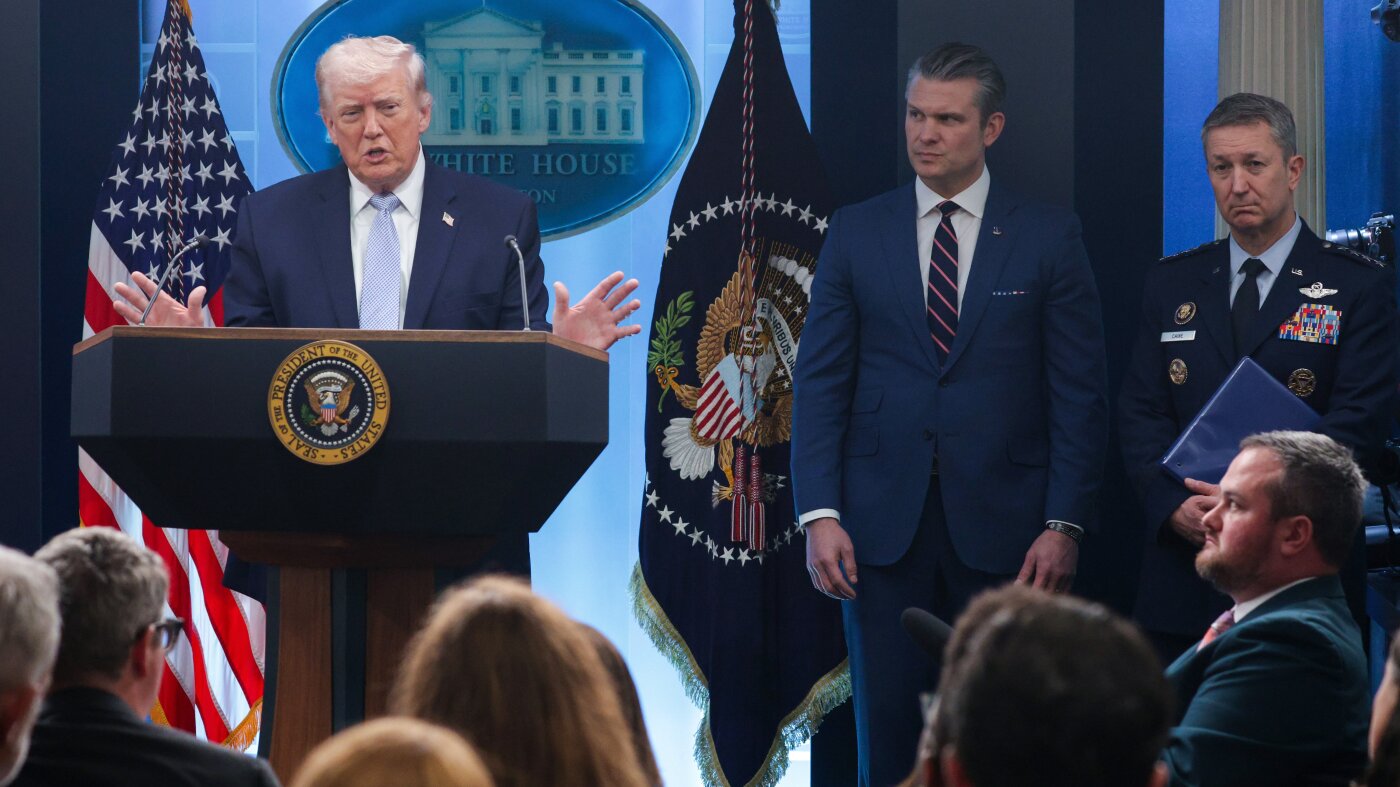
Trump reiterates threats to bomb Iran’s power plants and bridges

Trump threatens Iranian infrastructure over Strait of Hormuz | BBC News
-

 Atlanta, GA2 days ago
1 teenage girl killed, another injured in shooting at Piedmont Park, police say
-

 South-Carolina1 week ago
South Carolina vs TCU predictions for Elite Eight game in March Madness
-

 Movie Reviews5 days ago
Vaazha 2 first half review: Hashir anchors a lively, chaos-filled teen tale
-

 Vermont1 week ago
Skier dies after fall at Sugarbush Resort
-

 Politics1 week ago
Trump’s Ballroom Design Has Barely Been Scrutinized
-

 Politics1 week ago
JD Vance says he was ‘obsessed’ with UFOs, believes aliens are actually ‘demons’
-
 Entertainment5 days ago
Inside Ye’s first comeback show at SoFi Stadium
-

 Atlanta, GA1 week ago
Fetishist ‘No Kings’ protester in mask drags ‘Trump’ and ‘JD Vance’ behind her wheelchair