Politics
‘We want it back’: Trump asserts U.S. claims to Venezuelan oil and land


MEXICO CITY — President Trump’s order of a partial blockade on oil tankers going to and from Venezuela and his claim that Caracas stole “oil, land and other assets” from the United States mark a significant escalation of Washington’s unrelenting campaign against the government of President Nicolás Maduro.
Asked about Venezuela on Wednesday, Trump said the United States will be “getting land, oil rights and whatever we had.”
“We want it back,” he said without further elaboration. It was unclear whether Trump planned to say more about Venezuela in a televised address to the nation late Wednesday night.
The blockade, which aims to cripple the key component of Venezuela’s faltering, oil-dependent economy, comes as the Trump administration has bolstered military forces in the Caribbean, blown up more than two dozen boats allegedly ferrying illicit drugs in both the Caribbean and the Pacific, and threatened military strikes on Venezuela and neighboring Colombia.
“Venezuela is completely surrounded by the largest Armada ever assembled in the History of South America,” Trump said in a rambling post Tuesday night on his social media site. “It will only get bigger, and the shock to them will be like nothing they have ever seen before.”
Not long after Trump announced the blockade Tuesday night, the government of Venezuela denounced the move and his other efforts as an attempt to “rob the riches that belong to our people.”
Venezuelan National Assembly President Jorge Rodriguez is flanked by First Vice President Pedro Infante, left, and Second Vice President America Perez during an extraordinary session at the Federal Legislative Palace in Caracas on Dec. 17, 2025.
(Juan Barreto / AFP/Getty Images)
Leaders of other Latin American nations called for calm and United Nations Secretary-General Antonio Guterres, after a phone call with Maduro, called on U.N. members to “exert restraint and de-escalate tensions to preserve regional stability.”
Also Wednesday, Trump received rare pushback from the Republican-dominated Congress, where some lawmakers are pressuring the administration to disclose more information about its deadly attacks on alleged drug boats.
The Senate gave final approval to a $900-billion defense policy package that, among other things, would require the administration to disclose to lawmakers specific orders behind the boat strikes along with unedited videos of the deadly attacks. If the administration does not comply, the bill would withhold a quarter of Defense Secretary Pete Hegseth’s travel budget.
The bill’s passage came a day after Hegseth and Secretary Marco Rubio briefed lawmakers on Capitol Hill about the U.S. military campaign. The meetings left lawmakers with a mixed reaction, largely with Republicans backing the campaign and Democrats expressing concern about it.
The White House has said its military campaign in Venezuela is meant to curb drug trafficking, but U.S. Drug Enforcement Administration data show that Venezuela is a relatively minor player in the U.S.-bound narcotics trade.
Trump also declared that the South American country had been designated a “foreign terrorist organization.” That would apparently make Venezuela the first nation slapped with a classification normally reserved for armed groups deemed hostile to the United States or its allies. The consequences remain unclear for Venezuela.

A U.S. Air Force Boeing C-17 Globemaster takes off from Jose Aponte de la Torre Airport, formerly Roosevelt Roads Naval Station, on in Ceiba, Puerto Rico.
(Miguel J. Rodriguez Carrillo / AFP/Getty Images)
Regional responses to the Trump threats highlight the new ideological fault lines in Latin America, where right-wing governments in recent years have won elections in Chile, Argentina and Ecuador.
The leftist leaders of the region’s two most populous nations — Brazil and Mexico — have called for restraint in Venezuela.
“Whatever one thinks about the Venezuelan government or the presidency of Maduro, the position of Mexico should always be: No to intervention, no to foreign meddling,” Mexican President Claudia Sheinbaum said Wednesday, calling on the United Nations to look for a peaceful solution and avert any bloodshed.
Brazilian President Luiz Inácio Lula da Silva has also urged Trump to pull back from confrontation. “The power of the word can outweigh the power of the gun,” Lula said he told Trump recently, offering to facilitate talks with the Maduro government.
But Chile’s right-wing president-elect, José Antonio Kast, said he supports a change of government in Venezuela, asserting that it would reduce migration from Venezuela to other nations in the region.

Surrounded by security, Chilean President-elect José Antonio Kast, second from right, leaves after a meeting with Argentine President Javier Milei in Buenos Aires on Dec. 16, 2025.
(Rodrigo Abd / Associated Press)
“If someone is going to do it, let’s be clear that it solves a gigantic problem for us and all of Latin America, all of South America, and even for countries in Europe,” Kast said, referring to Venezuelan immigration.
In his Tuesday post, Trump said he had ordered a “complete blockade of all sanctioned oil tankers going into, and out of, Venezuela.” Although the move is potentially devastating to Venezuela’s economy, the fact that the blockade will affect only tankers already sanctioned by U.S. authorities does give Venezuela some breathing room, at least for now.
Experts estimated that between one-third and half of tankers transporting crude to and from Venezuela are part of the so-called dark fleet of sanctioned tankers. The ships typically ferry crude from Venezuela and Iran, two nations under heavy U.S. trade and economic bans.
However, experts said that even a partial blockade will be a major hit for Venezuela’s feeble economy, already reeling under more than a decade of U.S. penalties. And Washington can continue adding to the list of sanctioned tankers.
“The United States can keep sanctioning more tankers, and that would leave Venezuela with almost no income,” said David A. Smilde, a Venezuela expert at Tulane University. “That would probably cause a famine in the country.”
The growing pressure, analysts said, will probably mean the diminishing number of firms willing to take the risk of transporting Venezuelan crude will increase their prices, putting more pressure on Caracas. Purchasers in China and elsewhere will also probably demand price cuts to buy Venezuelan oil.
Trump has said that Maduro must go because he is a “narco-terrorist” and heads the “Cartel de los Soles,” which the White House calls a drug-trafficking syndicate. Trump has put a $50-million bounty on Maduro’s head. Experts say that Cartel de los Soles is not a functioning cartel, but a shorthand term for Venezuelan military officers who have been involved in the drug trade for decades, long before Maduro or his predecessor and mentor, the late Hugo Chávez, took office.

(Graeme Sloan / Bloomberg / Getty Images)
In his comments Tuesday, Trump denounced the nationalization of the Venezuelan oil industry, a process that began in the 1970s, when Caracas was a strong ally of Washington.
Echoing Trump’s point that Venezuela “stole” U.S. assets was Stephen Miller, Trump’s Homeland Security advisor, who declared on X: “American sweat, ingenuity and toil created the oil industry in Venezuela. Its tyrannical expropriation was the largest recorded theft of American wealth and property.”
Among those believed to be driving Trump’s efforts to oust Maduro is Secretary of State Marco Rubio, the son of Cuban immigrants to Florida. Rubio has long been an outspoken opponent of the communist governments in Havana and Caracas. Venezuelan oil has helped the economies of left-wing governments in both Cuba and Nicaragua.
Christopher Sabatini, a senior fellow for Latin America at the think tank Chatham House, said Rubio has been on a longtime campaign to remove Maduro.
“He has his own political project,” Sabatini said. “He wants to get rid of the dictators in Venezuela and Cuba.”
McDonnell and Linthicum reported from Mexico City and Ceballos from Washington. Special correspondent Mery Mogollón in Caracas contributed to this report.


NEWYou can now listen to Fox News articles!
LOS ANGELES — Outside a Bristol Farms market in LA’s Westchester neighborhood, residents who spoke to Fox News Digital all agreed that homelessness is a top problem facing the city, but disagreed on which mayoral candidate is the right choice to clean it up.
“Love him,” Shelley Zuckerman said about reality television star and independent candidate Spencer Pratt, adding that homelessness is a main motivator of her support for the reality TV star’s mayoral run.
“The fact that he’s not a politician, so he may or may not be a liar, we don’t know that yet, and I know that he wants to do something for LA that the politicians have been saying they’re going to do and then don’t,” Zuckerman added. “And I know politics works, that once you get in there you can’t always do what you want to do, but at least he’s got the passion.”
SPENCER PRATT SAYS HIS POLICY WILL FORCE HOMELESS OUT OF LA AND INTO CITIES LIKE SEATTLE
Los Angeles residents say homelessness is the top problem facing the city as they head to the polls for the mayoral primary. (Fox News Digital)
When asked if crime was a motivating factor to vote for Pratt, Zuckerman’s husband Saul responded, “Of course.”
The couple says they are supporting Republican Steve Hilton for governor.
Patrick Reynolds, who lives in the neighborhood, said he is “not happy with any of the candidates” and called Pratt a “clown” before saying he voted for incumbent Mayor Karen Bass “a little reluctantly.”
Homelessness has been a top-of-mind concern for voters in Los Angeles, and despite Bass being mayor for the last four years, Reynolds said he believes she’s the best choice on that front.
Reynolds, who said he is supporting billionaire Democrat Tom Steyer for governor, spoke at length about the problems with homelessness, including a local park he said has become “too dangerous” to visit in recent years.
KAREN BASS GRILLED OVER BROKEN HOMELESSNESS PROMISE, BLAMES BUREAUCRACY FOR SLOWED PROGRESS
Mayoral candidate Spencer Pratt hosts a campaign block party on 10th Avenue in Los Angeles on May 20, 2026. (Robert Gauthier/Los Angeles Times)
“Homelessness for sure,” a woman named Diane, who said she voted for Bass, told Fox News Digital, “That’s number one on my list, and I think she’s tried very hard to fix that problem. It’s a big problem, I know. And I just think she is down to earth. She’s not some rich billionaire, which I appreciate.”
Diane said she is supporting former Department of Health and Human Services Secretary Xavier Becerra, a Democrat who served in the Biden administration, for governor because he is a “good guy.”
“I like that he is an immigrant and that he has worked his way up in this world,” Diane said. “I think he has a good sensibility. I like also that he isn’t a billionaire. I can relate to him.”
Dan Madden, a resident of nearby Manhattan Beach, told Fox News Digital that if he could vote in LA proper, he’d go with Pratt.
WHO IS TOM STEYER? ANTI-ICE BILLIONAIRE IN CA GOVERNOR’S RACE FACES SCRUTINY OVER DETENTION INVESTMENTS
A Los Angeles city councilwoman and progressive candidate for mayor Nithya Raman, left, pictured alongside incumbent mayor Karen Bass, right. (Ronaldo Bolaños/Los Angeles Times via Getty Images; Justin Sullivan/Getty Images)
“That’d be my man,” said Madden, who added that he is voting for Hilton for governor. “The last 20 years in Los Angeles has been screwed.”
“It’s getting worse,” Madden said about the homeless situation in the Los Angeles area. “They cleaned up here and there. Spots, especially along the beach, coastline, you see it cleaned up. Two months later, everybody’s back.”
CLICK HERE TO DOWNLOAD THE FOX NEWS APP
Pratt, a registered Republican running as an independent, faces off in a nonpartisan mayoral primary against incumbent Mayor Karen Bass, a Democrat, and City Councilmember Nithya Raman, a socialist.
Tuesday’s election will determine which two candidates advance to the November general election. If a candidate receives more than 50% of the vote, they will automatically be named the next mayor.
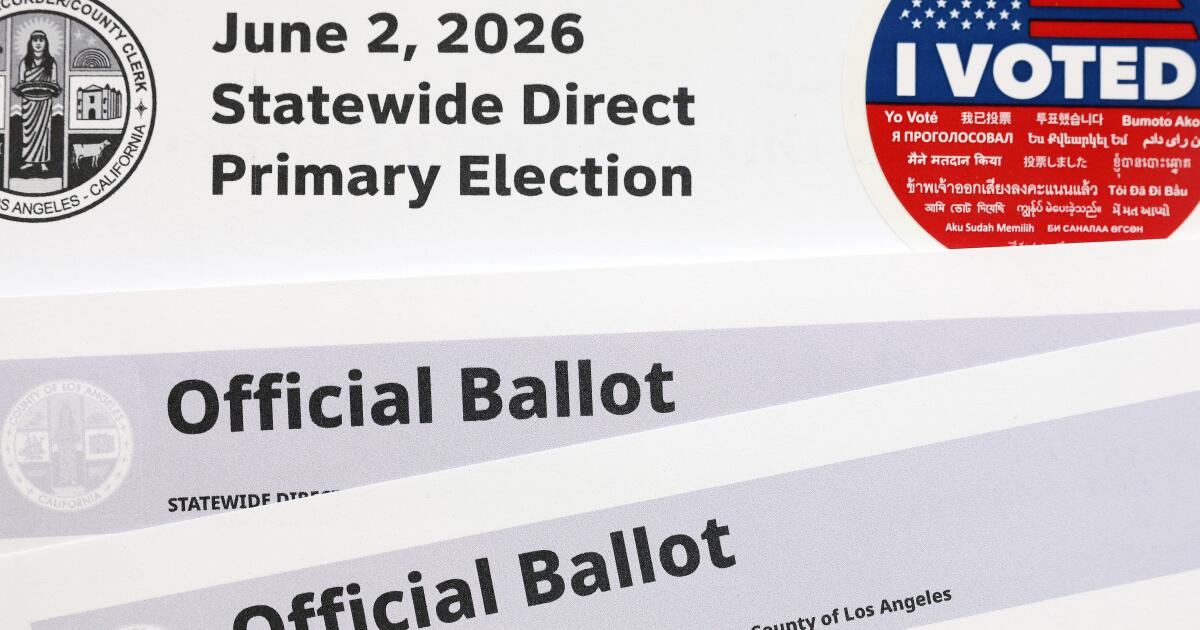
If the last few weeks have shown us anything, it’s that the gubernatorial primary is an unexpectedly close race among a trio unlikely leaders: MAGA Republican Steve Hilton, and Democrats Xavier Becerra and Tom Steyer.
Though Trump endorsed Hilton, a former Fox News host, a Hilton loss may be just what Trump wants — more fuel to fire up his MAGA base with false claims of rigged elections.
“Whether Hilton finishes first, second, or third, Trump will declare with zero evidence that there is voter fraud.,” Matt Barreto told me. He’s a professor of political science at UCLA and a founder of its Voting Rights Project, meant to promote free and fair elections.
And since California will probably take days or weeks to count all the ballots, a tight race will be fertile ground for those fraudulent fraud claims. President Trump has already started, clearly planning to use our primary to further his push to assert federal control of state-run elections.
“You have a really rigged vote in California,” Trump said last week, when asked about Hilton and Los Angeles mayoral candidate Spencer Pratt, another unlikely right-wing contender. “California’s one of the most dishonest states for voting.”
California is not, of course, dishonest in its voting, and Trump has whined about elections for so long that this rhetoric might elicit little more than a shrug from most. But California elections matter at this pivotal moment only months before the midterms. Fraud claims here will further erode trust in our electoral system and could provide Trump with ammunition for interference across the country.
Voter fraud claims may also test a new California law meant to protect real election integrity and trust — a law (Senate Bill 73, signed by Gov. Gavin Newsom last week) that has received little notice but one that could provide a model of protection for the rest of the U.S. It stops law enforcement agents, including federal agents, from “providing unauthorized access, disruption, modification, or seizure of voter rolls, voter lists, or certified voting technology,” without a court order.
Call it the Sheriff Chad Bianco Act.
Bianco, another MAGA gubernatorial hopeful, seized hundreds of thousands of ballots from a recent election, claiming he was investigating the kind of wrongdoing Trump constantly alleges without proof. State Sen. Tom Umberg (D-Santa Ana), a former federal prosecutor, said the warrant Bianco obtained from a friendly judge was “woefully deficient.”
So Umberg helped pass the measure to “protect the integrity of California elections” from “rogue law enforcement officials,” he said.
And he’s not just talking about Bianco.
“I am worried about interference in the election by federal authorities,” Umberg said. “I believe Donald Trump when he says, ‘I’m going to interfere in the election.’”
Umberg is so concerned that he has two other bills in the works he hopes will be law by November. One would stop Immigration and Customs Enforcement agents from being present at polling places. The other would make it illegal for anyone running for a third term as president to appear on the California ballot.
The buildup of fraud claims around California elections and the pushback from legislators like Umberg is a background battle that hasn’t received much attention, but one that is real and consequential.
Trump, through demands for voter rolls by the U.S. Department of Justice, the promotion of the SAVE Act, vague threats of ICE or other federal agents at polls, and the placement of election deniers in key federal rolls has gutted safeguards for voting on the national level.
States have been slow to meet the threat, largely waiting for November to see how it plays out. California, to it’s credit, isn’t so complacent.
The strange circumstances of this particular California election may be a test for both sides. Barreto, the UCLA voting expert, said he thinks “Hilton has the highest probability of finishing first on Tuesday with Becerra close by in second, and Steyer in third.”
But that could — and probably would — change as more ballots are counted.
By Thursday, Barreto said, it’s probable (far from certain) that Becerra is in the lead and Hilton is second.
“There will definitely be millions more ballots counted on Wednesday and Thursday and they will be disproportionately Democratic and contribute to both Becerra and Steyer numbers,” he said.
Maybe pushing Steyer into second? Again, a long shot. But possible.
Democrats have been holding on to their ballots until the last minute this year, with a huge number waiting until just the last few days to vote. It’s possible (though unlikely) that by sheer numbers, Democratic voters will propel both Steyer and Becerra toward November.
We do know that Republicans, despite their smaller numbers, have been voting, and trusting the postal service with their ballots this time around at a fairly high rate. That’s despite Trump’s claims that mail-in voting is inherently fraudulent.
So at the same time that we are expecting a big influx of Democratic ballots in coming days, Republicans may be closer to their voting peak, meaning Hilton’s numbers could top out on election night.
If Hilton doesn’t make the top three, after having been in the lead during in-person voting, MAGA will most certainly lose its collective mind.
And Trump will have something just as good as a Republican governor in the Golden State — “proof” we cheated.
Politics
Jared Kushner’s overseas luxury resort project faces anti-corruption investigation amid violent protests

NEWYou can now listen to Fox News articles!
Albanian anti-corruption prosecutors are investigating changes to the protected status of a coastal wetland where a luxury resort project linked to Jared Kushner, the son-in-law of U.S. President Donald Trump, has drawn environmental opposition and protests, according to Politico.
SPAK, Albania’s special anti-corruption prosecution office, has opened a probe into changes made to the status of the Vjosa-Narta protected landscape in Zvërnec, Politico reported. The coastal wetland area is home to flamingos, Mediterranean monk seals, and sea turtle nesting sites, Politico reported.
IVANKA TRUMP BREAKS DOWN IN EMOTIONAL INTERVIEW TALKING ABOUT HER MOTHER IVANA’S DEATH, OTHER CHALLENGES
Jared Kushner and Steve Witkoff participate in a charter announcement for President Donald Trump’s Board of Peace initiative in Davos, Switzerland, on Jan. 22, 2026. (Denis Balibouse/Reuters)
In 2024, Kushner publicly discussed plans for his firm, Affinity Partners, to develop luxury tourism projects in Albania, including in the Zvërnec area. Earlier this year, he visited the area with his wife, Ivanka Trump.
Albanian Prime Minister Edi Rama recently confirmed to Politico that talks were ongoing between the government and Kushner over the deal, which is expected to include roughly 10,000 hotel rooms and villas.
EUROPEAN CAPITAL ROCKED BY VIOLENT PROTESTS AS GOVERNMENT CORRUPTION PROBE FUELS UNREST
Albanian Prime Minister Edi Rama speaks during a press conference following the EU-Albania Intergovernmental Conference in Brussels, Belgium, on May 26, 2026. (Daniel Gnap/NurPhoto)
“I want to make Albania a country that is a destination to be envied in the region, and this project is part of this effort,” Rama said Monday.
Fox News Digital has reached out to Affinity Partners and SPAK for comment.
Protests by Albanian citizens and nonprofit groups began in May when large, barbed-wire-topped fences were erected at the proposed site, preventing locals and tourists from accessing the beach. On Sunday, protesters assembled outside government offices to demand an end to the project as well as Rama’s resignation.
Jared Kushner speaks during the inaugural meeting of the Board of Peace at the Donald J. Trump Institute of Peace in Washington, D.C., on Feb. 19, 2026. Kushner is facing pushback in Albania over a luxury development project. (Chip Somodevilla/Getty Images)
CLICK HERE TO DOWNLOAD THE FOX NEWS APP
Following Sunday’s protests, footage emerged showing private security guards appearing to assault and drag a protester along a cliff. Some guards allegedly threatened other demonstrators who were attempting to remove fences and halt construction.
The licenses of two private security companies were revoked following the incident. Meanwhile, around 15 protesters have been charged, and the local police chief has been stripped of his duties.
-

 Los Angeles, Ca39 minutes ago
L.A. police in pursuit of suspected car thief
-

 Detroit, MI57 minutes ago
Tigers injury updates: Javier Báez shut down from baseball activities
-

 San Francisco, CA1 hour ago
Live Updates: San Francisco Primary Election 2026
-

 Dallas, TX1 hour ago
Dallas weather: Flash flooding strands vehicles near DFW Airport after heavy rain
-

 Miami, FL1 hour ago
Miami-Dade condo owners plead for help after weeks-long elevator outrage impacting residents’ health
-

 Boston, MA1 hour ago
Who Will Form the Boston Bruins’ Future Core?
-
 Denver, CO1 hour ago
Family: Injured firefighter improving after deadly wrong‑way crash on I‑25 in Denver
-

 Seattle, WA2 hours ago
Seattle mayor is violating city law over CCTV cameras ahead of FIFA World Cup, CM says

