Politics
Video: Hunter Biden Makes Surprise Appearance on Capitol Hill


new video loaded: Hunter Biden Makes Surprise Appearance on Capitol Hill
transcript
transcript
Hunter Biden Makes Surprise Appearance on Capitol Hill
Before two House committees voted along party lines to hold Hunter Biden in contempt of Congress, he made an unannounced visit on Capitol Hill, prompting a partisan tussle.
-
“Hunter Biden’s willful refusal to comply with the committee’s subpoenas is a criminal act. We will not provide Hunter Biden with special treatment because of his last name.” “Second question: You are the epitome of white privilege coming into the Oversight Committee. Spitting in our face, ignoring a congressional subpoena to be deposed. What are you afraid of? I think that Hunter Biden should be arrested right here, right now, and go straight to jail.” “If the committee wants to hear from the witness and the chairman gave the witness that option, then the only folks that are afraid to hear from the witness with the American people watching are my friends on the other side of the aisle. I don’t know if there’s a proper motion, Mr. Chairman, but I’ll make a motion. Let’s vote. Let’s take a vote. Who wants to hear from Hunter right now, today? Anyone? Come on. Who wants to hear from Hunter? No one.” “Whoa [laughing]. Oh — I think it’s clear and obvious for everyone watching this hearing today, that Hunter Biden is terrified of strong conservative Republican women because he can’t even face my words as I was about to speak to him. What a coward.”
Recent episodes in U.S. & Politics



Politics
FBI arrests protester who threatened to kill ICE officer’s family at NJ detention center protest, Blanche says

NEWYou can now listen to Fox News articles!
Acting US Attorney General Todd Blanche on Friday said that a man who made death threats against a U.S. Immigration and Customs Enforcement officer and his family at a protest in New Jersey Thursday night had been arrested.
The arrest came just hours after Blanche promised the protester, who was captured on video, would be found and arrested.
“That’s a federal crime,” Blanche said on Fox News’ “The Will Cain Show” on Thursday. “Not only threatening the ICE officer — but think about how disgusting this individual is by threatening his wife and his children with death.
In the video, the protester can be heard taunting the officer: “I will kill your whole f—ing family. Your whole f—ing family is dead. Your children and wife all dead. I have your face mother—er! All dead!”
ANTI-ICE AGITATOR SCREAMS ‘I’LL KILL YOUR WHOLE F- FAMILY’ DAY AFTER DEM GOV PRAISES ‘PEACEFUL PROTESTING’
Federal immigration officers clashed with protesters outside Delaney Hall in Newark, N.J., on Thursday. (Mostafa Bassim/Anadolu)
Blanche said the officer was just doing his job and “standing there.”
On Friday evening, Blanche wrote on X: Told you. @FBI just arrested the man who threatened to kill ICE officers and their families. FAFO.”
He has not yet been identified.
ANTI-ICE PROTESTERS CLASH WITH AGENTS OUTSIDE NEW JERSEY DETENTION CENTER AS GOV. SHERRILL DENIED ENTRY
The clash occurred Thursday evening outside of Newark’s Delaney Hall detention center where protesters were accused of biting, kicking and punching agents.
The protests were in their sixth night by Thursday. (Mostafa Bassim/Anadolu)
Agents responded by deploying pepper spray and beating back agitators as the protest continued into its sixth night.
Nine rioters were arrested during the clashes Thursday, the Department of Homeland Security told Fox News Digital.
ANTI-ICE AGITATORS THROW WOODEN PALLETS, MATTRESSES AT FEDERAL AGENTS DURING CHAOTIC NJ DETENTION CENTER CLASH
Approximately 100 protesters mobbed the area surrounding the detention center, chanting “F— ICE” and brandishing black umbrellas, gas masks and other gear to protect themselves from pepper spray and various anti-riot measures.
On Wednesday evening, DHS reported that approximately 100 anti-ICE protesters gathered around the Delaney Hall ICE facility. While rioters assaulted and threw objects at law enforcement, DHS said “local police refused to help our officers.” Six rioters were arrested Wednesday night for allegedly assaulting law enforcement officers.
ICE agents use chemical irritants during clashes with protestors outside the federal immigration center at Delaney Hall in Newark, N.J., on Thursday. (Adam Gray/Getty Images)
“We called local police, we called state police multiple times. Listen, I know the law enforcement there would love to respond, but because of Governor Sherrill’s behavior what the governor is doing, she’s not allowing public officers and state officers to respond,” Mullin said during a Thursday morning appearance on Fox & Friends.
CLICK HERE TO DOWNLOAD THE FOX NEWS APP
Demonstrations over conditions for detainees began Friday, May 22, after detainees penned an open letter claiming they were being denied access to medical care, being insufficiently fed and detained without due process.
DHS has denied those claims.
Fox News’ Charles Creitz and Robert McGreevy contributed to this report.
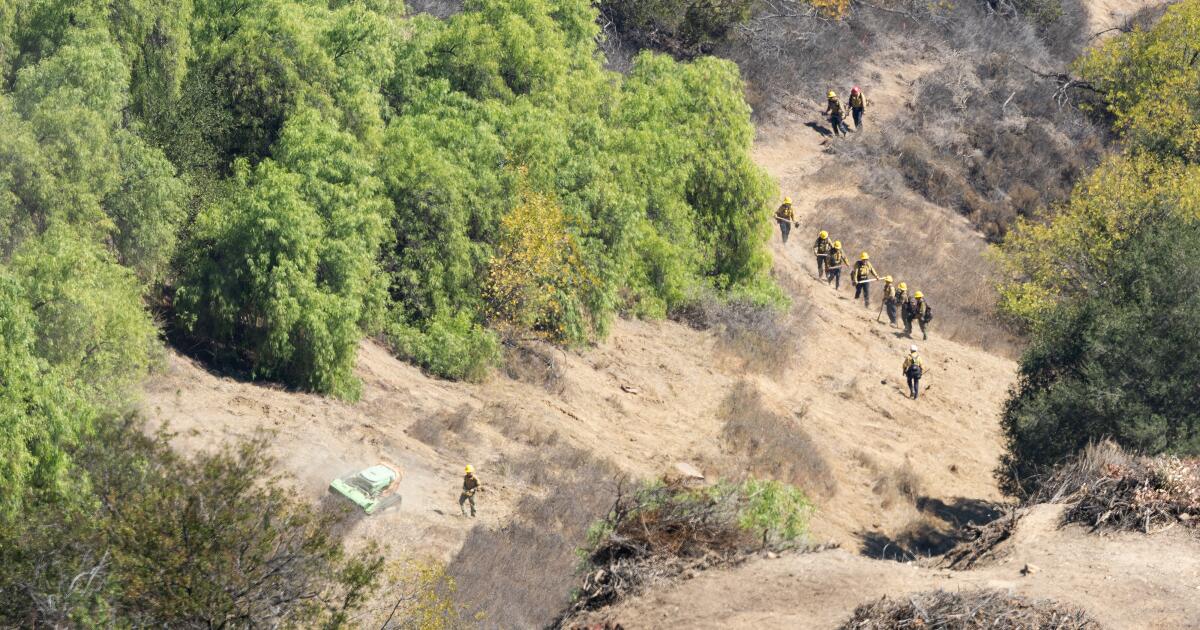
With California facing increasingly destructive wildfires, experts and officials have long urged the strategic removal of dense, flammable vegetation that can erupt into particularly destructive flames from a lightning bolt or the spark of a power line.
But after years of record investment by the state in such wildfire risk mitigation, two key money sources are drying up, potentially reducing the state’s annual budget for vegetation removal by hundreds of millions of dollars.
Wildfire resiliency advocates are warning that the loss of these funds will leave the state vulnerable to devastation, and are calling on California’s next governor to take that threat seriously.
Currently, California relies heavily on two funding sources for wildfire mitigation work: A state program that charges polluters for their emissions and a climate bond approved by voters in 2024.
Late Friday, however, state officials adopted a new structure for the emissions program, called cap-and-invest, that analysts say will likely reduce wildfire mitigation funding by $200 million per year. At the same time, the governor’s latest budget proposal puts the state on track to allocate the majority of the climate bond’s $1.5 billion in wildfire prevention money within just three years.
As a result, California could go from routinely pulling more than $600 million a year from these sources, to just $150 million, according to an estimate from the Wildfire Solutions Coalition — a group of more than 80 organizations representing conservationists, business owners, fire officials and tribal leaders.
The coalition is urging the state to find new sources of funding for the work.
“We have the scientists, we have the technicians, we have the advocates,” said Michelle Decker, who is on the coalition’s executive committee and serves as president and CEO of the Inland Empire Community Foundation. “We see this problem. We can get ahead of this problem. It is a revenue issue.”
California wildfires have become increasingly costly. The 2025 L.A. fires alone caused an estimated $250 billion in damage and economic loss. Insurance companies have already paid out $22.4 billion.
In attempt to reduce the risk of damage to communities and ecosystems, the state has employed a wide range of tactics. These includes fortifying homes against wildfires, replanting fire-ravaged forests and thinning out vegetation with prescribed burns, goat grazing and manual thinning with heavy machinery to reduce the intensity of potential fires.
Research suggests wildfire mitigation work pays off. A recent analysis of 285 fires in the western U.S. found that every dollar spent on landscape projects saved about $3.75 in wildfire damage.
But as funding from cap-and-invest and the climate bond dwindle, the state must increasingly turn to Cal Fire, which devotes only a small portion of its budget to mitigation work.
“This is not an issue that can be pushed off to a timeline based solely on politics,” said Steve Frisch, a founding member of the coalition and president of the Sierra Business Council. “Fire happens whether we want it to or not.”
After a series of destructive wildfires in Northern California and the 2017 Thomas fire in Southern California, the state legislature began to explicitly focus on funding wildfire mitigation.
In 2018, lawmakers directed $200 million per year of cap-and-invest funds to wildfire mitigation projects.
As the Woolsey fire in Southern California and the Camp fire in Paradise raged later that fall, Trump accused the state of “gross mismanagement” of forest lands and threatened to cut off federal funds unless it was corrected.
Gov. Gavin Newsom and the legislature, with a significant budget surplus, began earmarking even more funds, leading to a peak of $1.1 billion in wildfire mitigation investments during the 2021-2022 fiscal year.
After the surplus dwindled, the legislature opted in 2024 to put a $10-billion climate bond in front of voters — $1.5 billion of which was dedicated specifically for wildfire mitigation work.
Newsom has since pointed to this high state funding to call on the federal government to step up its own investments into forest management work.
The federal government manages 57% of all forests in the state. While the U.S. Forest Service spent $3.1 billion mitigating wildfire conditions in the state over the last few years, California spent $4.3 billion, according to the California Forest Resilience and Wildfire Task Force.
However, the state has already allocated about $600 million of the climate bond’s wildfire mitigation pot for the 2024-2025 and current fiscal years. The latest budget proposal would allocate more than $300 million for this upcoming fiscal year. While many advocates support allocating the money quickly, it leaves little for future years.
Once that money is spent, California has to pay off the $10 billion bond with interest. The result is an estimated price tag of $16 billion, paid in roughly $400 million increments every year, for 40 years, according to the state’s Legislative Analyst’s Office.
As for the cap-and-invest funds, a fraught months-long debate at the California Air Resources Board on how to extend the program beyond 2030 resulted in a compromise that will cut the revenue it generates in half, the Legislative Analyst’s Office estimates.
Since other projects get priority — including $1 billion every year for California’s high-speed rail project — the new proposal would “likely leave no funding” for the wildfire and forest resilience line item, the Legislative Analyst’s Office found.
Cal Fire still holds a modest annual budget for wildfire mitigation work. In the 2024-2025 fiscal year, the agency had $500 million for forest management and fire prevention that was not directly tied to cap-and-invest or the bond — up from about $65 million two decades prior.

As for the federal government, independent analyses by Grassroots Wildland Firefighters and NPR found that Forest Service wildfire mitigation work is on the decline amid federal staffing cuts. The Forest Service claims the decrease in work was primarily due to poor weather conditions for activities like prescribed burns and staff being occupied with firefighting.
Both the state and federal government’s investments pale in comparison to the spending of California’s investor-owned utilities. In 2025 alone, the utilities planned to spend more than $9.2 billion on preventing their equipment from sparking the next devastating wildfire, primarily funded by Californians’ electricity bills.
Times staff writer Hayley Smith contributed to this report.

By Zolan Kanno-Youngs, Gilad Thaler, Jon Miller, Stephanie Swart, Rafaela Balster, Whitney Shefte and Nikolay Nikolov
May 29, 2026
-
Detroit, MI9 minutes ago
Black Legacy Day to be celebrated May 30th in Detroit
-

 San Francisco, CA19 minutes ago
A 1906 fire burned 200,000 books. More than a century later, one was returned | CNN
-

 Dallas, TX24 minutes ago
Cowboys news: More moves that Dallas could make this offseason
-

 Miami, FL31 minutes ago
Here’s a guide to the seven World Cup teams (and their fans) headed to Miami | Honolulu Star-Advertiser
-

 Boston, MA34 minutes ago
Stormy Saturday, slightly sunnier Sunday – Boston News, Weather, Sports | WHDH 7News
-
 Denver, CO39 minutes ago
Storm threat for northeastern Colorado Saturday; sunny and warmer Sunday
-

 Seattle, WA46 minutes ago
WEST SEATTLE SATURDAY: 33 options!
-

 San Diego, CA49 minutes ago
Letters: Stop taxpayer funds for short-term rental trash


