Politics
Trump slaps major tariffs on Mexico, Canada and China, setting the stage for trade war


Washington — President Trump slapped sweeping tariffs on goods from Mexico, Canada and China on Saturday, sending shock waves through the global supply chain and sparking fears of a disruptive trade war that could dramatically raise costs for U.S. consumers.
Trump signed executive orders placing duties of 25% on imports from Mexico and Canada, except for a 10% rate on Canadian energy products. He imposed a 10% tax on all imports from China.
The White House said the tariffs would go into effect on Tuesday, and could be raised if the targeted countries retaliate with tariffs of their own, as they have threatened. In a post on Truth Social, the president said he was taxing imports from those countries because he blames them for the flow of undocumented immigrants and drugs into the United States.
The three nations are America’s top trading partners, supplying the U.S. with food, medicine, oil, cars, timber and electronics.
Employees work in a Honda car plant in 2014, in Celaya, in the central Mexican state of Guanajuato.
(Eduardo Verdugo / Associated Press)
The tariffs against Canada and Mexico upend a trade pact that dates back three decades and is the linchpin of many tightly integrated industries across North America. Trump himself signed the newest version of the trade accord during his first term, praising the 2020 U.S.-Mexico-Canada-Agreement as “the fairest, most balanced and beneficial trade agreement we have ever signed into law.”
The tariffs threaten to deeply disrupt the economies of Mexico, Canada and China and drive up consumer prices in the U.S.
Experts say some effects will be significant and quickly felt, with American consumers likely finding higher prices for fresh vegetables and fruits and other perishable imports in a matter of days.
“Foreigners don’t pay the tariffs, American businesses and consumers do,” said Jock O’Connell, a trade expert at Beacon Economics, a Los Angeles-based research firm.
Americans are still smarting from a surge of food prices in the wake of the pandemic. High inflation was widely considered an important factor in Trump’s election, and the president has promised to bring down prices for groceries and other goods. But these new tariffs are almost certain to do the opposite, economists say.
The U.S. imports more than $900 billion of products from Canada and Mexico, and a 25% tariff is huge given that goods have crossed North American borders duty-free for many years.
“Is the Trump administration comfortable with hiking the price of avocados and guacamole ahead of the Super Bowl?” said Joseph Brusuelas, chief economist at the accounting firm RSM US, adding that he was not joking.
For many other products, prices may start to increase only as inventories are depleted. Car prices will almost surely rise. U.S. auto manufacturing is so interlinked with Mexico and Canada, with parts going back and forth across borders many times, that analysts say they’re not really American cars but North American cars.
Michigan Gov. Gretchen Whitmer condemned the tariffs and the effect they would have on the auto industry in her state, which Trump flipped in 2024: “A 25 percent tariff will hurt American auto workers and consumers, raise prices on cars, groceries, and energy for working families and put countless jobs at risk. Trump’s middle-class tax hike will cripple our economy and hit working-class, blue-collar families especially hard.”
Gas prices may also rise, especially in the Great Lakes and Rocky Mountain West, which depend on Canadian oil. Trump has repeatedly talked about bringing down the cost of gas, but the U.S. still imports billions of dollars of crude — and ramping up domestic production isn’t so easy or quick.

Steam rises at Suncor’s oil sands facility near Fort McMurray, Canada, in September 2023.
(Victor R. Caivano / Associated Press)
The 10% tariffs on China will add to 10% to 25% duties that Trump imposed on many Chinese imports during his first term, and which former President Biden kept in place. That will hit American household pocketbooks broadly because China is such a big supplier of consumer items.
Under the U.S.-Mexico-Canada trade agreement, any country has the right to pull out at any time. And a U.S. president can impose new tariffs without approval from Congress by invoking the International Emergency Economic Powers Act, which authorizes executive action to counter threats to national security, foreign policy or the economy.
Trump had been warning for months that he planned to impose tariffs on imports in a bid to lure manufacturing back to the United States. Campaigning before the November election, he vowed at one point to establish an across-the-board tax of 10% or 20% on all goods entering the U.S. At another, he threatened a 200% tariff on vehicles from Mexico.
“Come make your product in America,” he told companies in a speech at the World Economic Forum earlier this year. If not, he said, “then very simply you will have to pay a tariff.”
But Trump sees tariffs also as a negotiating tactic to extract compromises from other nations on matters that have little to do with trade.
His executive order imposing tariffs against Canada blames the country for “failing to devote sufficient attention and resources or meaningfully coordinate with United States law enforcement partners to effectively stem the tide of illicit drugs.”
He has said that Mexico must suffer tariffs because it hasn’t done more to stop migrants from reaching the U.S. border.
But experts questioned Canada and Mexico’s ability to further curb drug and people smuggling. A 2022 report commissioned by the U.S. Congress found that “Canada is not known to be a major source of fentanyl, other synthetic opioids or precursor chemicals to the United States, a conclusion primarily drawn from seizure data.”
Others said the tariffs have the potential to spur more migration.
Economies in Mexico and Canada rely much more heavily on the U.S. than the other way around, and the threat of tariffs has made the peso and Canadian dollar very volatile in recent weeks.
The value of Mexico’s exports and imports amounts to almost 90% of the country’s gross domestic product, according to World Bank data. Economists warn that even a small increase in tariffs on goods destined to the U.S. poses serious risks for the economy.
“Under the worst-case scenario, the Mexican economy will fall into recession, the currency will depreciate, and inflation will rise,” reads a report released by the economic research firm Moody’s Analytics.
Analysts say that if tariffs drag down the Mexican economy, more Mexican workers without proper documentation will seek to enter the U.S. “If Mexico goes into a recession, you’ll see a surge in immigration,” said economist Brusuelas.

Migrants make their way to a Border Patrol van after crossing illegally and waiting to apply for asylum between two border walls separating Mexico and the United States on Jan. 21 in San Diego.
(Gregory Bull / Associated Press)
Evan Ellis, a research professor of Latin American studies at the U.S. Army War College’s Strategic Studies Institute, described tariffs as a “catastrophic risk.”
“If you essentially deep-six the Mexican economy … there are people who are going to once again flow across the U.S. border,” he said.
The country’s economy is already on shaky ground. Mexico faces its largest budget deficit since the 1980s. Data show 36% of the population lives in poverty with 7% living in extreme poverty.
A severe recession in Mexico in the 1990s contributed to some 5 million Mexicans immigrating to the U.S.
Mexican President Claudia Sheinbaum has insisted that Mexico has a plan to counter tariffs.
“We are prepared for any scenario,” she told journalists on Friday, although she said that Mexico had been “doing everything in our power” to prevent tariffs. “What do we want? That dialogue with respect prevails.”
Canadian officials have also promised an aggressive response.
“Being smart means retaliating where it hurts,” said Chrystia Freeland, the former finance minister who represented Canada in USMCA negotiations. “Our counterpunch must be dollar-for-dollar — and it must be precisely and painfully targeted: Florida orange growers, Wisconsin dairy farmers, Michigan dishwasher manufacturers, and much more.”
If China, Canada and Mexico retaliate by slapping tariffs on American products entering their markets, that will very likely slow the volume of trade. The ripple effects will be felt across the entire supply chain, hurting business and employment at ports, warehouses and other logistics and transportation operations.
Higher inflation from tariffs may hit Los Angeles especially hard coming soon after the fires, which appear to be pushing up prices for rents and other services and products.
“The timing couldn’t be worse. It will make for a double whammy for Southern California,” said Sung Won Sohn, professor of finance and economics at Loyola Marymount University.
During his first term, Trump in 2018 imposed tariffs on steel from Mexico and other countries, prompting counter-tariffs on American farm goods and straining U.S.-Mexico relations.
At the time, he also threatened broader tariffs on all Mexican goods, but he eventually backed off after American business leaders complained that it would hurt them and his administration extracted a promise from Mexican authorities to do more to stop migrants from reaching the U.S. border.
Marcelo Ebrard, Mexico’s economy secretary, suggested last year that the only goal of tariffs is to achieve political gains, given the makeup of the highly integrated global economy.
“The United States economy is not a manufacturing economy,” said Ebrard. “And I’m sorry, but it will not be that way again.”
Linthicum reported from Albuquerque, N.M., and Lee reported from Washington.

President Trump has promoted a chain of newly rebranded gas stations across the Philadelphia area with lower gas prices. The New York Times has not been able to get detailed information about who is behind the stations. The Trump administration says it did not fund or subsidize the company.

NEWYou can now listen to Fox News articles!
Kelley Paul is no stranger to the American political scene. As the wife of Senator Rand Paul (R-Ky.), and the daughter-in-law of longtime former Congressman Ron Paul (R-Texas), she has seen her fair share of the campaign trail, emerging as a powerful surrogate during her husband’s 2016 presidential run.
She is also an accomplished writer, speaker, and public relations professional. As America ushers in its 250th anniversary, Paul saw the perfect opportunity to branch out into the world of children’s literature. Recently she sat down with Fox News Digital in Las Vegas at Freedom Fest to discuss her new book, “Good Night, Young American.”
Kelley Paul is the wife of Sen. Rand Paul and author of two books. (Courtesy Kelley Paul)
Paul credits her family for giving her the inspiration for the new project:
“I have to give a lot of credit to my daughter-in-law, Kate. She and our son were over for dinner last summer with our grandson, who was only six months old at the time. And Kate was like, you know, we need more patriotic books for babies. She wasn’t really happy with a lot of the book options she was seeing. And that night at dinner, we kind of played around with some ideas. And I came up with ‘Good Night Young American.’ And a year later, here it is.”
EXCLUSIVE: RAND AND KELLEY PAUL OPEN UP ABOUT 2016 RACE
“Good Night, Young American,” recommended for children ages 4–8, takes kids on a visually and thematically engaging journey through early and colonial history.
“Well, our revolutionary history is such a great adventure, right? So when I came up with the concept that my little boy would start out on the 4th of July with his parents, asking, what is it all about? I knew we’d be celebrating the 250th. Kids ask, what are we really celebrating?
And his dad describes the Declaration of Independence to him in the signing. So I tried to think what is going to appeal to children in this great adventure of our revolution. So when he falls asleep that night, he’s in the crow’s nest of the Mayflower. He is a pilgrim, he’s a colonist, and then he makes friends with all the great revolutionary heroes that we know. So he makes friends with Sam Adams, he joins the Sons of Liberty, he meets at the Green Dragon. This is so exciting for children, right?
It’s visual stuff. He makes friends with Ben Franklin, and he’s flying the kite. Dramatically rides on the midnight ride with Paul Revere. He and his dog, his little dog, are with him for all the adventures. And of course, he crosses the Delaware with George Washington. And I wanted to make the signing of the Declaration of Independence and the writing of it something that was dynamic and exciting visually. So I have him swinging on the Liberty Bell when the declaration is signed.”
Paul worked closely with the illustrator, Marika Monesi, to bring the events of America’s founding to life in an engaging and visually appealing way for children.
The Liberty Bell, originally saved from the British by Lynnport farmer Frederick Leaser, sits in its Philadelphia shrine. (iStock)
“She really captured the excitement on the little boy’s face, his personality, but I worked very close with her,” Paul said. “I wanted there to be a lot of movement, a lot of dynamic images. So, for example, with the Liberty Bell, for kids, a bunch of men standing around writing a document…I wanted to bring it to life. So I said, let’s have him running up to the top of the bell tower in Philadelphia at Freedom Hall and swinging on the Liberty Bell. And she was just such a great artist. With the George Washington scenes, he’s crossing the Delaware because that, again, is so visual. I wanted drive home to children the incredible bravery and courage of our founders, how cold and miserable and hard that war was.
“Also, I love the illustration that she did of the King of England reading the Declaration of Independence. I have to give my husband Rand a little credit there. On the first couple of drafts that she did, Rand was like, ‘He needs to be fatter. King George was famously fat!’ So it was a lot of fun. It was very collaborative.”
KELLEY PAUL ‘EXHAUSTED AND ANGRY’ THAT THOSE WHO HARASSED HER AND HER HUSBAND FACE NO CHARGES
Part of Paul’s motivation for the book was related to the teaching of American history today, and the controversies therein:
“I do think that we’ve gotten away from really celebrating our founders and our heroes. What they were doing in 1776 was incredibly radical, if you think about it. At that time, everyone accepted the divine right of kings. Everyone accepted hereditary rule. And our founders took Enlightenment ideas from John Locke and philosophers, and they turned it into the framework for a government. The idea of self-government and that our rights come from our Creator, that we have inalienable rights that are given to us by God and not from a king. Those were radical ideas of the time.
Historians say an early draft of the Declaration of Independence offered new insight into how Thomas Jefferson refined the nation’s founding document. (Stock Montage/Stock Montage/Getty Images)
I like to say our founders were the first civil rights heroes, the first civil libertarians. And I think our education system has gotten away from that. They don’t view them in the time that they existed, and suddenly now everything is oppressor versus oppressed narrative. And they are labeled more like colonizers or enslavers, and that’s the only view that they’re looked at, and not as human beings who sacrificed their very lives to write the Declaration of Independence, to form this country…it was an incredible, bold, and courageous act, but it was also an act of moral courage and philosophical courage.”
Ultimately, Paul hopes that her books will stimulate the natural curiosity of America’s youth to learn more about their rich history:
Participants carry the City of Cumberland’s “America 250” parade banner down Baltimore Street during the America 250 parade in downtown Cumberland, Maryland, on June 27, 2026. Spectators line both sides of the street as American and Maryland flags lead the procession. (Fox News Digital/ David Marcus)
“Well, I hope that my books, especially with America’s 250, will spark a lot of questions and that they will give a framework for parents to talk to their kids about the founding of this country. And I hope children from a very, very young age will come away with this idea that they are a part of America’s story, that they as Americans can take pride in the heroism of our revolutionary founders. That as Americans, this is all of our story. So that’s really my goal with the books.”
One of the biggest challenges Paul faced was taking big ideas that may be hard for a four or five-year-old to grasp, like the Declaration of Independence or the Constitution, and distilling them down into an accessible format for kids:
“Well, I try to use language that kids could understand, and very much use simple terms. But if you think about it, it is simple. Our rights come from God. And when he makes friends with Thomas Jefferson, he says, Thomas Jefferson has written this amazing document that says that we can all be free to live our lives the way we choose, and no government can take our rights to, you know, to life, liberty, and the pursuit of happiness away from us.
He also talks about James Madison and the Bill of Rights and the most important right is freedom of speech. That is that no government can tell you what to say or what not to say.”
Rand Paul, who famously puts Constitutional principles front and center in the public square, also played a key role in the book’s thematic development.
Kelley Paul and her husband Kentucky Republican Sen. Rand Paul. (Courtesy Kelley Paul)
“Rand has been incredibly supportive. I’m just so grateful and blessed to have had an amazing, now 36-year marriage to Rand Paul. And he was very involved. He would read over the drafts and gave me a lot of, like I said, good advice about things in history that he thought I should include.
CLICK HERE TO DOWNLOAD THE FOX NEWS APP
And I’m also just very grateful to be the daughter-in-law of Ron Paul. And so, I wanted these books to be there for our little grandson who I call ‘my favorite little American’ and help him from an early age be educated in the legacy that, the Paul family has in this country.”
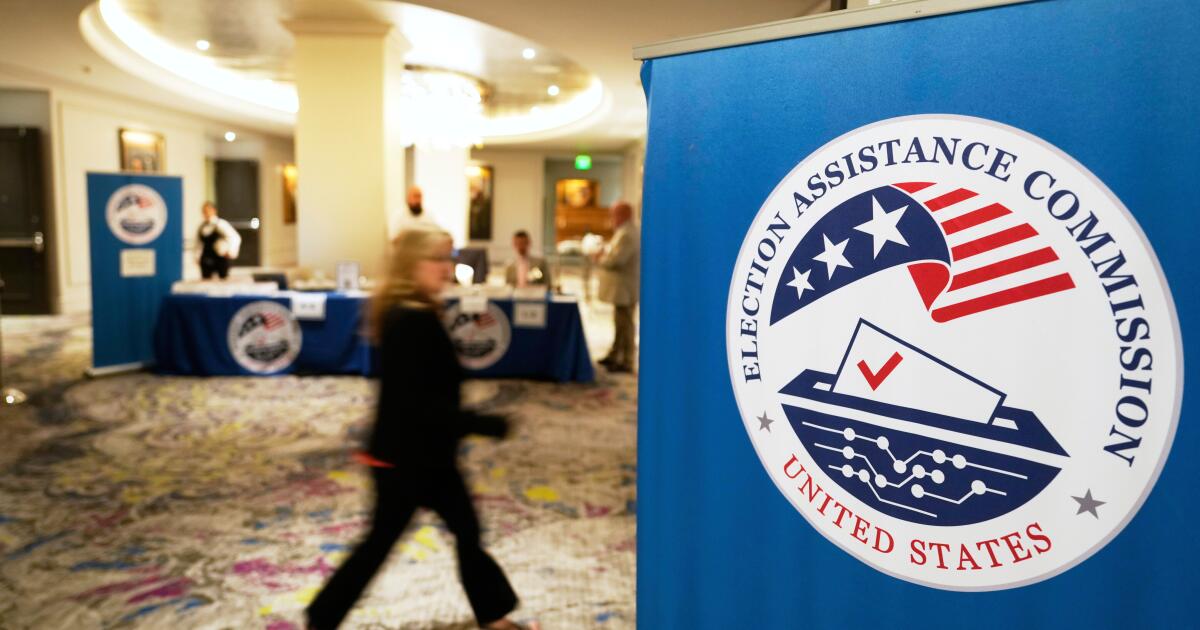
WASHINGTON — President Trump dismissed all remaining members of the bipartisan U.S. Elections Assistance Commission this week, his latest move to assert control over national elections in the final months before midterm voting.
The White House defended the move as justified by a recent U.S. Supreme Court decision handing the president greater authority to reshape independent government agencies, including by replacing appointed leaders.
Democrats and some independent elections experts blasted it as politically motivated, counter to the interests of voters and foolhardy with the November election so close.
“Purging commissioners just months before the midterm elections and further gutting support for our state and local elections officials is a blatant part of his plan to politicize our elections and enable more unlawful and dangerous election interference,” said Sen. Alex Padilla (D-Calif.), the top Democrat on the Senate Rules Committee, which oversees federal elections.
Padilla alleged the dismissals are an attempt by Trump “to dismantle yet another independent guardrail of our democracy designed to keep elections fair and secure.”
A White House official framed the dismissals in starkly different terms, saying the departing commissioners were “not totally aligned with the important task of securing America’s elections and ensuring every legal vote is counted.” It did not say when the president planned to appoint new commissioners.
The four-member commission was created by Congress in 2002 as part of the Help America Vote Act to help states improve their voting systems and voter access. By law, no more than two commissioners may belong to the same political party.
Historically, it has provided voluntary guidance and best practices for voting systems, and served as a sort of clearinghouse for election performance around the country — so that states and localities can learn from one another.
Since 2018, the panel has also disbursed more than $1 billion in election security grants, according to a report by the Bipartisan Policy Center. Those grants are then used to protect IT systems from foreign and domestic cyberattacks, update voting systems, ensure the accuracy of voter rolls and protect the integrity of ballots after they are cast.
Without leadership, the panel cannot take any official action until new members are nominated and confirmed by the Senate.
Benjamin W. Hovland, one of the Democratic commissioners removed by Trump, told NBC News that taking away a key federal agency designed to help state and local election administrators will have a negative effect on already strained elections officials.
“When you’re asking more and more of people without giving them the necessary resources, you know, mistakes happen,” he said.
California Secretary of State Shirley Weber, in a statement to The Times, said Trump was “injecting unnecessary chaos, confusion and instability into the very systems that Americans rely on to make their voices heard,” but that California “will not be intimidated or deterred” from maintaining elections “in which everyone can fairly and securely participate.”
California Atty. Gen Rob Bonta — whose office has already blocked federal agencies from implementing most of Trump’s election orders in court — called Trump’s firings “deeply troubling,” and said his office “will continue to closely monitor any efforts to weaken our democracy and fight back with every tool at our disposal.”
Gov. Gavin Newsom’s office said on X that “Newsom’s election protection efforts become more important by the day” — a reference to his recent push for state legislation that would make it a felony in California for anyone to seize ballots before a vote has been certified.
Newsom had said Thursday that Trump’s efforts to seize control over elections represented a “five-alarm fire” that must be confronted.
Trump’s dismantling of the commission comes as he wages a much broader campaign to rewrite voting rules. He has sought to place new restrictions on mail ballots, to tighten voter ID and proof of citizenship requirements for voters, to subject state voter rolls to federal oversight and purges, and to assert federal control over how and whether the U.S. Postal Service delivers mail ballots.
Much of that agenda, pushed through executive orders and other administrative actions, has been stymied by the courts, while stalling out in Congress, where it lacks support.
Whether Trump’s move to dismantle and reconstitute the commission will prove an effective path to instituting his election agenda remains unclear, experts said.
David Becker, the executive director of the nonpartisan Center for Election Innovation & Research, said the election commission has always had a “very limited mandate,” can’t dictate policy to the states and has no law enforcement powers — meaning Trump’s dismissals will have little real effect on elections.
Rick Hasen, an election law expert and director of the Safeguarding Democracy Project at UCLA Law, wrote that Trump could try to illegally direct the commission to “do his bidding” by amending the federal voter registration form to require proof of citizenship — though that would also have limited effect and would be challenged in court.
Sen. Adam Schiff (D-Calif.) said Trump’s firing of the commissioners was part of a broader effort by the president to “sow distrust in our voting system so he can contest the results if they are not to his liking.”
Kim Alexander, president of the California Voter Foundation, said California has “the most robust standards” for elections in the country, which won’t change with the removal of the commissioners.
Still, she said word of the firings rocketed around a conference of county elections officials in San Diego on Thursday — with some wondering whether the dismissals would threaten federal election funding, and others lamenting the loss of the ousted commissioners’ deep experience.
Dean Logan, head of the L.A. County Registrar-Recorder/County Clerk’s office, said in a statement to The Times that “any sudden change to the support structure for elections in the middle of an election cycle is concerning,” but that California “has a strong local and state foundation for election administration and voting systems support, and that will minimize any potential disruption caused by this action.”
In recent months, Trump has leveraged federal agencies to overhaul the nation’s voting rules in ways no previous president has attempted.
He has repeatedly pressured Republican lawmakers to pass a federal law that would require voters to provide proof of citizenship when they register, show identification when casting a ballot and force states to send voter data to the Department of Homeland Security.
Republican leaders have said the proposed SAVE America Act does not have enough votes to pass in the Senate. The GOP resistance has angered Trump, who on Friday said he was refusing to sign a bipartisan housing bill in protest.
The housing bill, which Trump called a “big yawn” last month, was to become law at midnight Friday without Trump’s signature.
-
 News25 minutes ago
With the white nationalist group Patriot Front, what you see is not what you get
-

 New York2 hours ago
How ‘The Wire’ Star Jamie Hector Spends a Hot Day in Brooklyn
-

 Los Angeles, Ca2 hours ago
Burglars ransack Sherman Oaks condo building during fumigation
-

 Detroit, MI2 hours ago
Metro Detroit weather forecast, July 10, 2026 — 11 p.m. Update
-

 San Francisco, CA2 hours ago
Classical music series helps reconnect downtown San Francisco community
-

 Dallas, TX2 hours ago
Dallas police officers, paramedics recall saving woman stuck in a ravine for days;
-

 Boston, MA2 hours ago
Red Sox win 7th straight game just hours after landing in New York
-
 Denver, CO3 hours ago
One tree at a time: Denver nonprofit works to close shade gap as heat dome threatens neighborhoods

