Politics
Trump accuser E Jean Carroll teases how she'll spend $83.3M court win: 'Not going to waste a cent'


E. Jean Carroll, a former columnist who alleges former President Trump raped her in a New York City department store dressing room in the 1990s, has teased how she plans to spend the $83.3 million judgment she won in her defamation case if and when she sees those funds.
“I’m not going to waste a cent of this,” Carroll told the New York Times from her lawyer’s office Saturday. “We’re going to do something good with it.”
“I’m going to be able to buy some premium dog food now,” she added, promising at least some luxury for her pets, a Great Pyrenees and a pit bull.
The interview was her first since a jury on Friday found that Trump had maliciously damaged Carroll’s reputation in 2019 after she went public with her accusations, and he insisted she was lying. Jurors awarded her $18 million to compensate for the personal harm she experienced, then added $65 million more to punish Trump – and maybe deter social media attacks.
E. JEAN CARROLL’S CLAIMS AGAINST TRUMP, LIFESTYLE BACK UNDER THE SPOTLIGHT AFTER EYE-POPPING VERDICT
E. Jean Carroll leaves federal court, Friday, Jan 26, 2024, in New York. (AP Photo/Yuki Iwamura)
A different jury concluded last May that Trump was responsible for sexually abusing Carroll in the Bergdorf Goodman store’s dressing room on Fifth Avenue in Manhattan in 1996. Those jurors awarded Carroll $5 million. If both judgments stand, Trump would owe her a total of $88.3 million. Trump and his lawyers have promised to appeal.
As she and her lawyers prepare to fight the promised appeals and push for the full judgment to be awarded, Carroll said they are also making plans for what to do with the money.
“I can’t say what they are yet. We will all talk and come up with a great plan,” she told the Times.
“I can’t possibly guess what Donald Trump will ever do or not do,” Carroll said Saturday, asked what she thinks will come next. “Can’t make a guess.”
Carroll told the Times the feeling upon learning the amount of the sum “was so overpowering,” and that she “couldn’t feel the elation.”
“This morning, around 8 or 9, having my first cup of tea, is when I truly felt calm enough to feel what we had accomplished,” Caroll said. “I felt they were my brothers and sisters on that jury,” she added. “They were like me. They were New Yorkers.”
Carroll’s lead lawyer, Roberta A. Kaplan, claimed to the Times that Trump might think twice about attacking Carroll on Truth Social after Friday’s decision.
TRUMP CANNOT ASSERT PRESIDENTIAL IMMUNITY IN E JEAN CARROLL DEFAMATION LAWSUIT, APPEALS COURT RULES
E. Jean Carroll leaves court, Friday, Jan 26, 2024, in New York after a jury awarded her an additional $83.3 million. (AP Photo/Yuki Iwamura)
“He cares about money,” Kaplan said. “And this is a lot of money to Donald Trump. And I don’t think he wants another judgment at the same amount.”
“Absolutely ridiculous! I fully disagree with both verdicts, and will be appealing this whole Biden Directed Witch Hunt focused on me and the Republican Party,” Trump posted on Truth Social shortly after the verdict was read on Friday. “Our Legal System is out of control, and being used as a Political Weapon. They have taken away all First Amendment Rights.”
Carroll referenced the issue of abortion access after the Supreme Court overturned Roe v. Wade last year, claiming her win against Trump was for all women.
“This win, more than any other thing, when we needed it the most — after we lost the rights over our own bodies in many states — we put out our flag in the ground on this one. Women won this one. I think it bodes well for the future,” she said.
Carroll sued Trump for defamation in 2019, saying his statements about her rape allegations were false and damaged her reputation. That claim wound up being bogged down for years over the legal question of whether, in denying the allegations, Trump had been fulfilling his duties as president. Trump claimed that the presidency shield him from liability.
Former President Trump leaves his apartment building, Friday, Jan 26, 2024, in New York before closing arguments began in the defamation case. (AP Photo/Yuki Iwamura)
In the meantime, New York changed its law to give sexual abuse survivors a fresh chance to sue civilly over attacks that happened in the distant past. Carroll was one of the first people to take advantage, filing a new legal claim against Trump alleging that he had raped her. She also sued over things he had said about her after leaving the White House.
Trump was not criminally charged with sexually assaulting Carroll. Under state law, too much time had passed since the alleged assault in 1996 for a criminal case to be considered against him.
Amid court proceedings and immediately following, supporters of the president and social media critics have sounded off about previous remarks Carroll has made that raised concerns about her recounting, including her 2019 interview on CNN, where she argued “most people” view rape as “sexy.”
Trump, along with his supporters, have argued his hands were tied amid the trial as the judge barred some evidence from being shown to the jury, including the Anderson Cooper interview.
Trump said in a Truth Social post Thursday that Carroll allegedly changed the timeline of her recounting of the incident due to previously claiming that she still had the Donna Karan dress she wore the day of the attack, though the dress had not yet been manufactured. The judge presiding over the case also barred Trump’s legal team from arguing he did not sexually assault Carroll, or “that she fabricated her account of the assault, or that she had any motive to do so.”
During last year’s trial, Trump’s legal team and critics drew parallels between Carroll’s allegations and an episode of “Law & Order: Special Victims Unit,” which included a plot line where a character discussed role-playing a rape fantasy in Bergdorf Goodman. Carroll said during last year’s trial that she was “aware” of the 2012 episode, but had not seen it.
Fox News’ Emma Colton and The Associated Press contributed to this report.


new video loaded: Steve Hilton Holds Slim Early Lead in California Governor’s Race
transcript
transcript
Steve Hilton Holds Slim Early Lead in California Governor’s Race
Steve Hilton, a Republican and former Fox News host, held a narrow lead in early votes over two Democratic opponents in California’s nonpartisan primary for governor. The top two candidates will advance to the general election in November.
-
“Change is coming to California, and it’s long overdue. I want to just say something from my heart to every single person who’s voted for me. We’re not — We’re not there yet, but it’s looking good.” [cheers] “Tonight, the people of the great state of California, in the greatest nation on earth, have spoken. [cheers] Loudly and proudly. [cheers] And while I take nothing for granted, there are lots of ballots left to be counted, it appears that we are on track to advance to November.” [cheers] “It might take some time to figure out where this is going. We’re going to wait until every ballot is counted. We’re going to give democracy a time to work, and we know we finished really strong.” [cheers]
By Axel Boada
June 3, 2026
Politics
Spencer Pratt surges to runoff in LA mayor’s race after angry voters send message to Karen Bass

NEWYou can now listen to Fox News articles!
Reality television personality Spencer Pratt appears on track to clear a key hurdle in Los Angeles’ mayoral race as he seeks to unseat incumbent Mayor Karen Bass in November.
Bass, who has led the city since 2022 amid a turbulent stretch rocked by her response to wildfires, advanced to a runoff after failing to secure a majority of the vote in Tuesday’s primary election. With no candidate surpassing the 50% threshold, the top two finishers will face off in a November runoff.
The anticipated runoff is a symbolic blow to Bass, who was endorsed by Gov. Gavin Newsom, D-Calif., and former Vice President Kamala Harris and has spent decades serving California in a series of elected Democratic offices.
Pratt, a first-time candidate known for the MTV reality show “The Hills,” was running in second place as of Wednesday morning.
Los Angeles Mayor Karen Bass attends the Women for Bass Phone bank event in the Baldwin Hills area of Los Angeles on June 1, 2026. (Louise Barnsley/Splash for Fox News Digital)
REALITY TV STAR SPENCER PRATT TESTS LA VOTERS’ APPETITE FOR POLITICAL OUTSIDER
“Obviously, God wanted five more months of me exposing the failures of our mayor,” Pratt gloated to reporters as the returns came in Tuesday evening.
Pratt has relentlessly hammered Bass on issues that have long plagued the city, including fire recovery, street homelessness and crime. The insurgent candidate holds Bass personally responsible for devastating wildfires that destroyed more than 18,000 structures in the city, including his Pacific Palisades home.
Pratt’s surge appears to have shut out Los Angeles City Council member Nithya Raman, a former ally of Bass who challenged the incumbent from the left and was once viewed as a threat to her bid for a second term. Raman is a member of the Democratic Socialists of America and has argued for steering the city in a more progressive direction.
Raman has not yet conceded despite running well behind Bass and Pratt as of Wednesday morning.
Pratt, a registered Republican, faces an uphill battle to defeat Bass in November if he advances to the runoff election.
Less than 20% of voters in the heavily Democratic city identify with the GOP, though Los Angeles’ mayoral contest is officially nonpartisan.
Media personality and independent candidate Spencer Pratt, left, pictured alongside LA mayor Karen Bass, right. (Robert Gauthier/Los Angeles Times via Getty Images; Justin Sullivan/Getty Images)
KAREN BASS GRILLED OVER BROKEN HOMELESSNESS PROMISE, BLAMES BUREAUCRACY FOR SLOWED PROGRESS
Rep. Darrell Issa, R-Calif., who represents a San Diego-anchored seat, told Fox News Digital that Pratt has won a following in the mayoral contest due to widespread voter discontent with Bass’ leadership.
“He’s catching fire among ardent historic Democrat voters because Karen Bass has been so ineffective,” Issa said in an interview. “And every time she opens her mouth, she’s talking about more of the same to people who have seen their streets, both crime-ridden and in fact … ineffectively managed.”
Bass, conversely, argues that her leadership is leading Los Angeles in the right direction.
“Los Angeles is at a turning point. After decades of rising homelessness, under-built housing and a shrinking police force, it’s Mayor Karen Bass who finally stepped up to change how City Hall works,” Bass’s website reads.
Los Angeles City Councilmember Nithya Raman appears likely to finish in third place, keeping her out of the November runoff. (Eric Thayer/Getty Images)
CLICK HERE TO DOWNLOAD THE FOX NEWS APP
“Homelessness is down, more housing is being built, and the LAPD is hiring new officers,” it also claims.
Fox News Digital’s Leo Briceno contributed reporting.
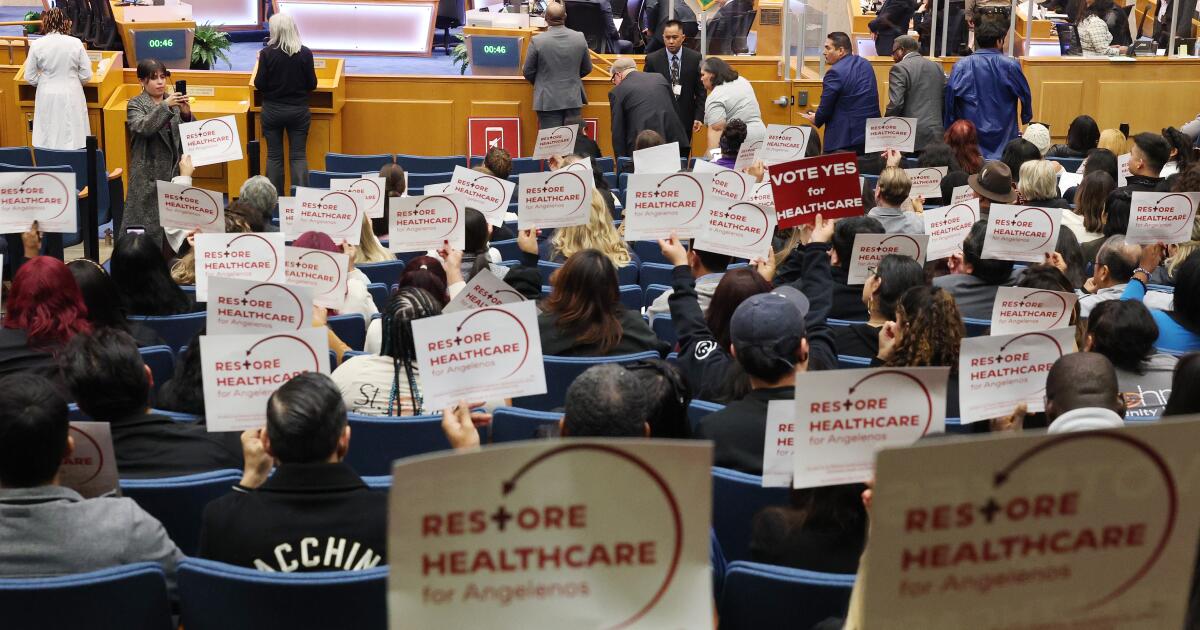
Los Angeles County’s half-cent sales tax to fund healthcare services was trailing Tuesday, with early returns showing a majority of voters rejecting the measure.
The tax — a half-penny of every dollar spent in the county — is meant to prop up local hospitals and clinics that are hemorrhaging funding after recent federal cuts.
The sales tax, which needs a simple majority to pass, would take effect Oct. 1 and last five years. Officials say it would pull in $1 billion annually to help plug the budget holes hitting local hospitals and clinics.
L.A. County health officials anticipate the One Big Beautiful Bill Act, signed into law by President Trump last summer, will slash more than $2 billion from the county’s health services budget within the next three years. Due to eligibility changes, the county will no longer be able to get reimbursements for many Californians who have lost Medi-Cal.
The measure was championed by a coalition of healthcare advocates called Restore Healthcare for Angelenos who warned that mass layoffs and emergency room closures could be imminent if new funding didn’t come fast. The Department of Public Health recently closed seven clinics — a grim sign, supporters said, of service cuts to come.
Voters haven’t rejected a sales tax hike since 2012, when a transportation measure fell just short with 66.1% support. It needed 66.7% to pass.
A majority of county supervisors had supported the new tax proposal, voting 4 to 1 this February to put it on the ballot. But the measure faced significant opposition from local cities, with opponents arguing the sales tax hike would unfairly burden the poorest county residents and encourage people to spend their dollars across the county line.
Supervisor Kathryn Barger, the board’s lone opponent of the tax, said she was concerned it was a “general” tax, meaning the money wouldn’t be earmarked for healthcare costs. Instead, she argued, politicians would have final say over how the money gets spent.
The supervisors have created a plan for spending the tax money, with the largest chunk of the money meant to cover the costs for patients without insurance. The measure also asked voters to sign off on a nine-member oversight committee.
The county currently has a base sales tax rate of 9.75%, and cities impose local taxes on top of that.
-

 Politics3 minutes ago
Video: Steve Hilton Holds Slim Early Lead in California Governor’s Race
-
 Lifestyle33 minutes ago
We’re having a main character summer. Are you? : It’s Been a Minute
-

 Technology41 minutes ago
Microsoft AI chief Mustafa Suleyman says there are three labs that matter — and he wants Microsoft to be the fourth.
-

 World48 minutes ago
US ally Kuwait condemns ‘brutal and ongoing Iranian attacks’ after airport was hit
-

 Politics51 minutes ago
Spencer Pratt surges to runoff in LA mayor’s race after angry voters send message to Karen Bass
-

 Health56 minutes ago
One extra serving of processed meat a day linked to higher cancer risk
-

 Sports1 hour ago
AJ Brown trade outcome: Dianna Russini paid a heavy price while Mike Vrabel emerged unscathed
-

 Technology1 hour ago
Could your Samsung phone replace your passport?

