Politics
The abortion debate is giving Kamala Harris a moment. But voters still aren't sold

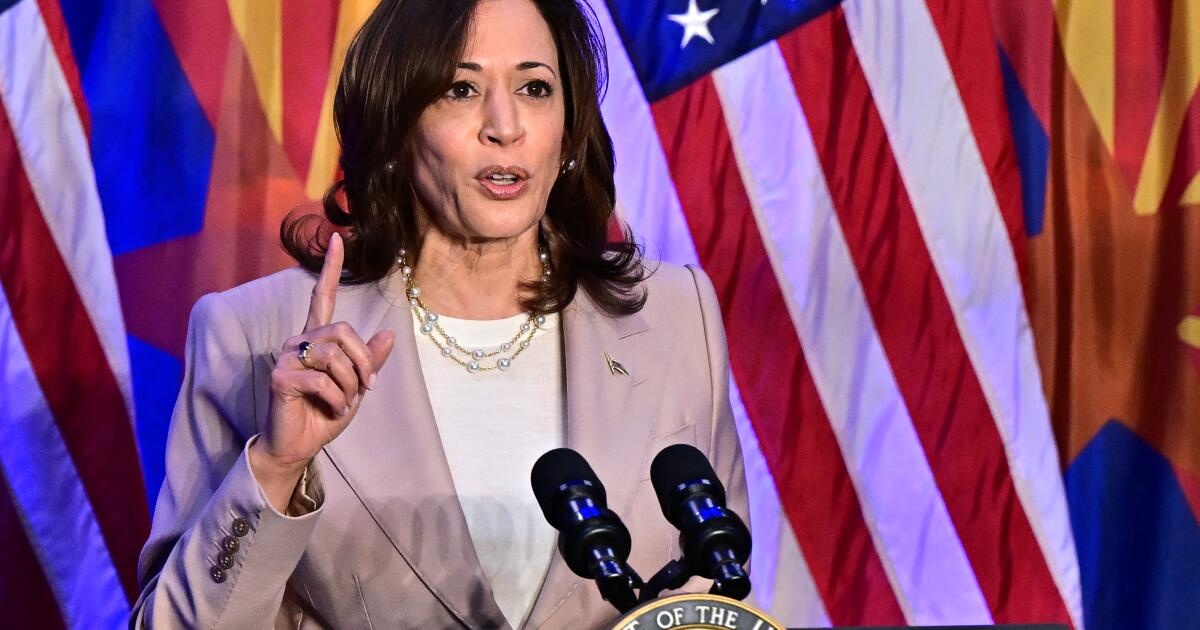
When a group of crossover voters was asked during a focus group about Vice President Kamala Harris, their assessments were brutal: If she is helping Biden, you don’t see it. She rubs me the wrong way. She was picked because she is a demographic. The big things she had, she failed.
The comments, fair or not, represent a problem for President Biden and for Harris, echoed in interviews with voters here in Arizona, a key swing state where Harris spoke on Friday. More than three years into the oldest president in history’s first term, his understudy has failed to win over a majority of voters or convince them that she is ready to step in if Biden falters, according to polls.
“Swing voters don’t like her,” said Gunner Ramer, political director for a group called Republican Voters Against Trump, which allowed The Times to view videos from three focus groups, including the crossover group that featured people who voted for former President Trump in 2016 and Biden in 2020.
It wasn’t just former Trump voters who were negative about Harris. In a focus group of Black voters who were disappointed with Biden, none raised their hand in support of Harris, with one participant calling her “the bad news bear.” A focus group of California Democrats, while they liked Harris, had to be prompted to discuss her and said she needed more influence and exposure.
Many of Harris’ allies and supporters say the judgments are influenced by racism and sexism, pointing out that other vice presidents stayed in the background with less scrutiny and saw their popularity tied to the top of the ticket. Some people in focus groups criticized her clothes or compared her to Hillary Clinton in comments that seemed to validate those concerns.
But her low popularity could pose a political problem that her predecessors have not faced, given the focus on Trump’s and Biden’s ages, 77 and 81 respectively. More than half of voters, 54%, said she is not qualified to serve as president in a March USA Today/Suffolk poll, compared with 38% who said she is.
“If there was a health event for either nominee, the VP is front and center in terms of people who may be on the fence, people who may dislike both candidates,” said David Paleologos, who conducted a USA Today/Suffolk poll that asked voters their assessment of Harris. “And there are a lot whose decision may hinge on a comfort level with the vice presidential choice.”
Harris has heard the criticism since she entered the White House to historic triumph in 2021. While she seldom responds directly, she has stepped up her appearances with core Democratic groups, often keeping a more robust campaign and travel schedule than Biden. Many allies believe her role as the administration’s leading voice on abortion rights will boost her and the Democratic ticket on an issue that helped carry the party to unexpected success in the 2022 midterm elections.
She spoke Friday in Tucson, three days after the state’s Supreme Court ruled that an1864 ban on abortion can be enforced in the coming weeks. She framed the Democrats’ case against Trump, who has claimed credit for shifting the Supreme Court against abortion rights and last week said each state should decide on the issue.
“Just like he did in Arizona, he basically wants to take America back to the 1800s,” Harris said.
Several voters said in interviews in Phoenix on Monday that they were not aware Harris was in their state just a few days ago, underscoring the challenge of getting attention as a vice president in an era of information overload.
“If she is coming for us, she doesn’t show it,” said Tracey Sayles, a 52-year-old Black Democrat.
Sayles voted in prior elections for Democrats Hillary Clinton and Biden but now says her choice is 50-50 in the coming election, despite calling Trump “vulgar,” because Biden “looks like he’s ill.” She would have driven to see Harris in Tucson if she’d known she was in the state, she said, but feels the vice president has been hiding.
Another voter who dislikes both Trump and Biden, Jeff Garland, said he has not seen much of Harris either.
“But from what I have seen of her, she doesn’t look like someone I want running my country,” said Garland, a 57-year-old retired member of the military who said he voted for Trump in 2016 and Biden in 2020 and planned to sit out 2024.
Kellie Hoverson, a 31-year-old Democrat, said she “was not thrilled about Biden” but was more bullish on Harris, despite hearing concerns from younger friends and relatives about her history as a prosecutor in California.
“I just want a woman president,” she said. “I just want to see it in my lifetime.”
Studies by the Barbara Lee Family Foundation, which works to advance women’s equality in politics, suggest women face an “imagination barrier” when they run for the highest executive offices, because voters have a harder time picturing them in the job than they do white men, who have historically held the posts.
“Men can tell and women have to show,” said Amanda Hunter, the foundation’s executive director.
Polls suggest Harris, who dropped out early in the 2020 presidential primary, has made strides with the Democratic base. Three quarters of Democrats had a favorable view of her in the USA Today/Suffolk poll, which showed a little more than a quarter of independents view her favorably.
Brian Fallon, who serves as her campaign communications director, said she “has proven to be a highly effective messenger on issues from reproductive freedom to gun violence prevention” and said she is “uniquely positioned to mobilize critical groups across the Biden-Harris coalition, including both progressives and independents.”
The fact that many voters say they remain unfamiliar with Harris is something her allies and advisors see as an opening, because it leaves room for persuasion when more voters focus in on the race in the early fall.
“This is not a one-speech or two-speech thing, this is four or five months of just putting in the work,” said Cornell Belcher, who served as one of former President Obama’s pollsters.
Belcher argued that the small slice of persuadable voters who give Harris her lowest marks won’t decide the race; it will instead be a question of whether Democrats can rebuild their coalition of young voters, women and people of color that delivered Obama his 2012 reelection and formed the backbone of Biden’s 2020 victory.
“I’m more worried about these younger voters taking the off-ramp, like they did in 2016,” he said, crediting Harris with her work reaching them in college campus tours and other outreach.
But there are questions there, too, with inconsistencies in polls of voters age 18-29, given the small sample sizes of subgroups. One poll conducted in early April by Emerson College showed Harris with pretty high favorable marks among those younger voters, nearly 49%, while another poll by the Economist taken a few days later showed only 34% of that age group viewed her favorably.
It’s unclear whether Trump, who has not targeted the vice president often, will pick up his attacks on Harris, who is unsurprisingly toxic among Republican base voters. “If they cheat on the election, it might be Kamala,” Trump said during a March rally in North Carolina, echoing his false claims of widespread election fraud.
He fairly quickly pivoted back to Biden: “We got enough problems with this guy.”
A senior advisor to the Trump campaign, Danielle Alvarez, called Harris irrelevant. “Political reality is that Biden’s under water and he is a failed president,” she said. ”She is certainly probably equal to him in those failures, but he is the target.”
Whit Ayres, a longtime Republican pollster, agrees that running mates do not generally impact votes but points to Sarah Palin in 2008 as an exception, in large part because polls showed dual concerns about John McCain’s health and Palin’s fitness for office. He argues that Harris, whom he characterizes as a walking gaffe, presents a similar problem.
“There may be plenty of time, but if you don’t have the ability to be more articulate and look like you’re ready to be leader of the free world, it’s going to be difficult to accomplish that,” Ayres said.
Harris is counting on that time. She is fairly busy with public events, but vice presidents, by design, don’t tend to draw much attention compared with the president.
As the campaign heats up, and Trump picks a running mate, they are likely to see more of her, and, potentially, in a different light.
“For people who have misgivings about her, ultimately the question for them is going to be how does she look as opposed to X?” said Joel Goldstein, a historian who studies the vice presidency. “Now, she’s measured against an ideal figure.”


NEWYou can now listen to Fox News articles!
Former President Joe Biden appeared to briefly seek directions before exiting the stage after delivering remarks at a Democratic gala Saturday night, capping his speech with an awkward onstage moment.
After delivering a roughly 10-minute keynote speech at the Maryland Democratic Party’s “Fight Back & Win Gala” near Baltimore, the 83-year-old paused onstage and looked toward the wings before pointing in two different directions, seemingly trying to determine where to exit. After receiving guidance, Biden turned and walked off the stage with his back to the audience.
Unlike several other speakers at the gala, who exited on the opposite side of the stage after their remarks, Biden left in a different direction.
EX-DEM INSIDER REVEALS SHE WILL EXPOSE DEMOCRATS WHO COVERED UP BIDEN’S COGNITIVE DECLINE IN NEW BOOK
Former President Joe Biden exits the stage after delivering remarks at the Maryland Democratic Party’s Fight Back and Win Gala near Baltimore on Saturday. (CSPAN)
The moment came after Biden delivered one of his sharpest public critiques of President Donald Trump since leaving office. During his remarks, Biden defended his own administration’s record while accusing the Trump administration of corruption. He also took aim at what he described as Trump’s “vanity projects,” including renovations to the White House, changes at the Kennedy Center and the ongoing saga with the reflecting pool on the National Mall.
“Whoa, what a loser,” Biden said.
After pausing several times to cough throughout his remarks, Biden concluded with a call for Democrats to “fight back,” saying the country could overcome its challenges by acting together.
“Folks, I guarantee we can do this. And we will. We just remember who in the hell we are. We’re the United States of America,” Biden said. “There’s nothing, nothing beyond our capacity if we act together. So let’s get up and fight back, God darn it.”
The latest onstage moment comes just days after another widely shared incident at the opening of the Obama Presidential Center in Chicago.
WATCH: BIDEN LEFT SEARCHING FOR FAMILY AFTER OBAMA PRESIDENTIAL CENTER CEREMONY
The star-studded ceremony brought together former Presidents Barack Obama, Bill Clinton and George W. Bush, along with former Secretary of State Hillary Clinton, former Vice President Kamala Harris and other political leaders and entertainers. At the conclusion of the event, Biden remained onstage after others had exited before calling out, “Where’s my granddaughter?”
Former First Lady Jill Biden then returned to the stage, took his hand and guided him off.
SIGN UP TO GET THE POLITICS NEWSLETTER
Former U.S. President Joe Biden and Former first lady Jill Biden appear on stage during the dedication ceremony for the opening of the Barack Obama Presidential Center in John Lewis Plaza on June 18, 2026 in Chicago, Illinois. (Scott Olson / Getty Images)
Biden has largely stayed out of the public eye since withdrawing from the 2024 presidential race after facing intense pressure from fellow Democrats to end his reelection bid.
CLICK HERE TO DOWNLOAD THE FOX NEWS APP
The former president has since made only occasional public appearances and recently disclosed that he is undergoing treatment for Stage 4 prostate cancer.

WASHINGTON — A spectacular economic upturn is on its way, President Trump promised Americans last week, galvanized in part by a deal brokered this month to end his war with Iran.
“Very soon you’ll be at $2.50 a gallon for gasoline,” Trump told a crowd Wednesday night on the National Mall. The next year, he said, “is set for an economic boom the likes of which no nation has ever seen before.”
Economists are skeptical. The effects of the war and other factors driving inflation are likely to stick around for months, experts say, presenting an ongoing challenge to American households — and to Trump’s party as it seeks to retain control of Congress in November’s midterm elections.
Yesenia De La Torre, 24, from Culver City pumps gas at the Chevron gas station on Sawtelle Boulevard and Culver Boulevard on June 15. Despite an agreement announced Sunday to end the Iran war and open the Strait of Hormuz, high oil, gasoline prices and energy supply problems won’t be solved overnight.
(Kayla Bartkowski / Los Angeles Times)
The war’s end will not create “a complete snap-back,” said Patrick Harker, professor at the University of Pennsylvania Wharton School and former president of the Federal Reserve Bank of Philadelphia.
“Markets are still cautious, and the infrastructure that’s been destroyed [in the Middle East] is going to take a while to re-create,” Harker said. “Inflation’s going to stay elevated for a while.”
Oil prices were dropping last week — falling to their prewar level Friday — and average gas prices fell by 7 cents per gallon over a week ago. But it will take significant time for oil shipping to ramp up through the Strait of Hormuz, infrastructure to be rebuilt and gas prices to drop, said Michael Negron, senior fellow for economic opportunity at the Center for American Progress.
“I would expect there to be a continued inching downward,” Negron said, but “we’re not going to just go back within weeks to $2.90 per gallon.”
That means the prices of gas and of other essentials aren’t likely to improve dramatically before the midterms, in which affordability has become a driving issue. It could heighten challenges for Republicans, who are defending their majorities in the U.S. House and Senate, as Democrats seek to leverage the issue to gain ground.
Positive messaging about the economy from Trump and other officials “doesn’t really resonate” with Americans who are struggling to make ends meet, said Gina Plata-Nino of the Food Research and Action Center, a national anti-hunger advocacy organization.
“When you’re still making the same amount of money but there’s less for you to be able to pay [for] your basic needs — gas is more expensive, food is more expensive — it doesn’t really add up,” she said.

A fruit stand on West 7th Street sells bananas for $2 per bunch.
(Carlin Stiehl / For The Times)
Americans question the costs
The Iran war has cost the average American household between $775 and $1,300 so far in fuel and taxpayer costs, according to an analysis by Roger Pielke, a senior fellow at the American Enterprise Institute.
The national average gas price sat at $3.90 on Friday, according to AAA, and California’s average was $5.48 per gallon, down 13 cents from a week earlier.
The increase in oil prices has also affected diesel and fertilizer prices, creating a ripple effect through several sectors, including agriculture. Consumer prices rose 4.1% in May from a year earlier, putting the inflation gauge at a three-year high.
Trump has leaned on a bullish message about the economy, but he has largely dismissed Americans’ worries about affordability, calling it a “fake word” and a “hoax.” Last week, he undermined the first major progress by Congress on the issue, refusing to sign a bipartisan housing affordability bill after both chambers passed it.

President Donald Trump closes his eyes as Dr. Ben Carson, left, speaks during an event with the White House Religious Liberty Commission in the Oval Office on Friday.
(Anna Moneymaker / Getty Images)
Meanwhile, the president’s approval rating on the economy dropped to 33% last week in an NPR/PBS News/Marist Poll — his lowest ever for that poll and 3 points below former President Biden’s worst reading on the question during his term.
Nearly four-fifths of respondents said that gas prices present some sort of strain, with 34% categorizing it as a major strain and 44% calling it a minor strain. Half of respondents who said they were not vacationing this summer said cost was the reason.
And only 23% of Americans say the war was worth the costs, according to a Reuters/Ipsos poll conducted days after the Trump administration announced the framework agreement to end the conflict earlier this month.
“People [are] just feeling like they’re getting left behind,” Harker said. “That’s a very real, palpable feeling when you go out and talk to people. They’re worried.”
The president and his party need a midterms message that “real economic change” is coming, said Brian Reisinger, a rural policy analyst in Wisconsin and a former GOP strategist.
“It has to be substance behind the sell,” Reisinger said.

Senate Majority Leader John Thune (R-S.D.) speaks to reporters after the weekly Senate policy luncheons at the U.S. Capitol on Tuesday in Washington, D.C. Thune spoke on a meeting with President Trump on the Iran deal.
(Kevin Dietsch / Getty Images)
U.S.-Iran talks on shaky ground
Trump’s boosters have hailed the Iran deal as a victory for the president. And Trump has justified the shock to gas prices as “worth it not to have a nuclear weapon” in Iran, though the war has not achieved the president’s stated aims, which included the elimination of its nuclear program.
“President Trump was clear all along that there would be short-term, temporary disruptions to energy markets, and that oil and gas prices will quickly fall as soon as the Iran situation is resolved,” White House spokesperson Taylor Rogers said Friday.
How rapidly the conflict will be resolved is not yet clear. The U.S.-Iran negotiations were on shaky ground by week’s end, with each country offering diametrically opposed messaging on the status of key points of negotiation.
Analysts say much of the increase in traffic through the strait has been driven by the return of Iranian oil to global markets. Trump agreed in the controversial deal with Iran to lift sanctions on Iranian oil, allowing Tehran to resume trading its most valuable export and breaking with decades of U.S. policy.
The unpredictability of the talks is another factor keeping energy companies, shippers and insurers cautious for now, Negron said.
“Everything is to be negotiated in the next nearly two months,” he said. “It is natural to expect there to be additional risk priced into each barrel of oil, into the insurance people are paying, just because of the volatility and uncertainty of where we are.”

NEWYou can now listen to Fox News articles!
He wasn’t on the ballot, but President Donald Trump was a winner in Louisiana’s GOP Senate runoff election.
That’s because Trump-backed Rep. Julia Letlow defeated state Treasurer John Fleming to capture the Republican nomination, The Associated Press reported on Saturday.
Six weeks after denying Trump-targeted GOP Sen. Bill Cassidy a third six-year term in the Senate, a majority of Republican voters in the solidly red Gulf Coast state backed Letlow. Her victory in the runoff is seen as another victory for Trump as he works to fill the halls of Congress with loyal lawmakers for his final two years in the White House. And it’s another sign of the power of a Trump endorsement in Republican primaries.
Five years after he voted to convict Trump in his second impeachment trial, Cassidy was sent packing.
WATCH: CASSIDY DETAILS NEW BEHIND CLOSED DOORS CLASH WITH TRUMP
Sen. Bill Cassidy of Louisiana fist bumps a supporter during a campaign stop at a gun retailer and firing range in Baton Rouge on May 15, 2026, the eve of the state’s Senate primary. (Paul Steinhauser/Fox News)
Trump reacted to Letlow’s victory in a Truth Social post, calling Saturday’s result “great news.”
“Julia Letlow WON in Louisiana, beating conclusively a very strong and smart opponent,” Trump wrote. “Congratulations to Julia. She will be a truly GREAT Senator!”
Letlow, who was backed by Trump even before she entered the race in January, finished first in the primary, double digits ahead of Fleming, with Cassidy in third place. Since no candidate cracked 50% of the vote, Letlow and Fleming advanced to the runoff for the Republican nomination and Cassidy became the first elected Republican senator to lose renomination since Sen. Richard Lugar of Indiana in 2012.
Trump, celebrating Cassidy’s defeat, said on social media that “it’s nice to see that his political career is OVER!”
Cassidy, in a speech to supporters after conceding, took a jab at Trump, saying, “When you participate in democracy, sometimes it doesn’t turn out the way you want it to. But you don’t pout, you don’t whine. You don’t claim the election was stolen… You don’t manufacture some excuse.”
President Donald Trump stands with Rep. Julia Letlow during the Congressional Ball at the White House Grand Foyer in Washington, D.C., on Dec. 11, 2025. (Alex Wong/Getty Images)
Letlow, who was backed by Louisiana Gov. Jeff Landry, a top Trump ally, won her congressional seat in 2021, after her husband, Luke Letlow, died five days before being sworn into the U.S. House after his 2020 election victory for the seat she now holds. She highlighted her support from Trump throughout her Senate campaign.
Fleming, who spent eight years in Congress before serving as a White House deputy chief of staff during Trump’s first term, argued he was the most conservative candidate in the GOP Senate primary.
DEMOCRACY ’26: STAY UP TO DATE WITH THE FOX NEWS ELECTION HUB
Letlow will be considered the clear frontrunner in the midterm election against either farmer Jamie Davis or Navy veteran Gary Crockett, who are facing off in the Democratic Party runoff.
The brute force of the president’s endorsement power has been on display in GOP primaries over the past two months, with his candidates ousting incumbents he targeted in showdowns in Indiana, Kentucky and Texas, as well as the Louisiana primary.
But Trump’s endorsement streak in statewide and congressional Republican primaries was snapped three weeks ago when his last-minute endorsement of Republican Rep. Randy Feenstra of Iowa in the race to succeed retiring GOP Gov. Kim Reynolds wasn’t enough to propel the three-term congressman to victory.
Feenstra was narrowly edged by Zach Lahn, a businessman, farmer and former political strategist who was backed by the political wings of MAHA — the acronym for the Make America Healthy Again movement aligned with Trump’s Health Secretary Robert F. Kennedy Jr. — and Turning Point USA, the powerful conservative organization co-founded by the late Charlie Kirk.
Zach Lahn raises his fist in celebration after defeating his primary opponent in Iowa’s GOP gubernatorial race on Tuesday, June 2, 2026. (Zach Lahn for Governor via Facebook)
The president rebounded three weeks ago in South Carolina, as Trump-backed Lt. Gov. Pam Evette finished first in the GOP gubernatorial primary and longtime Trump ally Sen. Lindsey Graham won a majority of the vote in the Republican Senate primary, and avoided a runoff.
Graham, who was endorsed by Trump, was facing primary challenges from five candidates, including conservative businessman Mark Lynch, who took aim at the senator over his support for the war in Iran. Lynch was backed by some MAGA leaders who have been critical of the president.
Two weeks ago, Trump-backed candidates won two of the three top races in Georgia and Alabama, with the one setback coming against a billionaire businessman who shelled out over $100 million of his own money to boost his campaign.
Rep. Barry Moore, a House Freedom Caucus member and longtime Trump supporter who was endorsed by the president, comfortably defeated rival Jared Hudson, a former Navy SEAL sniper who was supported by some top names on the right, in solidly red Alabama’s GOP Senate runoff.
In battleground Georgia’s Republican Senate runoff, an 11th-hour endorsement by Trump helped boost Rep. Mike Collins, a MAGA champion, to victory over former college football coach Derek Dooley, who was backed by popular conservative Gov. Brian Kemp.
TRUMP’S ENDORSEMENT FAILS TO SAVE MAGA CANDIDATE AS BILLIONAIRE ADVANCES IN KEY GOVERNOR RACE
Collins will face Democratic Sen. Jon Ossoff in the general election in a race that’s among a handful that will likely decide if the GOP holds its slim majority in the chamber in the midterms.
CLICK HERE TO DOWNLOAD THE FOX NEWS APP
But in Georgia’s GOP gubernatorial runoff, the candidate Trump backed, Lt. Gov. Burt Jones, who was also endorsed by Kemp this past weekend, was defeated by billionaire businessman Rick Jackson, who ran as an outsider.
On Tuesday, Trump-backed first-time candidate Anthony Constantino, a businessman and former boxer, defeated Robert Smullen, a retired Marine Corps colonel and New York Assembly member who had the backing of the state party, in the upstate New York race to succeed retiring GOP Rep. Elise Stefanik.
Meanwhile, in South Carolina’s Republican gubernatorial runoff, Trump couldn’t lose.
That’s because, besides backing Evette, he also gave a last-minute endorsement to state Attorney General Alan Wilson, who ended up winning the showdown in a landslide.
-

 South-Carolina2 minutes ago
South Carolina pitcher Will Craddock announces transfer to SEC program
-

 South Dakota5 minutes ago
Team South Dakota gets strong performances at National Junior High Finals Rodeo
-

 Tennessee10 minutes ago
2026 Tennessee Football Position Preview: Running Backs | Rocky Top Insider
-

 Texas17 minutes ago
Sisters, friend charged in Texas mom’s stabbing death
-

 Utah20 minutes ago
Utah Mammoth Announce 2026 Development Camp Roster | Utah Mammoth
-

 Vermont25 minutes ago
Commentary | Eric Peterson: Time is running out for Vermont
-

 Virginia32 minutes ago
Virginia State Police seeks information on shooting on I-64 between Jefferson Avenue and J. Clyde Morris Boulevard in Newport News
-

 Washington35 minutes ago
Week Ahead in Washington: June 28

