Politics
Supreme Court Sides With Migrant Trump Administration Wrongly Deported


The Supreme Court on Thursday instructed the government to take steps to return a Salvadoran migrant it had wrongly deported to a notorious prison in El Salvador.
In an unsigned order, the court stopped short of ordering the return of the migrant, Kilmar Armando Abrego Garcia, indicating that courts may not have the power to require the executive branch to do so.
But the court endorsed part of a trial judge’s order that had required the government to “facilitate and effectuate the return” of Mr. Abrego Garcia.
“The order properly requires the government to ‘facilitate’ Abrego Garcia’s release from custody in El Salvador and to ensure that his case is handled as it would have been had he not been improperly sent to El Salvador,” the Supreme Court’s ruling said. “The intended scope of the term ‘effectuate’ in the district court’s order is, however, unclear, and may exceed the district court’s authority.”
The case will now return to the trial court, and it is not clear whether and when Mr. Abrego Garcia will be returned to the United States.
“The district court should clarify its directive, with due regard for the deference owed to the executive branch in the conduct of foreign affairs,” the Supreme Court’s ruling said. “For its part, the government should be prepared to share what it can concerning the steps it has taken and the prospect of further steps.”
The ruling appeared to be unanimous. But Justice Sonia Sotomayor, joined by Justices Elena Kagan and Ketanji Brown Jackson, issued a statement that was harshly critical of the government’s conduct and said she would have upheld every part of the trial judge’s order.
“To this day,” Justice Sotomayor wrote, “the government has cited no basis in law for Abrego Garcia’s warrantless arrest, his removal to El Salvador or his confinement in a Salvadoran prison. Nor could it.”
Justice Sotomayor urged the trial judge, Paula Xinis of the Federal District Court in Maryland, to “continue to ensure that the government lives up to its obligations to follow the law.”
A Justice Department spokesman responded to the order by focusing on its reference to the executive branch.
“As the Supreme Court correctly recognized, it is the exclusive prerogative of the president to conduct foreign affairs,” the spokesman said. “By directly noting the deference owed to the executive branch, this ruling once again illustrates that activist judges do not have the jurisdiction to seize control of the president’s authority to conduct foreign policy.”
Andrew J. Rossman, one of Mr. Abrego Garcia’s lawyers, expressed satisfaction with the Supreme Court’s action.
“The rule of law won today,” he said. “Time to bring him home.”
Mr. Abrego Garcia’s wife described the effect the case has had on their family and said she would keep pursuing his return to the United States.
“This continues to be an emotional roller coaster for my children, Kilmar’s mother, his brother and siblings,” Jennifer Stefania Vasquez Sura, his wife, said on Thursday, adding that “I will continue fighting until my husband is home.”
Judge Xinis had said the Trump administration committed a “grievous error” that “shocks the conscience” by sending Mr. Abrego Garcia to El Salvador despite a 2019 ruling from an immigration judge. The immigration judge granted him a special status known as “withholding from removal,” finding that he might face violence or torture if sent to El Salvador.
The administration contends that Mr. Abrego Garcia, 29, is a member of a violent transnational street gang, MS-13, which officials recently designated as a terrorist organization.
Judge Xinis, who was appointed by President Barack Obama, said those claims were based on “a singular unsubstantiated allegation.”
“The ‘evidence’ against Abrego Garcia consisted of nothing more than his Chicago Bulls hat and hoodie,” she wrote, “and a vague, uncorroborated allegation from a confidential informant claiming he belonged to MS-13’s ‘Western’ clique in New York — a place he has never lived.”
In the administration’s emergency application seeking to block Judge Xinis’s order, D. John Sauer, the U.S. solicitor general, said she had exceeded her authority by engaging in “district-court diplomacy,” because it would require working with the government of El Salvador to secure Mr. Abrego Garcia’s release.
“If this precedent stands,” he wrote, “other district courts could order the United States to successfully negotiate the return of other removed aliens anywhere in the world by close of business,” he wrote. “Under that logic, district courts would effectively have extraterritorial jurisdiction over the United States’ diplomatic relations with the whole world.”
In a response to the court, Mr. Abrego Garcia’s lawyers said their client “sits in a foreign prison solely at the behest of the United States, as the product of a Kafka-esque mistake.”
They added: “The district court’s order instructing the government to facilitate Abrego Garcia’s return is routine. It does not implicate foreign policy or even domestic immigration policy in any case.”
Mr. Sauer said it did not matter that an immigration judge had previously prohibited Mr. Abrego Garcia’s deportation to El Salvador.
“While the United States concedes that removal to El Salvador was an administrative error,” Mr. Sauer wrote, “that does not license district courts to seize control over foreign relations, treat the executive branch as a subordinate diplomat and demand that the United States let a member of a foreign terrorist organization into America tonight.”
Mr. Abrego Garcia’s lawyers said there was no evidence that he posed a risk.
“Abrego Garcia has lived freely in the United States for years, yet has never been charged for a crime,” they wrote. “The government’s contention that he has suddenly morphed into a dangerous threat to the republic is not credible.”
Mr. Sauer said Judge Xinis’s order was one in a series of rulings from courts exceeding their constitutional authority.
“It is the latest in a litany of injunctions or temporary restraining orders from the same handful of district courts that demand immediate or near-immediate compliance, on absurdly short deadlines,” he wrote.
In her statement on Thursday, Justice Sotomayor wrote that it would be shameful “to leave Abrego Garcia, a husband and father without a criminal record, in a Salvadoran prison for no reason recognized by the law.”
She added that the government’s position “implies that it could deport and incarcerate any person, including U. S. citizens, without legal consequence, so long as it does so before a court can intervene.”
“That view,” the justice wrote, “refutes itself.”
Alan Feuer, Aishvarya Kavi and Glenn Thrush contributed reporting.



Politics
Trump announces peace deal with Iran, declares Strait of Hormuz will reopen: ‘Let the oil flow!’

JUST IN: Trump announces Iran deal opens Strait of Hormuz, lifts naval blockade
Fox News chief foreign correspondent Trey Yingst covers President Donald Trump’s major announcement of a peace deal with Iran. Trump’s ‘Truth Social’ post details the toll-free opening of the Strait of Hormuz and removal of the U.S. naval blockade, allowing for increased oil flow. The deal aims to bring peace to the Middle East after months of conflict.
NEWYou can now listen to Fox News articles!
President Donald Trump announced Sunday that the United States and Iran have officially reached a peace agreement, marking a major diplomatic breakthrough that would reopen the Strait of Hormuz and end the U.S. naval blockade of Iranian ports.
“The Deal with the Islamic Republic of Iran is now complete,” Trump wrote in a post on Truth Social.
“Congratulations to all! I hereby fully authorize the toll free opening of the Strait of Hormuz, and, simultaneously herewith, authorize the immediate removal of the United States Naval blockade. Ships of the World, start your engines. Let the oil flow!”
Pakistani Prime Minister Shehbaz Sharif, whose country has served as a mediator, was the first to announce the peace deal, saying a signing ceremony is scheduled to take place Friday in Switzerland.
TRUMP SAYS HE’S CANCELED IRAN STRIKES, ADDS POTENTIAL DEAL-SIGNING ‘TO BE ANNOUNCED SHORTLY’
President Donald Trump speaks in the Oval Office of the White House on June 11, 2026, in Washington, D.C. (Jim Lo Scalzo/EPA/Bloomberg via Getty Images)
Trump added that the Strait of Hormuz will reopen once the parties formally sign the agreement.
“With the opening of the Strait upon the signing of the Deal on Friday, for purposes of mine removal, oil will flow on both ends again for the Region, and the World!” he said.
IRAN REVEALS 10-POINT PLAN FOR PEACE WITH THE US – HERE’S WHAT’S IN IT
President Donald Trump looks at Pakistan’s Prime Minister Shehbaz Sharif speaking in Egypt in 2025, following the signing of the first phase of the Gaza ceasefire agreement between Israel and Hamas. (Evelyn Hockstein/Reuters)
According to Sharif, the deal includes the termination of military operations across the region, including in Lebanon, where Iran-backed terrorist proxy Hezbollah has been engaged in conflict with Israel.
“Both sides have declared the immediate and permanent termination of military operations on all fronts, including in Lebanon,” he said.
Additional details of the agreement, including any provisions related to Iran’s nuclear program, were not immediately released.
Iran’s deputy foreign minister said talks with the United States on a final and more comprehensive agreement will take place during a 60-day ceasefire period, according to Reuters.
The outlet reported that the future of Iran’s nuclear program will be addressed in upcoming negotiations. Trump has long maintained that Iran cannot be in possession of a nuclear weapon and has repeatedly vowed to prevent Tehran from developing, acquiring or obtaining one.
Trump further praised his administration for securing the agreement.
“This Great Deal will bring Peace and Security to the whole Region,” he said. “Many presidents have tried to make Peace with Iran, and all have failed before me. The Leaders of the Region have, for the first time, found a President who can help them achieve real Peace.”
Sharif also thanked the United States and Iran for their “commitment to finding a diplomatic solution to the conflict,” as well as Qatar, Saudi Arabia and Turkey for their contributions to the mediation effort.
With the agreement now in place, mediators are expected to facilitate a series of meetings this week that could lay the groundwork for technical negotiations and the official signing ceremony, Sharif said.
CLICK HERE TO DOWNLOAD THE FOX NEWS APP
The peace deal would formally end the high-stakes conflict that began on Feb. 28, which disrupted roughly 20% of global oil shipments that pass through the Strait of Hormuz and contributed to higher energy prices worldwide.
It comes roughly one year after Israel initiated massive strikes on Iran during Operation Rising Lion. The strikes sparked a 12-day conflict between the nations before Trump ordered strikes on a trio of nuclear facilities later that same month.
Fox News’ Ashley J. DiMella and Reuters contributed to this report.
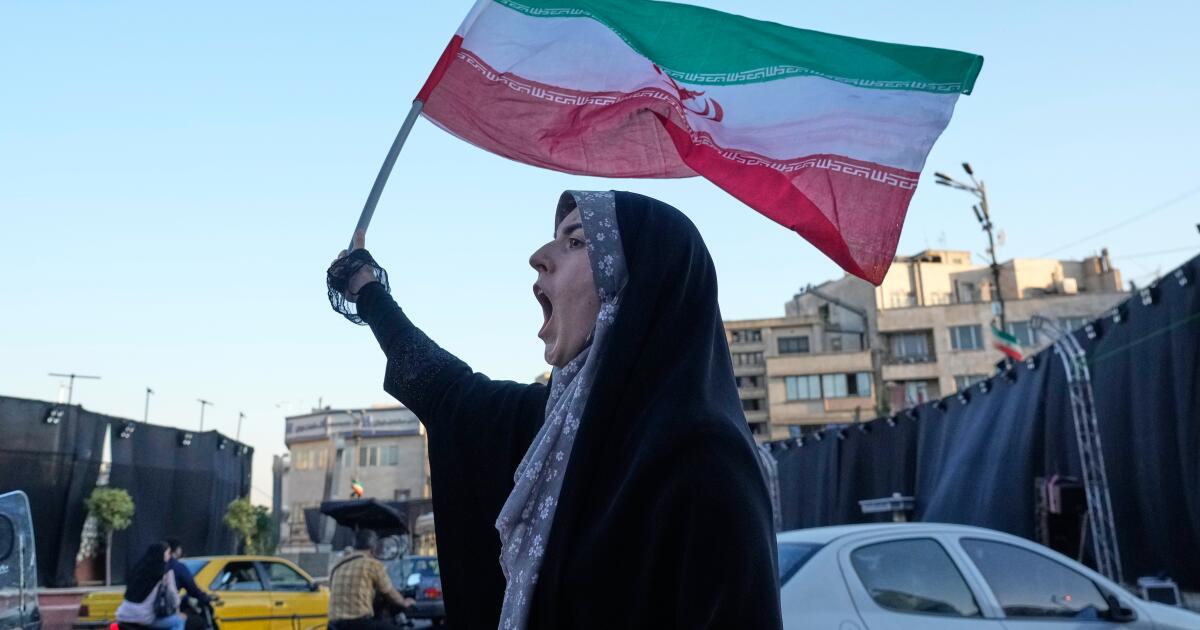
WASHINGTON — President Trump said Sunday that the United States and Iran have reached a framework agreement to end the war in the Middle East, a breakthrough in months of negotiations aimed at ending the conflict.
The deal, described by diplomats as a memorandum of understanding, commits Tehran to forgo the development or acquisition of nuclear weapons in exchange for helping reopen the Strait of Hormuz, and the paced release of its assets frozen overseas, upon the signing of the deal Friday in Switzerland.
Trump said he has also authorized “the immediate removal of the United States Naval blockade” on Iranian imports.
“Ships of the World, start your engines. Let the oil flow!” Trump wrote in a social media post Sunday evening. It was the president’s 80th birthday.
The full details of the agreement have not been released. Many details — including how Tehran would give up, destroy or dilute its fissile material, or whether Iran would continue treating the international strait as its sovereign waters — will continue to be negotiated in the coming days.
Pakistani Prime Minister Shehbaz Sharif said Sunday that mediators are planning to hold a series of meetings this week to “lay the foundation for the technical talks and the official signing ceremony.”
“We would like to thank the United States of America and the Islamic Republic of Iran for their commitment to finding a diplomatic solution to the conflict,” Sharif wrote in a post on X.
The Associated Press reported that negotiations on outstanding issues like Iran’s nuclear program would continue over the next 60 days, according to two senior Pakistani officials who spoke on condition of anonymity.
Vice President JD Vance told Fox News that the White House is “still figuring out the logistics” on whether he or Trump will attend the signing ceremony.
“What we know is that we have a lot of work to do, but a very big win for the American people tonight,” Vance said.”We are just going to keep on working at it, keep on driving energy prices down, keep on ensuring that region of the world is less than a basket case and finally, and most importantly, celebrate, that we can say with confidence Iran will never have a nuclear weapon.”
Iran’s deputy foreign minister, Kazem Gharibabadi, confirmed the agreement on state television but said Iran would not start implementing it until it was signed on Friday. He said the deal followed over 14 hours of talks in Tehran with a representative from Qatar, another mediator.
Iranian state TV showed a banner asserting: “US was forced to sign an agreement to end the war.”
Iran’s commitment to refrain from pursuing nuclear weapons would simply repeat a vow Iran has made several times before, including in its signing of the Nuclear Non-Proliferation Treaty and its nuclear deal brokered with international powers under the Obama administration over 10 years ago.
Iran has 972 pounds of uranium that is enriched up to 60% purity, a short, technical step from weapons-grade levels of 90%, according to the International Atomic Energy Agency. Under the 2015 international agreement with Iran abandoned by the first Trump administration, Iran’s uranium enrichment was capped at less than 4%, monitored by IAEA inspectors.
The vagueness of the new agreement, the demand for further negotiations to flesh out its details, and the pacing of sanctions relief for Iran are all likely to draw criticism of the president, who launched his political career in 2015 by attacking President Obama’s newly signed nuclear deal as a historically bad agreement.
That deal, known as the Joint Comprehensive Plan of Action, followed two years of painstaking negotiations that were predicated on a similar, yet more detailed framework, called the JCPOA.
Defense Secretary Pete Hegseth said in a Sunday morning interview on CBS’ “Face the Nation” that the the difference between the JCPOA and how the Trump administration is handling negotiations is the “threat of military force.”
“The huge difference is we did this from a position of strength,” Hegseth said. “That military might will stay as long as necessary.”
And, as in 2015, Israeli leadership across the political aisle remains deeply skeptical of the agreement, pronouncing they will not be bound by a deal to which they are not a party.
In a phone interview with the New York Times on Sunday afternoon, Trump called Benjamin Netanyahu, the prime minister of Israel, a “very difficult guy.”
“To be honest with you, he should be very thankful to us for doing this. Because if Iran had a nuclear weapon, Israel wouldn’t be around for two hours,” Trump said.
Since the U.S.-Israeli attacks on Iran that started the war Feb. 28, there have been 3,468 confirmed deaths in Iran, according to independent monitors. In addition, 13 U.S. service members have been killed, and the Israeli war with Hezbollah has killed 2,679 in Lebanon as well as 23 Israelis, including eight civilians.

It was back in late May that construction began on the towering, claw-like superstructure that now sits complete on the South Lawn of the White House, ready to stage Ultimate Fighting Championship bouts on Sunday, President Trump’s 80th birthday.
The spectacle is estimated to cost more than $60 million, according to Mark Shapiro, who is the president of U.F.C.’s parent company, TKO Group Holdings. (Mr. Trump purchased between $15,000 and $50,000 worth of stock in TKO weeks ahead of this event at the White House that he has been promoting for months).
Here’s a look at the fighting arena.
The Claw
The Claw is a 600-ton steel arch built in Belgium. Jumbo-sized and star-spangled, with huge television screens hanging from every corner, it coexists strangely with the rest of its environs.
It towers over the old willow oaks and magnolia trees planted long ago by past presidents on the gentle slope of the South Lawn. It towers over the White House itself. Spectators seated in the topmost section on Sunday night will be on eye level with the Truman balcony.
The Octagon
This is the Octagon, the caged ring in which men will beat one another to a pulp.
The cage is an eight-sided feat of marketeering, its every angle prominently displaying the name of some sponsor who’d paid big bucks to have their brands juxtaposed against the ultimate backdrop.
Among them: Live Trade on Polymarket, Bud Light, Pit Boss Grills, Total Wireless, Morgan & Morgan (“Dial #Law”) and Toyo Tires. “Crypto.com” is carved into each metal step leading into the ring.
The Venue
The Claw is not all. That venue can only fit a little more than 4,000 people, so a space for a watch party capable of hosting more than 70,000 people has been set up on The Ellipse, which is the park just south of the White House gates.
Back on the White House lawn, just behind the Claw, there are large tents set up. On Saturday afternoon, the day before the fight, a crew of six motocross riders will be performing stunts on the lawn, including backflips 45 feet in the air.
-

 Augusta, GA1 minute ago
1 dead, teen arrested after Burke County shooting
-

 Washington, D.C4 minutes ago
The Resy Guide to D.C.’s New Old-School Restaurants — Resy | Right This Way
-
Cleveland, OH9 minutes ago
Thousands without power after storms hit Northeast Ohio
-

 Austin, TX16 minutes ago
Texas closer Sam Cozart is the NCBWA Stopper of the Year
-

 Alabama19 minutes ago
Texas battles Alabama in CWS elimination game
-

 Alaska24 minutes ago
The Sunday Minefield – June 14, 2026
-

 Arizona31 minutes ago
Arizona Lottery Pick 3, Fantasy 5 results for June 14, 2026
-
Arkansas34 minutes ago
Arkansas Lottery Cash 3, Cash 4 winning numbers for June 14, 2026


