Politics
Supreme Court rejects gun rights for people charged with domestic violence

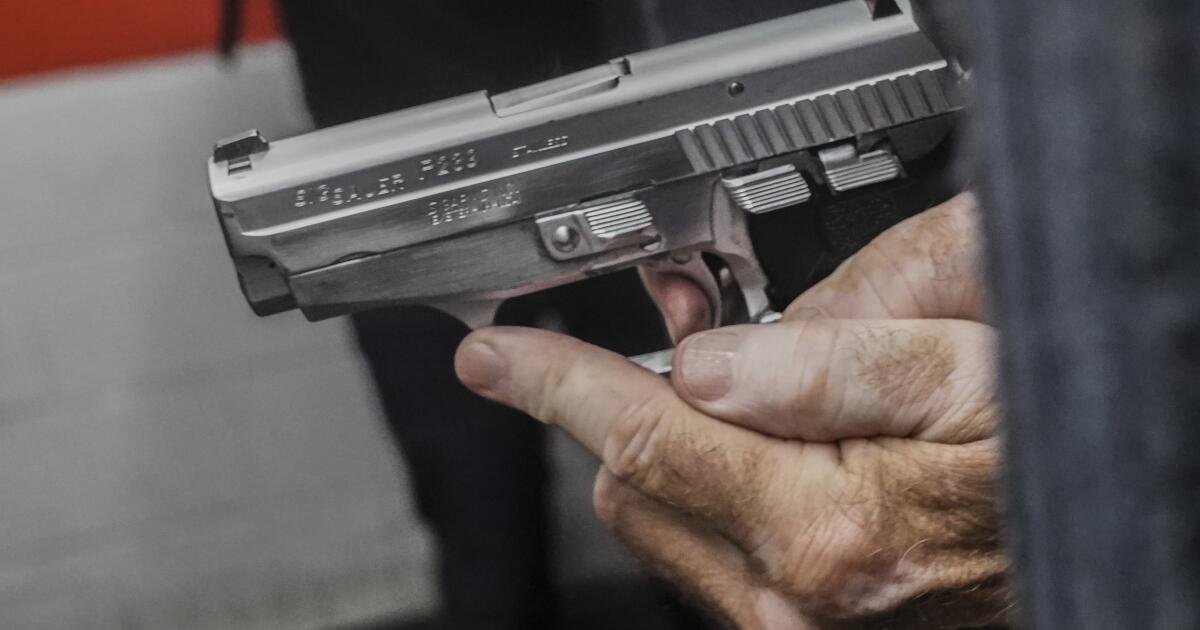
The Supreme Court on Friday put new limits on the 2nd Amendment, ruling that dangerous people who have threatened a domestic partner may be denied their right to have guns.
The 8-1 decision upholds federal and state laws that take away guns from persons who are subject to domestic violence restraining orders.
“Since the founding, our nation’s firearm laws have included provisions preventing individuals who threaten physical harm to others from misusing firearms,” said Chief Justice John G. Roberts Jr., writing for the court.
The outcome shows that the conservative justices are willing to restrict 2nd Amendment. The court reversed a ruling by the conservative 5th Circuit Court of Appeals in New Orleans, which had struck down part of the Violence Against Women Act. The law authorizes judges to remove guns from persons who pose a “credible threat” to a domestic partner or a child.
In the past, gun rights advocates had argued that a responsible and law-abiding person has a right to have a gun for self-defense, and the Supreme Court had agreed. Two years ago, the justices ruled in favor of gun owners in New York and said they had a right to seek a permit to carry a concealed gun with them when leaving home.
But the justices were not willing to rule that the 2nd Amendment protects the rights of dangerous people who have threatened others.
“An individual found by a court to pose a credible threat to the physical safety of another may be temporarily disarmed consistent with the 2nd Amendment,” the chief justice said. Equally important, seven other justices were willing to sign on to his opinion.
Justice Clarence Thomas, the author of the New York opinion two years ago, dissented alone on Friday.
The defendant in the case before the court could not be easily described as law-abiding or responsible. Texas police said Zackey Rahimi was a drug dealer who had shot at people and cars five times within a month in December 2020.
They said he had fired into the house of a man who he said had been “talking trash” about him on social media. He also shot at a driver after getting into an auto accident, and fired wildly into the air “after a friend’s credit card was declined at a fast-food restaurant,” prosecutors said.
A year before the five shooting incidents, Rahimi had been brought before a judge in Arlington, Texas, because he had beaten and threatened a girlfriend who had a child with him. He grabbed her in a parking lot, forced her into his car and shot at a bystander who saw what happened. He later threatened to kill the woman if she reported the assault.
The federal Violence Against Women Act of 1994 said judges may enforce restraining orders that take away firearms from someone who has harassed or threatened an “intimate partner” or a child, and who poses a “credible threat.”
The judge issued a restraining order for two years that denied Rahimi the right to have firearms and warned him he would be guilty of a federal crime if he defied the order. Rahimi agreed, but then defied the order, including by threatening the woman again.
When police went to arrest Rahimi for the shooting incidents, they found a .45-caliber pistol, a .308-caliber rifle, magazines for both pistols and rifles, ammunition, approximately $20,000 in cash, and a signed copy of a court restraining order that prohibited him from having firearms.
He was indicted by a federal grand jury, pleaded guilty to violating the restraining order and was sentenced to six years in prison.
But last year,, the 5th Circuit Court of Appeals ruled for Rahimi, overturning his conviction and declaring unconstitutional the part of the federal law that denied guns to those accused of domestic violence.
The three-judge panel, which included two Donald Trump appointees, agreed it was laudable to “protect vulnerable people in our society,” but said the “the 2nd Amendment right is exercised individually and belongs to all Americans …. Rahimi, while hardly a model citizen, is nonetheless among the people entitled to the 2nd Amendment’s guarantees.”

Politics
RFK Jr. responds to snake-handling critics with new video showing him wrangling a venomous rattlesnake

NEWYou can now listen to Fox News articles!
Health and Human Services Secretary Robert F. Kennedy Jr. shared another snake-handling video Wednesday after social media users raised concerns over his earlier encounter with a pair of black racer snakes.
Kennedy Jr. posted an Instagram video captioned, “In response to the many comments about venomous snakes, this video shows how Cheryl and I handled a recent rattlesnake rescue.”
The clip begins with Kennedy Jr. sitting in his home office before someone alerts him to a snake in the driveway.
“Hold on, guys. I’ll be back in a flash,” he says before grabbing a bucket and a small net and heading outside.
RFK JR BAREHANDS A PAIR OF SNAKES ON DR. OZ’S PATIO IN WILD VIDEO
RFK Jr. wrangles a Western Diamondback rattlesnake during a rescue video shared to Instagram Wednesday. (Instagram/RFKJr.)
The HHS secretary then carefully scoops up the rattlesnake as onlookers react in amazement.
After placing the snake in a bucket, Kennedy Jr. later pins it behind the head and lifts it toward the camera while explaining how to identify the reptile.
“His fangs are in there. I don’t want to touch them,” he said. “This is a beautiful snake. This is a Western Diamondback. You can tell by these rings at the end of his tail.”
Kennedy Jr. then asked his wife, actress Cheryl Hines, to bring him a pillowcase before transporting and releasing the snake back into the wild.
ACTRESS CHERYL HINES CLASHES WITH ‘THE VIEW’ OVER HER HUSBAND RFK JR’S RECORD SERVING AMERICANS
Health and Human Services (HHS) Secretary Robert F. Kennedy Jr. proudly displays a pair of black North American racer snakes he caught on Dr. Oz’s patio. (Robert F. Kennedy Jr.)
The Instagram post appeared to respond directly to criticism and concern sparked by another snake video Kennedy Jr. shared Tuesday on X.
In that clip, Kennedy Jr. grabbed two black North American racer snakes with his bare hands while visiting Dr. Mehmet Oz’s patio as Hines watched in apparent horror.
“Honey, honey … why?” Hines yelled as Kennedy Jr. cornered the snakes.
Kennedy Jr. then lunged at the reptiles and eventually lifted both by their tails as they repeatedly bit his hands.
CHERYL HINES SHARES HARROWING EVACUATION FROM WHITE HOUSE CORRESPONDENTS’ DINNER AS GUNSHOTS RANG OUT
U.S. Secretary of Health and Human Services Robert F. Kennedy Jr. and Cheryl Hines attend the 2026 White House Correspondents’ Dinner at the Washington Hilton in Washington, D.C., on April 25, 2026. (Taylor Hill/WireImage)
“Black snakes, they’re biting me,” Kennedy Jr. said with a smile.
The snakes continued striking at his hands as Hines pleaded, “Bobby, please! Bobby, Bobby, please,” before later telling him, “You are nuts.”
Kennedy Jr. later posted the video to X with the caption, “Cheryl cheerleads the removal of a pair of Black Racers from Dr Oz’s patio.”
According to the Florida Museum of Natural History, black racer snakes are nonvenomous and generally harmless to humans, though they will “readily bite to defend themselves.”
CLICK HERE TO DOWNLOAD THE FOX NEWS APP
The earlier video showed Kennedy Jr. handling nonvenomous snakes, while Wednesday’s Instagram clip focused on a venomous Western Diamondback rattlesnake, prompting some social media users to question whether the HHS secretary was taking unnecessary risks.
Fox News Digital’s Robert McGreevy contributed to this report.

SACRAMENTO — Gov. Gavin Newsom has threatened to tax 100% of the money Californians receive from President Trump’s “anti-weaponization” fund for his political allies.
Trump’s Justice Department had announced last week that it would establish a $1.776-billion fund to compensate allies of the president who claim they have “suffered weaponization and lawfare” under the Biden administration’s Justice Department.
“Anyone from California that receives any of those funds, we want to tax 100% of those proceeds,” the governor told reporters Thursday.
“That’s an action the state of California can take …[and] it’s an action we look forward to taking.”
Just how Newsom would do so remains unclear. He indicated that he would need action from the Democratic-led California Legislature to impose the new tax. If adopted, the measure would likely face legal challenge.
The fund has prompted outrage from Democrats and some Republicans — including Sen. Mitch McConnell (R-Ky.), who said in a statement that the “slush fund,” which would “pay people who assault cops,” was “utterly stupid.”
Newsom’s remarks about Trump’s settlement fund came on Thursday as he signed a bill designed to prevent election interference ahead of Tuesday’s primary.
The bill, Senate Bill 73, restricts law enforcement agencies and officers — including those from federal agencies — from interfering with state and local election officials, such as confiscating ballots, voter rolls or voting machines without a warrant.
The governor said the bill is meant to address “legitimate anxiety” over threats to election integrity after Riverside County Sheriff Chad Bianco’s decision to seize ballots from the county’s voter registrar as part of a fraud probe. Bianco, a long-time Trump supporter, is one of the top Republicans running to succeed Newsom after the end of his second and final term as governor.
Newsom also pointed to ICE and Border Patrol’s decision last November to stage an event near Dodger Stadium, calling it a “show of force designed to intimidate free expression and free speech.”
“That’s why we have to step up and we have to draw the line,” Newsom said. “We have to clarify the rules of engagement… there are fines associated with this, criminal fines and jail time of three years, so that’s a warning [to] the folks out there that think they can do the bidding of the Trump administration.”
Newsom said he expects Trump to interfere with the upcoming election — noting that the president has falsely claimed that he “won” California in the last election.
“Every single thing that Donald Trump is saying only suggests that he will do more, not less, to intimidate and to impact the outcome of this election,” Newsom said. “I absolutely expect the worst again, because we’ve been on the receiving end of it.”

The nationwide gerrymandering battle has escalated in recent weeks, after a landmark Supreme Court ruling in April weakened the Voting Rights Act and set off a scramble to redraw maps in some Southern states that have yet to hold primaries.
Eight states have redrawn their congressional districts since President Trump pressured Texas lawmakers last summer to pass a new map favoring Republicans. Republican lawmakers in two states are pushing to use a new map ahead of November’s midterm elections.
Here is a look at how district lines have changed in each of the states that have redrawn maps, and how the new maps would have fared in the 2024 presidential election.
Tap on a district for details.
2024 presidential vote margin
Number of districts
2024
2026
Change
+20 Dem. and greater
27
21
–6
+10 to +20 Dem.
6
16
+10
0 to +10 Dem.
8
10
+2
0 to +10 Rep.
6
1
–5
+10 to +20 Rep.
3
2
–1
+20 Rep. and greater
2
2
0
 Tap on a district for details.
Gov. Gavin Newsom and Democratic state lawmakers moved quickly to redraw California’s congressional districts in response to Texas’ gerrymandered map. The new California map, which lawmakers approved in August and voters passed in November of last year, was designed to flip five red districts.
The Supreme Court upheld the map in February, dismissing Republican claims that the state’s new district boundaries illegally favored Latino voters.
Tap on a district for details.
| 2024 presidential vote margin | Number of districts | ||
|---|---|---|---|
| 2024 | 2026 | Change | |
| +20 Dem. and greater | 3 | 3 | 0 |
| +10 to +20 Dem. | 0 | 1 | +1 |
| 0 to +10 Dem. | 5 | 0 | –5 |
| 0 to +10 Rep. | 0 | 1 | +1 |
| +10 to +20 Rep. | 9 | 16 | +7 |
| +20 Rep. and greater | 11 | 7 | –4 |
Florida’s Legislature passed a new map just days after the Supreme Court ruling on the Voting Rights Act. The map creates four more Republican-leaning House seats, splitting up a Democratic-leaning district in the Tampa area and eliminating a Democratic-leaning district in the Orlando area.
Tap on a district for details.
2024 presidential vote margin
Number of districts
2024
2026
Change
+20 Dem. and greater
2
1
–1
+10 to +20 Dem.
0
0
0
0 to +10 Dem.
0
0
0
0 to +10 Rep.
1
0
–1
+10 to +20 Rep.
0
3
+3
+20 Rep. and greater
5
4
–1
In late September, Gov. Mike Kehoe, a Republican, signed into law a new map that slices the Democrat-leaning core of Kansas City into districts with heavily Republican rural areas. Republicans hope to add one Republican seat, ousting longtime Representative Emanuel Cleaver and leaving the state with just one solidly Democratic district in the St. Louis area.
Tap on a district for details.
2024 presidential vote margin
Number of districts
2024
2026
Change
+20 Dem. and greater
3
3
0
+10 to +20 Dem.
0
0
0
0 to +10 Dem.
0
0
0
0 to +10 Rep.
2
1
–1
+10 to +20 Rep.
8
10
+2
+20 Rep. and greater
1
0
–1
In North Carolina, Republicans control both houses of the legislature and approved a new map in October of last year. The new map could give Republicans an extra seat in the First Congressional District, which previously included all eight of the state’s majority Black counties and was redrawn to include more conservative-leaning counties.
Gov. Josh Stein, a Democrat, cannot veto redistricting plans, per the state Constitution.
Tap on a district for details.
2024 presidential vote margin
Number of districts
2024
2026
Change
+20 Dem. and greater
2
2
0
+10 to +20 Dem.
0
0
0
0 to +10 Dem.
2
1
–1
0 to +10 Rep.
3
3
0
+10 to +20 Rep.
2
3
+1
+20 Rep. and greater
6
6
0
Ohio’s bipartisan redistricting commission approved a new map in October of last year that could add up to two Republican seats. The new map dilutes Democrat-held districts near Toledo and Cincinnati.
Unlike many other states pursuing maps ahead of the normal timeline, Ohio had been required under its state Constitution to redraw its congressional maps before the 2026 midterms.
Tap on a district for details.
| 2024 presidential vote margin | Number of districts | ||
|---|---|---|---|
| 2024 | 2026 | Change | |
| +20 Dem. and greater | 1 | 0 | –1 |
| +10 to +20 Dem. | 0 | 0 | 0 |
| 0 to +10 Dem. | 0 | 0 | 0 |
| 0 to +10 Rep. | 0 | 0 | 0 |
| +10 to +20 Rep. | 1 | 0 | –1 |
| +20 Rep. and greater | 7 | 9 | +2 |
Tennessee Republicans moved swiftly after the Supreme Court decision that weakened the Voting Rights Act. Gov. Bill Lee signed a new map into law in early May that carves up the only Democratic district in the state, a majority Black district encompassing the Memphis area, splitting it into three neighboring districts.
A coalition of voters and Democratic candidates sued Tennessee officials in federal court over the new map, arguing that it was unconstitutional to implement new district lines this close to the state’s Aug. 6 primary.
Tap on a district for details.
2024 presidential vote margin
Number of districts
2024
2026
Change
+20 Dem. and greater
10
7
–3
+10 to +20 Dem.
1
1
0
0 to +10 Dem.
0
0
0
0 to +10 Rep.
2
0
–2
+10 to +20 Rep.
4
8
+4
+20 Rep. and greater
21
22
+1
Texas was the first state to redistrict last year, after President Trump urged Republican leaders to redraw maps ahead of the midterm elections.
The new map, signed into law by Gov. Greg Abbott in August of last year, could add up to five Republican seats in the state. Democrats argued that the new lines cut into majority Black and Hispanic districts in violation of the Voting Rights Act, but the Supreme Court upheld the map in December.
Tap on a district for details.
2024 presidential vote margin
Number of districts
2024
2026
Change
+20 Dem. and greater
0
1
+1
+10 to +20 Dem.
0
0
0
0 to +10 Dem.
0
0
0
0 to +10 Rep.
0
0
0
+10 to +20 Rep.
1
0
–1
+20 Rep. and greater
3
3
0
A Utah state judge in November tossed out a congressional map proposed by the state’s Republican Legislature, instead adopting a map offered by a centrist coalition. That map adds a Democratic-leaning district surrounding Salt Lake City.
Tap on a district for details.
2024 presidential vote margin
Number of districts
2024
2026
Change
+20 Dem. and greater
1
0
–1
+10 to +20 Dem.
0
1
+1
0 to +10 Dem.
1
0
–1
0 to +10 Rep.
0
0
0
+10 to +20 Rep.
0
1
+1
+20 Rep. and greater
5
5
0
Alabama had faced a ban on middecade redistricting until after the 2030 census. But after the Supreme Court ruling on the Voting Rights Act, Republicans in Alabama sought to revert back to a map first proposed in 2023 that had previously been rejected as a violation of the act.
The Supreme Court removed a critical obstacle for the use of that map in May, which would most likely do away with one of two majority-Black districts in the state.
Still, legal challenges remain. A panel of federal judges on May 26 rejected the new map, saying that the districts discriminated against Black people and could not be used so shortly before a vote. Alabama has appealed the ruling to the Supreme Court.
Gov. Jeff Landry, a Republican, delayed House primary elections after the Supreme Court’s decision on the Voting Rights Act tossed out Louisiana’s current maps. Ballots cast in the state’s primaries, where early voting began just days after the decision, did not count. New primary elections will be held in November.
The Louisiana Legislature is continuing to debate a new map, but is expected to eliminate at least one of the state’s two majority-Black districts.
-
 News25 minutes ago
Former senior CIA officer took home gold bars and millions in cash, FBI says
-

 Los Angeles, Ca2 hours ago
Loved ones search for 80-year-old woman missing in Westlake for nearly a week
-

 Detroit, MI2 hours ago
Detroit PWHL team names Michigan native Josh Sciba head coach
-

 San Francisco, CA3 hours ago
World Cup dining guide near Levi’s Stadium and in San Francisco
-

 Dallas, TX3 hours ago
North Texas doughnut shops named among best in U.S.
-

 Miami, FL3 hours ago
Miami’s Jai Lucas Tackles Year Two With A New Roster and New Goal
-

 Boston, MA3 hours ago
A look inside Joan Bennett Kennedy’s Back Bay condo, listed for $2.6m
-

 Denver, CO3 hours ago
Denver Fashion Week Responds To Community Demand With Second Model Audition Date – 303 Magazine

