Politics
Supreme Court OKs Virginia GOP's last-minute bid to purge alleged noncitizens from voter rolls

WASHINGTON — A divided Supreme Court on Wednesday ruled for Virginia Republicans, clearing the way for an election-eve purge of about 1,600 registered voters who were suspected of being noncitizens.
In a 6-3 vote, the court granted an emergency appeal from Virginia’s attorney general and set aside rulings by a federal judge who called the last-minute purge a “clear violation” of federal law.
The six justices in the majority were all Republican appointees. The three Democratic appointees — Justices Sonia Sotomayor, Elena Kagan and Ketanji Brown Jackson — dissented.
In a fast-track appeal, Virginia Atty. Gen. Jason Miyares, a Republican, said it would violate “common sense” and “irreparably injure Virginia’s sovereignty” to keep noncitizens on the voting rolls.
Federal law says states may not “systematically remove” registered voters from the rolls in the 90 days prior to a federal election. Congress, in passing the law, said the danger is that voters will go to the polls on election day and discover they are no longer registered.
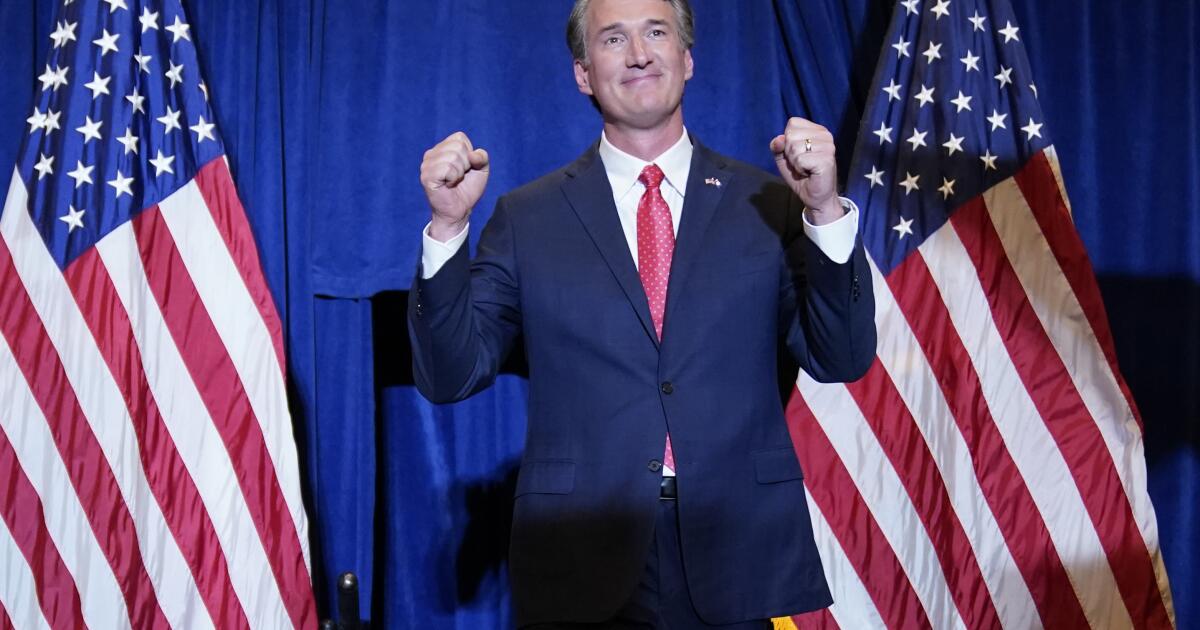
In early August, Virginia Gov. Glenn Youngkin issued an order to speed up the process of removing voters from the rolls who were flagged as possible noncitizens in state databases. They included residents or people with the same name who had checked a box when renewing their driver’s license that said they were noncitizens.
Shortly after voting rights advocates learned of the order, they discovered about two dozen longtime legal voters who had been wrongly removed from the rolls.
They sued along with the Justice Department, and a federal judge blocked Youngkin’s order on Oct. 18.
U.S. Judge Patricia Giles said the state’s data-based program is a “clear violation” of the National Voter Registration Act of 1993, and she ordered the state to restore the affected voters to the rolls. She noted, however, the state may cancel the registration of individuals who are shown to be noncitizens or otherwise ineligible.
In a 3-0 decision, the 4th Circuit Court refused to lift the judge’s order on Oct. 27.
Virginia’s state attorneys filed an appeal with the high court on Monday, arguing the federal law that forbids election-eve purges “does not even apply to the removal of noncitizens. … This election-eve injunction is thus based on legal error.”
U.S. Solicitor Gen. Elizabeth Prelogar had urged the court to deny the appeal. She said the state clearly violated a federal law “enacted to prevent the very type of 11th-hour disenfranchisement and confusion that [state officials] have caused here. “



Politics
EXCLUSIVE: ICE says El Paso detention facility will stay open under new contractor after $1.2B deal scrapped

NEWYou can now listen to Fox News articles!
EXCLUSIVE: Immigration and Customs Enforcement (ICE) said Camp East Montana in El Paso, Texas will remain open and is undergoing an operational upgrade, Fox News Digital has learned.
“Camp East Montana is NOT closing, quite the opposite,” an ICE spokesperson exclusively told Fox News Digital Tuesday.
“Rather, ICE has contracted with a new provider following Secretary Noem’s termination of the old contract inherited from the Department of War. ICE is always looking at ways to improve our detention facilities to ensure we are providing the best care to illegal aliens in our custody.”
Camp East Montana is photographed Friday, March 6, 2026, in El Paso, Texas. (Omar Ornelas/El Paso Times / USA TODAY NETWORK via Imagn Images)
BLUE-STATE GOVERNORS MOVE TO KEEP HEAT ON NOEM AS DHS FIRES BACK
The spokesperson said the new contract will allow the facility to maintain what the agency described as the “highest detention standards” while expanding oversight.
According to ICE, the new contractor will also provide increased on-site medical care, additional staffing and a “PRECISE quality assurance surveillance plan.”
The agency said the updated agreement also strengthens ICE’s direct oversight of operations at the El Paso-area facility.
“Far from closing, Camp East Montana is upgrading,” the spokesperson said.
El Paso immigration facility faces scrutiny but ICE says Camp East Montana is upgrading, not closing, after the $1.2 billion contract termination. (Omar Ornelas/El Paso Times / USA TODAY NETWORK via Imagn Images)
FOUR ILLEGAL IMMIGRANTS LINKED TO MS-13 INDICTED FOR ALLEGEDLY MURDERING 14-YEAR-OLD BOY IN MARYLAND PARK
The news that the facility will remain open comes after The Washington Post reported that the facility could face closure amid scrutiny over operations.
A document was distributed to ICE staff, the Post reports, indicated that the agency was drafting a letter to terminate the facility’s $1.2 billion contract at an unspecified date.
ICE officials, however, characterized the contract termination as a deliberate effort by Noem to raise standards and improve services.
Download
Image
Headline:
Syndication: El Paso Times Caption:
Camp East Montana is photographed Friday, March 6, 2026, in El Paso, Texas, as a bus enters the detention center. (Omar Ornelas/El Paso Times / USA TODAY NETWORK via Imagn Images)
CLICK HERE TO DOWNLOAD THE FOX NEWS APP
The facility, located at Fort Bliss in Texas, has been used to house thousands of detainees as part of the Trump administration’s immigration enforcement efforts.
ICE did not immediately provide details on the identity of the new contractor or the timeline for full implementation.

WASHINGTON — Russia is emerging as one of the few early economic beneficiaries of the war with Iran, as disruptions to energy infrastructure drive up demand for Russian exports and the world casts its gaze to the Middle East and away from Moscow’s war in Ukraine.
The U.S. and its European counterparts slapped severe sanctions on Russia in March 2022, barely a month into Russian President Vladimir Putin’s full-scale invasion of Ukraine. The effect was a stranglehold on Russia’s exports, depriving Putin’s war effort of at least $500 billion, experts say. But over the last week, as President Trump’s war in the Middle East choked energy markets worldwide, the White House began easing its restrictions on Moscow.
“It is traitorous conduct for you to help Russia,” California Rep. Ted Lieu (D-Torrance) said on X, demanding the Trump administration reverse course. “Russia is giving intelligence info to Iran that helps Iran target American forces.”
Crude droplets rained over Tehran after Israeli airstrikes decimated oil depots, draping the Iranian capital in a dense smog. Iranian counterattacks have also targeted refineries and oil fields in Saudi Arabia and Bahrain. Crude oil prices have surged, and traffic through the Strait of Hormuz has all but ceased, sending energy importers in search of alternate sources.
Those spikes are giving Russia, one of the world’s largest oil and gas exporters, a rare advantage. After spending a decade as the world’s most sanctioned nation over his aggression in Ukraine, Putin is finally starting to regain some leverage in global markets.
“In the current economic situation, if we refocus now on those markets that need increased supplies, we can gain a foothold there,” Putin said at a meeting at the Kremlin on Monday, according to Russian state media. “It’s important for Russian energy companies to take advantage of the current situation.”
On March 4, the Treasury Department issued a temporary 30-day waiver allowing Indian refiners to purchase Russian oil. The appeal by the Trump administration was described as a way to ease demand for Mideast oil, but was criticized as a reversal of sanctions placed against Putin meant to deny him the capital needed to fund his occupation of eastern Ukraine.
Now, Moscow is poised to press that advantage further, after Trump said Monday he will further lift sanctions on oil-producing countries to ease the trade friction and reintroduce additional oil and gas supplies. The only countries with U.S. oil sanctions are Russia, Iran and Venezuela.
“So, we have sanctions on some countries. We’re going to take those sanctions off until this straightens out,” Trump said at a news conference at his golf club in Doral, Fla. “Then, who knows, maybe we won’t have to put them on — they’ll be so much peace.”
The surprise concession to Moscow comes as reports suggest Russia is assisting Iran in targeting U.S. personnel.
Trump’s announcement followed an unscheduled hourlong call with Putin about the situation in the Middle East.
The war has also set the stage for Russia to make gains in Ukraine, as hostilities draw the global spotlight away from Kyiv and its struggle to hold back the bigger Russian army. U.S.-brokered talks between the two adversaries have been sidelined as Washington shifts focus to its war in Iran.
“At the moment, the partners’ priority and all attention are focused on the situation around Iran,” Ukrainian President Volodymyr Zelensky said on X. “We see that the Russians are now trying to manipulate the situation in the Middle East and the Gulf region to the benefit of their aggression.”
Putin is unlikely to intervene militarily on Iran’s behalf, according to Robert English, an international foreign policy expert at USC. Instead, Putin is expected to play his position carefully, reap the economic rewards, and keep focused firmly on Ukraine at a time when key air defense systems are diverted from Ukraine to the Persian Gulf.
“Russia is winning the Iran-U.S.-Israel war, at least so far. Oil and natural gas prices have soared, filling Putin’s Ukraine war chest,” he said. “Russia is gathering forces for a big spring offensive in Eastern Ukraine, and it’s not even front-page news.”
Ukraine has dispatched drone interceptors and ordered its anti-drone experts to pivot from their war with Russia to help Western allies help intercept Iranian attacks. Zelensky’s allegiance may not pay off, English said.
“When will Ukraine see the benefits of helping the U.S. with anti-drone technology? No time soon, apparently,” he said.
Even several weeks of interruption in Gulf energy supplies could bring the largest windfall to Russia, the Associated Press reported, citing energy analysts.
The economic turmoil caused by the war has exposed vulnerabilities in Europe’s energy system, particularly its lingering dependence on Russian fuel.
Despite sanctions, the European Union remains a major purchaser of Russian natural gas and crude oil. Russian gas accounted for approximately 19% of E.U. gas imports in 2025. Allied Europeans have agreed to completely stop importing Russian liquefied natural gas, oil and pipeline gas by late 2027.
Putin expressed no desire Monday to rescue the European market now that U.S.-Israeli escalations and Iranian retaliation have choked oil production and shipping. The Russian president instead proposed to divert volumes away from the European market “to more promising areas” like the Asia-Pacific region, Slovakia and Hungary, which he said were “reliable counterparties.”
European leaders have been criticized for being “stunned, sidelined, and disunited” since hostilities began in late February. Excluded from the initial military planning by the U.S. and Israel, Europe entered the conflict with gas storage at only 30% capacity, the lowest levels in years. Instead of bold action, English said, European leaders have quarreled over internal divisions and rivalries.
“Sky-high energy prices are the underlying cause of many of these frictions, as Europe struggles now more than ever to find affordable alternatives to the cheap Russian petroleum,” English said.
Antonio Costa, president of the European Council, told European leaders in Brussels on Tuesday that rising energy prices and the world’s shifting attention risk strengthening the Kremlin at a critical moment in the war in Ukraine.
“So far, there is only one winner in this war,” Costa said. “Russia.”

NEWYou can now listen to Fox News articles!
President Donald Trump is taking his feud with Rep. Thomas Massie, R-Ky., to the libertarian lawmaker’s home turf on Wednesday.
Trump is expected to hold an event in Hebron, Kentucky, on Wednesday, the Republican Party of Kentucky announced on social media Monday. It’s located in the northern part of the state’s 4th Congressional District, which Massie represents.
Massie’s primary rival, Ed Gallrein, will attend the Hebron event, his campaign confirmed to Fox News Digital on Tuesday, while deferring all other questions on the matter to the White House.
Massie himself will miss the event due to a previously scheduled official engagement, his spokesperson told Fox News Digital.
KHANNA AND MASSIE THREATEN TO FORCE A VOTE ON IRAN AS PROSPECT OF US ATTACK LOOMS
President Donald Trump will be visiting Rep. Thomas Massie’s congressional district on Wednesday. (Win McNamee/Getty Images; Nathan Posner/Anadolu via Getty Images)
When asked about the visit, White House spokeswoman Liz Huston told Fox News Digital, “President Trump will visit the great states of Ohio and Kentucky on Wednesday to tout his economic victories and detail his Administration’s aggressive, ongoing efforts to lower prices and make America more affordable.”
The president has thrown his considerable influence behind Gallrein to unseat Massie after the GOP lawmaker publicly defied Trump on multiple occasions.
MASSIE, KHANNA TO VISIT DOJ TO REVIEW UNREDACTED EPSTEIN FILES
Massie most recently was one of two House Republicans to vote to stop Trump’s joint operation in Iran with Israel, though the legislation was successfully blocked by the majority of GOP lawmakers and a handful of Democrats.
Ed Gallrein, left, seen with President Donald Trump in the Oval Office at the White House. (Ed Gallrein congressional campaign)
He was also one of two Republicans to vote against Trump’s “big, beautiful bill” last year.
Trump in turn has hurled a slew of personal attacks against Massie, including calling him “weak and pathetic” in a statement endorsing Gallrein in October.
“He only votes against the Republican Party, making life very easy for the Radical Left. Unlike ‘lightweight’ Massie, a totally ineffective LOSER who has failed us so badly, CAPTAIN ED GALLREIN IS A WINNER WHO WILL NOT LET YOU DOWN,” Trump posted on Truth Social at the time, one of numerous criticisms targeting the Kentucky Republican through the years.
He called Massie the “worst Republican congressman” in July amid Massie’s bipartisan push to force the Department of Justice (DOJ) to release its files on Jeffrey Epstein.
Then-Rep. Marjorie Taylor Greene, a Republican from Georgia, Rep. Thomas Massie, a Republican from Kentucky, and Rep. Ro Khanna, a Democrat from California, during a news conference outside the U.S. Capitol in Washington, D.C., on Tuesday, Nov. 18, 2025. (Graeme Sloan/Bloomberg via Getty Images)
But Massie has so far appeared to defy political gravity despite making political enemies out of both Trump and House GOP leaders.
CLICK HERE TO DOWNLOAD THE FOX NEWS APP
He handily defeated multiple primary challengers in 2024 and 2022, despite public feuds with Trump, and has served his district since 2012.
Gallrein is a retired Navy SEAL and farmer who launched his campaign days after Trump made his endorsement. Their primary election day is May 19.

The Good, the Bad and the Ugly from Virginia Tech’s 95-89 Loss to Wake Forest

Western Washington braces for wind, rain and hazardous Cascade travel through Thursday

‘Not a hiding place’: Ogden police lauded for role in catching Nevada, Wisconsin murder suspects

W.Va. lawmakers push through multiple bills as Saturday deadline nears

Wyoming Coaches Pick the Best of 1A & 2A Boys Basketball in 2026

Florida High School Football Rankings: Top 25 teams – Oct. 21

Cleary's 21 help Le Moyne down Central Connecticut State 69-64 in OT

How old is Bo Nix? What to know about Oregon quarterback ahead of 2024 NFL Draft

99th annual Pony Swim held in Virginia

Indiana Members Credit Union announced as new anchor tenant at Bottleworks District

EXCLUSIVE: ICE says El Paso detention facility will stay open under new contractor after $1.2B deal scrapped

Von der Leyen ‘acting outside of competence,’ Araud tells Euronews

Wheelchair curler Steve Emt’s path from drunk driver to three-time Paralympian

Map: 2.3-Magnitude Earthquake Reported North of New York City

Trump stirs GOP primary drama with visit to Massie’s Kentucky home turf
-

 Wisconsin1 week ago
Setting sail on iceboats across a frozen lake in Wisconsin
-

 Massachusetts1 week ago
Massachusetts man awaits word from family in Iran after attacks
-

 Pennsylvania6 days ago
Pa. man found guilty of raping teen girl who he took to Mexico
-

 Florida1 week ago
Florida man rescued after being stuck in shoulder-deep mud for days
-

 Detroit, MI5 days ago
U.S. Postal Service could run out of money within a year
-

 Miami, FL6 days ago
City of Miami celebrates reopening of Flagler Street as part of beautification project
-

 Sports6 days ago
Keith Olbermann under fire for calling Lou Holtz a ‘scumbag’ after legendary coach’s death
-

 Virginia7 days ago
Giants will hold 2026 training camp in West Virginia