Politics
Prop. 50 is on the ballot, but it’s all about Donald Trump


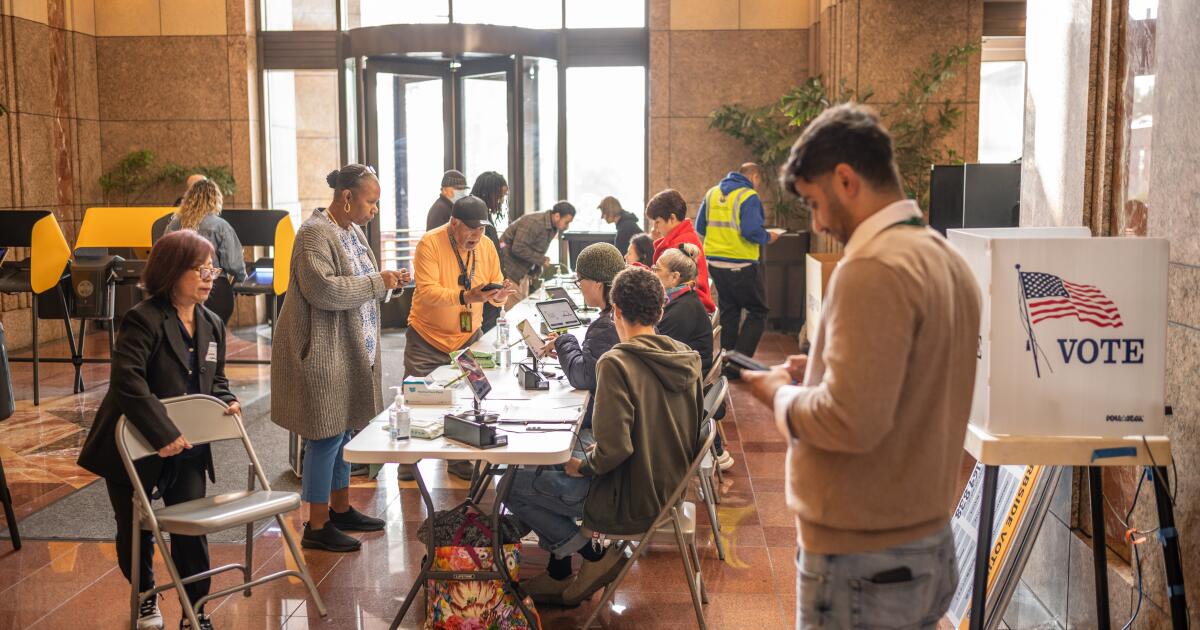
California voters went to the polls Tuesday to decide on a radical redistricting plan with national implications, but the campaign is shaping up to be a referendum on President Trump.
Proposition 50, a ballot measure about redrawing the state’s congressional districts, was crafted by Democrats in response to Trump urging Texas and other GOP-majority states to modify their congressional maps to favor Republicans, a move that was designed to maintain Republican control of the U.S. House of Representatives.
Opponents have said Proposition 50 is a power grab by Democrats that would blatantly disenfranchise Republican voters.
But supporters, fueled by a huge war chest in deep blue California, managed to make the vote about Trump and what they say are his efforts to erode democracy. The president has never been popular in California, but unprecedented months of immigration raids, tariffs and environmental rollbacks have only heightened the conflict.
“Trump is such a polarizing figure,” said Rick Hasen, a professor of law and political science at UCLA. “He commands great loyalty from one group of people and great animosity from others. … It’s not surprising that this measure has been portrayed as sticking it to Donald Trump or [California Gov.] Gavin Newsom.”
A CNN exit poll of California voters found that about half said their vote on Prop. 50 was a way of opposing Trump.
Proposition 50 underscores how hyperpartisan California politics have become. A UC Berkeley poll last week conducted in conjunction with The Times found more than 9 out of 10 Democrats supported Proposition 50 and a similar proportion of Republicans opposed it.
California voters had been bombarded with television ads, mailers and social media posts for weeks about the high-stakes special election, so much so that only 2% of likely voters were undecided, according to the poll.
As if on cue, Trump weighed in on Proposition 50 on Tuesday morning just as voting was getting underway.
“The Unconstitutional Redistricting Vote in California is a GIANT SCAM in that the entire process, in particular the Voting itself, is RIGGED,” Trump said on Truth Social just minutes after polling stations opened across California.
The president provided no evidence for his allegations.
Newsom dismissed the president’s claims on X as “the ramblings of an old man that knows he’s about to LOSE.”
At a White House briefing Tuesday afternoon, White House Press Secretary Karoline Leavitt claimed, without providing examples, that California was receiving ballots in the name of undocumented immigrants who could not legally vote.
California’s top elections official, Secretary of State Shirley Weber, called Trump’s allegation “another baseless claim.”
“The bottom line is California elections have been validated by the courts,” Weber said in a statement. “California voters will not be deceived by someone who consistently makes desperate, unsubstantiated attempts to dissuade Americans from participating in our democracy.”
More than 6.3 million Californians — 28% of the state’s 23 million registered voters — had cast ballots as of Monday, according to a voting tracker run by Democratic redistricting expert Paul Mitchell. Ballots submitted by Democrats were outpacing votes by Republicans on Monday, though GOP voters were believed to be more likely to vote in person on election day.
Disabled Army veteran Micah Corpe, 50, had some choice words for Newsom outside a Twentynine Palms church that served as a polling place, calling the politician a “greasy used car salesman.”
Corpe, a Republican, described Proposition 50 as an effort by the governor to “do whatever he wants because he doesn’t like Trump.” At the same time, he said Texas’ decision to redraw its congressional districts was a necessity because of the influx of people moving there from California and other blue states.
“He fights [Trump] on everything,” Corpe said of Newsom. “Just give in a little to get a little. That’s all he’s got to do.”
Matt Lesenyie, an assistant professor of political science at Cal State Long Beach, said the seeds of Proposition 50 were sowed when it became clear that Republicans in Congress were not going to challenge Trump in an investigatory way or provide serious oversight.
“One of the benefits of our system is that there are checks designed in there and we haven’t exercised those checks in a good long time, so I think this is a Hail Mary for potentially doing that,” he said.
Bob Rowell, 72, said that in an ideal world Proposition 50 wouldn’t be necessary. But the Trump administration’s push to redraw lines in red states has created a “distinct danger of creating a never-ending Republican domination in Congress,” he said. So Rowell, a Green Party member, voted yes.
“I hope there’s some way to bring us back into balance,” he said.
Robert Hamilton, 35, an architectural drafter who lives in Twentynine Palms, sees Proposition 50 as a necessary step to push back on Trump’s policies, which he said are impinging on people’s rights. He’s proud of the role California is playing in this political moment.
“I think as a state we’re doing an excellent job of trying to push back against some of the more egregious oversteps of our liberties,” Hamilton said outside a church where he’d just cast his ballot in favor of the measure. “I do hope that if this measure is successful that other states will follow suit — not necessarily taking the same steps to redistrict but finding ways to at least hold the line while hopefully we get things sorted out.”
Times staff writers Seema Mehta and Katie King contributed to this report.



new video loaded: Trump’s War of Choice With Iran

By David E. Sanger, Gilad Thaler, Thomas Vollkommer and Laura Salaberry
March 1, 2026

NEWYou can now listen to Fox News articles!
Some of the top rumored Democratic potential candidates for president in 2028 are showing a united front in opposing U.S. strikes on Iran, with several high-profile figures accusing President Donald Trump of launching an unnecessary and unconstitutional war.
Former Vice President Kamala Harris said Trump was “dragging the United States into a war the American people do not want.”
“Let me be clear: I am opposed to a regime-change war in Iran, and our troops are being put in harm’s way for the sake of Trump’s war of choice,” Harris said in a statement Saturday following the joint U.S. and Israeli strikes throughout Iran.
“This is a dangerous and unnecessary gamble with American lives that also jeopardizes stability in the region and our standing in the world,” she continued. “What we are witnessing is not strength. It is recklessness dressed up as resolve.”
Former Vice President Kamala Harris, Rep. Alexandria Ocasio-Cortez and California Gov. Gavin Newsom are leading Democratic 2028 hopefuls who spoke out against U.S. strikes on Iran. (Big Event Media/Getty Images for HumanX Conference; Reuters/Liesa Johannssen; Mario Tama/Getty Images)
California Gov. Gavin Newsom delivered some of his sharpest criticism during a book tour stop Saturday night in San Francisco, accusing Trump of manufacturing a crisis.
“It stems from weakness masquerading as strength,” Newsom said. “He lied to you. So reckless is the only way to describe this.”
“He didn’t describe to the American people what the endgame is here,” Newsom added. “There wasn’t one. He manufactured it.”
Newsom is currently promoting his memoir, “Young Man in a Hurry,” with recent and upcoming stops in South Carolina, New Hampshire and Nevada — three key early voting states in the Democratic presidential calendar.
Earlier in the day, Newsom said Iran’s “corrupt and repressive” regime must never obtain nuclear weapons and that the “leadership of Iran must go.”
“But that does not justify the President of the United States engaging in an illegal, dangerous war that will risk the lives of our American service members and our friends without justification to the American people,” Newsom wrote on X.
California is home to more than half of the roughly 400,000 Iranian immigrants in the United States, including a large community in West Los Angeles often referred to as “Tehrangeles.”
DEMOCRATS BUCK PARTY LEADERS TO DEFEND TRUMP’S ‘DECISIVE ACTION’ ON IRAN
Rep. Alexandria Ocasio-Cortez, D-N.Y., a leading progressive voice and “Squad” member, accused Trump of dragging Americans into a conflict they did not support.
“The American people are once again dragged into a war they did not want by a president who does not care about the long-term consequences of his actions. This war is unlawful. It is unnecessary. And it will be catastrophic,” Ocasio-Cortez said.
“Just this week, Iran and the United States were negotiating key measures that could have staved off war. The President walked away from these discussions and chose war instead,” she continued.
“In moments of war, our Constitution is unambiguous: Congress authorizes war. The President does not,” she said, pledging to vote “YES on Representatives Ro Khanna and Thomas Massie’s War Powers Resolution.”
Illinois Gov. JB Pritzker criticized the strikes and accused Trump of ignoring Congress. (Daniel Boczarski/Getty Images for Vox Media)
Illinois Gov. JB Pritzker, another Democrat often mentioned as a potential 2028 contender, also criticized the strikes and accused Trump of ignoring Congress.
“No justification, no authorization from Congress, and no clear objective,” Pritzker wrote on X.
“Donald Trump is once again sidestepping the Constitution and once again failing to explain why he’s taking us into another war,” he continued. “Americans asked for affordable housing and health care, not another potentially endless conflict.”
“God protect our troops,” Pritzker added.
Pennsylvania Gov. Josh Shapiro focused his criticism on war powers, arguing Trump acted outside constitutional guardrails.
“In our democracy, the American people — through our elected representatives — decide when our nation goes to war,” Shapiro said, adding that Trump “acted unilaterally — without Congressional approval.”
JONATHAN TURLEY: TRUMP STRIKES IRAN — PRECEDENT AND HISTORY ARE ON HIS SIDE
Pennsylvania Gov. Josh Shapiro focused his criticism on war powers, arguing Trump acted outside constitutional guardrails. (Rachel Wisniewski/Bloomberg via Getty Images)
“Make no mistake, the Iranian regime represses its own people… they must never be allowed to possess nuclear weapons,” he said. “But that does not justify the President of the United States engaging in an illegal, dangerous war.”
Shapiro added that “Congress must use all available power” to prevent further escalation.
Former Transportation Secretary Pete Buttigieg also accused Trump of launching a “war of choice.”
“The President has launched our nation and our great military into a war of choice, risking American lives and resources, ignoring American law, and endangering our allies and partners,” Buttigieg wrote on X. “This nation learned the hard way that an unnecessary war, with no plan for what comes next, can lead to years of chaos and put America in still greater danger.”
Buttigieg has been hitting early voting states, stopping in New Hampshire and Nevada in recent weeks to campaign for Democrats ahead of the 2026 midterm elections.
Sen. Ruben Gallego, D-Ariz., who has been floated as a rising national figure within the party, said he lost friends in Iraq to an illegal war and opposed the strikes.
CLICK HERE TO DOWNLOAD THE FOX NEWS APP
“Young working-class kids should not pay the ultimate price for regime change and a war that hasn’t been explained or justified to the American people. We can support the democracy movement and the Iranian people without sending our troops to die,” Gallego wrote on X.
Fox News’ Daniel Scully and Alex Nitzberg contributed to this report.
Related Article

Politics
Commentary: With midterm vote starting, here’s where things stand in national redistricting fight
Donald Trump has never been one to play by the rules.
Whether it’s stiffing contractors as a real estate developer, defying court orders he doesn’t like as president or leveraging the Oval Office to vastly inflate his family’s fortune, Trump’s guiding principle can be distilled to a simple, unswerving calculation: What’s in it for me?
Trump is no student of history. He’s famously allergic to books. But he knows enough to know that midterm elections like the one in November have, with few exceptions, been ugly for the party holding the presidency.
With control of the House — and Trump’s virtually unchecked authority — dangling by a gossamer thread, he reckoned correctly that Republicans were all but certain to lose power this fall unless something unusual happened.
So he effectively broke the rules.
Normally, the redrawing of the country’s congressional districts takes place once every 10 years, following the census and accounting for population changes over the previous decade. Instead, Trump prevailed upon the Republican governor of Texas, Greg Abbott, to throw out the state’s political map and refashion congressional lines to wipe out Democrats and boost GOP chances of winning as many as five additional House seats.
The intention was to create a bit of breathing room, as Democrats need a gain of just three seats to seize control of the House.
In relatively short order, California’s Democratic governor, Gavin Newsom, responded with his own partisan gerrymander. He rallied voters to pass a tit-for-tat ballot measure, Proposition 50, which revised the state’s political map to wipe out Republicans and boost Democratic prospects of winning as many as five additional seats.
Then came the deluge.
In more than a dozen states, lawmakers looked at ways to tinker with their congressional maps to lift their candidates, stick it to the other party and gain House seats in November.
Some of those efforts continue, including in Virginia where, as in California, voters are being asked to amend the state Constitution to let majority Democrats redraw political lines ahead of the midterm. A special election is set for April 21.
But as the first ballots of 2026 are cast on Tuesday — in Arkansas, North Carolina and Texas — the broad contours of the House map have become clearer, along with the result of all those partisan machinations. The likely upshot is a nationwide partisan shift of fewer than a handful of seats.
The independent, nonpartisan Cook Political Report, which has a sterling decades-long record of election forecasting, said the most probable outcome is a wash. “At the end of the day,” said Erin Covey, who analyzes House races for the Cook Report, “this doesn’t really benefit either party in a real way.”
Well.
That was a lot of wasted time and energy.
Let’s take a quick spin through the map and the math, knowing that, of course, there are no election guarantees.
In Texas, for instance, new House districts were drawn assuming Latinos would back Republican candidates by the same large percentage they supported Trump in 2024. But that’s become much less certain, given the backlash against his draconian immigration enforcement policies; numerous polls show a significant falloff in Latino support for the president, which could hurt GOP candidates up and down the ballot.
But suppose Texas Republicans gain five seats as hoped for and California Democrats pick up the five seats they’ve hand-crafted. The result would be no net change.
Elsewhere, under the best case for each party, a gain of four Democratic House seats in Virginia would be offset by a gain of four Republican House seats in Florida.
That leaves a smattering of partisan gains here and there. A combined pickup of four or so Republican seats in Ohio, North Carolina and Missouri could be mostly offset by Democratic gains of a seat apiece in New York, Maryland and Utah.
(The latter is not a result of legislative high jinks, but rather a judge throwing out the gerrymandered map passed by Utah Republicans, who ignored a voter-approved ballot measure intended to prevent such heavy-handed partisanship. A newly created district, contained entirely within Democratic-leaning Salt Lake County, seems certain to go Democrats’ way in November.)
In short, it’s easy to characterize the political exertions of Trump, Abbott, Newsom and others as so much sound and fury producing, at bottom, little to nothing.
But that’s not necessarily so.
The campaign surrounding Proposition 50 delivered a huge political boost to Newsom, shoring up his standing with Democrats, significantly raising his profile across the country and, not least for his 2028 presidential hopes, helping the governor build a significant nationwide fundraising base.
In crimson-colored Indiana, Republicans refused to buckle under tremendous pressure from Trump, Vice President JD Vance and other party leaders, rejecting an effort to redraw the state’s congressional map and give the GOP a hold on all nine House seats. That showed even Trump’s Svengali-like hold on his party has its limits.
But the biggest impact is also the most corrosive.
By redrawing political lines to predetermine the outcome of House races, politicians rendered many of their voters irrelevant and obsolete. Millions of Democrats in Texas, Republicans in California and partisans in other states have been effectively disenfranchised, their voices rendered mute. Their ballots spindled and nullified.
In short, the politicians — starting with Trump — extended a big middle finger to a large portion of the American electorate.
Is it any wonder, then, so many voters hold politicians and our political system in contempt?

Arkansas Bested by Mizzou on Sunday

More SoCal rallies for and against military action in Iran expected on Sunday and Monday

Colorado lawmakers duel over data centers: Grant millions in tax breaks or regulate them without incentives?

Two people shot in New Haven restaurant Saturday evening

When will Delaware warm up? After snow, ice Tuesday, temps will rise

Florida High School Football Rankings: Top 25 teams – Oct. 21

Cleary's 21 help Le Moyne down Central Connecticut State 69-64 in OT

How old is Bo Nix? What to know about Oregon quarterback ahead of 2024 NFL Draft

99th annual Pony Swim held in Virginia

Indiana Members Credit Union announced as new anchor tenant at Bottleworks District

Video: What the Texas Primary Battle Means for the Midterms

Dems’ potential 2028 hopefuls come out against US strikes on Iran

At least nine killed after Iranian strike on Israel’s Beit Shemesh

Mass shooting at Austin, Texas bar leaves at least 3 dead, 14 wounded, authorities say

Mamdani’s response to Trump’s Iran strike sparks conservative backlash: ‘Rooting for the ayatollah’
-

 World4 days ago
Exclusive: DeepSeek withholds latest AI model from US chipmakers including Nvidia, sources say
-

 Massachusetts4 days ago
Mother and daughter injured in Taunton house explosion
-

 Montana1 week ago
2026 MHSA Montana Wrestling State Championship Brackets And Results – FloWrestling
-

 Denver, CO4 days ago
10 acres charred, 5 injured in Thornton grass fire, evacuation orders lifted
-

 Louisiana7 days ago
Wildfire near Gum Swamp Road in Livingston Parish now under control; more than 200 acres burned
-

 Technology1 week ago
YouTube TV billing scam emails are hitting inboxes
-

 Technology1 week ago
Stellantis is in a crisis of its own making
-

 Politics1 week ago
OpenAI didn’t contact police despite employees flagging mass shooter’s concerning chatbot interactions: REPORT