Politics
Oprah's 'spiritual guru,' a longtime Californian, tests whether new age can win votes in New Hampshire

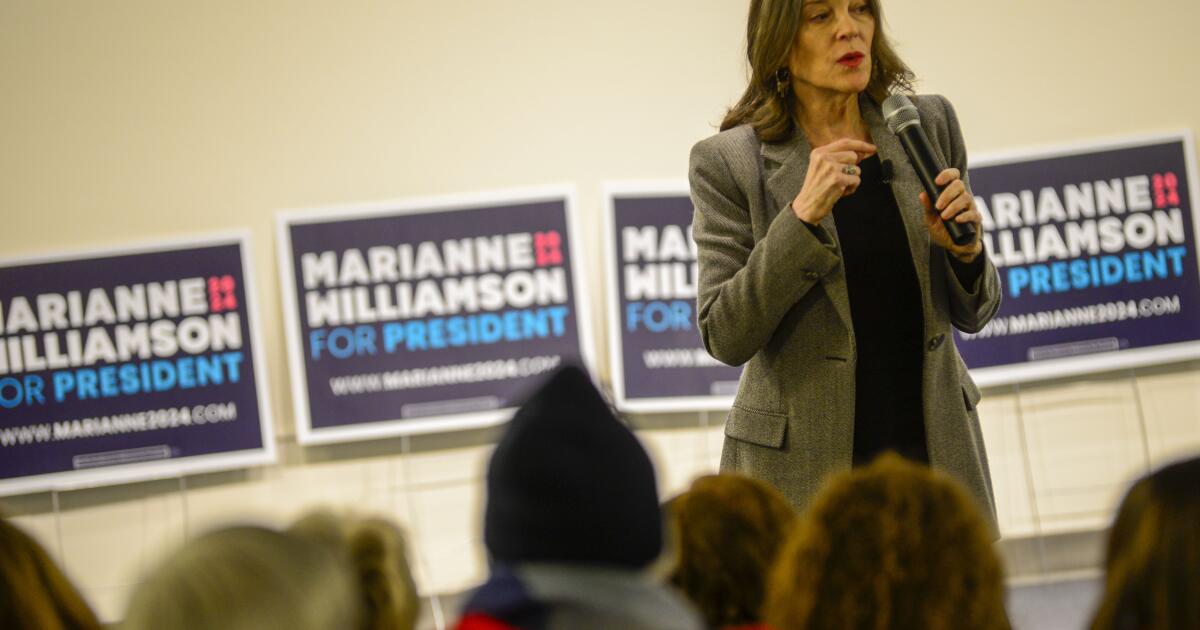
Presidential long shot Marianne Williamson flitted down the aisle of a two-century-old granite church, pausing to gracefully bow to dozens of supporters as they chanted her name.
The author, the most well-known Democrat who will appear on the ballot Tuesday, when New Hampshire holds the nation’s first presidential primary, spent much of her adult life in Los Angeles before moving east in 2018.
Williamson, who has never held elected office but was once dubbed Oprah Winfrey’s spiritual guru, has next to zero chance of denying President Biden his renomination. Polls suggest that many New Hampshire voters may write in Biden, who will not appear on the ballot after the Democratic Party chose to revoke the state’s first-in-the-nation status and make South Carolina the first official primary.
Gatherers for presidential candidate Marianne Williamson gathered at a Unitarian church in Portsmouth, New Hampshire Saturday. The long shot candidate has almost no chance of winning the state’s vote, but she may be the best-known candidate on the Democratic ballot, since President Biden won’t be on it. Asked what she planned to do after Tuesday’s primary, Marianne Williamson said she would follow her heart.
(Faith Pinho / Los Angeles Times)
But Williamson’s quixotic second bid for the White House (she also ran in 2020) is a test of a different question: Exactly how many of these supposedly flinty New Hampshirites will vote for a woman who has been stereotyped as a “woo woo” Californian?
The Texas native’s ties to California date back decades. In 1970, she moved to California to attend Pomona College, where she studied theater and philosophy and protested the Vietnam War before dropping out a couple of years later. After bouncing around the nation and being sidetracked by what Entertainment Weekly called “bad boys and good dope,” she moved to L.A. in 1983 and shared an apartment with actress Laura Dern.
Williamson, 71, became a spiritual leader and wrote more than a dozen books, one of which Winfrey promoted by saying, “I have never been more moved by a book than I am by this one.” Millions have bought her books, and she was adored by celebrities, officiating the 1991 wedding of Elizabeth Taylor and Larry Fortensky at Michael Jackson’s Neverland Ranch.
Williamson was also actively engaged in charities that helped those with HIV or living in poverty.
She came to believe that the two-party system disenfranchises the average voter by prioritizing the interests of wealthy elites.
Democratic presidential candidate Marianne Williamson, center, is cheered by the crowd after finishing her talk at The Interfaith Center for Spiritual Growth, Sunday, Sept. 10, 2023, in Ann Arbor, Mich. “The most important things you do in life, not because there’s guaranteed success on some external level, but because you feel in your heart it’s the right thing to do,” Williamson, 71, said during an interview in New York City.
(Jose Juarez / Associated Press)
“The majority of Americans are demonstrably a little bit left of center,” Williamson told The Times in an interview last year. “The problem is that we have a political system which is more beholden to the short-term profits of their corporate donors than to the will of their own constituents. Their idea of an acceptable candidate is someone who will perpetuate the system as it is. What we need in a president is someone who will disrupt that system.”
Williamson’s message resonates with a diverse group, but especially with people who believe that changing the system starts with changing oneself. Her followers include fans of her books, disillusioned Democrats and some former Bernie Sanders supporters.
But not many are New Hampshire voters.
When she arrived this weekend at South Church Unitarian Universalist in Portsmouth, the pews were filled with nearly as many volunteers as voters.
Orson Maazel drove from rural Virginia to volunteer for the campaign. Wearing a “Disrupt the corrupt” sweatshirt, he said he was drawn to Williamson because she’s an outsider who doesn’t take money from corporations.
“I agree with her that we don’t just need people who got us into the climate mess we’re in and economic mess we’re in to get us out of the system,” Maazel, 35, said. “We need somebody outside who’s not bought by anybody and who has a really good character.”
Williamson brought tears to the eyes of Nicole Dillon, 47, who lives in Massachusetts. Dillon, who hadn’t known much of Williamson before the event, said she loved the candidate’s message about advocating for women and children, ending the war on drugs and combating climate change.
Dillon watched closely when, about 20 minutes into Williamson’s stump speech, a man approached the stage and took the candidate’s hand, quietly thanking her. The 50 or so people seated in the pews watched in uneasy silence until a couple of security guards approached the man to usher him off the stage.
“Can you just sit down for me now?” Williamson said softly to the man.
He turned around, noticed the crowd in the pews and, with a look of surprise, allowed security to usher him up the aisle, apologizing for the disruption.
“Just tripping on his birthday,” a guard said, shrugging and laughing, after leading the man out. “She draws all kinds!”
“He was drawn to her truth and her light,” Dillon said. “She was so gentle with him and like a mother. She’s very motherly; she’s gonna gather us all in her basket and take care of us.”
Democratic presidential candidate Marianne Williamson, second from right, answers a question from University of Michigan senior Mahi Vyas, 20, at The Interfaith Center for Spiritual Growth, Sunday, Sept. 10, 2023, in Ann Arbor, Mich. (AP Photo/Jose Juarez)
(Jose Juarez / Associated Press)
But neither Dillon nor Maazel can vote in New Hampshire’s primary.
Only 2% of New Hampshire’s registered Democratic voters said they planned to vote for Williamson, compared with 64% who planned to write in Biden’s name, according to a recent Suffolk University poll.
“She has a perspective that actually reaches a certain percentage of the population. The issue is, was that ever going to be enough to catch on nationally?” said Ray Buckley, chairman of the New Hampshire Democratic Party. “I don’t know anyone that doesn’t think she’s a good person. She’s in it for the right reasons. She just doesn’t seem to be connecting with enough voters to be able to be successful.”
Perhaps the inability to connect with voters comes in part from her unusual political presence. Williamson peppered her speech with $20 words, book titles and quotes. Her answers to voters’ questions frequently invoked references to books she had read, and sometimes an esoteric history lesson.
She repeatedly voiced frustration with the Democratic National Committee’s dismissal of her campaign. In several states — including North Carolina, Florida and Tennessee — Biden will be the only Democratic candidate on the ballot.
Should something happen to the president to prevent him from running for a second term, “I suppose their idea would be to put [California Gov.] Gavin Newsom …” she said, before catching herself. “I don’t know. I don’t know any more than the next person does.”
Tables at the entrance laden with “Marianne Williamson for president” signs, buttons and stickers were still full at the end of the night.



NEWYou can now listen to Fox News articles!
House Republicans are demanding ActBlue, a top Democratic campaign fundraising apparatus, turn over international communications, probing whether the organization knowingly misled lawmakers and dodged subpoenas to hide weaknesses in its screening process to weed out illegal, overseas donations.
House Administration Committee Chairman Bryan Steil, R-Wis., House Judiciary Committee Chairman Jim Jordan, R-Ohio, and House Oversight Committee Chairman James Comer, R-Ky., collectively laid out their demands in a letter published on Tuesday.
“For more than a year, the Committees have conducted oversight regarding ActBlue’s ‘fundamentally unserious approach to fraud prevention,’” the letter reads.
“Recent reporting … strongly suggests that ActBlue deliberately obstructed the Committees’ investigation, including through misleading statements and noncompliance with our subpoenas.”
BREAKING THE FOURTH WALL: LEFT-WING GROUPS DEFIANT AS GOP SHEDS LIGHT ON GROUPS TIED TO CHINA
Rep. Jim Jordan leaves a House Republican Conference meeting at the U.S. Capitol in Washington, D.C., on Dec. 10, 2024. (Tom Williams/CQ-Roll Call, Inc)
The letter is addressed to Regina Wallace-Jones, the CEO and president of ActBlue, and is the most recent entry in investigations that began in 2023 when Republicans originally raised concerns about foreign donations possibly influencing American elections.
It also follows New York Times reporting on a memo from Covington & Burling, a law firm, warning that gaps in its screening armor could present “a substantial risk for ActBlue.”
The memo, on its own, does not implicate wrongdoing or indicate that ActBlue accepted international donations. Even so, the reporting caught the eye of Republicans in Congress.
Steil, Jordan and Comer are collectively asking ActBlue to produce two internal documents to examine the internal understanding ActBlue may have had about its own weaknesses.
The first is a resignation letter from General Counsel Aaron Ting — a document Republicans contend centers on liabilities created by ActBlue’s donation security.
Republicans believe the second, a message from ActBlue’s former legal counsel Zain Ahmad, relates to an ignored whistleblower complaint about those practices.
HOUSE HEARING RAISES RED FLAGS OVER FORMER TECH MOGUL’S ‘CCP NETWORK’ ALLEGEDLY FUNDING OF FAR-LEFT GROUPS
House Oversight Committee Chairman Rep. James Comer (R-KY) speaks to the media on his Committee’s investigation into former President Joe Biden’s cognitive state, in the Rayburn House Office Building on July 24, 2025 in Washington, DC. (Kevin Dietsch/Getty Images)
Republicans have already requested those documents before, but haven’t received them.
“There is considerable reason to believe that ActBlue may have deliberately withheld this responsive material to impede our investigation,” the letter states.
For its own part, ActBlue has claimed it makes every effort to ensure its fundraising complies with legal requirements.
In ActBlue’s own letter published in Nov. 2023, Wallace-Jones, the CEO, affirmed that the organization maintained the highest standards for scrutiny of its fundraising.
“Our approach is multilayered, with checks and confirmations occurring throughout the donation process to verify donors and donor information,” Wallace-Jones wrote.
“These measures, which include compliance measures, technological tools, and manual reviews, help to ensure the identity of donors, root out potential foreign contributions, and protect donors from financial fraud.”
OVERSIGHT DEMANDS DOJ ANSWERS ON FOREIGN FUNDING OF AGITATOR GROUPS AS IRAN, ANTI-ICE PROTESTS CONTINUE
Regina Wallace-Jones of Palo Alto soaks up the first evening of the DNC Convention at the United Center in Chicago, IL on Monday, August 19, 2024. (Photo by Yalonda M. James/San Francisco Chronicle via Getty Images)
CLICK HERE TO DOWNLOAD THE FOX NEWS APP
Republican lawmakers have given ActBlue two weeks to produce the requested documentation, setting a deadline for April 28, 2026.
“Absent these steps, the Committees are prepared to use available mechanisms to enforce our subpoenas,” the letter reads.
WASHINGTON — Eric Swalwell’s downfall has raised the possibility of a broader reckoning on Capitol Hill as congressional staffers, reporters and opposition researchers race to verify long-standing rumors of a sordid underground culture among the city’s most powerful.
Former lawmakers across the political spectrum have warned for years of a hushed congressional bacchanal marked by inappropriate revelry and sexual misconduct. But a sense of growing momentum gripped Congress on Tuesday, as Democrats grappled with Swalwell’s resignation and Republicans called for other lawmakers to face scrutiny.
The 72-hour collapse of Swalwell’s political career has shifted attention not only to his closest associates in Congress, but also to a larger set of sitting lawmakers from both parties suspected of lurid sexual activity. Several members have claimed that Swalwell’s alleged behavior was an open secret amid a cacophony of rumors on social media of other potential offenders.
“I think that many people knew about this for a while,” Rep. Anna Paulina Luna, a Florida Republican, said in an interview with The Times.
Luna, who planned to lead the charge to expel Swalwell before he resigned, alleged that young staffers would talk among one another about Swalwell’s conduct. Lawmakers should have done more to approach him about the rumors, she said.
Multiple current and former female staffers who spoke with The Times described a broader culture of warning one another about lawmakers with reputations for inappropriate conduct.
But the warnings, passed privately among junior aides, have focused on “sleazy” activity and boundary-crossing behavior, said one former legislative aide, who asked to remain anonymous. Whispers about sleazy behavior generally do not meet the coverage threshold for traditional newsrooms, which are bound by strict ethical standards.
Another former aide said that quiet guidance shared among female staffers focused on behavior that is legal, but nevertheless viewed as unprofessional and unbecoming of members of Congress — a line that has prevented many from speaking out publicly.
Now, a race is on for leverage between two political parties facing comparable strategic risks — each with members facing growing questions over their alleged conduct — and for scoops among news outlets, seeking to break the story first.
The Monday resignations of Swalwell and Texas Republican Rep. Tony Gonzales, who faced his own sex scandal, was also forcing lawmakers to address the issue publicly. Sen. Ruben Gallego (D-Ariz.) — one of Swalwell’s closest friends in Congress — answered questions from reporters at length Tuesday, telling them he should have confronted Swalwell when he heard rumors about his behavior.
“You let your guard down. I let him into my circle. … I deeply regret it,” Gallego said.
He denied knowing about Swalwell’s alleged misconduct when asked about the behavior.
“Look, we socialized. We went out. But I never saw him engage in any of the predatory behavior, harassment, sexual assault,” Gallego said.
Notably quiet was President Trump, who has faced sexual assault accusations of his own and frequently parried with Swalwell throughout his presidency. Although Trump posted an article reporting Swalwell’s resignation on social media, he has not commented on the matter in his own words.
The unraveling scandal comes at a time when lawmakers have come together across party lines to push for transparency in the case of Jeffrey Epstein, the late sex offender and alleged sex trafficker whose network of powerful associates included Democrats and Republicans alike.
The White House did not immediately respond to a request for comment.
Meanwhile, details of the Swalwell scandal continued to unfold Tuesday, as a Beverly Hills woman accused him of drugging and raping her in 2018. The Times could not immediately reach his attorney; he previously denied allegations of rape and sexual misconduct made by multiple women in published accounts last week.
Sex scandals are not a new phenomenon on Capitol Hill, which has seen over a dozen members embroiled in controversy over the last decade, including Katie Hill of California, Cory Mills and Matt Gaetz of Florida, and Blake Farenthold of Texas, among others.
But several prominent former members — including former House Speaker Kevin McCarthy — have warned of a more widespread cultural problem.
“Every member in Congress knows not to let any young staffer get around Swalwell or Matt Gaetz. It’s not a secret there,” McCarthy said Sunday on ABC’s “This Week.”
Luna had pressed lawmakers to address alleged sexual misconduct on Capitol Hill. In February, she called on the “predatory freaks” in Congress to leave office as she complained about the process to get ethical complaints handled.
“It pisses me off because while some of us are actually working and busting our asses, these clowns are sexually harassing their own staff, doing illegal crap, insider trading etc,” Luna wrote at the time.
Luna said Monday that she was encouraged to see bipartisan support for expelling Swalwell and Gonzales.
A longtime staffer who spoke on condition of anonymity said Tuesday that allegations against Swalwell have sparked conversations about how to do more to help staffers report sexual misconduct, such as reforming procedural rules that would allow staffers to report any of their concerns directly to ethics panels, and about the need for ethics investigations to move more quickly.
“Congress has a short-term memory, that is the difficulty here,” the staffer said. “After these guys leave their seats, there needs to be a concerted and consistent effort for reforms to be established and be made permanent.”

new video loaded: Vance Says Pope Should Stay Out of U.S. Affairs
transcript
transcript
Vance Says Pope Should Stay Out of U.S. Affairs
Vice President JD Vance weighed in on the tension between President Trump and Pope Leo XIV as Catholics expressed dismay about Mr. Trump’s attacks.
-
“I certainly think that in some cases, it would be best for the Vatican to stick to matters of morality, to stick to matters of, you know, what’s going on in the Catholic Church and let the president of the United States stick to dictating American public policy.” “I don’t think that the message of the Gospel is meant to be abused in the way that some people are doing. And I will continue to speak out loudly against war, looking to promote peace.” “Pope Leo said things that are wrong. There’s nothing to apologize for. He’s wrong.” “I’m not a big fan of Pope Leo. He’s a very liberal person. I don’t think he’s doing a very good job.” “I did post it, and I thought it was me as a doctor, and it had to do with the Red Cross. There’s a Red Cross worker there, which we support.” “It’s terrible. It’s gross. It’s blasphemous.” “I stand with the pope. I mean, the pope speaks the Gospel. He speaks for peace.”

By Shawn Paik
April 14, 2026

Video: Designer Fashion Hits the 2026 WNBA Draft

Godzilla Minus Zero stomps through New York in first teaser trailer

Trump blasts close ally Meloni, says she’s failing US on Iran

Dem fundraising giant in the hot seat as GOP lawmakers demand answers over dodged subpoena

Weight gain in certain decade of life may be more dangerous, study suggests

Florida High School Football Rankings: Top 25 teams – Oct. 21

How old is Bo Nix? What to know about Oregon quarterback ahead of 2024 NFL Draft

Cleary's 21 help Le Moyne down Central Connecticut State 69-64 in OT

99th annual Pony Swim held in Virginia

Indiana Members Credit Union announced as new anchor tenant at Bottleworks District
Dem fundraising giant in the hot seat as GOP lawmakers demand answers over dodged subpoena

Fifth woman accuses former US lawmaker Eric Swalwell of sexual misconduct

Commercial Ships Transit Strait of Hormuz as U.S. Blockades Iran’s Ports

Video: How Stephen Miller Is Adjusting Trump’s Immigration Agenda

Biden DOJ weaponized FACE Act against pro-life Americans, 882-report alleges
-

 Atlanta, GA1 week ago
1 teenage girl killed, another injured in shooting at Piedmont Park, police say
-

 Georgia1 week ago
Georgia House Special Runoff Election 2026 Live Results
-

 Arkansas4 days ago
Arkansas TV meteorologist Melinda Mayo retires after nearly four decades on air
-

 Pennsylvania1 week ago
Parents charged after toddler injured by wolf at Pennsylvania zoo
-
 Milwaukee, WI1 week ago
Potawatomi Casino Hotel evacuated after fire breaks out in rooftop HVAC system
-

 Ohio9 hours ago
‘Little Rascals’ star Bug Hall arrested in Ohio
-

 Austin, TX7 days ago
ABC Kite Fest Returns to Austin for Annual Celebration – Austin Today
-

 World1 week ago
Zelenskyy warns US-Iran war could divert critical aid from Ukraine