Politics
Opinion: Unhappy with the Supreme Court? Your vote for president could make it worse

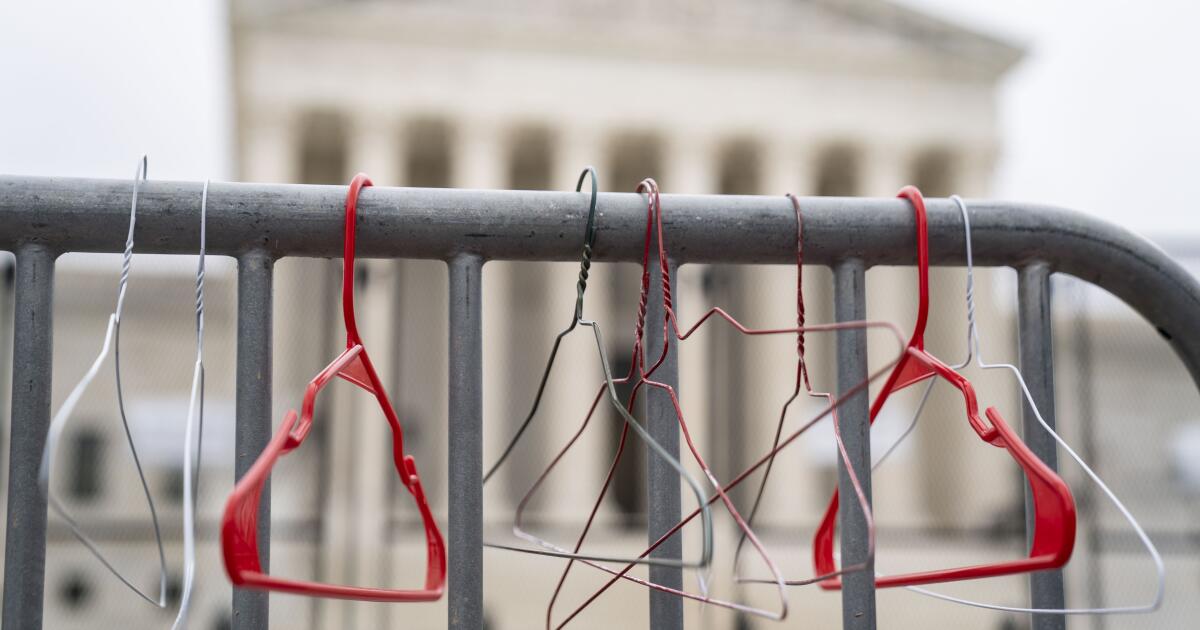
By now it shouldn’t need to be said: When Americans vote for a president, the federal courts are on the ballot as well. Yet too few voters, especially among those in the decisive middle, make their choice with that in mind.
Think about it: The issues that voters do care most about in this election year — immigration, reproductive rights, the economy and government regulation, gun control — increasingly are decided in federal courts reshaped by Donald Trump, including the Supreme Court, because of the paralyzing dysfunction in Congress.
Opinion Columnist
Jackie Calmes
Jackie Calmes brings a critical eye to the national political scene. She has decades of experience covering the White House and Congress.
Add to those perennial issues the novel one of 2024: Trump’s legal accountability. Here, the judiciary’s impact couldn’t be more clear. Foot-dragging — by the Supreme Court, where three Trump appointees sit, and at the Florida district court where a Trump-appointed judge presides — has all but assured that voters won’t get criminal verdicts before election day on the former president’s efforts to overturn his 2020 defeat and to squirrel away top-secret documents.
We’ve learned the hard way: It matters whether Trump or President Biden is picking federal judges, just as it matters which party controls the Senate and has the power to confirm them.
Only since the 2022 Dobbs decision overturning a half-century of abortion rights have Democrats begun to wise up to what Republicans have long known: With executive and legislative power, your party can put its stamp on the unelected third branch of government, the judiciary, and that legacy can long outlast the politicians. As Trump lackey Sen. Lindsey Graham of South Carolina recently said of 2024, “One of the big issues on the ballot is trying to have a more conservative judiciary.”
Be forewarned, Democrats. Flip the script — mobilize your voters around this issue.
Here are the stakes: If Biden wins, he can continue the unfinished work of trying to offset the right-wing tilt (and white male dominance) that Trump gave to the courts by naming more judges in a single term than any president other than Jimmy Carter. Biden’s effort could well be slowed if, as widely expected, Republicans take control of the Senate and gum up the confirmation works.
But better slow action in the Senate on Biden appointees than a return, if Trump wins, to a fast track for extreme right-wingers. Such as Trump-appointee Aileen Cannon, the novice Florida district judge (mis)handling the former president’s trial involving classified material. Or Matthew Kacsmaryk, the Texas district judge and culture warrior who last year sought to outlaw mifepristone, one of two drugs used for the medication abortions that account for more than half of all abortions in the country. He filled his opinion with the jargon of antiabortion activists, writing at one point that mifepristone, which is used just up to 10 weeks’ pregnancy, “ultimately starves the unborn human until death.” The Supreme Court will hear that case March 26.
Another consideration for voters: While a reelected Biden likely wouldn’t be able to alter the imbalance at a Supreme Court between six archconservatives and three liberals, he could prevent it from getting even worse.
None of the justices are expected to retire soon. However, the two oldest (and most conservative), Clarence Thomas and Samuel A. Alito Jr., are in their mid-70s and could opt to step aside if Trump wins, court watchers speculate, so that he could replace them with like-minded jurists young enough to serve for decades. (In normal times, we might already be rid of Thomas through impeachment or resignation, given his well-documented ethical lapses and his refusal to recuse himself from Jan. 6 cases despite his wife’s complicity in efforts to overturn Biden’s election. But these aren’t normal times.)
When Trump reluctantly left the White House, his judicial picks made up one-third of the Supreme Court, nearly one-third of the 13 appeals courts and more than a quarter of the 94 district courts. Because relative youth and proven Republican bona fides were the job criteria set by Trump and the trio to whom he outsourced his court-packing — Senate Republican leader Mitch McConnell, then-White House Counsel Don McGahn and former Federalist Society leader Leonard Leo — Trump judges likely will be prominent on the federal bench well past midcentury.
“Topping Trump seems impossible” was the headline last fall on an analysis of Biden’s judicial appointments by Russell Wheeler, of the Brookings Institution, who tracks the courts. In an update in January, however, Wheeler said that although Biden probably won’t top Trump’s one-term total for judges on the appeals courts, he could match him on district court judges.
Should Biden fall short, it won’t be for lack of trying. More than Democratic predecessors Bill Clinton and Barack Obama, he has made judicial nominations a priority in the wake of Team Trump’s single-minded courts makeover. Better late than never?
Biden was, after all, a leader on the Senate Judiciary Committee for years; he knows his stuff. (Except we do have him to thank for Thomas’ confirmation three decades ago.) And Senate Democrats, with their one-vote majority, have helped. Together, they set a record for confirmations in a president’s first year in office, though the pace was only “so-so,” as Wheeler put it, by the end of last year.
One problem is that Biden didn’t inherit nearly as many vacancies as Trump did. McConnell had thwarted confirmation of many nominees in Obama’s final year — most famously, Merrick Garland for the Supreme Court — so Trump was able to fill the seats. Then in Trump’s final year, McConnell nearly made good on a vow to “leave no vacancy behind”; he even rammed 14 nominees to confirmation after Trump lost the 2020 election, the first time a defeated president’s nominees were confirmed since 1897.
Now Democrats must copy McConnell’s zeal. Fifty-seven judgeships are open, and Biden has picked nominees for just a third of them. For one thing, he and Senate leaders are being too deferential to Republicans about whom to nominate for red-state vacancies. Just get ‘em all filled before election day, lest Trump and a Republican-run Senate once again inherit a bonanza of seats.
If the republic is lucky, voters will give Biden another four years to keep at it. And that’s more likely if enough of them remember: The bench is on the ballot too.


NEWYou can now listen to Fox News articles!
“Two down and two to go” blared the new wanted poster targeting the two remaining fugitive sons of infamous Mexican cartel kingpin Joaquin “El Chapo” Guzman-Loera, who is serving life-plus-30-years in Colorado’s federal supermax prison.
On Monday, ICE posted a new wanted poster for two members of “Los Chapitos” — Ivan Archivaldo Guzman Salazar and Jesus Alfredo Guzman Salazar, two of El Chapo’s sons with his first wife, Alejandrina Maria Salazar-Hernandez.
After El Chapo’s final capture in 2016, control of the powerful Sinaloa Cartel shifted to Ismael “El Mayo” Zambada. Following Zambada’s arrest during the Biden administration, leadership passed to Guzman’s four sons.
MEXICAN SENATOR ACCUSES SHEINBAUM OF SHIELDING ‘NARCO-POLITICIANS’ AFTER US CARTEL INDICTMENT
Both the Trump administration in the U.S. and the Sheinbaum administration in Mexico have said they are focused on cracking down on cartel’s new leadership.
“Two down and two to go with $10 million reward,” the wanted poster read, with Xs over the faces of the already captured Joaquin Guzman Lopez and Ovidio Guzman Lopez.
The two captured Chapitos are reportedly cooperating with authorities and have not yet been sentenced, but Ivan and Jesus remain “armed and dangerous,” according to ICE.
ICE NABS ACCUSED MS-13 KILLER HIDING IN NORTHERN VIRGINIA SUBURB
El Chapo Guzman arrives in the United States after his capture in Mexico. (AP File)
The two fugitives are charged with conspiracy to distribute a controlled substance and operating a continuing criminal enterprise.
Two of Guzman’s four sons have already been captured through Operation Take Back America, an initiative seeking the “total elimination of cartels and transnational criminal organizations” in order to protect U.S. communities from violent crime.
U.S. Attorney for the Northern District of Illinois Andrew Boutros said in a recent statement that efforts to capture El Chapo’s sons are the latest steps “in our efforts to bring to justice drug lords and other dangerous criminals who poison the American public with illegal and harmful drugs and who otherwise engage in violence and corruption to carry out their and their enterprises’ wide-reaching criminal activities.”
US MILITARY KILLS TWO ALLEGED NARCO-TERRORISTS IN LATEST EASTERN PACIFIC STRIKE ON DRUG-TRAFFICKING VESSEL
Joaquin “Shorty” Guzman, center, is escorted by soldiers during a presentation at the Navy’s airstrip in Mexico City. (Reuters/Edgard Garrido)
SIGN UP TO GET THE POLITICS NEWSLETTER
In his plea agreement, Guzman Lopez admitted that he and his cartel associates committed violence against law enforcement officials, rival drug traffickers and members of their own organization to protect the Sinaloa Cartel’s trafficking operations.
CLICK HERE TO DOWNLOAD THE FOX NEWS APP
Fox News Digital reached out to ICE and DHS for additional comment and information on the mission to capture the two at-large Chapitos.

WASHINGTON — President Trump said Monday that he called the president of FIFA to dispute a red card that would have barred the American striker Folarin Balogun from playing in Monday’s elimination game with Belgium, acknowledging an extraordinary intervention by a head of state in the sport’s disciplinary process.
“I asked for a review because I didn’t think it was a foul,” Trump told reporters during an event in the Oval Office. “I am good at this stuff. I didn’t think it was a foul. I thought it was two great athletes that crashed into each other and got entangled.”
FIFA subsequently rescinded Balogun’s suspension, the first time the governing body has reversed a red-card penalty during a World Cup in 64 years. Belgium has protested the decision, and a hearing is scheduled for Monday to determine whether Balogun’s reinstatement will stand.
Trump said it would be a “stain” on the World Cup to let the penalty stand, and even called the referee who issued the card “suspect” with a questionable past, though he did not provide evidence to support the accusation.
While many in the United States joined the president in celebrating the reversal, others blasted its adverse impact on the integrity of the sport.
The Belgium team has protested the penalty reversal, with the country’s soccer federation saying it was “astonished” by the ruling.
“We are not defending the national team or federation. We are defending football,” Belgian coach Rudi Garcia said.
The episode has drawn attention to Trump’s close relationship with Gianni Infantino, the president of FIFA. In December, Infantino presented Trump with the inaugural FIFA Peace Prize, an award the governing body created after Trump was passed over for the Nobel Peace Prize. That decision is now the subject of an ethics complaint, backed by members of the European Parliament, who argue it compromised FIFA’s political neutrality.
Trump appeared to downplay the significance of his call to Infantino.
“I can’t tell him what to do, and I don’t believe he made the decision,” Trump said. “I think it was a committee that made the decision, and they made the right decision, because number one, it wasn’t a foul, and you want to see a game with your best players.”
But he said it would be “very unfair” and “terrible” to not let Balogun play. He said it would be the equivalent of barring Argentina’s Lionel Messi or Portugal’s Cristiano Ronaldo — both global superstars — because they “ran” or “bumped” into someone on the field.
“We have to have our best players, and they have to have their best players. And if we win or we lose, it’s fair,” Trump said. “Let’s say we lost [Balogun] and we lose the game — it would be a terrible thing.”

Secretary Burgum condemns vandalism targeting National Mall amid new threats
Interior Secretary Doug Burgum reacts to a disturbing pattern of vandalism targeting the National Mall, including the Lincoln Memorial Reflecting Pool, which suffered significant damage. Burgum details the restoration efforts, the deployment of security and the arrest of seven individuals involved. He stresses that such acts are an attack on the country and will be prosecuted to the full extent of the law.
NEWYou can now listen to Fox News articles!
President Donald Trump and his Interior Department are declaring an America 250 victory over algae in the Lincoln Reflecting Pool.
Trump shared photos on Truth Social on Sunday showing the pool and the reflection of the Washington Monument appearing clear and blue, and made a call out with a “Wanted” poster for vandals.
“The U.S. Park Police is seeking the public’s assistance in identifying the individual in the notice below in connection with a Destruction of Government Property investigation related to the Reflecting Pool,” Trump wrote Sunday on Truth Social.
Trump also shared an Interior Department statement crediting “advanced nanobubbler technology” and National Park Service cleanup work.
FORMER US OLYMPIAN DAVID HEARN INDICTED IN ALLEGED REFLECTING POOL VANDALISM
President Donald Trump is touting the algae cleanup and the prosecution of vandals from the Lincoln Reflecting Pool, with the water proving clear and refective in this July 3 photo. (Finn Gomez/Getty Images)
“The advanced nanobubbler technology very effectively killed the algae that has plagued every Lincoln Reflecting Pool reopening — most infamously Obama’s reopening — since 1922,” Dei Gratia Minerals founder Greg Wischer, Interior’s deputy assistant secretary for land and minerals management, wrote in a letter shared with Interior Secretary Doug Burgum and Trump.
“The Reflecting Pool water is crystal clear, and our National Park Service team is now vacuuming up the dead algae resting on the bottom of some parts of the Reflecting Pool — just like the destroyed Iranian Navy resting on the bottom of the Persian Gulf.”
The photos shared by Trump show the Reflecting Pool stretching toward the Washington Monument under blue skies. One image appears to show the pool from the Lincoln Memorial end, while a second closer view shows the Washington Monument reflected in the water.
Trump also shared a U.S. Interior Press social media post hailing the technological success, quoting that Wischer memo.
YOSEMITE, GRAND CANYON LEAD NOTABLE LIST OF NATIONAL PARK CAMPGROUNDS FOR AMERICA’S 250TH
Pete Folch carries an American flag during a morning run past the Reflecting Pool as the city prepares for July 4th festivities on July 3, 2026, in Washington, D.C. (Joe Raedle/Getty Images)
“The vacuuming is the final maintenance step after refilling the pool, and it will be complete in a few days,” his memo continued. “Already, the section of the Reflecting Pool closest to the Lincoln Memorial has been vacuumed up, and the beautiful American Flag Blue coating on the bottom of the pool can be seen clearly.”
Trump’s Interior Department has praised the technology for overcoming past challenges in keeping the pool clear, including dunking on former President Barack Obama.
“Previous administrations — most notably under Obama — failed to maintain the Reflecting Pool, and after refilling the pool, the water would quickly become murky and thick with massive clumps of algae floating on the surface,” the memo concluded.
INTERNAL EMAILS EXPOSE HOW JULY 4TH BASH IS BEING DERAILED BY DEM-RUN COUNTY: ‘OFFENSIVE’
Police said the incident happened on Friday at around 3:36 p.m. at the Reflecting Pool on the grounds of the Lincoln Memorial in the nation’s capital. (U.S. Park Police)
“The photos below show how the nanobubbler technology and vacuuming have been incredibly effective, making the water crystal clear with the American Flag Blue coating shining brightly on the bottom of the pool.
“As our National Park Service team noted, the Reflecting Pool is now so ‘blue’ that the Fake News Media, which has been staked out at the Reflecting Pool for weeks, has fled!”
The 6.75 million-gallon pool has been targeted by Trump critics and leftist anti-Trump activists for attacks both verbally and physical, Burgum discussed with ABC’s “This Week” on Sunday.
“The Reflecting Pool has been a big success,” he said. “And we’ve got 340 million people in this country that are celebrating 250. We did have a few vandals, but all that’s going to be repairable, and that’ll all be fixed in the coming weeks as we go forward.”
People look out at the Reflecting Pool and Washington Monument from the steps of the Lincoln Memorial ahead of July 4 festivities on July 03, 2026, in Washington, D.C. (Joe Raedle/Getty Images)
Burgum now believes that the pool might not require a full draining after its “multiple gashes that add up to 350 feet,” he added.
“We don’t know if we need to drain the whole thing or not because, you know, the cutting happened on the edge, and, of course, it slopes from the edge,” according to Burgum.
“We may be able to partially drain it and do the repair. To be able to fix it, we may not have to drain the whole thing, but it could go very quickly.”
CLICK HERE TO DOWNLOAD THE FOX NEWS APP
While the media and Trump critics are pointing to added costs of the reflecting pool refurbishment, Burgum pointed to the vandalism causing that.
“We weren’t expecting that we were going to have a small group of people that wanted to try to destroy effectively what is part of the Lincoln Memorial,” Burgum told ABC. “There’s plenty of cameras around the Lincoln statue and around the memorial, but the Reflecting Pool had gone for, you know, decades without vandalism.”
-
 News7 minutes ago
The U.S. men’s run at the World Cup ends with a 4-1 Round of 16 loss to Belgium
-

 Los Angeles, Ca1 hour ago
L.A. man who violently crashed into Border Patrol agents sentenced to 5 years in prison
-

 Detroit, MI2 hours ago
Fans pack Detroit’s Campus Martius for USA-Belgium World Cup match
-

 San Francisco, CA2 hours ago
Terrified passengers film Waymo autonomous vehicle driving into live fireworks in San Francisco
-

 Dallas, TX2 hours ago
WATCH: USA vs. Belgium watch party at FIFA Fan Festival Dallas
-

 Miami, FL2 hours ago
Tim Hardaway Jr. returns home as Miami Heat sign veteran guard:
-

 Boston, MA2 hours ago
‘Enough is enough’: Weekend violence in Boston sparks calls for change, from more police to community investment – The Boston Globe
-

 Denver, CO2 hours ago
Kalshi Promo Code DENVER: Trade $10, Get $10 World Cup Bonus for USA-Belgium – Denver Stiffs

