Politics
Opinion: Three reasons China would be happier with Trump than Biden


The month after former President Trump left office in 2021, Matt Pottinger, who had been the point man for China on Trump’s National Security Council, told me in an interview that had Trump stayed on for a second term, he might have moved to a “wholesale decoupling” of the U.S. economy from China.
Yet John Bolton, who served as Trump’s third national security advisor, predicted in early 2021 that if Trump had been reelected, he “might have careened back to bromance and a disastrous trade deal [with China], just for starters.”
Those conflicting statements point to Trump’s unpredictability on China. They also raise the question of how Chinese President Xi Jinping and his aides are viewing the 2024 American election and the possibility of another Trump presidency.
In this country, a false logic has taken hold. Trump talks tough about China, and he promises a wave of new tariffs on imports. Therefore, the thinking goes, China must not want Trump to return to the White House; Xi would favor the reelection of President Biden.
That conclusion is wrong. China not only isn’t worried about the prospect of a second Trump presidency, it would choose it over a continuation of Biden and the Democrats.
First, Trump is precisely the sort of leader China knows how to deal with. He has a huge ego and thinks only he can resolve problems through deals he thinks only he can make. Remember: Trump believed he alone could get North Korea to curb its nuclear weapons program by meeting with its leader, Kim Jong Un. His clumsy efforts at deal-making brought forth lots of drama and no results.
China has a history of dealing with powerful officials through flattery, personal relationships and financial rewards. Chinese leaders prefer such officials to those who are preoccupied with impersonal rules or laws.
During Trump’s presidency, we saw China working these levers. With the help of real estate deals and trademark grants, the Chinese forged connections with Jared Kushner and Ivanka Trump. Chinese officials also spent millions of dollars at Trump’s hotel properties. Such efforts would no doubt revive in a second Trump presidency.
Trump supporters will point out that Biden’s son Hunter has also done business with China, trading on his father’s name and power. But Hunter’s business interests were penny-ante compared with Trump Inc.’s, and no one has turned up convincing evidence that Joe Biden benefited from his family’s foreign dealings.
Beyond the appeal of Trump’s egomania, Beijing would see his foreign policy aims as a big improvement over Biden’s.
China’s principal geopolitical concern these days is heading off the series of alliances and partnerships the Biden administration has pulled together in response to its policies. The president has strengthened U.S. ties with Japan, South Korea and Australia; announced new U.S. bases in the Philippines; enhanced bilateral cooperation with Vietnam; and recruited European nations to help counter China on trade, technology and sanctions.
Trump, on the other hand, was scornful of American alliances in his first term, and he has been even more so in his recent campaign statements, questioning America’s NATO obligations, supporting an end to Ukraine aid and offering words of praise for authoritarian leaders such as Hungarian strongman Viktor Orban, who was at Mar-a-Lago on Friday.
Most importantly, Trump promises a new, warmer relationship with Russian President Vladimir Putin, with whom China forged a “no-limits” partnership in 2022. If Trump is reelected, he might even lift sanctions against Russia.
From China’s perspective, an America separating itself from its allies and moving closer to Russia would be ideal. An America in retreat from the world stage gives ample room for China to project its international ambitions.
Finally, China understands that it is a Democratic not a Republican administration that will more likely act tough rather than merely talk tough.
It’s true that while Trump was in the White House, the U.S. shifted away from a policy of engagement and began to treat China as the geopolitical and commercial adversary it had become. But that might well have happened under any president, given the underlying factors: China’s aggressive actions overseas and the U.S. business community’s growing dissatisfaction with China’s commercial spying and theft of intellectual property.
Trump was willing to impose tariffs on China although his predecessors were not. But Biden not only continued those tariffs, he imposed new technology trade restrictions that went well beyond anything Trump did to challenge the Chinese — notably, he imposed limits in 2022 that he tightened a year later on China’s access to semiconductors and chip-making equipment. Such efforts seem likely to continue if the Democrats keep the White House.
And there’s this: Trump’s tariffs on Chinese goods were groundbreaking, but it is less well remembered that he also entered into a trade deal with China — “It just doesn’t get any bigger than this,” he boasted — that proved unsuccessful. In exchange for modest cuts in the tariffs Trump had imposed, China pledged to buy $200 million in American exports. The Chinese never came close to keeping that promise.
Based on his track record, it seems fair to predict that if Trump returned to the White House, he would start out with bombastic rhetoric against China. Then, with an emphasis on personalized diplomacy, he might look for another trade deal he could tout, no matter its real results.
Trump’s promises to weaken U.S. relations with its allies, his egocentric approach to diplomacy and his propensity to over-hype and under-deliver would only make it easier for Beijing to realize its global ambitions.
China doesn’t fear Trump. It relishes the prospect of his return to the presidency.
James Mann, author of three books on the U.S. relationship with China, is a member of the Foreign Policy Institute at Johns Hopkins School of Advanced International Studies.



James Gagliano on anti-ICE protests and threats against agents
Retired FBI Special Agent James Gagliano discusses anti-ICE protests and threats against agents in Newark, New Jersey. A new curfew has curbed chaos after violent clashes, with one Brooklyn man arrested for threatening to kill an ICE agent. DHS Secretary Markwayne Mullin vows ‘zero tolerance’ for attacks, while Sen. Cory Booker, D- N.J., calls ICE ‘out-of-control.’ Gagliano warns against allowing these protests to continue.
NEWYou can now listen to Fox News articles!
A Canadian national accused of slapping a teen wearing political clothing at the Jersey Shore has been turned over to Immigration and Customs Enforcement, a representative for the local jail told Fox News Digital on Wednesday.
Over the Fourth of July weekend, Kaitlyn Tracey, 33, was reportedly seen on surveillance video confronting a group of teens in Point Pleasant Beach, some of whom were wearing pants with the words “Trump” and “ICE” on them, local media reported.
Tracey, a Canadian national who entered the U.S. on a passport in 2024, then allegedly struck one of the girls and recorded the confrontation, according to court documents reported by NJ.com.
An official who picked up the phone at the Ocean County Jail in Toms River confirmed to Fox News Digital that Tracey had been released into ICE custody as of Monday.
ICE CLASHES WITH AGITATORS INTENSIFY OUTSIDE DELANEY HALL
She was reportedly taken to Delaney Hall in Newark – the site of months-long clashes between left-wing agitators and ICE.
NEW JERSEY GOVERNOR, DEMOCRATIC SENATOR SPEND MEMORIAL DAY PROTESTING ICE FACILITY
Billboard at Trump rally in Wildwood declaring historical blue New Jersey is “Trump Country.” (The Image Direct for Fox News Digital)
Tracey’s criminal charges include endangering the welfare of a child and simple assault, according to reports.
The alleged victim was reportedly uninjured.
NJ TAXPAYERS ON THE HOOK FOR $12M MORE AS DEM GOVERNOR PROTECTS ILLEGAL ALIENS BATTLING DEPORTATION
CLICK HERE TO DOWNLOAD THE FOX NEWS APP
While New Jersey at a state level has adopted sanctuary-type policies, Ocean County is known as one of the few Republican strongholds remaining, and retains the state’s longest-serving lawmaker of any party: Rep. Chris Smith, R-N.J., in office since 1981.
People enjoy the Jersey Shore in Seaside Heights, N.J., as businesses prepare for the holiday weekend on May 23, 2025. (Asbury Park Press via IMAGN)
SIGN UP TO GET THE POLITICS NEWSLETTER
It was not immediately clear on what immigration basis ICE initiated proceedings against Tracey. Fox News Digital reached out to DHS for clarification and comment.
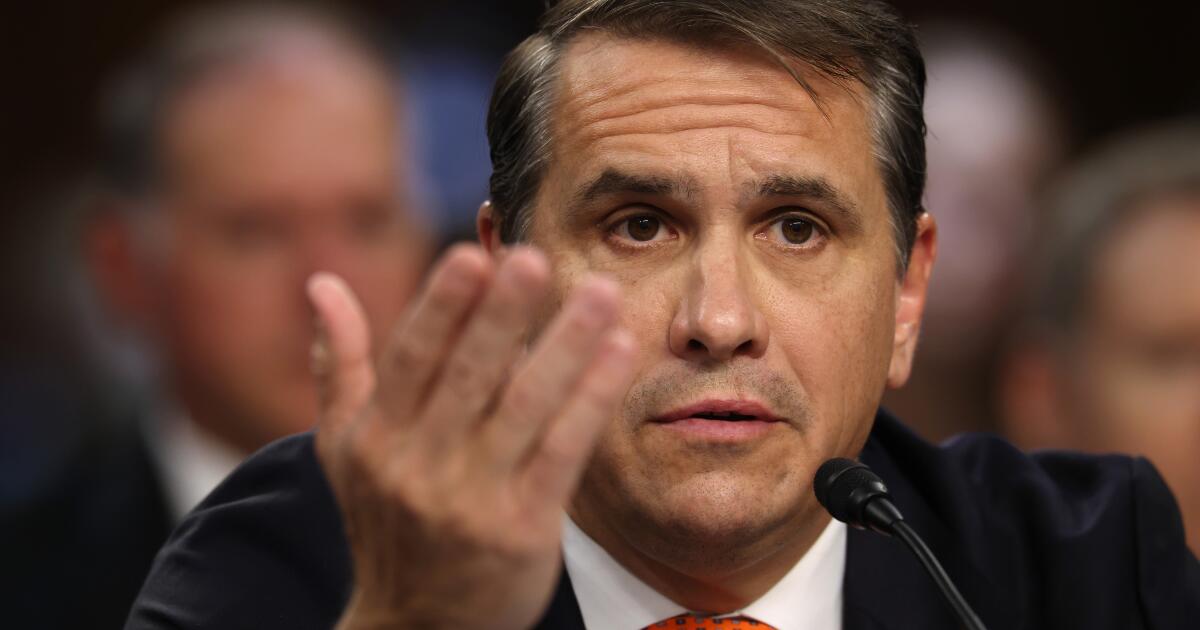
WASHINGTON — The Senate confirmation hearing Wednesday for Todd Blanche, President Trump’s pick for attorney general, will be a referendum on far more than his individual merits.
Blanche, the acting attorney general, served as Trump’s defense attorney before taking office and has been closely linked to many of the most consequential — and controversial — issues that have dominated the first two years of Trump’s second term.
Blanche is set to appear before the Senate Judiciary Committee, which will decide whether to approve his nomination and send it to the full Senate for a confirmation vote. The committee hearing will continue Thursday.
“I would expect committee Democrats to treat Mr. Blanche’s hearing as an opportunity to conduct oversight of the Department of Justice,” said Phil Brest, president of the American Constitution Society, a progressive legal nonprofit and a former top Democratic staffer on the committee. “It’s a test of the Senate’s willingness to probe the department’s operations and to actually serve as a check on the department and the administration more broadly.”
Democrats on the committee are expected to push Blanche on a host of topics, including the $1.8-billion “anti-weaponization fund” that critics derided as a slush fund for the president’s allies, the Justice Department’s rollout of the so-called Epstein files, and the department’s prosecution of several perceived enemies of Trump, notably former FBI Director James Comey.
“While deploying the Justice Department as a shield for the president and his cronies, Blanche has also used our top law-enforcement agency as a sword against Trump’s political opponents,” said Sen. Dick Durbin (D-Ill.), the ranking Democrat on the committee last month. “The independence of DOJ has been decimated under Blanche’s authority.”
Blanche was confirmed by the Senate as deputy attorney general in March, 2025, and was elevated to his current role after Atty. Gen. Pam Bondi was fired in April.
More critical to the success of Blanche’s nomination will be whether he can win the support of two lame-duck Republican senators, Thom Tillis of North Carolina and John Cornyn of Texas, who expressed some reservations about Blanche soon after his nomination was announced.
Cornyn raised concern about Blanche’s independence from Trump, while Tillis said Blanche’s stance on protesters who violently stormed the U.S. Capitol on Jan. 6, 2021, would be critical to his consideration.
Some of those Jan. 6 protesters were expected to be the beneficiaries of the $1.8-billion fund announced as part of a settlement to a lawsuit Trump and his sons and business brought against the IRS.
In a scathing ruling this week, the federal judge wrote that the lawsuit was improper and recommended sanctions against two Justice Department attorneys who worked on the case, though not Blanche himself.
Cornyn told Semafor on Tuesday that the ruling raised a number of issues, including “the potentially collusive nature of the lawsuit.”
He has said previously that he will hold off on making a decision about whether to approve Blanche until after the hearing.
Tillis, meanwhile, told CNN’s Manu Raju on Tuesday that the weaponization fund would need to be completely off the table for him to support Blanche’s nomination.
Trump touted Blanche’s record ahead of the hearing.
“Todd Blanche is doing a PHENOMENAL job as Acting Attorney General of the United States,” the president wrote on Truth Social. “He is a great lawyer, always very fair, and every Republican Senator should vote to CONFIRM Todd Blanche, ASAP!”
Sen. Lindsey Graham’s death means that Republicans currently only enjoy a one-seat majority, but a replacement for Graham on the committee could be in place before it votes on whether to move his nomination to the Senate floor, which will likely come two weeks after the hearing.
Blanche, 51, spent 12 years working for the U.S. attorney’s office for the Southern District of New York, working largely on drug and violent crime cases, and rose to the level of co-chief of the district’s White Plains division.
He left the office in 2014 for private practice and joined the prominent law firm Cadwalader, Wickersham & Taft in 2017 as a partner. He left the firm in 2023 and went independent after other partners expressed concern when he took Trump on as a client.
Blanche went on to represent Trump in several criminal matters, including the New York case about hush money payments to porn star Stormy Daniels, and cases brought by Special Counsel Jack Smith about Trump’s alleged efforts to block the transfer of power after the 2020 presidential election and his alleged retention of classified documents.
He listed all three as among the 10 most significant cases of his career in the questionnaire he completed ahead of the hearing, along with his work at the Justice Department on a lawsuit challenging the construction of a new White House ballroom.
A group of more than 1,200 former Justice Department attorneys wrote a letter opposing Blanche’s nomination, asserting that his leadership has resulted in mass departures of career staff. That has “meant that much of the department’s vital work isn’t being done, or isn’t being done as well – leaving communities less safe, Americans’ rights less protected, and our national security more vulnerable,” the lawyers wrote.
Former Justice Department pardon attorney Liz Oyer is scheduled to testify as a witness for Democrats on Thursday. She has said she was fired for refusing to recommend the restoration of actor Mel Gibson’s gun rights.
Oyer will be joined Thursday by Dani Bensky, one of many victims of the deceased sex abuser Jeffrey Epstein who has criticized Blanche’s handling of the release of the so-called Epstein files — millions of pages of records detailing the Justice Department’s investigations into Epstein’s crimes.
Numerous victims have said that their names and other sensitive information were not properly redacted in the files and criticized Blanche and the department for failing to investigate Epstein’s potential co-conspirators.
Blanche has also come under criticism from survivors of Epstein’s abuse for the interview he conducted in July, 2025, with Epstein accomplice Ghislaine Maxwell, who is serving a 20-year prison sentence for her role in facilitating and participating in Epstein’s abuse.
Days after their interview, Maxwell was moved from her prison in Florida to a minimum-security prison in Texas.
Politics
Biden special counsel’s ‘runaway train’ scooped up sensitive lawmaker info: ‘Abuse of power’

NEWYou can now listen to Fox News articles!
Former special counsel Jack Smith’s investigation into President Donald Trump swept up text messages from nearly 50 members of Congress, bypassing a required review process in what one victim alleged is a direct constitutional violation.
Senate Judiciary Committee Chairman Charles Grassley, R-Iowa, said the situation is more proof Smith’s probe was a “runaway train” of abuses of power, and the elder statesman and Senate Investigations Subcommittee Chairman Ron Johnson, R-Wis., jointly released their filings Tuesday evening.
Grassley and Johnson’s findings were from a full-scale probe of Operation Arctic Frost, the code name for Smith’s endeavor to investigate Trump for alleged corruption and election malfeasance, an operation top Senate Republicans call “worse than Watergate.”
LEGAL WAR ON TRUMP’S AGENDA GAINS FIREPOWER AS FEDERAL LAWYERS DEFECT TO DEMOCRATS
Jack Smith, former U.S. special counsel, arrives for a closed-door deposition before the House Judiciary Committee in Washington, D.C., Dec. 17, 2025. (Getty Images)
Forty-four members of Congress had the contents of their text messages obtained and reviewed by Smith’s team in a way that bypassed protocol. A “filter team” was tasked with reviewing millions of documents in the case and should have had first crack at determining whether such messages were relevant or potentially violated statute or ethics.
Rep. Elise Stefanik, R-N.Y., one of the lawmakers whose texts were swept up in this way, said Tuesday such reviews amounted to clear violations of the Constitution’s speech and debate clause that protects lawmakers from being questioned in “any other place” than the Capitol for legislative acts.
Internal communications have been historically included in that clause in the courts as technology has advanced.
SUPREME COURT JUSTICES HEAD TO CAPITOL HILL FOR FIRST CONGRESSIONAL APPEARANCE SINCE 2019
Stefanik said in a statement that the new records prove Smith’s team “unlawfully and unconstitutionally accessed my private text messages, along with 43 other Members of Congress, in clear violation of the Constitution.”
She said she long suspected there had been “unconstitutional spy[ing] on members of Congress.”
The records were provided by the Trump Justice Department to Grassley and Johnson, which the chairmen said indicated Smith’s team had “circumvented its own filter review process.” The process is additionally meant to protect attorney-client privilege, they said in a statement.
OBAMA-APPOINTED JUDGE TORCHES TRUMP ADMIN IN LATEST COURTROOM SHOWDOWN, REFERS ATTORNEY FOR BAR REVIEW
Former special counsel Jack Smith says the Pledge of Allegiance before he prepares to testify during a hearing before the House Judiciary Committee in the Rayburn House Office Building on Capitol Hill Jan. 22, 2026, in Washington, D.C. (Al Drago/Getty Images)
The news also complicated some of Smith’s prior depositions under oath, including an excerpt in which he answered “no” to a question from a congressional counsel whether records he requested from congresspeople included text messages.
Johnson called the situation a “grotesque example” of Biden-era “weaponization” of the executive branch.
“Jack Smith’s criminal investigation of President Trump was a runaway train that had no brakes,” Grassley added Tuesday.
“Based on the information that’s been produced to me and Senator Johnson, Biden DOJ and FBI investigators apparently ignored their own routine investigative protocols to obtain and review work-related messages from me and dozens of my Republican and Democrat colleagues who were outside the scope of the government’s investigation.”
Grassley added that he hopes Democrats caught up in the otherwise bipartisan text tranche will finally discard their partisanship and recognize the severity of the alleged violations by Smith.
He also indicated he planned to recall Smith before Congress to “hold him accountable.”
Of the 44 members swept up in the text reviews, several were Democrats, including Los Angeles Mayor Karen Bass, Rep. Josh Gottheimer, D-N.J., Sen. Cory Booker, D-N.J., and the top Democrat on the House Armed Services Committee, Rep. Adam Smith of Washington.
Grassley, Johnson and Stefanik were also swept up in the situation, along with top figures like senators Mike Lee, R-Utah; Josh Hawley, R-Mo.; Dan Sullivan, R-Alaska; Rand Paul, R-Ky., former Senate Republican Conference Chairman Lamar Alexander, R-Tenn.; and the late Lindsey Graham, R-S.C.
SIGN UP TO GET THE POLITICS NEWSLETTER
Former House Intelligence Chairman Devin Nunes, R-Calif., was one of the victims, along with current House Judiciary Committee Chairman Jim Jordan, R-Ohio, as well as House Freedom Caucus member Scott Perry of Pennsylvania, EPA Administrator Lee Zeldin of New York, Veterans Affairs Secretary Doug Collins of Georgi, and prominent Trump critic Rep. Thomas Massie of Kentucky.
CLICK HERE TO DOWNLOAD THE FOX NEWS APP
Several lawmakers sounded off on the news soon after Grassley announced his findings, including Hawley, who called for “everyone involved [to] be prosecuted.”
“Joe Biden’s DOJ not only tapped my phone; I just learned they illegally obtained my texts with members of President Trump’s administration,” the Missourian fumed.
Paul called the allegations a “blatant abuse of power and exactly what our Founders warned about,” while citing Smith’s past denial under oath.
Fox News Digital reached out to a representative for Smith for comment.
-
Hawaii2 minutes ago
Kilauea eruption’s Episode 51 begins
-

 Idaho8 minutes ago
Idaho AG warns Idaho renters about growing scam targetting home seekers
-

 Illinois14 minutes ago
‘Mini Nerf football’: Hailstone produced during severe storms breaks Illinois record
-

 Indiana20 minutes ago
Indianapolis firefighter hospitalized after battling fire at vacant home
-

 Iowa26 minutes ago
Iowa State Basketball Will Have Work To Do Following Recent Bracketology Update
-

 Kansas32 minutes ago
Kansas cases climb in ‘explosive diarrhea’ outbreak
-

 Kentucky38 minutes ago
Drafted by Reds, Matt Ponatoski enrolls at University of Kentucky
-

 Louisiana44 minutes ago
New Louisiana waterway cleanup initiative aims to start in September

