Politics
Opinion: A Republican senator got the border deal the GOP said it wanted. Watch while his party betrays him

How did we get to this place where so many legislators don’t legislate, where lawmakers won’t make law? Why come to Washington if not to govern?
I witnessed the obstructionist evolution among Republicans in Congress in the post-Reagan years. Successful legislating requires compromise, and the more right-wing that Republicans — and their voters — have become, the less compromising they are.
Donald Trump only intensified the dynamic. As president, he talked a big game about bipartisan deals with Congress on gun limits, infrastructure, healthcare and immigration, and delivered on none, leaving the White House with enough grist for a new book: “The Art of No Deals.” As Time magazine reported early in his term about Trump’s negotiating style, “Time and again, the President has proven himself an unreliable partner.”
Opinion Columnist
Jackie Calmes
Jackie Calmes brings a critical eye to the national political scene. She has decades of experience covering the White House and Congress.
Alas, even out of office, Trump continues to work his black arts against deal-making, exploiting spineless Republicans’ fear of him and his supporters.
Trump’s immediate thumbs-down Monday on a bipartisan Senate border-security compromise (“horrendous,” he pronounced) was the apparent coup de grace for the first significant immigration bill in years. Trump’s toadies in the House preemptively declared the bill DOA. It may not get there; sycophantic senators are putting even Senate passage in doubt.
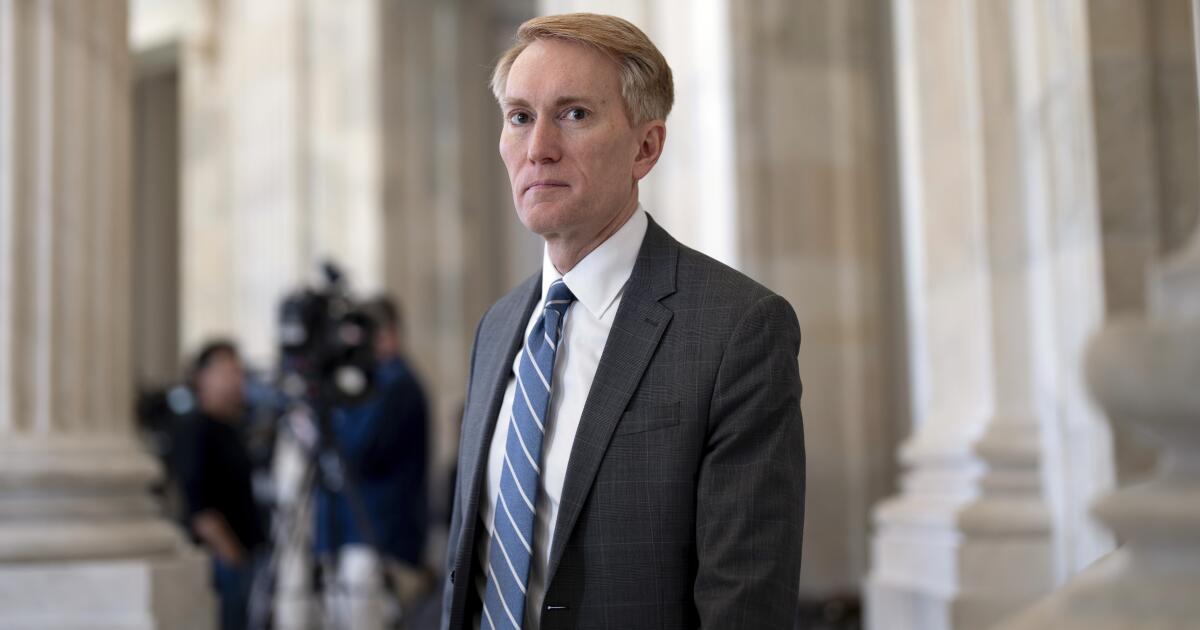
Forget those Republicans for now, however. Instead, let’s acknowledge a Republican profile in courage: Sen. James Lankford.
The formerly obscure Oklahoman has braved not-so-friendly fire from the right for months while he negotiated the immigration compromise with Democratic Sen. Christopher S. Murphy of Connecticut, independent Sen. Kyrsten Sinema of Arizona and advisors to President Biden, who blessed the final product. Now, with Republicans’ attacks redoubled, Lankford is standing his (high) ground — and standing up to Trump. (It helps, to be sure, that Lankford was elected to a second term in 2022 and doesn’t face his voters again until 2028.)
Lankford is a rarity in Congress, a Republican willing to work with Democrats to actually try to solve problems that Americans want solved, rather than endlessly campaign on them. The few such Republicans — Sen. Todd Young of Indiana is another — must get credit when it’s due. They certainly aren’t getting it from their party: The Oklahoma party censured Lankford for his efforts last month, before rescinding its action.
Constructive Republicans were the rule in Congress when I began covering the place, That was mostly before the advent of social media, right-wing cable and grievance-infused populism. Now, too many members of Congress count clicks and cable hits, not hard-won laws, as measures of success.
Senate Republicans “used to be divided between conservatives and moderates. Now it’s divided between invertebrates and vertebrates,” said Luke Albee, a longtime senior Senate aide who worked for two Democratic senators always looking for principled conservatives willing to cut deals. “Senators like Lankford … are in the vertebrate camp, though they are clearly on the endangered species list.”
Few Congress-watchers expected this leadership from Lankford, least of all on immigration, easily one of the nation’s most divisive issues, and one that Republicans hope will be Biden’s and other Democrats’ undoing in November.
Lankford, a lanky 55-year-old whose drink of choice is iced skim milk, has a bass voice befitting the Southern Baptist preacher he used to be, but otherwise projects a boyishness that calls to mind the ginger-haired Opie from early TV’s fictional Mayberry. He’s no RINO. Lankford checks all the boxes on Republicans’ litmus test: pro guns and fossil fuels, anti taxes, abortion and gay rights. On Jan. 6, 2021, he was among the 2020 election objectors before the rioting, but he ultimately voted to certify Biden’s election.
Lately, Lankford has been ubiquitous in the media, unflappably pushing back against what he calls Republican “falsehoods,” like the claim that the border compromise would permit 5,000 migrants into the country daily. He describes the provisions on asylum, detention, deportation, border-security funding and presidential authority to close borders as a once-unthinkable win for conservatives. The bill omits, just as Republicans prefer, Democrats’ past priorities: permanent legal status for DACA beneficiaries and a path to citizenship for longtime, law-abiding unauthorized immigrants.
But Lankford’s Republican colleagues are focused on politics, not policy, and he knows it. He characterized the thinking of many of them on CNN: “We’re in a presidential year, so let’s not help Biden in the process.”
His foes include the Senate’s usual knee-jerk naysayers, including Sen. Mike Lee of Utah. Lee personifies the modern Republican Party’s disdain for bipartisan legislating: He arrived in Congress in 2011 as a tea party insurgent who had unseated a widely respected Republican. The incumbent’s sin? Compromising with Democrats on the hot issue of that time, healthcare.
Lee’s upset victory shook party incumbents and presaged the replacement of pragmatic Republicans with the uncompromising kind. Like Sens. Ted Cruz of Texas, Roger Marshall of Kansas, Marsha Blackburn of Tennessee, J.D. Vance of Ohio. Now that ilk defines the party in Congress.
Which is why so many Republicans lie about a border-security bill that they initially demanded and why on Wednesday they’ll likely deprive the deal of the 60 Senate votes needed to proceed, taking the attached aid for Ukraine and Israel down with it.
If that’s not the death of governing, it’s something close. If only we could have more Lankfords, and fewer Lees.



NEWYou can now listen to Fox News articles!
The attorney who helped persuade the Supreme Court to strike down Hawaii’s private-property concealed-carry restriction on Thursday criticized the state’s reliance on a Reconstruction-era Black Code to defend the law.
In a 6-3 decision in Wolford v. Lopez, the Court held that Hawaii cannot require licensed gun owners to obtain express permission before carrying firearms onto private property open to the public. Gun-rights challengers dubbed the policy the “vampire rule” because lawful gun owners had to be “invited in” before entering businesses while armed.
“It is disgraceful that any state would rely on a law specifically aimed at taking away the Second Amendment rights or any constitutional right of Black Americans as it was at that time,” attorney Kevin O’Grady, who represented the plaintiffs, told Fox News Digital.
“And it’s not surprising, however, that Hawaii would rely on it as they are diametrically opposed to the Second Amendment. We fully expected that the Supreme Court would identify that as the kind of law that one absolutely should not look to determine whether or not something is constitutional because this is the perfect example of something which is not constitutional.”
SUPREME COURT HANDS SECOND AMENDMENT WIN TO CONCEALED CARRY HOLDERS IN BLUE STATE GUN CONTROL CASE
Justice Ketanji Brown Jackson speaks on stage during the “Ketanji Brown Jackson on Lovely One: A Memoir” panel at The Atlantic Festival in Washington, D.C., on Sept. 20, 2024. (Tasos Katopodis/Getty Images for The Atlantic)
A major flashpoint was Hawaii’s effort to justify the law under the Supreme Court’s 2022 decision in New York State Rifle & Pistol Association v. Bruen. Since Bruen, courts evaluating firearm regulations have generally asked whether modern gun restrictions are consistent with the nation’s historical tradition of firearm regulation.
Hawaii cited several historical laws, including an 1865 Louisiana statute enacted as part of the post-Civil War Black Codes. The law made it unlawful to carry firearms onto another person’s property without the owner’s consent.
Justice Samuel Alito, writing for the majority, rejected that argument outright, calling the Louisiana statute a “tainted artifact” that was enacted to disarm newly freed Black Americans and leave them defenseless after the Civil War. He concluded the law “cannot be taken seriously” as evidence of the Second Amendment’s original public meaning.
Justice Ketanji Brown Jackson, however, argued in her dissent the Court skipped an important constitutional question.
Jackson did not defend the Black Codes, which she acknowledged were racist and used to oppress newly freed Black Americans. But she argued the Court should have first decided whether the Louisiana law itself violated the Second Amendment, or whether the real constitutional problem was that it was enforced in a racially discriminatory way.
SUPREME COURT TAKES SECOND AMENDMENT CASE CHALLENGING HAWAII GUN LAW
Todd Settergren handles pistols inside his display case at Setterarms gun shop in Walnut Creek, Calif., on Jan. 13, 2017. (Michael Macor/The San Francisco Chronicle via Getty Images)
“It might well be that the Black Codes are invalid inputs for Bruen’s test,” Jackson wrote, “but only if they violated the Second Amendment — which may or may not be the case.”
Instead, she argued that under the Supreme Court’s Bruen framework, the Court could not simply dismiss those laws without first explaining why they should not count as historical evidence.
She outlined two possibilities: either the firearm restrictions in the Black Codes were constitutional but enforced in a racially discriminatory manner — making the constitutional defect an equal-protection problem — or the restrictions independently violated the Second Amendment. The Court, she argued, never resolved that question before excluding the Louisiana law from consideration.
US APPEALS COURT STRIKES DOWN CALIFORNIA’S OPEN-CARRY BAN IN MAJOR SECOND AMENDMENT RULING
“Either history does matter, and if so, all potentially relevant historical experiences must be thoroughly examined,” she wrote. “Or, it does not, and the Court should just admit that the test it has created is boundless.”
Her reasoning immediately drew pushback from critics, who argued the Fourteenth Amendment was passed in response to laws like the Black Codes that denied newly freed Black Americans their constitutional rights, like the right to bear arms.
Rain clouds roll over the United States Supreme Court building in Washington, D.C., on June 18, 2026. (Chip Somodevilla/Getty Images)
“I would simply point her to what Justice Alito pointed out in the majority ruling — it was in response to these types of laws that the Fourteenth Amendment was enacted in the first place,” Hannah Hill, vice president of the National Association of Gun Rights, told Fox News Digital.
US JUDGE TOSSES ILLINOIS’ BAN ON SEMIAUTOMATIC WEAPONS, GOVERNOR PLEDGES SWIFT APPEAL
“That right there is your answer,” Hill continued. “Yes, there was a historical tradition — they enacted a constitutional amendment to fix that deprivation of rights, and that is also in the Constitution now, so I think she should probably go back to law school.”
Tyler Yzaguirre, president of Second Amendment Institute, echoed O’Grady and Hill’s criticism.
“Those laws were not legitimate expressions of our Nation’s constitutional tradition; they were examples of government using its power to deprive Americans of a fundamental right,” Yzaguirre told Fox News Digital. “The Court was right to reject the notion that such laws could define the historical limits of the Second Amendment.”
CLICK HERE TO DOWNLOAD THE FOX NEWS APP
Businesses may still ban guns by posting or enforcing a “no firearms” policy. But what Hawaii can’t do, the Court said, is treat every business as off-limits to licensed gun owners unless the owner specifically says guns are allowed.

SACRAMENTO — Gov. Gavin Newsom reached an agreement Friday with legislative leaders on a $351.7-billion state budget in his final year as governor, a spending plan that uses a tax windfall to avoid major cuts and lessen California’s chronic deficit in the years ahead.
The deal provides nearly $2 billion in state revenue next year through tax hikes on corporations, new levies on software sales and a revamped tax on managed healthcare organizations. Lawmakers and the governor continue major investments in public schools, healthcare and agreed to increase spending on subsidized childcare and affordable housing.
“We want to leave the next governor not only a balanced budget, but a budget that is substantially structurally sound, and we’re going to accomplish that,” Newsom said in an interview Friday. “We were very cautious in terms of new spending,”
The agreement ends weeks of lobbying by outside interests and negotiations among lawmakers and the governor at the state Capitol about how to handle a surge of income tax collected on stock market gains related to artificial intelligence.
Early forecasts last June projected a $12.6-billion deficit in 2026-27, according to the California Department of Finance. Updated predictions now suggest the state will end the year with a surplus of $4.5 billion.
Democrats, following Newsom’s lead, are tucking away $6.4 billion for future years, which allows the governor to knock down a deficit previously projected through 2027-28 and assuage criticism about his spending habits.
But economists say the fix and revenue increase are likely only temporary.
Spending in California has generally exceeded revenue growth during Newsom’s tenure in the governor’s office, creating a chronic shortfall. Despite the extra funding, the budget continues a trend of relying on reserves, shifting funds, borrowing and suspending debt payments to balance state spending.
The Legislative Analyst’s Office, the nonpartisan fiscal advisor for lawmakers, has warned of a roughly $10-billion annual gap between the amount of money the state brings in and spends, which could grow dramatically worse if the stock market turns downward. The LAO has said the existence of any operating deficit during a revenue boom is a red flag and that the state is “ill-prepared” for even a modest decline.
Christopher Thornberg, an economist and founder of the consulting firm Beacon Economics, said it’s business as usual in Sacramento.
“They love increasing spending. But it seems politically impossible to go the other way,” Thornberg said. “We’ve seen this play out over and over again.”
Lawmakers and the governor offered a different take and asserted that their decision to put the $6.4 billion into a short-term reserve, called the Projected Surplus Temporary Holding Account, and ask voters to allow them to store more money in the rainy day fund are examples of prudent budgeting.
“You see us save more and you see us try to address the immediate needs of our community, but also the structural budget that potentially awaits us,” said Senate President Pro Tem Monique Limón (D-Goleta) in an interview. “We are forecasting a moment where we will need to address these issues and we want to start now to think about the future as well.”
Under a progressive tax structure, the state budget is dependent on income taxes paid by the ultra-rich on earnings largely from capital gains. The set up leaves California vulnerable to the unpredictable nature of the stock market, dramatic swings in revenue and, in recent years, reliant on poor projections.
Negotiations at the state Capitol included an agreement on a constitutional amendment that seeks to offset the revenue highs and lows.
If approved by voters on the statewide ballot in November, the amendment would raise a cap on mandatory deposits into the rainy day fund from 10% to 20% of general fund revenue. The measure would also allow lawmakers to exempt money they put into the rainy day fund and the temporary holding account from state spending limits.
Under an existing state appropriations restraint, also known as the Gann Limit, lawmakers cannot spend more than an amount determined by a formula that takes annual tax proceeds, changes to the population and cost of living into consideration. Tax revenue above the limit must be divided between schools and refunds to taxpayers.
With few exceptions, the limit applies to most appropriations of tax revenue, including when lawmakers put money away in the rainy day fund and other reserves.
Newsom said the change will leave the state in a much better position to weather the volatility. Though calls for tax reform remain in California, the governor said being able to place more money into the reserves could ultimately solve the state’s budget challenges.
“The one thing missing is the one thing that I think we finally landed, which is the change in the reserves,” Newsom said. “It changes the political dynamic, where now you’re not exchanging general fund priorities.”
Republicans criticized the proposed constitutional amendment, which passed in a budget trailer bill this week, for failing to require that excess revenue pays down the state’s $22 billion in unemployment insurance debt.
State Sen. Tony Strickland (R-Huntington Beach) called it a missed opportunity.
“It does not require debt payment to go to the UI debt,” Strickland said. “It facilitates more spending, exempting reserve deposits from the state spending limit.”
The proposed change to the state Constitution also jabs the president and asks voters to approve a 100% tax on payments any California taxpayers receive from the “Anti-Weaponization Fund” Trump established for allies who claim they were unjustly targeted by the federal government.
As part of the overall budget negotiations, lawmakers agreed to delay some healthcare cuts that would have required monthly premiums for immigrants and eliminated dental care. The deal adopts a Medi-Cal asset test of $21,000 on July 1, 2027, instead of $2,000.
The budget agreement includes a provision requiring California’s next governor to develop options to reduce taxpayer subsidies for corporations whose employees receive state-sponsored healthcare through Medi-Cal instead of the company’s health plan. The plan is aimed at raising revenue to offset federal cuts that are expected to leave millions of Californians without access to healthcare.
To generate $11.25 billion for affordable housing, Democrats approved a bond for the November ballot that would include down payment and mortgage assistance to veterans and low-income families. Democrats also approved $900 million in Homeless Housing, Assistance, and Prevention grants, marking a $400-million increase from Newsom’s budget proposal in May.
The California Department of Finance said state reserves are expected to total $28.8 billion under the 2026-27 budget.
Politics
Warren tells Trump to ‘sign the damn bill’ as bipartisan housing package remains stalled in Washington

NEWYou can now listen to Fox News articles!
Sen. Elizabeth Warren, D-Mass., lashed out at President Donald Trump during a recent local television interview, labeling him a “man-child” throwing a “tantrum” over his refusal to sign a sweeping bipartisan housing package.
Appearing on WCVB’s “On the Record,” the left-wing senator did not hold back her frustration over the stalled legislation, delivering a blunt message to the president: “Sign the damn bill.”
“If he cared about the American people, he’d have already signed the damn thing,” Warren said during the interview, arguing that Trump “does not care about the economic survival of America’s working families.”
FILE – The Senate previously advanced the massive housing package geared toward lowering the costs of homes and supercharging the housing supply. Sen. Elizabeth Warren, D-Mass., pitched it as legislation to prevent America from becoming a “nation of renters.” (Jemal Countess/Getty Images for Protect Borrowers ; Anna Moneymaker/Getty Images)
TRUMP-BACKED HOUSING BILL CLEARS HOUSE AFTER GOP DEFIES SENATE PRESSURE CAMPAIGN
The 21st Century ROAD to Housing Act is an expansive bipartisan package that she said contains nearly 50 provisions designed to address the nationwide housing emergency.
Warren noted that decades of under-building have driven prices up, leaving the U.S. in need of millions of new units.
The primary focus of the bill is to lower the costs of construction and make it easier to build new homes.
FILE – President Donald Trump previously said lawmakers must first approve the SAVE America Act before he moves forward with the housing package. (Yuri Gripas/Abaca/Bloomberg)
BIPARTISAN HOUSING PUSH ADVANCES, BUT TRUMP-BACKED INVESTOR BAN FACES RESISTANCE
The bill, which was co-sponsored by Sen. Tim Scott, R-S.C., also includes a secondary focus aimed at blocking corporate consolidation of the housing market.
Warren explained that the legislation is designed to keep private equity firms from buying up local neighborhoods and turning America “into a nation of renters.”
According to Warren, the legislation had widespread support from both sides of the aisle before it was stalled.
TRUMP VOWS BLOCK ON SIGNING NEW LAWS UNTIL SAVE AMERICA ACT PASSES SENATE
She claimed the bill was “handed to the president on a silver platter” and that lawmakers from both parties were eagerly taking credit for the legislation.
“Republicans were all going online, saying, ‘well, I helped write that bill. This bill is terrific,’” Warren said. “So everybody’s out there saying, ‘my bill, I helped make this happen,’ right up until the man-child has a tantrum and announces he will not be signing it.”
FILE – Sen. Elizabeth Warren called President Donald Trump a “man-child” during the interview, describing his refusal to sign the bill as a “tantrum.” (Chip Somodevilla/Getty Images)
CLICK HERE TO DOWNLOAD THE FOX NEWS APP
Critics of the legislation claim it does not allocate fresh federal funding, directly address rising costs of homeownership, or go far enough to address permitting issues.
The president previously canceled a scheduled signing event, insisting lawmakers must first approve the unrelated SAVE America Act, a voting-focused measure, before he moves forward.
The White House did not immediately respond to Fox News Digital’s request for comment.
Fox News Digital’s Alex Miller contributed to this report.
-
Tennessee2 minutes ago
Tennessee GOP leaders denounce antisemitic Young Republicans mailers | The Jerusalem Post
-

 Texas9 minutes ago
A truck crash released 20 million bees. Local beekeepers rushed to save them.
-

 Utah12 minutes ago
‘2.5 minutes of terror’: Passengers sue Delta, alleging crew flew into dangerous weather despite warnings, injuring dozens
-

 Vermont24 minutes ago
Four Vermont beaches named among New England’s best. How to go
-

 Virginia27 minutes ago
Virginia Thomas – Scranton Times-Tribune
-

 Washington32 minutes ago
Where to watch Washington Nationals vs Baltimore Orioles: TV channel, start time, streaming for June 27
-

 Wisconsin39 minutes ago
Baboucarr Ann’s commitment pushes Wisconsin into nation’s top three
-

 West Virginia42 minutes ago
Justice firm’s delinquent DEP fines rise past $1.6M amid DOJ criminal liability relief

