Politics
Newsom's Prop 1 holds narrow lead in California primary

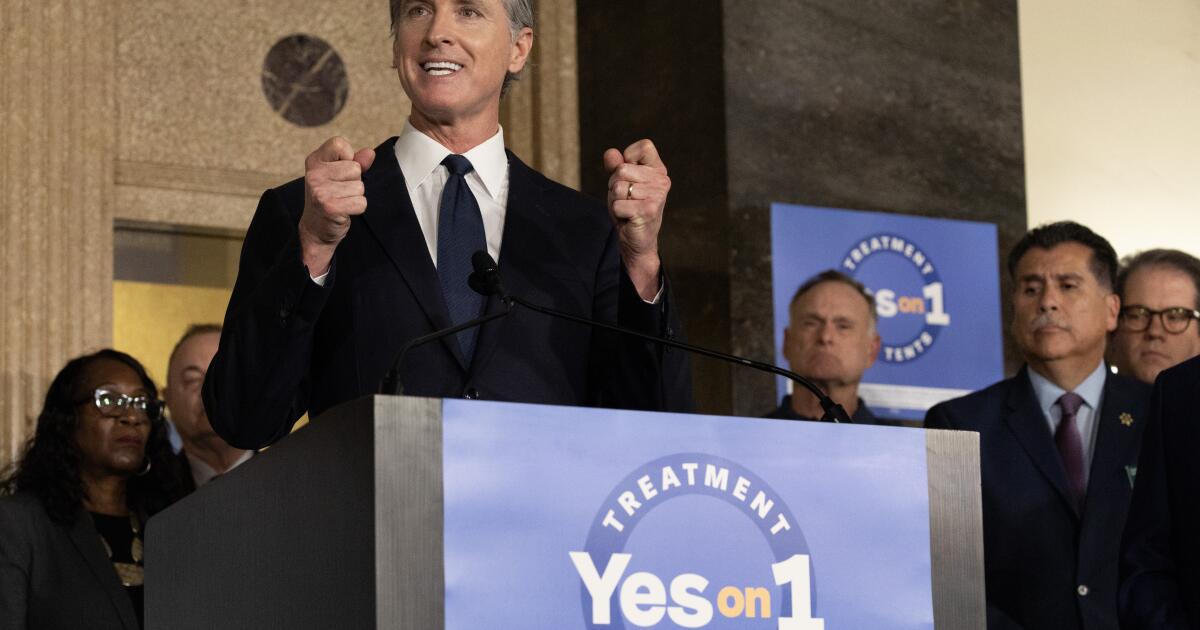
Proposition 1, a statewide bond measure that Gov. Gavin Newsom championed as critical to solving the state’s mental health and homelessness crisis, held a narrow lead Tuesday evening in California’s primary election, but the contest was too close to call with votes still being counted across the state.
The measure redirects an existing tax on the rich under the state’s 20-year-old Mental Health Services Act to fund services for people with substance abuse disorders and includes a $6.4-billion bond to build more than 10,000 treatment beds.
Newsom campaigned from San Francisco to San Diego in the lead-up to the primary election, urging voters to pass the measure to address the most vexing problem of his governorship and the most visible challenge in his home state, where voters have become alarmed by the number of people living in tents and under freeways in cities large and small.
At rallies and in ads, Newsom portrayed Proposition 1 as an opportunity to correct mistakes of the past when the state shuttered state mental health hospitals in the 1960s without boosting local services, “leading to decades of neglect.”
“Prop. 1 finally writes a new chapter,” Newsom said. “Prop. 1 rights a historic wrong.”
About 181,000 people statewide, including 75,000 in Los Angeles County, are homeless, according to 2023 counts. As much as 82% of unhoused individuals have experienced a serious mental health condition, and nearly two-thirds have at some point regularly used illicit drugs, according to a recent survey by UC San Francisco.
Arguing that the status quo isn’t working, Newsom has pushed a series of policies since he took office to begin to tackle the problem, such as expanding the criteria by which people can be detained against their will to include substance abuse disorders, giving families and authorities the ability to ask courts to mandate treatment for people and expanding the availability of temporary and permanent shelters.
For the record:
7:50 p.m. March 5, 2024An earlier version of this article said the Mental Health Services Act was approved by voters in 2023. Voters approved it in 2004.
Proposition 1 complements those efforts by revamping the Mental Health Services Act, which was approved by voters in 2004, to include treatment for those with substance use disorders regardless of whether they are suffering from a mental health condition. The act imposes a 1% tax on incomes in excess of $1 million to fund the expansion of mental health treatment options in California, which will be redirected under Proposition 1.
The measure also increases state oversight of county spending on behavioral health at a time when Newsom has repeatedly questioned the resolve of local governments to fix the problem.
But each step Newsom takes receives pushback from the right and the left.
Liberal organizations worry Newsom’s policies, such as CARE Court and expanding conservatorship, could infringe on civil rights, deter people from seeking help for fear of being forced into care and consign people to harsher treatment settings than necessary. Local governments have raised concerns about their ability to fund the governor’s more ambitious policy directives and to quickly train police and other personnel to abide by the new laws.
Meanwhile, voters are frustrated over the lack of progress and Republicans contend that unchecked liberal rule in California caused the crisis.
Opponents of Proposition 1 called out the large price tag as one reason they wanted voters to reject the measure.
“No matter where you stand politically, there’s something in Prop. 1 to hate,” said Paul Simmons, a director of Californians Against Proposition 1, in a statement issued before the election. “Whether it’s the cost, or the track record of failure, or the fact that Prop. 1 hurts people who are getting mental health services now, there are flashing red lights everywhere.”
The California Department of Finance estimates that the Behavioral Health Infrastructure Bond within Proposition 1 would cost a total of $14 billion. Bonds, which are bought by investors, act as loans that the state pays back with interest.
Two bills that sent the measure to the March ballot received rare bipartisan support in the state Legislature, with Republicans and Democrats leaving their party corners to provide voters with a potential solution to an issue plaguing the state. But voters didn’t appear to share the bipartisan spirit by election day.
The measure teetered with only 50% support in a UC Berkeley Institute of Governmental Studies poll co-sponsored by The Times that was conducted in late February. A large majority of Republican voters opposed the measure, raising concerns about how Proposition 1 would fare in an election with higher GOP turnout.


NEWYou can now listen to Fox News articles!
Mallory McMorrow announced Sunday that she is suspending her campaign for the U.S. Senate in battleground Michigan.
The Michigan state senator’s decision leaves her party’s primary as a two-way race between moderate Rep. Haley Stevens, who is backed by longtime Senate Democratic leader Sen. Chuck Schumer and the establishment, and former Wayne County Health Department Director Abdul El-Sayed, a left-wing candidate endorsed by progressive champions Sen. Bernie Sanders of Vermont and Rep. Alexandria Ocasio-Cortez of New York
McMorrow’s name will remain on the ballot for the Aug. 4 primary as ballots have already been printed and distributed to absentee voters, according to Bridge Michigan.
The eventual Democratic nominee will face off in the midterms with former Republican Rep. Mike Rogers, who is on a glide path to the GOP nomination, in a crucial midterm race to succeed retiring Sen. Gary Peters, a Democrat.
MICHIGAN SENATE CANDIDATE ABDUL EL-SAYED TAKES HEAT FOR KHAMENEI COMMENTS, HASAN PIKER EVENT
Michigan state Sen. Mallory McMorrow speaks on the first day of the Democratic National Convention in Chicago on Aug. 19, 2024. (Andrew Caballero-Reynolds/AFP via Getty Images)
The seat is a top Republican target and is a must-hold for the Democrats as they aim to win back the Senate majority from the GOP, which currently controls the chamber 53-47. The leading nonpartisan political handicappers rate the Senate race in Michigan as a toss-up.
In a video posted on X announcing her decision, McMorrow did not provide a specific reason for ending her campaign. She instead thanked her staff and supporters for helping build what she described as a campaign powered by small-dollar donations and no corporate PAC money.
But McMorrow, who has seen her national profile expand in recent years and was running as a progressive in an ideological space between El-Sayed and Stevens, suspended her campaign amid faltering polling numbers and fundraising that weren’t keeping pace with her two main rivals.
McMorrow also pledged to fully support whichever Democrat wins the primary and faces off with Rogers, who is running for the Senate for a second straight cycle and lost in 2024 to now-Sen. Elissa Slotkin by a razor-thin margin.
“So here’s what we do next. Every day through November 3rd. We win this Senate seat and send Mike Rogers back to Florida for good,” she said. “Whoever wins this primary on August 4th will have my full support.”
MICHIGAN DEMOCRATIC SENATE CANDIDATE CLAIMS ISRAEL ‘JUST AS EVIL’ AS HAMAS
Rep. Haley Stevens, D-Mich., speaks during the House Democrats’ news conference in the Capitol on Feb. 6, 2025. (Bill Clark/CQ-Roll Call, Inc via Getty Images)
Following McMorrow’s announcement, Stevens praised her fellow Democrat by calling her an “important voice” for policies that benefit Michigan families.
Stevens then argued that she is the strongest Democratic candidate to win the primary and defeat Rogers in November.
“As we enter the final month of the primary election, I’m excited to continue to make my case to Michiganders why I’m the strongest Democrat to defeat Mike Rogers this November, lower costs, protect manufacturing jobs, and stand up to Trump’s abuses of power.”
MAMDANI-BACKED SOCIALISTS LOOK TO TAKE NEW YORK PLAYBOOK NATIONWIDE AFTER PRIMARY VICTORIES
Abdul El-Sayed, speaks before Sen. Bernie Sanders and takes the stage at Mumford High School on May 3, 2026, in Detroit, Michigan. (Sarah Rice/Getty Images)
In his statement, El-Sayed praised McMorrow for having the “courage” to challenge what he described as a rigged political system, accusing Democratic Party insiders of spending millions to influence the primary. While he did not name specific groups, the remarks appeared to reference corporate PACs and party leaders such as Senate Minority Leader Chuck Schumer, D-N.Y., who has endorsed Stevens.
He then invited McMorrow’s supporters to join his progressive movement to combat big money in politics and defeat the political establishment.
“Throughout this campaign, Senator McMorrow showed what it looks like to fight back against politics that rigs the system against too many of us. While we have policy disagreements, I never questioned whether Senator McMorrow would fight for a better America for my daughters and hers,” he said.
“The same party insiders she had the courage to challenge have been bullying anyone who opposes their chosen candidate. After spending $30 million to drown Senator McMorrow and me out, they’re now spending even more to attack me. It’s everything we are standing up against.”
“I welcome her supporters to our movement to stand up against money in politics, to put money back in pockets, and pass Medicare for All. We cannot allow the establishment to decide our nominee for us.”
U.S. Sen. Bernie Sanders (I-VT) stands with Senate candidate Abdul El-Sayed after speaking at Mumford High School on May 3, 2026 in Detroit, Michigan. (Sarah Rice/Getty Images)
El-Sayed, who, if elected would make history as the nation’s first Muslim senator, is an epidemiologist who unsuccessfully ran for governor as an insurgent candidate in 2018. He has made support for “Medicare-for-all” a major component of his campaign.
El-Sayed also calls for abolishing ICE, and he’s a vocal critic of Israel in its war with Hamas. He has characterized Israel’s actions in Gaza as “genocide” against Palestinians. And El-Sayed, who served as a top surrogate on Sanders’ 2020 presidential campaign, has also vowed not to accept PAC donations.
Schumer and the party establishment view Stevens as more electable than El-Sayed, who has sparked controversy with his past comments. They worry that El-Sayed as the party’s nominee would jeopardize the Democrat-controlled Senate seat by pushing the party too far to the left in a state that President Donald Trump carried two years ago.
Meanwhile, Stevens has been backed by millions in super PAC spending, including big bucks from Israel-aligned groups.
AOC JOINS BERNIE SANDERS IN BACKING SENATE CANDIDATE OPPOSED BY SCHUMER
Former Rep. Mike Rogers, seen speaking with Fox News Digital, is on a glide path for the 2026 Republican Senate nomination in Michigan, as he campaigns for the Senate a second straight time. (Paul Steinhauser – Fox News )
The National Republican Senatorial Committee (NRSC), in a statement reacting to McMorrow’s move, pointed to the burgeoning battle between the far left and the establishment for the future of the Democratic Party.
CLICK HERE TO DOWNLOAD THE FOX NEWS APP
“Bernie Sanders’ radical socialist flank is completely taking over the Democrat Party. It is now up to Chuck Schumer to combat Abdul El-Sayed’s clear momentum and get Haley Stevens over the finish line in their messy primary,” NRSC Regional Press Secretary Samantha Cantrell argued in a statement.
Greg Manz, the Michigan GOP senior communications adviser, said in a statement that “Michigan’s Senate Democrat primary has shifted from a three-car pileup to a head-on collision.”

Immigrants detained at two federal facilities in California have launched a boycott in protest of increasing and, in their view, burdensome prices at the facilities’ commissaries for items including tampons, coffee and soup.
The Times reviewed a grievance letter and spoke with three detainees who are involved in the boycott at the California City Detention Facility, about 80 miles east of Bakersfield, and at the Golden State Annex in McFarland.
More than 300 detainees are estimated to have signed grievance letters sent recently to facility administrators, according to advocates with the California Collaborative for Immigrant Justice.
Both facilities are operated by private prison corporations — the California City facility by Tennessee-based CoreCivic and the Golden State Annex by Florida-based GEO Group.
Ryan Gustin, public affairs director for CoreCivic, said the company cares for people at the facility safely, humanely and with dignity while their cases proceed. He said the facility provides three nutritious meals per day and accommodates religious, therapeutic and cultural diets, and that commissary items are a supplement.
Proceeds from commissary sales, per the facility’s contract, are put into a detainee welfare fund, Gustin added. Those funds are used to buy electronics or recreational or educational items.
“We regularly collaborate with our outside commissary vendor and government partners to review and set commissary item pricing that is reasonable,” he said. “It’s important to note that the commissary program is not a profit mechanism.”
The Times also reached out to the Department of Homeland Security and GEO Group for comment.
Detainees are provided certain essentials, such as food and soap, free of charge, but many also purchase items at commissary stores that are of better quality or otherwise unavailable.
Detainees said shampoo and other hygiene items sometimes run out for days and that meals are small or exacerbate diabetes and other health issues. One detainee said the facility provides a pint of milk twice a week and that he has never received fresh fruit.
“The three daily meals that CoreCivic provides at California City Detention Facility are the bare minimum to keep a person alive,” they wrote. “Because of this, charging inflated prices on necessities is considered price gouging and profiteering against vulnerable incarcerated population who have no ability to refuse or shop elsewhere.”
The detainees said an 8-ounce jar of Folgers instant coffee costs $18 at the California City facility, a single instant ramen soup is 75 cents and a box of 40 tampons costs nearly $21.
At Walmart, the same Folgers coffee costs $8.97, Maruchan chicken ramen soup is 50 cents and 40 Tampax tampons are $12.19.
U.S. Immigration and Customs Enforcement detains immigrants for civil purposes. Detention is meant to facilitate removal proceedings but is not meant to be punitive.
Detainees are paid $1 per day under a voluntary work program for cleaning or cooking. Many detainees rely on money from family and friends.
In their grievance letter, the detainees called the markups an unacceptable business practice with no apparent limit. They said they view the situation as an example of captive market exploitation and economic coercion.
The detainees requested a review of commissary pricing by facility leaders, a comparison of prices with prison industry standards, an immediate reduction in prices of essential items and the implementation of reasonable price caps. They also requested an increase in the portions of daily meals, including meals meeting religious requirements, which they said are particularly small.
In May, the California State Senate passed a bill that would prohibit the excessive markup of products sold at private detention centers, limiting prices to 35% above the vendor cost. Existing California law already limited such markups in state prisons.
“It’s just a cycle of unnecessary exploitation,” said Sen. Steve Padilla (D-Chula Vista), who wrote the bill, which is now in the Assembly. “If someone is under contract, they should engage in ethical business practices.”
Priya Patel, an attorney at the California Collaborative for Immigrant Justice, represents people who have been detained at both facilities. She said that during legal service consultations, the topic of commissary pricing frequently comes up.
“The higher the prices get, the higher of an impact the conditions have on people and the more difficult it becomes to fight their cases,” Patel said.
The collaborative is one of the organizations that brought a lawsuit last year alleging inadequate medical care, as well as insufficient clothing, food, water and outdoor recreation time, at the California City facility, which can hold more than 2,500 people. The lawsuit remains ongoing; in March, a U.S. district judge in San Francisco appointed an external monitor to ensure the facility provides “constitutionally adequate health care.”
The lawsuit describes multiple commissary-related issues. For example, it says the facility doesn’t provide headphones for tablets, making private phone calls — including privileged calls with attorneys — impossible unless the detainee can afford to purchase headphones from the commissary.
“One detained person has difficulty walking and standing for extended periods of time without shoes that provide arch support,” the complaint says. “He arrived at California City with appropriate shoes to accommodate his mobility disability, which were approved as an accommodation at a prior ICE facility. California City staff confiscated those shoes and instead provided him with plastic, orange sandals.”
“Several weeks after staff confiscated his shoes, he had an appointment with a doctor at California City,” it continues. “The doctor told him … to buy different shoes from commissary to accommodate his foot condition.”
Gustin disputed those accounts, saying that detainees are given headphones at intake and that attorney calls typically take place in private booths. He said that the company provides orthopedic footwear for any detainee with a medical provider’s order, and that he couldn’t review the case detailed in the complaint without specifics.
A contract between CoreCivic and ICE for the California City facility, dated April 1, 2025, says that the contractor must provide notice of any price increases and that “any revenues earned in excess of what is required for commissary operations shall be used solely to benefit aliens at the facility.” A 2019 contract between GEO Group and ICE for Golden State Annex and two other facilities in California includes the same language.
Alfredo Parada Calderon, 52, has been detained at the California City facility since September. He said commissary prices were already high before they increased around mid-June.
Parada Calderon said he asked an ICE officer why the prices had increased so much. The officer said he wasn’t aware of the change but that the vendor is Keefe Group, which supplies commissaries at prisons and immigrant detention centers across the country.
Detainees in his dormitory submitted a grievance about commissary prices, Parada Calderon said. The answer was vague.
“They’re blaming it on inflation,” he said.
Parada Calderon said his family sends him about $100 per month for commissary items, which he spends on packets of crackers, coffee, soups, soap, shampoo, deodorant and chips.
“Enough is enough,” he said. “It’s a horrible enough place to be in and you guys are making it even more horrible, not just for me but for my family. The detainees want to be heard and this is the only option we actually have — a peaceful protest.”
Tommaso Bardelli, a researcher at New York University who studies mass incarceration, said the families of most people in prison are working class and may sacrifice their electricity bill or credit card payment to send money to their incarcerated relatives. The money they send no longer pays for small luxuries, he said, because prisons have over the years reduced how much they spend per person on necessities such as food.
Bardelli published a research article in 2022 about inequality within prison commissary stores. Commissaries are often now the difference between starving and having a semi-normal diet, he said.
Politics
Expert who fled Cuba warns of ‘vicious cycle’ that will lead to ‘communists in double digits’ in Congress

NEWYou can now listen to Fox News articles!
A national security expert who fled to the U.S. from Cuba is warning that one “vicious cycle” currently dominating American politics could lead to “communists in double digits” serving in Congress.
Mike Gonzalez, a senior fellow at the Heritage Foundation who fled communist Cuba in the 1970s, said in an interview with Fox News Digital that the socialist “threat is real now.”
Gonzalez likened this trend to a “takeover of a host body, the Democratic Party,” saying, “It’s being taken over by body snatchers and they’re not able to mount any defense of it whatsoever even if they wanted to.”
Under the current political environment, Gonzalez predicted, “We’re going to get communists in double digits in the House of Representatives at least, there’s no doubt of that.”
BILL MAHER’S DIRE MIDTERM ELECTION WARNING TO DEMS AFTER ‘REALLY CRAZY’ SOCIALISTS WIN PRIMARIES
Members of the Democratic Socialists of America gather outside of a Trump owned building during a May Day rally in New York City in 2019. (Spencer Platt/Getty Images)
Over the course of a year, New York City elected a socialist mayor, Zohran Mamdani, while three of his endorsed socialist congressional candidates — Brad Lander, Claire Valdez and Darializa Avila Chevalier — defeated establishment Democrats, including two incumbents. On the other side of the country, Seattle elected a socialist mayor, Katie Wilson. Just this week, Colorado congressional candidate Melat Kiros defeated 15-term Democratic incumbent Rep. Diana DeGette, further illustrating socialists’ ability to topple entrenched party figures.
While these politicians identify as socialist, Gonzalez pointed out that to the authors of the communist manifesto, Karl Marx and Friedrich Engels, “there was no difference between socialism and communism, they were interchangeable.”
“These people are communists, and when you catch them unawares, they actually say, ‘Oh, yeah, I know we want communism,’” he said.
According to Gonzalez, the widespread success of socialist candidates in races across the U.S. is due to several factors, including the breakdown of immigrants assimilating to American culture, increased hatred of the U.S. and even White guilt combined with a real affordability crisis in cities like New York.
“A very important component of this and one that conservatives sometimes forget is that a lot of these votes are White votes, White young kids who have come in from the suburbs, who feel guilty about a number of things,” he explained.
SOCIALISM GOES WEST AS DSA-BACKED CHALLENGER OUSTS LONGTIME DEMOCRAT
New York City Mayor Zohran Mamdani speaks during a primary-night watch party for NYC Congressional candidate Claire Valdez at 99 Scott Studio on June 23, 2026 in the East Williamsburg neighborhood of the Brooklyn borough in New York City. (Michael M. Santiago/Getty Images)
“They have gone to very expensive Ivy League schools and they’re trying to make a living in New York City without being a banker. And you can’t make a living in New York City if you’re not a banker, sorry, you’re going to have an affordability crisis.”
This, Gonzalez said, makes socialist promises of handouts, such as free tuition, free bus fares and public-run grocery stores, an easy sell.
“So, they end up voting for this. This is a very bad vicious cycle that is taking place and that is going to produce communism in this country if we’re not careful.”
Meanwhile, Neetu Arnold, a young immigrant to the U.S. who now works as a policy analyst for the Manhattan Institute, emphasized that the socialist trend is not just isolated to cities like New York but becoming increasingly prevalent in cities across the U.S.
“The rise in the socialism in America, it’s going to shape our politics. I think it’s going to make things more extreme,” Arnold said in an interview with Fox News Digital.
DSA CO-CHAIR PUSHES BACK ON SOVIET UNION COMPARISONS, WANTS PRISONS TO BE ‘LESS NECESSARY’
Members of the Party for Socialism and Liberation filmed children supporting the regime in Iran, during a protest on Saturday, March 7, 2026, in Washington, D.C. (Asra Q. Nomani/Fox News Digital)
“What the socialist candidates have tapped into are real frustrations and grievances, but the solutions that they’re offering is essentially more government involvement rather than trying to address the underlying problems,” she explained. “What a lot of younger people are finding out is that it’s not that easy to get housing. They’re in student debt, they are struggling to find stable jobs, and so the things that they were promised are not necessarily coming true.”
SIGN UP TO GET THE POLITICS NEWSLETTER
As a naturalized U.S. citizen, Arnold said she hopes both sides of the political aisle recognize that “socialist policies are a threat to the American way of life.”
CLICK HERE TO DOWNLOAD THE FOX NEWS APP
“In this country we value merit, we value wealth, and the ability to move upward in this society,” she said. “I’ve seen my life change before my eyes by being here in this county, by having the opportunities that I did, and that I saw for my family, and I think that was only possible because of free markets and the opportunities that we had in this country.”
“Socialist policies essentially restrict what we are able to do,” Arnold continued. “So, I do take it seriously and I hope that Democrats, Republicans, they all take the rise of socialism seriously.”
-
 Arizona7 minutes ago
Fiery crash on Loop 202 in Tempe under investigation
-

 Arkansas10 minutes ago
7 on 7: The biggest stories from last week you might’ve missed
-
 California10 minutes ago
Jackie and Shadow fled during Big Bear fireworks but returned to nest and eaglets the next day
-

 Colorado22 minutes ago
Colorado ranchers rush to save livestock as Aspen Acres Fire pushes south
-

 Connecticut25 minutes ago
CT Cleans Up After Storm, Braces For More Heavy Rain | CT News Junkie
-

 Delaware30 minutes ago
Body of missing 19-year-old tuber recovered from Delaware River in Hunterdon County – WRNJ Radio
-

 Florida37 minutes ago
Why the Red Sox are sending Roman Anthony to Florida (and to another doctor) – The Boston Globe
-

 Georgia38 minutes ago
324 impaired drivers arrested in Georgia during holiday weekend

