Politics
News Analysis: Trump's transition moves raise fears of a politicized military

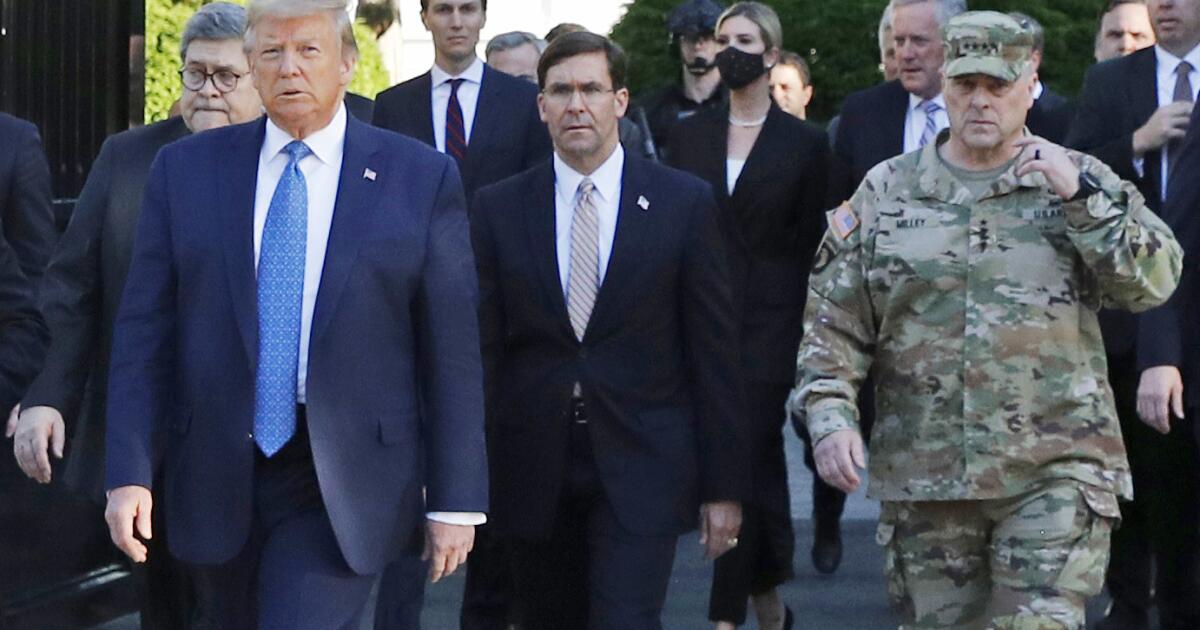
WASHINGTON — Critics of President-elect Donald Trump have long contended that he aspires to use the U.S. military — a nonpartisan force, by rule and tradition — as an instrument of the MAGA agenda that propelled his latest election victory.
Now, in the eyes of some, those concerns are being supercharged.
The relationship of the executive branch and the military has always been a balancing act. The American president is, after all, the commander in chief of the world’s most formidable fighting machine, and the figure ultimately responsible for the nation’s safety and security.
But every senior military officer also takes an oath to defend the Constitution, and pledges to refuse illegal, unconstitutional or criminal directives. During his campaign, Trump flirted with those boundaries, repeatedly musing about using the military to go after domestic political opponents, or to aid in mass deportations of illegal immigrants.
Despite a pledge to be a president who presides over peace rather than war, Trump takes office against a backdrop of global upheaval: wars in Ukraine and the Middle East, the increasing closeness of Russia and North Korea, an ascendant China.
Trump rattled wide swaths of the U.S. defense establishment this week with a draft executive order, whose existence was reported Tuesday by the Wall Street Journal, to create a special panel — dubbed a “warrior board” — that would have the power to force out high-ranking generals and admirals.
“I think people should be concerned, in the military and out of it, about the politicization of the military, and the attempt to use it to do the president’s personal will,” said Benjamin Friedman, policy director of the Washington-based think tank Defense Priorities, which advocates for restraint in U.S. foreign policy.
He called the proposed commission a “bad idea.”
The creation of such a panel, if it came to fruition, would facilitate the purging of military leaders who were unwilling to carry out presidential orders — or those relayed by a loyal subordinate. For some, that brand of fealty is in line with Trump’s choice for his secretary of Defense: conservative Fox News personality and military combat veteran Pete Hegseth.
The pick, unveiled Tuesday, drew immediate pushback from some influential veterans groups and current and former lawmakers, who suggested that Hegseth’s ideological leanings, rather than any demonstrated expertise, lay behind him being tapped to run the vast U.S. defense complex. Hegseth, on TV, podcasts and books, has railed against what he calls the “woke” military.
“Pete Hegseth is wholly unqualified to head the Department of Defense and hold the lives of our troops in his hands — period,” Paul Eaton, a former U.S. Army officer and chairman of VoteVets, a nonprofit group that supports veterans and progressive causes, said in a statement.
“I don’t think Hegseth is a serious person or a serious pick,” Rep. Pat Ryan, a New York Democrat and an Army veteran, told MSNBC.
However, House Speaker Mike Johnson (R-La.), who has committed to enacting Trump’s agenda, called Hegseth “a tireless advocate for America’s soldiers and veterans,” saying the weekend “Fox & Friends” co-host would bring “a fresh perspective” to the Pentagon.
“Pete is dedicated to ensuring that our military is focused on lethality and readiness, not woke ideology,” Johnson said in a statement. “He served our country faithfully in Guantanamo, Afghanistan, and Iraq and is a believer in peace through strength and the America First agenda.”
Hegseth’s loyalty is significant, because Trump has previously demonstrated willingness to extend his decision-making reach into matters traditionally left to Pentagon leaders. In his first White House tenure, he went through five Defense secretaries in four years.
At least two of those relationships with civilian Pentagon chiefs — retired Marine Gen. James N. Mattis and Army combat veteran Mark Esper — resulted in open acrimony, despite a long-standing reluctance on the part of current and retired military officers to publicly criticize the commander in chief.
Such reticence might be exacerbated by the existence of the so-called warrior board. According to the Journal, the panel would consist of ranking retired officers who were empowered to recommend removal of former peers deemed to be “lacking in requisite leadership qualities.”
What exactly those leadership qualities might entail was left vague. But the report quickly raised fears in the context of harsh criticism by Trump and those in his inner circle of “woke generals” — a catchall phrase for those who are derided for allegedly promoting diversity and inclusion at the expense of military readiness.
The “warrior board” proposal takes on broader significance in light of growing fears that Trump will move swiftly to reshape institutions such as the armed forces.
One reason the subject is so sensitive is that accounts of some of Trump’s unorthodox first-term dealings with serving and retired military officials are fresh in the minds of many, aired in the final weeks of the presidential campaign.
The former president’s longest-serving chief of staff, retired Marine Gen. John Kelly, made waves with a series of interviews in which he disclosed that Trump spoke wistfully of the loyalty of Hitler’s Nazi generals, and said he believed that Trump’s views aligned with “the general definition of fascist.”
Elements of that assessment were echoed by the former chairman of the Joint Chiefs of Staff, now-retired Gen. Mark Milley, who told Watergate journalist and author Bob Woodward that he considered Trump “fascist to the core.”
In a retirement speech in September 2023, Milley — who worries about being recalled to active duty and court-martialed under a new Trump administration, according to Woodward’s latest book, “War” — offered an indirect commentary widely presumed to refer to the former president: “We don’t take an oath to a king or a queen, to a tyrant or dictator, or wannabe dictator.”
Trump has fired back at such comments, calling Kelly a “total degenerate” in a post last month on TruthSocial.
“John Kelly is a LOWLIFE, and a bad General, whose advice in the White House I no longer sought, and told him to MOVE ON!”
During Trump’s first run for the White House, some of the then-candidate’s commentary on military-related matters would have stopped other political careers in their tracks: his derisive reference to war hero John McCain (“I like people who didn’t get captured”) and his public spat with a Gold Star family.
In the just-ended campaign, Trump also hammered the outgoing administration — first President Biden, and then Vice President Kamala Harris when she took up the fight after Biden dropped out — over the chaotic U.S. withdrawal from Afghanistan in 2022 after the Taliban takeover, insisting that those who oversaw the pullout should have been fired.
It was Trump, however, who had set the U.S. departure from Afghanistan in motion, setting a timetable that left his successor in office with a narrow range of options.
To scholars of authoritarianism, asserting a high degree of personal control over the military is typical of global strongmen in the mold of Syria’s Bashar Assad or Russian President Vladimir Putin. Prominent experts such as historian Ruth Ben-Ghiat say that under classic authoritarianism, the military is viewed as a tool for pursuing the leader’s own aims, rather than upholding the state’s interests and safeguarding its people.
In a 2021 essay, she cited Trump’s “intensive efforts to chip away at the apolitical nature of the American military” as a means of using the armed forces to help him try to stay in power after losing the 2020 election.
But Trump’s transition moves on defense are seen by many observers as likely to be constrained by factors including the ethics adhered to by the military’s officer class, combined with the sheer weight of Pentagon bureaucracy.
“The kind of outcome where you have a military that is used as the tool of a despot — I don’t think we’re particularly close to that,” said Friedman, of Defense Priorities. “The military will remain professional and apolitical.”
Nonetheless, Trump made clear his determination to leave his mark on the U.S. armed forces, consisting of about 1.3 million active-duty troops and another 1.4 million serving in the National Guard.
In announcing his choice of the “courageous and patriotic” Hegseth for the top defense job, Trump again touted his self-described policy of “peace through strength” — deterrence underpinned by a willingness to use military force when necessary.
“America’s enemies are on notice,” he declared.

Politics
Rubio sanctions Cuban groups with ties to US nonprofit network funded by communist donor Neville Roy Singham

NEWYou can now listen to Fox News articles!
Secretary of State Marco Rubio put U.S. organizations on notice: they can no longer do business with a key Cuban organization that has spent over six decades – since the launch of Fidel Castro’s communist revolution in 1959 – cultivating relationships with U.S. activists and groups, many of them now funded by communist American tycoon Neville Roy Singham.
The sanctions target the Cuban Institute of Friendship with the Peoples, known by its Spanish acronym ICAP, an organization founded by Castro in 1960 to spread Marxist ideology and support for Cuba. Long ago, U.S. officials and intelligence assessments concluded ICAP is a key component of Cuba’s intelligence apparatus.
“For decades, Cuba has been the world capital for radical left-wing terrorism,” Rubio said. “The regime in Havana has recruited, trained and backed violent Marxist and third-worldist movements across our hemisphere and beyond.”
REVOLUTIONARY TOURISM: INSIDE THE $600M MARRIAGE OF DARK MONEY AND FAR-LEFT AGITPROP
Marco Rubio moves to put sanctions on a group that Fidel Castro established in 1960 to spread Cuba’s communist influence in the world. (Sven Creutzmann/Mambo Photography/Getty Images; Nathan Posner/Anadolu via Getty Images)
Earlier this year, ICAP worked with U.S. nonprofits, including the People’s Forum, Progressive International and CodePink, to organize a March “convoy” that included controversial Marxist streamer Hasan Piker landing in Cuba to support Cuba’s communist party.
The trip has since attracted federal scrutiny, with CodePink co-founder Medea Benjamin confirming she received questions from federal officials about the trip, investigating whether she violated sanctions.
Late last month, Fox News Digital published a three-part series, reporting that federal investigators are examining Cuba’s alleged malign foreign influence operation in the U.S., investigating a network of 145 groups with collective revenues of about $1 billion, promoting Cuba’s agenda and communist ideology.
“Today, we are targeting the network that enables and funds Cuba’s subversive and radical operations,” Rubio said.
The groups working closely with ICAP include the People’s Forum, CodePink, BreakThrough News and Tricontinental, funded by Singham, a Marxist tech tycoon living in Shanghai. As reported, Singham has pumped $285 million into nonprofits since 2017 that have built very close relationships with ICAP and the communist government of Cuba.
Singham is married to CodePink co-founder Jodie Evans.
INSIDE CUBA’S FOREIGN INFLUENCE CAMPAIGN: FROM THE VENCEREMOS BRIGADE OF THE 1960S TO SATURDAY IN A UNION HALL
ICAP is today led by Fernando González Llort, one of five former Cuban intelligence officers, known as the “Cuban Five,” convicted in the U.S. years ago on espionage-related charges and released after spending time in jail.
Critics say ICAP acts as a gateway for revolutionaries from around the world to get embedded in the propaganda, organizing tactics and strategic goals of the Communist Party of Cuba. ICAP has denied wrongdoing and says it’s a civil society organization.
ICAP was one of five entities that Rubio designated as off-limits under sanctions authorities established by President Donald Trump’s Cuba executive order. The sanctions also target Cuba’s Ministry of the Revolutionary Armed Forces (MINFAR), the Committees for the Defense of the Revolution (CDR), Minera La Victoria S.A. and the state-run tourism company Amistur Cuba S.A., which has arranged trips to Cuba with U.S. nonprofits in the Singham network.
Experts said the move signals that the Trump administration is focused not only on the Cuban government but also on U.S. institutions that U.S. officials believe help project Cuban influence internationally.
A declassified CIA report from the Cold War era, “Cuba: Castro’s Propaganda Apparatus and Foreign Policy,” described Cuba’s international propaganda and influence activities as a central component of Castro’s foreign policy strategy. The report named ICAP among organizations that act as important instruments for cultivating sympathetic political movements abroad and extending Cuban influence beyond the island.
DOJ, TREASURY INVESTIGATE NONPROFITS AND LEADERS ALLEGEDLY COORDINATING WITH CUBA IN INFLUENCE CAMPAIGN
One of the most notable examples was the Venceremos Brigade, a Cuba solidarity program established in 1969 that brought generations of American activists to the island through exchanges organized with Cuban authorities and institutions including ICAP.
The program became one of the most visible pipelines connecting American activists to the Cuban revolutionary government.
Today, the Venceremos Brigade operates as a fiscally-sponsored project of the People’s Forum.
Lawmakers and federal authorities are examining whether organizations funded by Singham have acted on behalf of foreign interests without properly registering and have helped amplify messaging favorable to the Chinese Communist Party and the Communist Party of Cuba.
Cuba’s President Miguel Diaz-Canel (C) listens to Progressive International’s general coordinator, David Adler, during an event at the Cuban Institute for Friendship with the Peoples (ICAP) in Havana, on March 21, 2026. (Ernesto Mastrascusa/AFP via Getty Images)
HOW A RHODES SCHOLAR WITH TIES TO CUBA’S PRESIDENT ORGANIZED THE CONVOY THAT BROUGHT HASAN PIKER TO HAVANA
During the recent convoy in March, Progressive International co-founder David Adler appeared alongside Cuban President Miguel Díaz-Canel and ICAP President González at an official event hosted by ICAP.
Years ago, Los Angeles Mayor Karen Bass participated in Venceremos Brigade trips, a connection that her mayoral candidate Spencer Pratt resurfaced during her campaign. Bass has denied any wrongdoing.
Supporters of such exchanges describe them as educational and humanitarian programs intended to foster international understanding. Critics argue they function as political influence operations designed to build support for the Cuban regime and its ideological objectives.
The Cuban government condemned Rubio’s sanctions shortly after the announcement.
President Miguel Díaz-Canel accused the United States of escalating economic pressure against Cuba and attempting to intensify tensions between the two countries.
Hasan Piker, a Democratic Socialists of America member, and CodePink co-founder Jodie Evans meet in Havana, Cuba, as part of a “United Front” supporting the communist regime. (CodePink via Storyful)
“The Treasury Department has added new names of Cuban leaders, organizations and companies to an illegitimate sanctions list,” Díaz-Canel wrote on social media. “They are aimed at reinforcing the blockade measures and the scenario of conflict between Cuba and the United States.”
Rubio’s warning extended beyond the sanctioned entities.
The action signals that the administration is increasingly focused on the networks, partnerships and influence channels that U.S. officials believe have helped advance Cuban interests abroad long after the Cold War officially ended.
“Anyone providing services to these sanctioned actors is at risk of sanctions themselves,” he said. “Foreign banks and other companies that provide services to these entities should freeze those activities.”
CLICK HERE TO DOWNLOAD THE FOX NEWS APP
Fox News Digital’s Reagan Schroeder contributed to this report.
Politics
Commentary: No, Mr. Hilton, our elections are not ‘a joke.’ It’s time for you to stand up to Trump

Well, that didn’t take long.
A day after California’s primary election, President Trump took to social media with baseless claims of election fraud — predictable, but also dangerous.
“Look what’s happening in California, the Dumocrats, right before our very eyes, are stealing the Vote,” Trump wrote in one post.
“There’s BIG cheating by the Dumocrats in California,” he wrote in another, apparently enamored of his latest juvenile slur.
Never mind that his candidate, Steve Hilton, is in the lead — for now anyway.
California has once again become the main dish on Trump’s buffet of bull-hockey as he continues to undermine democracy and consolidate authoritarian power, using this disingenuous and patently untrue narrative that American elections are rigged by shadowy Democratic forces working in collusion with illegal immigrants.
That last part is called the Great Replacement Theory, the idea that “elites” are replacing white people — and white voters — with Black and brown immigrants in a bid to destroy white culture. It’s at the heart of Trump’s voter fraud allegations.
The twist this time is that Hilton, the man who wants to represent all Californians, seems to be jumping on the election fraud conspiracy train with the president. I get it, there’s the MAGA base to feed, and it’s a base that feasts on outrage and fakery. Serving up resentment glazed with lies and propaganda has been the MAGA playbook for years under Trump, a strategy that no one can deny has been heartbreakingly effective.
But Hilton is a smart man and must certainly know that voter fraud is rare, to the point of being inconsequential to election outcomes. Hilton by his own admission understands voting patterns, and that in this cycle, Republicans have voted early and often by mail, despite Trump’s claims that all vote-by-mail should be suspect. So Hilton understands that early votes have skewed his way, and that later vote tallies will likely favor Democrats.
And Hilton is definitely intelligent enough to expect that in a state where Democrats outnumber Republicans nearly three to one, he will not keep the top spot in this primary, and a slim chance remains that he will not make it into the top two. That’s just simple math.
So if Hilton truly seeks to represent this state as its top elected executive, now is the time to renounce election fraud myths and stand up to Trump’s lies. If Hilton can’t say that he believes our recent election was free and fair, then he has no business being our governor.
Unfortunately, that doesn’t seem to be the path he’s taking, even as it seems increasingly likely that he will advance to the general election.
This week, speaking with far-right podcaster and former Turning Point USA creative director Benny Johnson (who was allegedly duped into working for a Russian influence operation), Hilton said that while “so far we’re not seeing any signs” of cheating, “we’re going to be all over it. We’re not going to let them do that.”
Hilton was responding to a question from Johnson on whether Hilton will sue over “cheating.”
On a post-election appearance with Laura Ingraham, the conservative Fox News host who has repeatedly promoted the Great Replacement Theory, Hilton delved into more conspiracy.
“Just to really underline the point that you made about the corruption,” he told Ingraham an anecdote about supposed fraud in a previous election cycle when a “whistleblower” at the post office told him that they were instructed that a handwritten postmark was acceptable when sorting ballots to deliver to the county registrar.
“It’s just unbelievable, and of course, that’s why so many people don’t believe the results, but it just undermines confidence,” he told Ingraham, certainly knowing that the post office forwarding a ballot on to a county registrar in no way means it will be certified or counted. Would we really want the USPS deciding which ballots to deliver? Disingenuous on Hilton’s part at best.
“The whole thing is a joke,” Hilton went on to say of California elections, which of course, is absurd.
Thursday, when I asked Hilton’s team to speak with him about his views on voter fraud, they sent back a response that focused on the slowness of the California vote count; voter rolls Hilton has described as “wildly inaccurate,” which is a wildly inaccurate claim; and two instances of actual fraud with voter registration — not examples of votes that were counted.
To be sure, all those items are important. Any malfeasance should be punished, and the system should always strive to improve.
But how hard is it to simply be against fraud, while accurately acknowledging that it is rare and our current system provides accurate results?
I am against voter registration fraud. I am against vote fraud. I am absolutely pro-democracy, including policies such as mail-in voting that increase participation.
I do not believe that there is widespread fraud in the California primary, or in American elections in general, because the evidence does not support that conspiracy. I do not believe that Democrats are running a decades-long, nationwide conspiracy to replace white voters with votes from Black and brown undocumented immigrants, because that is both false and racist.
Pretty basic stuff, and statements in line with the values and common sense of the majority of Californians Hilton says he will represent.
If Hilton can’t come out and clearly say that Trump is wrong — about fraud and about the Great Replacement Theory — can he really be trusted to represent the values of the Golden State?

new video loaded: Jan. 6 Rioter Hired by Pentagon
transcript
transcript
Jan. 6 Rioter Hired by Pentagon
Elias Irizarry, who pleaded guilty to climbing through a broken window at the Capitol on Jan. 6, 2021, now works for an office responsible for uncovering and defending against terrorism plots at the Pentagon.
-
“Full pardon or commutation?” “Full pardon.”
By Alisa Shodiyev Kaff
June 4, 2026
-

 Oregon5 minutes ago
PGE requests large rate increase for Oregon data centers
-

 Pennsylvania8 minutes ago
Pennsylvania’s beloved 100-year-old amusement park still refuses to charge admission
-

 Rhode Island14 minutes ago
R.I. Senate passes pair of DiPalma bills on dementia services and pension revocation for sex crimes – What’s Up Newp
-

 South-Carolina21 minutes ago
South Carolina Lottery Pick 3, Pick 4 results for June 4, 2026
-
South Dakota23 minutes ago
SD Lottery Millionaire for Life winning numbers for June 4, 2026
-

 Tennessee29 minutes ago
Knox County school board urges lawmakers to change Tennessee’s book ban law
-

 Texas36 minutes ago
Weekend Check: 6 things to do in Central Texas this weekend
-

 Utah39 minutes ago
Utah mother charged in connection with toddler’s 2019 death

