Politics
Mayors London Breed and Karen Bass take different approaches to homelessness and drug use in their cities

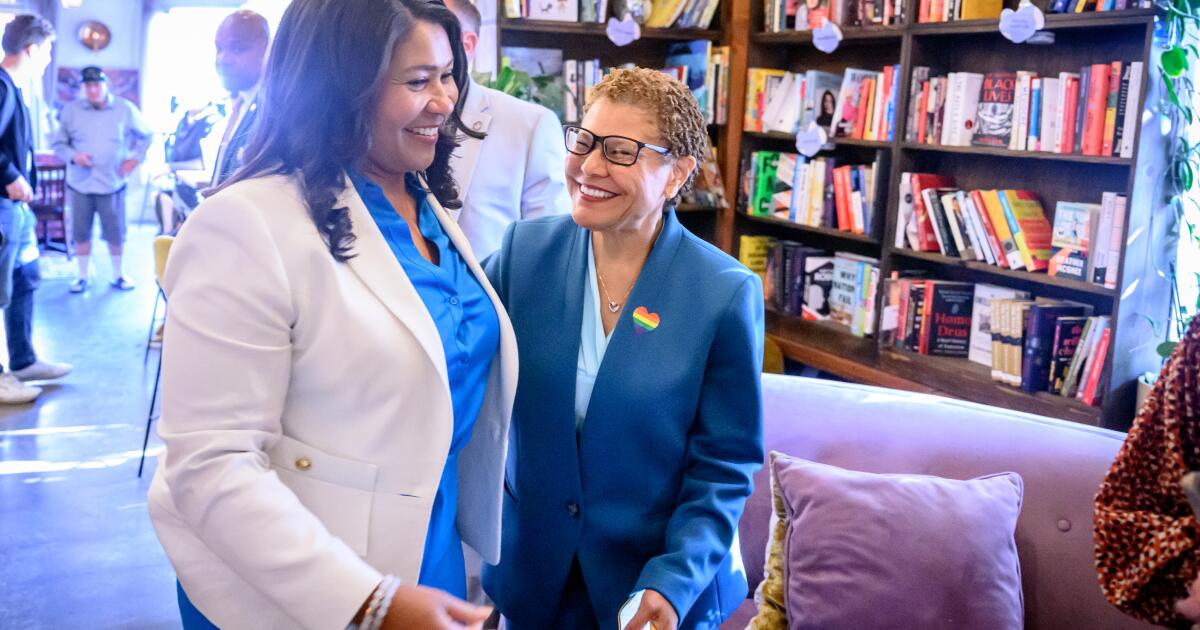
Karen Bass and London Breed each made history when they were elected, shattering glass ceilings in their respective cities as the first female mayor of Los Angeles and first Black woman to lead San Francisco.
They share many other similarities as powerful Democrats leading California’s marquee cities: a promise to reduce homelessness; plans to mitigate an opioid overdose crisis; an electorate concerned about crime.
But the ways the two mayors are attacking those urban problems reveal some surprising differences between them.
Breed, 49, has backed a tough-on-crime statewide ballot initiative that Bass, 70, does not support. The San Francisco mayor has also worked to toughen criminal penalties for fentanyl dealers and require drug screening and treatment for certain welfare recipients — issues the Los Angeles mayor has not weighed in on with financial assistance overseen by the county.
And they are split over a high-profile Supreme Court case that could make it easier for cities to clear homeless encampments: Breed has welcomed the high court’s review while Bass warned against a ruling that “could embolden those who wish to criminalize unhoused Angelenos.”
“Homelessness is the reason I ran,” Bass said during a discussion Monday at the civic engagement cafe Manny’s in San Francisco. “The main thing is getting people off the street ASAP because people are dying. But the problem in L.A. is the massive numbers.”
It was the first time the two mayors came together publicly for a one-on-one conversation. They discussed the challenges they face leading California’s most famous and influential cities.
“Homelessness is the reason I ran,” Los Angeles Mayor Karen Bass said.
(Josh Edelson / For The Times)
About 46,000 people are homeless in Los Angeles, where the population is about 3.8 million. An estimated 8,323 people are homeless in San Francisco, a city of about 808,000.
Breed said the problem in San Francisco is “a little bit different.”
Though the city has increased shelter capacity and helped 15,000 people exit homelessness, Breed said, the city faces a conundrum: The number of people who refuse housing or shelter is growing.
“The biggest problem is fentanyl, is drugs,” she said. “That has been the biggest challenge we’ve had to get people off the streets.”
Political differences in L.A. and S.F.
Breed and Bass are at different points in their mayorships, which may explain some of their divergence on policy. After six years leading San Francisco, Breed is up for reelection this year in a tough race against four serious challengers.
In contrast, Bass, who referred to herself as a “rookie” Monday, is still in a honeymoon phase after winning the election in November 2022.
“There seems to be this kind of doomy narrative in San Francisco that I don’t feel is quite as front of mind for Angelenos,” said Jason Ward, an economist at Rand Corp. in Santa Monica.
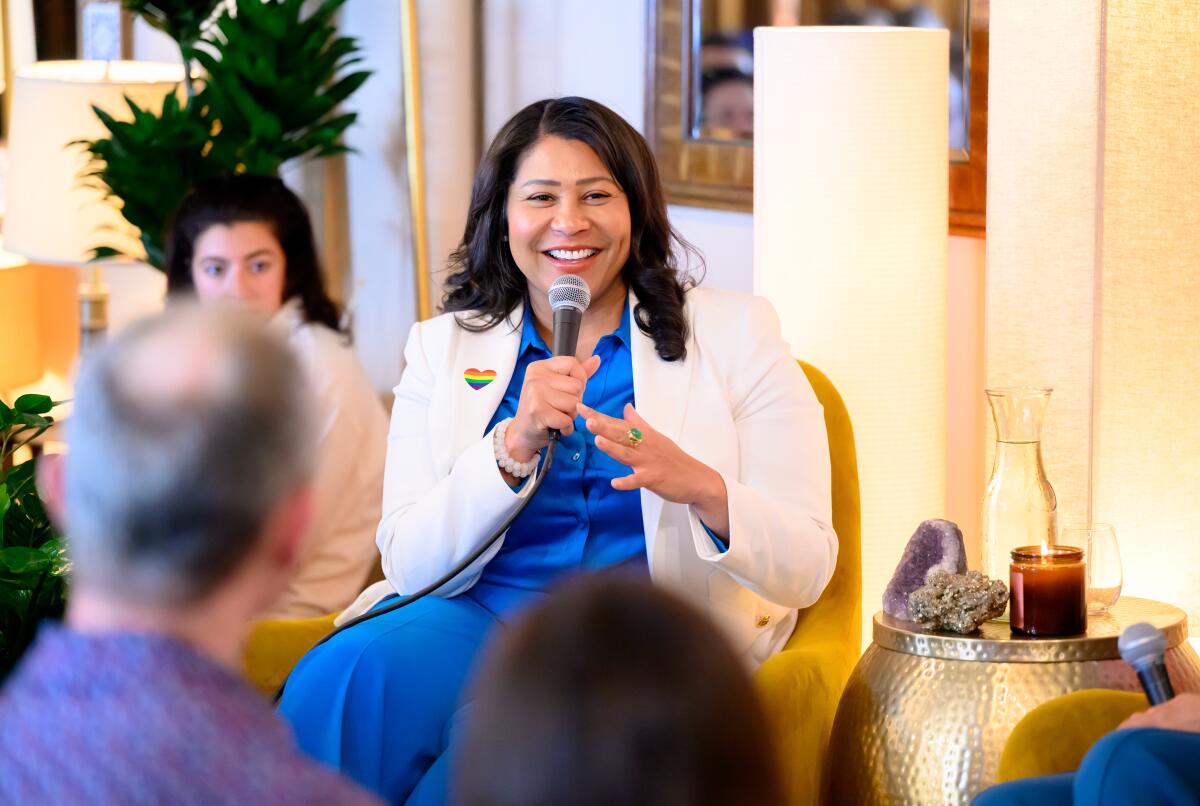
Mayor London Breed has supported some tough-on-crime strategies to address street homelessness and open-air drug use in San Francisco.
(Josh Edelson / For The Times)
As Breed’s political challenges have mounted in the last two years, she has turned to tough-on-crime strategies to crack down on street homelessness, open-air drug use and other public safety issues she once described in a speech as the “bull— that destroyed our city.”
Bass has sought a compassionate approach to homelessness without losing the support of the business community, a strategy that’s drawn praise and criticism. She has not given an endorsement in the heated L.A. district attorney race, which pits a so-called law and order candidate against the progressive incumbent.
In some instances, the two politicians are bringing the same blueprint to solving their cities’ problems.
Breed declared a state of emergency in December 2021 for the drug-infested Tenderloin district, with Bass following suit a year later with her own emergency declaration on homelessness. Both efforts aimed to make it easier to get people off the streets and increase access to resources.
Both mayors have rejected calls to roll back funding for police, even adding money for law enforcement in their city budgets, despite objections from some left-leaning voters. And they’ve each focused much of the last year on addressing homelessness via temporary shelter beds, while also putting money toward addiction and mental health services.
But it’s their policy differences that illustrate the varied ways civic leaders are trying to solve some of California’s thorniest problems.
“This is the nice thing about more and more women getting into elected life,” said Elizabeth Ashford, a Democratic strategist and board member of California Women Lead, an organization that works to elect more women. “People are going to have to rise and fall based on their own merits as leaders.”
As Black women, both mayors said their identities shape their experiences as politicians.
Bass said L.A.’s Black population is “quite small” at about 8%, and because of that she believes people misjudge her.
“I don’t mind being underestimated,” she said. “They won’t see it coming!”

San Francisco Mayor London Breed and Los Angeles Mayor Karen Bass discuss their cities’ challenges at Manny’s cafe in San Francisco.
(Josh Edelson / For The Times)
Breed echoed those same hurdles leading San Francisco, where the Black population is less than 5%.
“I’ve had to have some really hard conversations with a lot of very privileged people in this city who feel comfortable talking to me as if I’m beneath them,” Breed said.
“As African American women leading major cities, it’s different. Everybody wants the mayor to do a good job, but sometimes the challenges we face are different.”
Different approaches to fighting crime
Breed earlier this year endorsed a GOP-backed measure proposed for the November ballot that aims to roll back part of Proposition 47, a 2014 voter-approved initiative that reduced certain theft and drug felonies to misdemeanors. The measure would increase penalties for fentanyl dealers and organized retail theft rings, and provide mandatory treatment for drug users.
Bass said she doesn’t support efforts to repeal Proposition 47.
She said in a statement to The Times that the law “has its strengths and weaknesses and it should be evaluated in the same way that the impacts of any policy should be examined,” though her office didn’t make clear how she thinks the policy should be analyzed.
The mayors’ approaches “couldn’t be more different,” said Anne Irwin, director of Smart Justice California, a group that advocates for progressive changes to the criminal justice system.
Bass has “taken the lessons from the tough-on-crime era and accepted the hard truth that it didn’t work,” Irwin said. Breed, she said, has reverted to a “familiar political rhetoric” that appeases voters in the short term but fails public safety in the long haul.
“That’s why I call it an easy, expedient response,” Irwin said. “But that’s not leadership.”
While Irwin acknowledged that many San Franciscans want to see a tougher approach on public safety issues, she attributed waning voter support for Breed to what she described as an inconsistent and chaotic approach to solving those problems.
“San Franciscans are watching Mayor Breed over these past several years lurch from one approach to another based on the loudest headlines that week,” Irwin said.
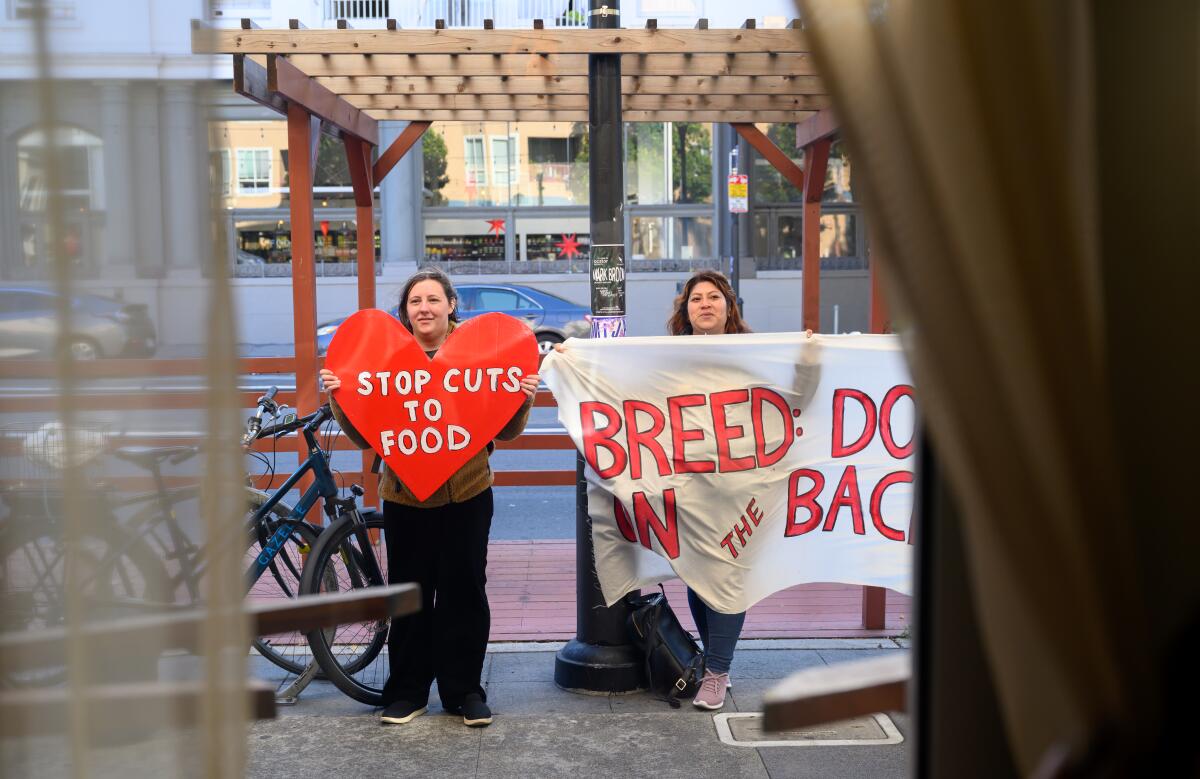
People outside the event protest budget cuts Mayor London Breed has proposed in San Francisco, including funds for child-care programs and food banks.
(Josh Edelson / For The Times)
To Breed’s supporters, she is making tough decisions for a city she loves.
Breed grew up in the Western Addition, raised by her grandmother in a tough childhood defined by poverty, gang violence and street crime. She has shared the story of losing a sister to a drug overdose nearly 20 years ago, and her brother has served more than two decades in prison for armed robbery and other charges.
“London Breed has a ton of experience being exposed to that kind of a life, and I would think that she has reacted in the way she should for the safety of her citizens,” said former Mayor Willie Brown, who made history himself as the first Black mayor of San Francisco and, before that, as speaker of the state Assembly. “And that’s what would be expected of a mayor.”
Bass has spent much of her time in office so far as she promised on the campaign trail — almost exclusively focused on homelessness. Under Bass’ Inside Safe program, which places homeless people in hotels, motels and other forms of shelter, 2,720 people have been moved from street encampments, according to officials.
She also issued an order that has dramatically sped up the city’s approval of residential projects deemed 100% affordable. In April, she said that more than 16,000 affordable housing units had entered the city’s pipeline.
Bass was raised in the Venice-Fairfax area of Los Angeles, and was volunteering for Sen. Robert Kennedy’s presidential campaign by age 14.
She founded Community Coalition, a nonprofit focused on tackling the structural racism that led to neglect in South L.A. A former emergency room physician assistant, she served more than a decade in Congress before being elected mayor.
She has sought to walk a fine line between helping people get into shelters and housing and responding to complaints from businesses and neighbors about tents and drug use.
She has mostly stayed out of the debate over a policy that gives council members the option to bar homeless encampments within 500 feet of schools and parks. The law is attacked by the most left-leaning members of the City Council, who decry it as a waste of police resources.
Bass, in interviews, has suggested that the law simply shuffles homeless encampments around, but said she won’t seek to repeal it.
The way the two mayors are responding reflects the frustrations in their respective cities, said Sam Tsemberis, chief executive of the Pathways Housing First Institute in Santa Monica.
“It comes down to personal attitudes and values,” Tsemberis said. “And also for the politicians, what will play well in terms of the likelihood of their reelection.”

Senator John Cornyn, Republican of Texas, may have the deciding vote on Todd Blanche’s confirmation as attorney general. Even a single Republican “no” vote would block Mr. Blanche’s nomination, and the senator said after Wednesday’s meeting that he had not made up his mind.

NEWYou can now listen to Fox News articles!
It was 2:35 am et Sunday.
The phone rang, yanking me out of deep slumber.
Calls like these are never good.
In the split second before I answered the phone, my mind traveled to the obvious place for any journalist who covers Capitol Hill and gets a call at that hour.
LINDSEY GRAHAM, SOUTH CAROLINA SENATOR WHO ROSE FROM SMALL-TOWN ROOTS TO GOP POWER BROKER, DIES AT 71
Former U.S. Sen. Lindsey Graham hugs his sister Darline Graham Nordone on June 1, 2015, in South Carolina. (Jessica McGowan/Getty Images)
Surely it was about former Senate Majority Leader Mitch McConnell (R-KY).
McConnell has been out of service and nowhere to be found for weeks — after being hospitalized with an unspecified illness. The internet was rife with conspiracy theories and conjecture. And, considering the dearth of information, I suspected the worst.
My longtime colleague Jodie Curtis was on the line when I picked up. Jodie is a senior figure at Fox, forced into weekend overnight assignment editor duty because of an illness. Jodie calling to tell me that Sen. Lindsey Graham (R-SC) was dead.
“Graham?” I asked incredulously. “Not McConnell?”
Emerging from my stupor, I instinctively presumed this might be about the infirm, Kentucky Republican. You’d have better odds presuming that overnight call was about McConnell than hitting an exacta wheel at Churchill Downs.
My instincts immediately kicked in.
What if this was psy-ops by the Russians, Chinese or Iranians. A rouse. A hoax. A hack.
I told my colleague to just wait a moment while we confirmed. It would be easy to get this wrong.
Back in the 1990s, lawmakers “killed” comedian Bob Hope on the House floor, prematurely announcing his death during special orders speeches. Yours truly – and everyone else in Washington – prematurely reported the death of the late Rep. Stephanie Tubbs-Jones (D-OH). She suffered from a catastrophic brain aneurism. Yet after they removed the Congresswoman from life support, she continued to live for a few hours before dying.
However, it became clear that Lindsey Graham was indeed dead. I was quickly on the air. When asked about the shock of Graham passing, I invoked a Native American adage: Death comes. And it’s always out of season.
Lindsey Graham was gone. But who would succeed him on Capitol Hill?
Think all in the family. At least for now.
Sens. Katie Britt (R-AL) and Tim Scott (R-SC) both implored the late senator’s kid sister Darline Graham to follow her brother. President Trump believed it would be a fitting tribute to the senator. So did South Carolina Gov. Henry McMaster (R) – who was in charge the appointment.
“It’s my honor to ask his sister to finish his work now,” said McMaster.
Darline Graham is a political neophyte. Lindsey Graham adopted his sister after their parents died – and Darline was a teenager.
“Lindsey has always been there for me. And now I will be there for him,” said now Sen. Darline Graham (R-SC).
Lindsey Graham was his sister’s caretaker. Now she’s the caretaker of his Senate seat until January.
But who’s next?
South Carolina has a small Congressional delegation. Rep. Joe Wilson (R-SC) quickly excluded himself from the immediate running, noting the importance of remaining in the House. Plucking one of South Carolina’s House GOP members and appointing them to the Senate is a problem for the narrow Republican majority. The Constitution bars appointments to the House. So McMaster would have diminished the GOP’s slim majority had he picked a House member to fill in for Lindsey Graham. It would take months to conduct a special election to fill the vacant House seat.
Appointing Darline Graham solves that problem.
Reps. Russell Fry (R-SC), Nancy Mace (R-SC) and Ralph Norman (R-SC) are all interested in running for the full term. South Carolina will hold a snap primary in mid August. The winner will face Democrat Annie Andrews in November. Lindsey Graham had just secured the Republican nomination for a fifth term last month.
President Trump’s influence will play an outsized role in who gets the nod. He’s already singled out Fry.
But the election will look a little different this fall. November will mark the first time since the mid-1950s that either Lindsey Graham or late, legendary Sen. Strom Thurmond (R-SC) isn’t on the ballot in the Palmetto State.
The Senate met for the first time Monday afternoon since Graham’s passing.
“Lord, we remember with gratitude his commitment to the responsibilities entrusted to him and the many ways he sought to serve the people of this country. Give comfort, strength and peace to his family, friends, colleagues and all who mourn his passing,” prayed Senate Chaplain Barry Black.
The Senate shrouded Graham’s desk with a black cloak. A bouquet of white roses rested on the desk, signifying a new beginning without a Senate titan.
“The halls of the Senate already feel empty without him,” said Senate Majority Leader John Thune (R-SD).
‘THIS IS NOT NORMAL’: AOC UNLOADS ON MCCONNELL’S PROLONGED ABSENCE
Former Sen. Lindsey Graham attends a press conference on border security at the U.S. Capitol in Washington, D.C. on December 7, 2023. (Kevin Dietsch/Getty Images)
Well wishers left notecards and flowers outside Graham’s office in the Russell Senate Office Building.
Senators praised Graham’s tenacity.
“He didn’t want to just argue about things. He wanted to actually solve things,” said Sen. James Lankford (R-OK) on Fox.
Even until the end.
Over the weekend, Graham appeared to forge a deal on a Russia sanctions measure.
“This could be well, this could well be the end of the war in Ukraine. It could put all the pressure on Russia to finally end their illegal war of aggression,” predicted Sen. Angus King (I-ME).
Lindsey Graham first won a seat in Congress in 1994 as part of the “Republican Revolution.” That’s the historic class which flipped control of the House for the first time in 40 years. Graham and Senate Armed Services Committee Chairman Roger Wicker (R-MS) are the only members from that 1994 class still serving in Congress.
Graham earned a national profile barely four years after arriving in Washington. House GOP leaders tapped Graham to serve as one of the House “managers,” prosecuting articles of impeachment for President Clinton in the Senate.
“Impeachment is not about punishment,” argued Graham before the Senate in January, 1999. “Impeachment is about cleansing the office.”
Three years after that, Graham left the House. He became one of 100 in the Senate. But his colleagues conceded that the institution felt hollow at just 99.
“I am comforted by the knowledge that in the end, he has just changed his address. And that one day, Mr. President….” said Thune on the floor, pausing for ten seconds. “We will laugh together again.”
The Leader’s voice then cracked as he fought back tears.
“Mr. President, I yield the floor,” Thune whispered.
By Tuesday afternoon, Darline Graham became the 2,022nd senator in American history. But the first to immediately succeed her brother.
“He always said that his greatest accomplishment was the way that Darline turned out,” said Britt.
“I’m glad that there will be another Sen. Graham and that Darline will serve with us,” said
Sen. Chris Coons (D-DE). “That’ll allow for some continuity.”
Graham’s passing leaves a Congressional chasm.
“It will be difficult to pass anything without Sen. Graham because he’s been such a significant voice in the Senate,” said Sen. Cynthia Lummis (R-WY).
It’s unclear if any of that will fall to the Senate’s newest member.
LINDSEY GRAHAM’S SISTER CARRIES ON LATE SENATOR’S WORK, BECOMING SOUTH CAROLINA’S FIRST FEMALE SENATOR
Darline Graham Nordone speaks during a press conference outside the governor’s South Carolina State House office in Columbia. (Grant Baldwin/Getty Images)
CLICK HERE TO DOWNLOAD THE FOX NEWS APP
Darline Graham joined her brother’s side when he briefly ran for President in 2015. She says Lindsey taught her how to ride a bike while growing up.
“He would hold on to the bicycle as I pedaled. And he’d run along beside of me. Give me a big push and shout ‘Keep pedaling! Keep pedaling!’ said the new senator. ” And then he was the one who comforted me when I stopped pedaling and fell off the bicycle.”
Today, Darline Graham is again hopping onto that bicycle to finish Lindsey Graham’s term.
You can almost hear the late senator, in his “upstate” twang shouting to his sister “Keep pedaling! Keep pedaling!”

Democrat Xavier Becerra holds a commanding lead in the California governor’s race in a new poll, which also shows broad voter support for a ballot proposition to reform the state’s landmark environmental law to speed up housing and infrastructure.
The survey by the Public Policy Institute of California, released Wednesday night, focused primarily on questions related to climate change and environmental policies.
The results show Californians have a strong distaste for building data centers for artificial intelligence technology, and largely favor the state’s efforts to protect the environment and cut emissions — with some exceptions.
The survey showed Becerra with a big lead over Republican Steve Hilton in the race to replace term-limited Gov. Gavin Newsom. Becerra, a longtime Democratic officeholder, received support from 61% of likely voters, compared with 36% for Hilton, a populist conservative who once advised a British prime minister.
Gubernatorial candidate Steve Hilton speaks at the National Assn. of Latino Elected and Appointed Officials conference in L.A. on Wednesday.
(Myung J. Chun / Los Angeles Times)
The results are not surprising in a state where Democratic voters significantly outnumber Republicans. The GOP has not won a statewide election since 2008.
Just 2% of likely voters said they were unsure which candidate to support in the November election. The poll results skewed heavily partisan, with more than 9 in 10 Democratic and Republican voters picking their party’s respective candidate. Most independent voters leaned toward Becerra, 60%, over Hilton, 34%.
The results are similar to data from a poll conducted just before the June 2 primary election that asked voters to pick between the two candidates. In that survey, 52% said they supported Becerra and 31% were for Hilton.
In a statement Wednesday, Hilton characterized the race as “wide open,” contending that Becerra’s support was weaker than the poll’s headline figures would indicate.
“Instead of a 36-year career politician, we need a positive, energetic problem-solver with business experience and plans to make our state ‘Califordable’ — that’s me,” Hilton said.
Becerra spokesman Jonathan Underland said in a statement that “Californians got to know Xavier Becerra during the primary, and they’re ready to make him their next governor. We’re keeping our eyes on the prize — hitting the trail every day ’til November to turn that support into votes.”
Support for CEQA reform
A ballot measure aimed at reforming the California Environmental Quality Act to speed up construction notched a strong showing in the poll.
Nearly three-quarters of likely voters, including majorities of Democrats, Republicans and independents, said that they would vote for Proposition 45. The measure would shorten windows for environmental review, public comment and legal challenges for certain housing, transportation, water infrastructure and other projects.
“At this early stage in the campaign, California voters are feeling more aligned with Democratic candidates on the environment, and it shows in the polling,” said PPIC survey director Mark Baldassare. “But strong support for Proposition 45 reveals their desire to balance environmental priorities with housing and infrastructure needs.”
Strong data center opposition
The poll found large majorities of Californians do not want new data centers to support the AI boom built in their area; 44% of adults say they “strongly oppose” such projects, and 29% “somewhat oppose” them.
The majority opposition holds across political parties, geographic regions, gender, race and income. It’s especially pronounced in the Inland Empire, where plans for a 950,000-square-foot data center came to a halt after fierce resident pushback. Three-quarters of people surveyed in that region said they oppose building new data centers.
“Every day, we are hearing about how local communities across the nation are responding to plans for data centers,” Baldassare said. “Californians have weighed in and they share this growing concern.”
Support for environmental policies — except if they cost more
The poll also shows strong, if somewhat qualified, support for California’s efforts to reduce climate-warming greenhouse gas emissions and protect the environment.
Three-quarters of adults said policies to reduce greenhouse gas emissions have been a good thing overall, and 65% said they support California leaders’ efforts to make their own environmental policies separate from the federal government.
While most respondents — 62% — said they favor a law requiring 100% of the state’s electricity to come from renewable energy sources within the next two decades, just 38% said they were willing to pay more for electricity sourced from renewables.
“With energy prices spiking and affordability a growing concern, Californians are just not willing to pay more for renewable energy,” Baldassare said. A near-unanimous majority, 96%, said the cost of energy — including gasoline, natural gas and electricity — is a problem.
Newsom’s move to ban the sale of new gas-powered vehicles in the state by 2035 also appears to have fallen out of favor. Two-thirds of Californians oppose the policy, a significant slip in approval from 2021, when a PPIC survey showed 49% supported the move.
Still, majorities of likely voters — 53% and 51%, respectively — said they approve of Newsom’s and the state Legislature’s handling of environmental issues.
At 28%, President Trump’s approval rating on the environment was much lower. In his second term, Trump has moved to slash environmental regulations, including easing pollution regulations on coal-fired power plants and pushing for oil drilling off California’s coast.
“Given this ratings gap, it’s not surprising that Californians want to see the state take the lead on climate change policy,” Baldassare said.
The survey polled 1,578 California adults, 1,003 of whom were likely voters, in English and Spanish from June 29 to July 6 and had a margin of error of 3.8 percentage points in either direction.
-
 New Mexico49 seconds ago
The Chinese immigrants trafficked on New Mexico’s weed farms – High Country News
-

 North Carolina7 minutes ago
North Carolina’s Charming Raleigh Suburb Is A Fast-Growing Town With River Views And A Historic Downtown – Islands
-

 North Dakota13 minutes ago
‘I think I was cheated’: Men speak out after birth switch discovery
-
Ohio19 minutes ago
Ohio Lottery Powerball, Pick 3 Midday winning numbers for July 15, 2026
-

 Oklahoma25 minutes ago
Failed report, recorded calls offer look inside Oklahoma County Jail
-
Oregon31 minutes ago
Oregon Lottery Powerball, Pick 4 results for July 15
-

 Pennsylvania37 minutes ago
Fifth Time’s The Harm: Pennsylvania Gov. Shapiro Again Signed A Budget With No Money For Transit — Streetsblog USA
-

 Rhode Island43 minutes ago
Jamestown Swarm Chaser has unique talent for catching, moving bees

