Politics
Many O.C. residents deny Trump election results, potentially swaying key races, poll finds

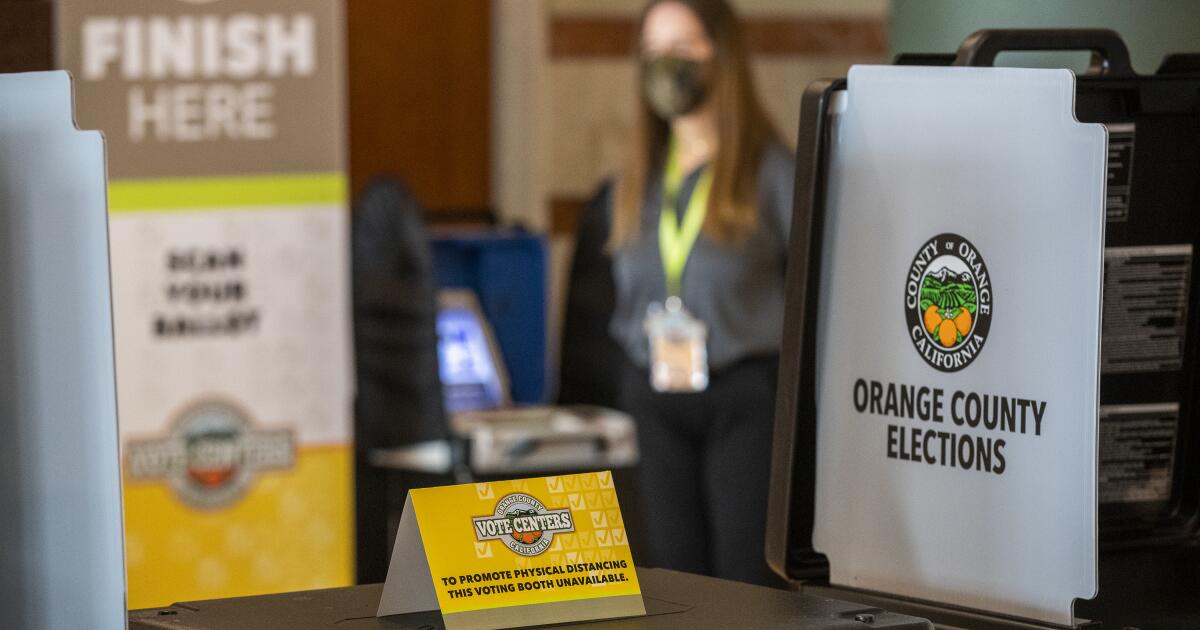
Alex Lopez doesn’t contest that Joe Biden was elected president in 2020.
His concern lies with how those results came to be.
“By the numbers? He absolutely won it. Ethically? Probably not,” said the 38-year-old Anaheim resident, who works as a logistics coordinator.
Questions about the integrity of the election process have been stoked nationally for years, in large part because of former President Trump’s claims that victory was stolen from him.
The same goes for Orange County, where 26% of adults surveyed in a UC Irvine poll released this month said they did not believe Biden legitimately won the presidency in 2020, with another 17% unsure about the question.
In a purple county with several key races that could help determine the balance of power in Congress, these doubts could cause voters to stay home in November — particularly conservative voters.
A majority of the O.C. Republicans surveyed for the poll — 55% — thought Biden had not won fairly, while most Democrats — 88% — believed the election results.
A majority of people surveyed who aren’t members of either party said Biden won legitimately. However, 23% said he didn’t, and the same percentage didn’t know.
“Distrust in the election system may very well convince some people not to participate, and what we’re seeing is that people who distrust it more tend to skew to the right, and so that would hurt Republicans,” said Jon Gould, dean of the UCI School of Social Ecology, who spearheaded the poll.
The issue has played out locally in Huntington Beach, a longtime GOP stronghold that in recent years — along with the rest of the county — has grown more politically and demographically diverse. This has led to friction among residents and politicians with opposing political views.
In March, voters approved a measure allowing the city to require that voters show government-issued photo identification, beginning in 2026.
Huntington Beach Councilman Tony Strickland and Mayor Gracey Van Der Mark wrote in support of the ballot measure that voters “deserve the right to know that our elections are secure.”
“It is crucial for our democracy that voters have faith in our election results. That trust in the outcome of elections comes into question when we can’t always be certain who is voting,” they wrote.
California law requires residents to verify their identities when they register to vote and imposes criminal penalties for fraudulent registration. The state does not ask for photo identification at the polls, but voters are required to provide their names and addresses.
This month, California sued Huntington Beach over its new law. Atty. Gen. Rob Bonta said during a news conference that the photo identification requirement “is not only misguided — it is blatantly and flatly illegal.”
Election skepticism in O.C. may be lower than in some other parts of the country. In a national poll conducted by the Washington Post and the University of Maryland last December, 36% of respondents said Biden’s victory was not legitimate.
But in the highly competitive Orange County congressional races, particularly the 47th and 45th districts, where a few votes could sway the outcome, the repercussions could be far-reaching.
In the 45th District, Democrat Derek Tran is challenging incumbent Republican Rep. Michelle Steel. In the 47th District, which runs largely along the coast, Democrat state Sen. Dave Min and Republican Scott Baugh are facing off to replace Democratic Rep. Katie Porter.
As for the presidential rematch between Biden and Trump, there is little suspense in California because of its deep blue population in urban areas.
Still, Trump asserted in a speech at the GOP California Convention in Anaheim last year that “we would win California in a general election if they didn’t have a rigged voting system.” He alleged that people are getting five or six ballots mailed to them.
“Nobody knows where they’re going, who they’re going to, who signs them, who delivers them and who the hell counts them? Nobody knows,” he said.
The widespread use of vote-by-mail ballots, which began during the pandemic and has remained popular, has altered the pattern of vote counting as results trickle in, fueling beliefs that something nefarious is afoot.
“Trump was winning on election night, and then as more and more votes were counted, he began to lose, and that looks to some people like someone’s been tweaking the election results, as opposed to people for the first time being exposed to vote by mail,” Gould, of UCI, said.
Orange County Registrar of Voters Bob Page started conducting open tours of the ballot counting operation in Santa Ana during the 2022 midterms in an effort to show people the process and alleviate concerns.
But election skepticism and allegations of a “rigged” voting system have persisted.
The economy, abortion, foreign policy and immigration remain top issues for Orange County voters this cycle, according to the UC Irvine poll. The economy is among the top issues for both Democrat and Republican voters.
Democrats rank abortion as the third most important issue, behind checking a Trump presidency from “going too far” and the economy. Republicans rank the economy and situation at the border as their first and second most important issues.
Lopez, who is a nonaffiliated voter, said he worries about issues like ballot harvesting — particularly affecting people who might be susceptible to outside pressure — that he fears could skew election results.
He also has concerns about the “motor voter” system, in which Californians applying for or updating a driver’s license are automatically registered to vote, unless they opt out. In 2018 — the year the system rolled out in California — roughly 1,500 people, including noncitizens, were wrongly registered to vote.
“I would love to hear the government and states come out and say, ‘Hey, you know what, these are the concerns from a lot of people, and we’re going to put some stopgaps in there,’” Lopez said.
Lopez, who ranks the economy as a top issue, still plans to vote. He is still researching candidates in all the races but said he’s leaning toward Trump for president.
Others disillusioned with the voting process might choose to sit this one out.
“By selling doubts in the election, there is an interesting question as to whether Republicans and Trump in particular are sowing the seeds for their own defeat,” Gould said.



NEWYou can now listen to Fox News articles!
President Donald Trump has signed an executive order blocking U.S. courts from seizing Venezuelan oil revenues held in American Treasury accounts.
The order states that court action against the funds would undermine U.S. national security and foreign policy objectives.
CLICK HERE TO DOWNLOAD THE FOX NEWS APP
President Donald Trump is pictured signing two executive orders on Sept. 19, 2025, establishing the “Trump Gold Card” and introducing a $100,000 fee for H-1B visas. He signed another executive order recently protecting oil revenue. (Andrew Harnik/Getty Images)
Trump signed the order on Friday, the same day that he met with nearly two dozen top oil and gas executives at the White House.
The president said American energy companies will invest $100 billion to rebuild Venezuela’s “rotting” oil infrastructure and push production to record levels following the capture of Venezuelan dictator Nicolás Maduro.
The U.S. has moved aggressively to take control of Venezuela’s oil future following the collapse of the Maduro regime.
This is a developing story. Please check back for updates.

One of the most important political stories in American history — one that is particularly germane to our current, tumultuous time — unfolded in Los Angeles some 65 years ago.
Sen. John F. Kennedy, a Catholic, had just received his party’s nomination for president and in turn he shunned the desires of his most liberal supporters by choosing a conservative out of Texas as his running mate. He did so in large part to address concerns that his faith would somehow usurp his oath to uphold the Constitution. The last time the Democrats nominated a Catholic — New York Gov. Al Smith in 1928 — he lost in a landslide, so folks were more than a little jittery about Kennedy’s chances.
“I am fully aware of the fact that the Democratic Party, by nominating someone of my faith, has taken on what many regard as a new and hazardous risk,” Kennedy told the crowd at the Memorial Coliseum. “But I look at it this way: The Democratic Party has once again placed its confidence in the American people, and in their ability to render a free, fair judgment.”
The most important part of the story is what happened before Kennedy gave that acceptance speech.
While his faith made party leaders nervous, they were downright afraid of the impact a civil rights protest during the Democratic National Convention could have on November’s election. This was 1960. The year began with Black college students challenging segregation with lunch counter sit-ins across the Deep South, and by spring the Student Nonviolent Coordinating Committee had formed. The Rev. Martin Luther King Jr. was not the organizer of the protest at the convention, but he planned to be there, guaranteeing media attention. To try to prevent this whole scene, the most powerful Black man in Congress was sent to stop him.
The Rev. Adam Clayton Powell Jr. was also a warrior for civil rights, but the House representative preferred the legislative approach, where backroom deals were quietly made and his power most concentrated. He and King wanted the same things for Black people. But Powell — who was first elected to Congress in 1944, the same year King enrolled at Morehouse College at the age of 15 — was threatened by the younger man’s growing influence. He was also concerned that his inability to stop the protest at the convention would harm his chance to become chairman of a House committee.
And so Powell — the son of a preacher, and himself a Baptist preacher in Harlem — told King that if he didn’t cancel, Powell would tell journalists a lie that King was having a homosexual affair with his mentor, Bayard Rustin. King stuck to his plan and led a protest — even though such a rumor would not only have harmed King, but also would have undermined the credibility of the entire civil rights movement. Remember, this was 1960. Before the March on Washington, before passage of the Voting Rights Act, before the dismantling of the very Jim Crow laws Powell had vowed to dismantle when first running for office.
That threat, my friends, is the most important part of the story.
It’s not that Powell didn’t want the best for the country. It’s just that he wanted to be seen as the one doing it and was willing to derail the good stemming from the civil rights movement to secure his own place in power. There have always been people willing to make such trade-offs. Sometimes they dress up their intentions with scriptures to make it more palatable; other times they play on our darkest fears. They do not care how many people get hurt in the process, even if it’s the same people they profess to care for.
That was true in Los Angeles in 1960.
That was true in Washington, D.C., on Jan. 6, 2021.
That is true in the streets of America today.
Whether we are talking about an older pastor who is threatened by the growing influence of a younger voice or a president clinging to office after losing an election: To remain king, some men are willing to burn the entire kingdom down.
YouTube: @LZGrandersonShow
Politics
Federal judge blocks Trump from cutting childcare funds to Democratic states over fraud concerns

NEWYou can now listen to Fox News articles!
A federal judge Friday temporarily blocked the Trump administration from stopping subsidies on childcare programs in five states, including Minnesota, amid allegations of fraud.
U.S. District Judge Arun Subramanian, a Biden appointee, didn’t rule on the legality of the funding freeze, but said the states had met the legal threshold to maintain the “status quo” on funding for at least two weeks while arguments continue.
On Tuesday, the U.S. Department of Health and Human Services (HHS) said it would withhold funds for programs in five Democratic states over fraud concerns.
The programs include the Child Care and Development Fund, the Temporary Assistance for Needy Families program, and the Social Services Block Grant, all of which help needy families.
USDA IMMEDIATELY SUSPENDS ALL FEDERAL FUNDING TO MINNESOTA AMID FRAUD INVESTIGATION
On Tuesday, the U.S. Department of Health and Human Services said it would withhold funds for programs in five Democratic states over fraud concerns. (AP Photo/Jose Luis Magana, File)
“Families who rely on childcare and family assistance programs deserve confidence that these resources are used lawfully and for their intended purpose,” HHS Deputy Secretary Jim O’Neill said in a statement on Tuesday.
The states, which include California, Colorado, Illinois, Minnesota and New York, argued in court filings that the federal government didn’t have the legal right to end the funds and that the new policy is creating “operational chaos” in the states.
U.S. District Judge Arun Subramanian at his nomination hearing in 2022. (Tom Williams/CQ-Roll Call, Inc via Getty Images)
In total, the states said they receive more than $10 billion in federal funding for the programs.
HHS said it had “reason to believe” that the programs were offering funds to people in the country illegally.
‘TIP OF THE ICEBERG’: SENATE REPUBLICANS PRESS GOV WALZ OVER MINNESOTA FRAUD SCANDAL
The table above shows the five states and their social safety net funding for various programs which are being withheld by the Trump administration over allegations of fraud. (AP Digital Embed)
New York Attorney General Letitia James, who is leading the lawsuit, called the ruling a “critical victory for families whose lives have been upended by this administration’s cruelty.”
New York Attorney General Letitia James, who is leading the lawsuit, called the ruling a “critical victory for families whose lives have been upended by this administration’s cruelty.” (Win McNamee/Getty Images)
CLICK HERE TO DOWNLOAD THE FOX NEWS APP
Fox News Digital has reached out to HHS for comment.

'There Could Be A Whole Other Life He's Living' 'The Ramsey Show' Host Says After Wife Finds $209K Debt Behind Her Back

Just 10 minutes of exercise can trigger powerful anti-cancer effects

1986 Movie Reviews – Black Moon Rising | The Nerdy

Video: Owner of Swiss Bar Detained in Fire Investigation

Video: Raising a Baby in Altadena’s Ashes

Florida High School Football Rankings: Top 25 teams – Oct. 21

Cleary's 21 help Le Moyne down Central Connecticut State 69-64 in OT

How old is Bo Nix? What to know about Oregon quarterback ahead of 2024 NFL Draft

99th annual Pony Swim held in Virginia

Video: ‘It Didn’t Have to Happen This Way:’ U.Va. Faculty Call for Review of Police Response to Protests
Video: Raising a Baby in Altadena’s Ashes

Trump signs order to protect Venezuela oil revenue held in US accounts
What Canada, accustomed to extreme winters, can teach Europe

New video shows fatal Minnesota ICE shooting from officer’s perspective

Federal judge blocks Trump from cutting childcare funds to Democratic states over fraud concerns
-

 Detroit, MI7 days ago
2 hospitalized after shooting on Lodge Freeway in Detroit
-

 Technology4 days ago
Power bank feature creep is out of control
-

 Dallas, TX5 days ago
Defensive coordinator candidates who could improve Cowboys’ brutal secondary in 2026
-

 Iowa4 days ago
Pat McAfee praises Audi Crooks, plays hype song for Iowa State star
-

 Dallas, TX2 days ago
Anti-ICE protest outside Dallas City Hall follows deadly shooting in Minneapolis
-

 Health6 days ago
Viral New Year reset routine is helping people adopt healthier habits
-

 Delaware1 day ago
MERR responds to dead humpback whale washed up near Bethany Beach
-

 Nebraska3 days ago
Oregon State LB transfer Dexter Foster commits to Nebraska