Politics
Kristi Noem grilled over L.A. Purple Heart Army vet who self-deported


The saga of a Los Angeles Army veteran who legally immigrated to the United States, was wounded in combat and self-deported to South Korea earlier this year, became a flashpoint during a testy congressional hearing about the Trump administration’s immigration policy.
Homeland Security Secretary Kristi Noem was grilled Thursday on Capitol Hill about military veterans deported during the immigration crackdown launched earlier this year, including in Los Angeles.
“Sir, we have not deported U.S. citizens or military veterans,” Noem responded when questioned by Rep. Seth Magaziner (D-R.I.).
Rep. Seth Magaziner (D-R.I.) speaks during a hearing of the House Committee on Homeland Security on Thursday. He was joined on a video call by Sae Joon Park, a U.S. military veteran who self-deported to South Korea.
(Mark Schiefelbein / Associated Press)
An aide then held up a tablet showing a Zoom connection with Purple Heart recipient Sae Joon Park in South Korea. The congressman argued that Park had “sacrificed more for this country than most people ever have” and asked Noem if she would investigate Park’s case, given her discretion as a Cabinet member. Noem pledged to “absolutely look at his case.”
Park, reached in Seoul on Thursday night, said he was skeptical that Noem would follow through on her promise, but said that he had “goosebumps” watching the congressional hearing.
“It was amazing. And then I’m getting tons of phone calls from all my friends back home and everywhere else. I’m so very grateful for everything that happened today,” Park, 56, said, noting that friends told him that a clip of his story appeared on ABC’s “Jimmy Kimmel Live!” show Thursday night.
The late-night host featured footage of Park’s moment in the congressional hearing in his opening monologue.
“Is anyone OK with this? Seriously, all kidding aside, we deported a veteran with a Purple Heart?” Kimmel said, adding that Republicans “claim to care so much about veterans, but they don’t at all.”
Park legally immigrated to the United States when he was 7, grew up in Koreatown and the San Fernando Valley, and joined the Army after graduating from Notre Dame High School in Sherman Oaks in 1988.

Sae Joon Park received a Purple Heart while serving in the Army.
(From Sae Joon Park)
The green card holder was deployed to Panama in 1989 as the U.S. tried to depose the nation’s de facto leader, Gen. Manuel Noriega. Park was shot twice and honorably discharged. Suffering post-traumatic stress disorder, he self-medicated with illicit drugs, went to prison after jumping bail on drug possession charges, became sober and raised two children in Hawaii.
Earlier this year, when Park checked in for his annual meeting with federal officials to verify his sobriety and employment, he was given the option of being immediately detained and deported, or wearing an ankle monitor for three weeks as he got his affairs in order before leaving the country for a decade.
At the time, Department of Homeland Security Assistant Secretary Tricia McLaughlin said Park had an “extensive criminal history” and had been given a final removal order, with the option to self-deport.
Park chose to leave the country voluntarily. He initially struggled to acclimate in a nation he hasn’t lived in since he was a child, but said Thursday night that his mental state — and his Korean-language skills — have improved.
“It hasn’t been easy. Of course, I miss home like crazy,” he said. “I’m doing the best I can. I’m usually a very positive person, so I feel like everything happens for a reason, and I’m just trying to hang in there until hopefully I make it back home.”
Among Park’s top concerns when he left the United States in June was that his mother, who is 86 and struggling with dementia, would die while he couldn’t return to the county. But her lack of awareness about his situation has been somewhat of a strange blessing, Park said.
“She really doesn’t know I’m even here. So every time I talk to her, she’s like, ‘Oh, where are you?’ And I tell her, and she’s like, ‘Oh, when are you coming home? Oh, why are you there?’” Park said. “In a weird way, it’s kind of good because she doesn’t have to worry about me all the time. But at the same time, I would love to be next to her while she’s going through this.”



NEWYou can now listen to Fox News articles!
President Donald Trump said on Thursday that he plans to meet with Venezuelan opposition leader Maria Corina Machado in Washington next week.
During an appearance on Fox News’ “Hannity,” Trump was asked if he intends to meet with Machado after the U.S. struck Venezuela and captured its president, Nicolás Maduro.
“Well, I understand she’s coming in next week sometime, and I look forward to saying hello to her,” Trump said.
Venezuelan opposition leader Maria Corina Machado waves a national flag during a protest called by the opposition on the eve of the presidential inauguration, in Caracas on January 9, 2025. (JUAN BARRETO/AFP via Getty Images)
This will be Trump’s first meeting with Machado, who the U.S. president stated “doesn’t have the support within or the respect within the country” to lead.
According to reports, Trump’s refusal to support Machado was linked to her accepting the 2025 Nobel Peace Prize, which Trump believed he deserved.
But Trump later told NBC News that while he believed Machado should not have won the award, her acceptance of the prize had “nothing to do with my decision” about the prospect of her leading Venezuela.
Politics
California sues Trump administration over ‘baseless and cruel’ freezing of child-care funds
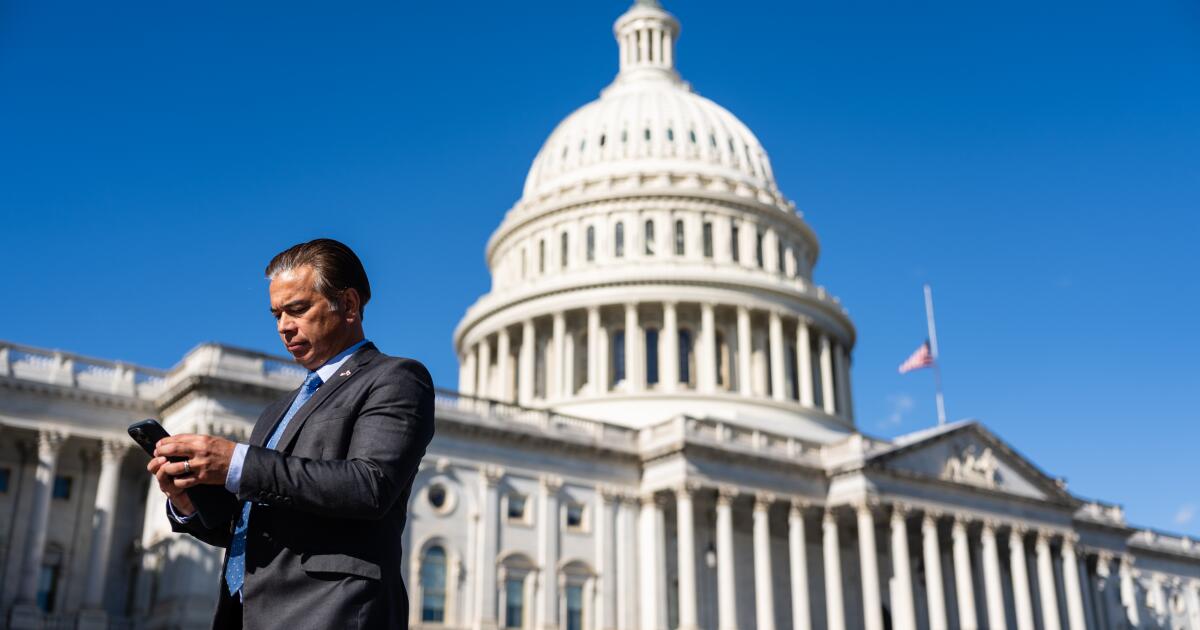
California is suing the Trump administration over its “baseless and cruel” decision to freeze $10 billion in federal funding for child care and family assistance allocated to California and four other Democratic-led states, Atty. Gen. Rob Bonta announced Thursday.
The lawsuit was filed jointly by the five states targeted by the freeze — California, New York, Minnesota, Illinois and Colorado — over the Trump administration’s allegations of widespread fraud within their welfare systems. California alone is facing a loss of about $5 billion in funding, including $1.4 billion for child-care programs.
The lawsuit alleges that the freeze is based on unfounded claims of fraud and infringes on Congress’ spending power as enshrined in the U.S. Constitution. The White House did not immediately respond to a request for comment.
“This is just the latest example of Trump’s willingness to throw vulnerable children, vulnerable families and seniors under the bus if he thinks it will advance his vendetta against California and Democratic-led states,” Bonta said at a Thursday evening news conference.
The $10-billion funding freeze follows the administration’s decision to freeze $185 million in child-care funds to Minnesota, where federal officials allege that as much as half of the roughly $18 billion paid to 14 state-run programs since 2018 may have been fraudulent. Amid the fallout, Gov. Tim Walz has ordered a third-party audit and announced that he will not seek a third term.
Bonta said that letters sent by the U.S. Department of Health and Human Services announcing the freeze Tuesday provided no evidence to back up claims of widespread fraud and misuse of taxpayer dollars in California. The freeze applies to the Temporary Assistance for Needy Families program, the Social Services Block Grant program and the Child Care and Development Fund.
“This is funding that California parents count on to get the safe and reliable child care they need so that they can go to work and provide for their families,” he said. “It’s funding that helps families on the brink of homelessness keep roofs over their heads.”
Bonta also raised concerns regarding Health and Human Services’ request that California turn over all documents associated with the state’s implementation of the three programs. This requires the state to share personally identifiable information about program participants, a move Bonta called “deeply concerning and also deeply questionable.”
“The administration doesn’t have the authority to override the established, lawful process our states have already gone through to submit plans and receive approval for these funds,” Bonta said. “It doesn’t have the authority to override the U.S. Constitution and trample Congress’ power of the purse.”
The lawsuit was filed in federal court in Manhattan and marked the 53rd suit California had filed against the Trump administration since the president’s inauguration last January. It asks the court to block the funding freeze and the administration’s sweeping demands for documents and data.

new video loaded: Trump Says ‘Only Time Will Tell’ How Long U.S. Controls Venezuela
transcript
transcript
Trump Says ‘Only Time Will Tell’ How Long U.S. Controls Venezuela
President Trump did not say exactly how long the the United states would control Venezuela, but said that it could last years.
-
“How Long do you think you’ll be running Venezuela?” “Only time will tell. Like three months. six months, a year, longer?” “I would say much longer than that.” “Much longer, and, and —” “We have to rebuild. You have to rebuild the country, and we will rebuild it in a very profitable way. We’re going to be using oil, and we’re going to be taking oil. We’re getting oil prices down, and we’re going to be giving money to Venezuela, which they desperately need. I would love to go, yeah. I think at some point, it will be safe.” “What would trigger a decision to send ground troops into Venezuela?” “I wouldn’t want to tell you that because I can’t, I can’t give up information like that to a reporter. As good as you may be, I just can’t talk about that.” “Would you do it if you couldn’t get at the oil? Would you do it —” “If they’re treating us with great respect. As you know, we’re getting along very well with the administration that is there right now.” “Have you spoken to Delcy Rodríguez?” “I don’t want to comment on that, but Marco speaks to her all the time.”
January 8, 2026

Controversy Surrounds ‘The Raja Saab’ as Makers Allegedly Offer Money for Positive Reviews | – The Times of India

‘If it expires, it expires,’ Trump tells NYT about US-Russia nuclear treaty

Brain Health Challenge: Doctor Appointments for Your Mind and Body

Doctors says ‘The Pitt’ reflects the gritty realities of medicine today

Xbox’s Towerborne is switching from a free-to-play game to a paid one

Florida High School Football Rankings: Top 25 teams – Oct. 21

Cleary's 21 help Le Moyne down Central Connecticut State 69-64 in OT

How old is Bo Nix? What to know about Oregon quarterback ahead of 2024 NFL Draft

99th annual Pony Swim held in Virginia

Video: ‘It Didn’t Have to Happen This Way:’ U.Va. Faculty Call for Review of Police Response to Protests

Trump plans to meet with Venezuela opposition leader Maria Corina Machado next week

Trump says meeting Iran’s ‘Crown Prince’ Pahlavi would not be appropriate

Federal immigration agents shoot 2 people in Portland, Oregon, police say

Video: What Trump Told Us About the ICE Shooting

Trump calls for $1.5T defense budget to build ‘dream military’
-

 Detroit, MI5 days ago
2 hospitalized after shooting on Lodge Freeway in Detroit
-

 Technology3 days ago
Power bank feature creep is out of control
-

 Dallas, TX4 days ago
Defensive coordinator candidates who could improve Cowboys’ brutal secondary in 2026
-

 Health5 days ago
Viral New Year reset routine is helping people adopt healthier habits
-

 Nebraska2 days ago
Oregon State LB transfer Dexter Foster commits to Nebraska
-

 Iowa2 days ago
Pat McAfee praises Audi Crooks, plays hype song for Iowa State star
-
 Nebraska2 days ago
Nebraska-based pizza chain Godfather’s Pizza is set to open a new location in Queen Creek
-
 Entertainment2 days ago
Spotify digs in on podcasts with new Hollywood studios