Politics
In Tim Walz's rural hometown, his Democratic politics are an awkward fit


Mayor Kyle Arganbright steered his dusty diesel truck through this ranching town, past the rodeo grounds and livestock auction, and pointed out the football field of the Valentine High School Badgers, whose roster once included a teenage Tim Walz. Next up: the quiet, tree-lined street where the Walz family once lived.
After Walz, the Minnesota governor, was named Vice President Kamala Harris’ running mate, reporters descended on his hometown of Valentine, population 2,600.
“Now I’m the local Tim Walz tour guide. Write that on the list of things I never thought I’d do,” Arganbright said with a laugh as a fishing rod, stretching from the back seat, rattled on his dashboard.
Harris and Walz come from vastly different worlds.
Harris is the biracial daughter of immigrants whose career was forged by the rough-and-tumble Democratic politics of the Bay Area — a place nationally synonymous with West Coast liberalism.
Walz is a white guy who spent formative years in Valentine, the remote seat of Cherry County, the nation’s top producer of beef cows.
Walz leans heavily on his upbringing, and during a campaign stop in Los Angeles this week, he even walked onstage to the John Mellencamp song “Small Town.”
But here in Cherry County — where former President Trump won 87% of the vote in 2020 — the presence of a hometown boy on the Democratic ticket is, well, a little awkward.
Asked if Walz might flip many votes, Arganbright chuckled.
“Um, no,” he said.
Vice President Kamala Harris’ running mate, Tim Walz, grew up in Valentine, population 2,600.
(Hailey Branson-Potts / Los Angeles Times)
Arganbright, a fifth-generation Valentinian, said most voters here are Republicans with a leave-me-alone libertarian bent.
“If Tim Walz came back, I bet someone would buy him a beer if they saw him and say, ‘Hey, welcome home, man,’” he said. “People are very accommodating. But they’re not going to give up on their principles to impress somebody.”
Arganbright would not say whom he will be voting for — but said it might be a hint of his party preference that he once interned for Nebraska-born former Vice President Dick Cheney and that one of his young nephews had a show steer named Donald.
With Harris tapping Walz and Trump picking as his running mate Ohio Sen. JD Vance — whose bestselling “Hillbilly Elegy” chronicled his impoverished upbringing in the Rust Belt and Appalachia — the race has become, in part, a contest of rural bona fides.
Though the Trump campaign branded Walz “a West Coast wannabe,” Democrats are betting Walz will help them broaden their appeal in overwhelmingly white swaths of rural America, where the party has been trying to claw back voters after two decades of steep losses.
The country’s urban-rural political divide — evident even in California, where conservative northern counties have long talked of seceding to form their own State of Jefferson— has only grown wider since Trump was elected in 2016.

The Niobrara River bridge on the Cowboy Trail, a hiking and biking path along a former railroad track in Valentine.
(Hailey Branson-Potts / Los Angeles Times)
For urban Democrats, “it’s as if rural America has become a throwaway, and that lack of interest morphed into enormous resentment after Trump was elected,” said Lisa Pruitt, a professor at the UC Davis School of Law and president-elect of the Rural Sociological Society.
During the 2022 midterm elections, 69% of rural voters cast ballots for Republicans, compared with 29% supporting Democrats, according to the Pew Research Center. Among urban voters, 68% supported Democrats and 30% backed Republicans.
Randy Adkins, a political scientist at the University of Nebraska Omaha, said he does not see places like Nebraska suddenly going blue.
“What we’re seeing in the polls right now is there’s a little bit of movement toward Harris, but people made hard decisions and they made them a long time ago,” he said.

A building under construction along the newly refurbished Main Street in Valentine.
(Hailey Branson-Potts / Los Angeles Times)
Still, there is palpable excitement among rural Democratic organizers, who say they have long been overlooked by their national party.
Jane Kleeb, chair of the Nebraska Democratic Party, said in an email that Harris “has absolutely expanded the map beyond swing states with Tim Walz” and that “we do not have to hand him a briefing book on rural issues, because he has lived our experiences.”
Among Democrats’ many identity-based Zoom fundraising calls that have raised millions — including “White Dudes for Harris” — was an event last week called “Rural Folks for Harris.” It drew about 6,000 listeners across 48 states and raised $22,000.
In Valentine, there were no visible yard signs for Harris or Trump this week. At the Cherry County Rodeo, people donned cowboy hats, not MAGA caps.
The rodeo clown wondered aloud if one cowboy in a green shirt had actually “gone green” and had an electric pickup truck in the parking lot. It was a wink-wink joke in this far-flung town with no electric vehicle chargers, where such vehicles are seen not only as impractical — it is 130 miles to the nearest Walmart — but as a whiff of liberalism.
Arganbright — whose 7-year-old daughter rode a sheep bareback for just over two seconds in the rodeo’s mutton-bustin’ contest — is amused by the sudden, if fleeting, national interest that Walz’s selection has brought to Valentine. He hopes to use the spotlight to highlight positive things, like the just-finished, multimillion-dollar overhaul of Main Street.
But, he said, there are pressing issues here in vast Cherry County, where the population has dropped nearly 11% since 2000, to roughly 5,500 residents. Residents have struggled with high inflation, job losses as agricultural work becomes more mechanized, and a lack of child care and affordable housing.
As for people’s views of the federal government? One of the best examples, he said, of how “federal policies aren’t taken great locally” is the federally established time zone line, which, until the late 1960s, ran along Main Street, splitting Valentine between Mountain and Central time.
He said it took the government too long to fix it — although some bars are said to have benefited by opening on the west side of town, where they could stay open an hour later.
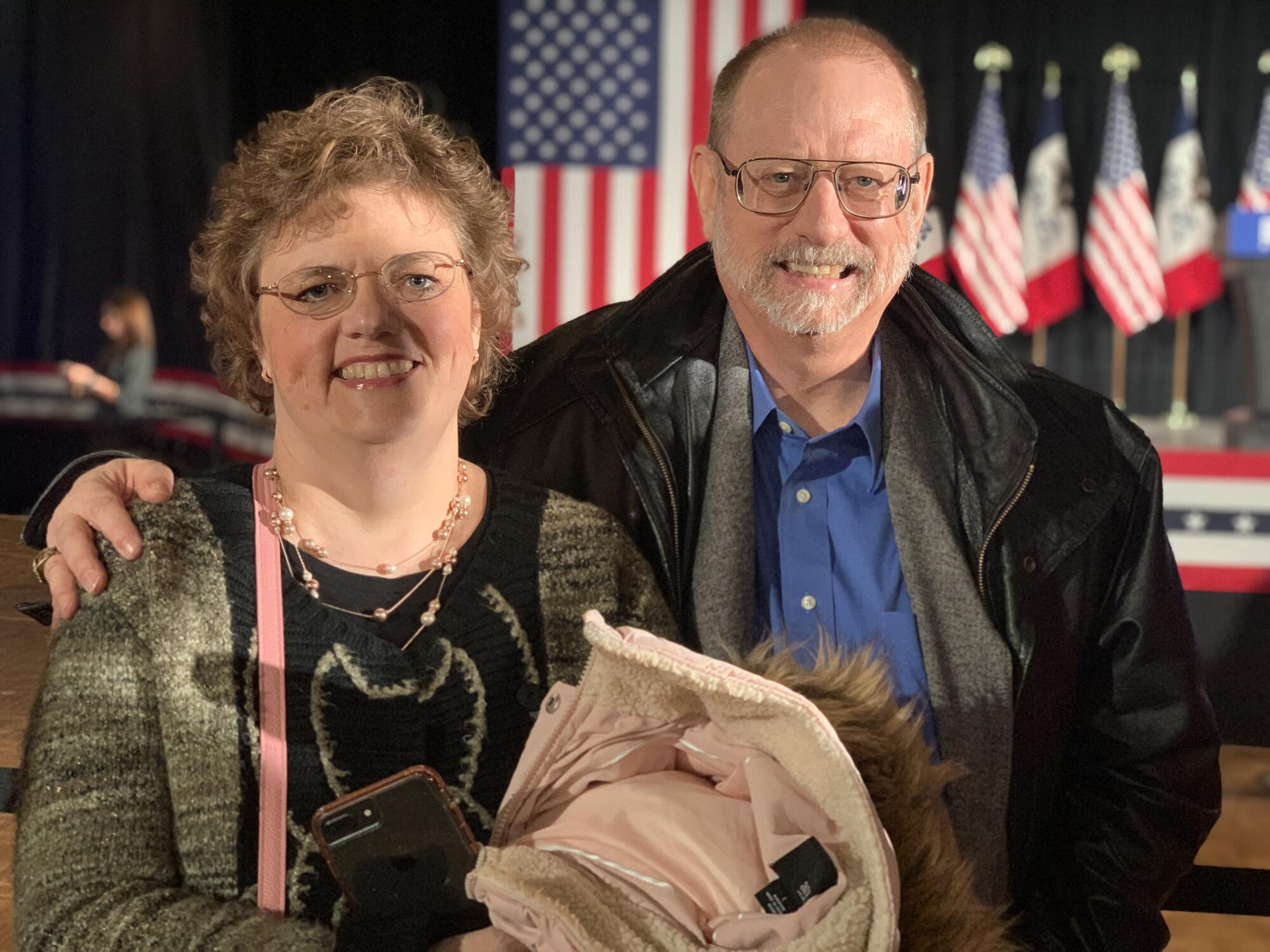
Bud Pettigrew, with wife Angie at the 2020 Democratic Iowa caucuses, attended Valentine High School with Tim Walz and is a former Nebraska Democratic Party official.
(Melanie Mason / Los Angeles Times)
Bud Pettigrew, who attended Valentine High School with Walz and is a former Nebraska Democratic Party official, said he’s heard mixed reactions in the Cornhusker State to the vice presidential nod.
“The people who are Democrats or open-minded independents are all thrilled about Tim,” said Pettigrew, former Marine and high school teacher. “The MAGA-type Republicans, they don’t care. He’s just another liberal. Once you move away, you don’t count anymore. You hear this a lot from rural people.”
Pettigrew, 63, was a senior when Walz was a freshman quarterback on the junior varsity team. Pettigrew saw in Walz “a pretty tough kid who had some ability.”
Walz’s father was the school superintendent, and Pettigrew remembers him fighting for a school bond — not an easy feat in a fiscally conservative town — to replace the 1897 schoolhouse said to be haunted by the ghost of a student who died after someone poisoned her clarinet reed.
Pettigrew is planning to vote for Harris and Walz.
Darlene Meyer, who owns the Plains Trading Company bookstore on Main Street, said she “was frightened” when she learned Harris was running — not because she dislikes her, but because she figured too many conservatives would refuse to vote for her because she’s a woman, because she’s Black and Asian American, and because she’s from California.
“How many strikes can you have against you?” she said. Walz, she added, was a smart choice.
Meyer is a registered Republican but not a party-line voter. She does not like Trump and said it was frustrating that he politicized masks during the COVID-19 pandemic lockdown.
Meyer, a septuagenarian and longtime nurse, still requires masks in the bookstore, a 1914 building with poor ventilation. A few people have spit on the floor in protest. Others boycotted.
Still, Meyer tries to avoid discussing politics.
“There’s plenty else to talk about. The weather. Grasshoppers.”

The quiet main drag in Butte, Neb., where Walz moved with his family when he was a teenager.
(Hailey Branson-Potts / Los Angeles Times)
When he was a sophomore, Walz moved with his family 100 miles east to the farm town of Butte to be near relatives after his father was diagnosed with lung cancer. His dad died when he was 19.
Butte, which had a population of around 500 back then, has shrunk to about half that size. Butte High School — from which Walz graduated in 1982 among a class of 25 students — closed years ago. A fading mural downtown reads: “Save the Rural Schools.”
A Trump 2024 flag flies alongside the American flag next to the Butte Community Center.
Walz’s mother, Darlene, still lives in town, and some residents said that while they don’t agree with her son’s politics, they try not to talk about it because they don’t want to hurt her feelings.
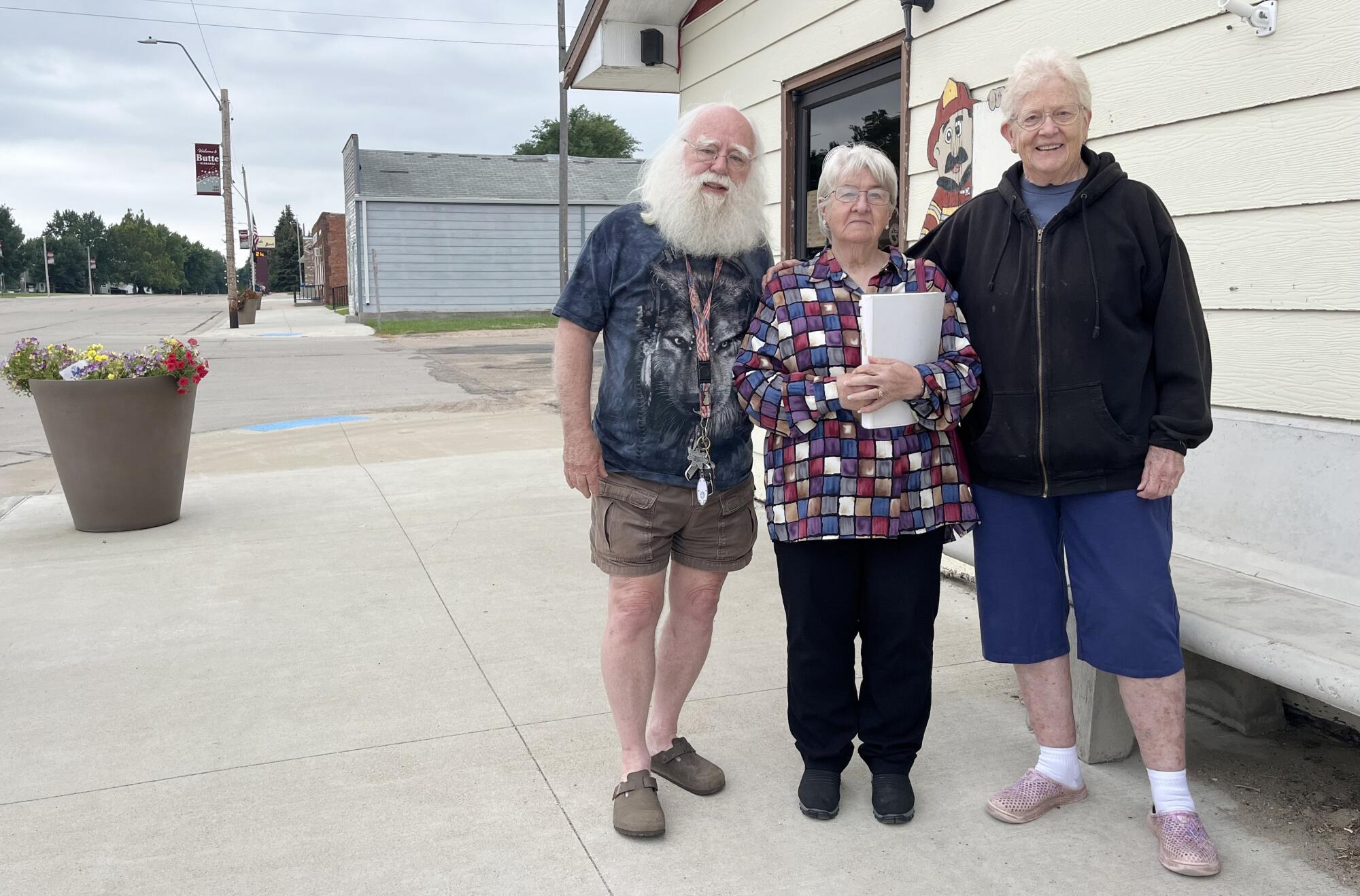
Richard Meadows, from left, Dorothy Boes and Francine Meadows are friends of Tim Walz’s mom, Darlene, in Butte, Neb.
(Hailey Branson-Potts / Los Angeles Times)
Dorothy Boes, a retired special education teacher who lives just over the South Dakota line, goes to church in Butte and is in a women’s coffee group with Darlene Walz.
Boes does not like the way Trump “talks about and bad-mouths women” and was outraged by the Jan. 6, 2021, insurrection. She worries about more potential violence.
“I just feel like he’s not going to go quietly into the night if he doesn’t win,” she said.
Boes, 77, does not know much about Walz’s political record. But she knows that he comes back to Butte often to take care of his mom and that he frequently brings her to Minnesota.
“Those are good, positive things, and, in my heart, I feel that he deserves a chance. And so does she,” Boes said of Walz and Harris. Boes is a longtime Republican who voted twice for Trump — but is undecided this year.
Richard Meadows, an 81-year-old “die-hard Democrat” who mows Darlene’s lawn, said he and his wife “coexist” peacefully with their Republican neighbors in Butte.
But Meadows — who has a chest-length white beard and worked for years as a professional St. Nick — knows who’s getting his vote.
“Santa Claus is gonna vote for Tim and Kamala.”
As for Valentine? Its post office gets inundated with packages every February by romantics who want a holiday-themed postmark. But the town is not named for St. Valentine.
It is named for Edward K. Valentine, a Union soldier during the Civil War and a congressman.
He was a Republican.

Politics
Jeffries welcomes Democratic Socialists into the fold as critics warn party is revealing ‘exactly who it is’

NEWYou can now listen to Fox News articles!
House Minority Leader Hakeem Jeffries publicly embraced a new crop of congressional nominees Saturday, including three Democratic Socialists of America-backed candidates whose primary victories have fueled fresh debate over the Democratic Party’s leftward shift ahead of the 2026 midterms.
The powerful New York lawmaker’s post highlights the challenge facing the top House Democrat as he works to unite his party ahead of the general election. If Democrats take back the House in November, Jeffries is expected to become the next speaker. That means he’ll likely be leading a Democratic caucus with more self-described Democratic Socialists than ever before. So far, more than a dozen Democratic Socialists of America-backed candidates have won or advanced in primaries across the country this election cycle.
In a post on X, Jeffries wrote, “Congratulations to our Democratic nominees,” before listing the party’s congressional candidates from across New York. Among those recognized were Brad Lander, Claire Valdez and Darializa Avila Chevalier, all of whom are affiliated with or backed by the Democratic Socialists of America and secured victories in closely watched Democratic primaries last week.
House Minority Leader Hakeem Jeffries has called Trump official Bill Pulte a “malignant clown.” (Aaron Schwartz/Bloomberg)
“From public servants to union organizers to community activists, the path is different but the work is the same,” Jeffries wrote. “We must decisively address the affordability crisis and crush far-right extremism!”
RISING SOCIALIST STARS ON TRACK TO CONGRESS: WHO ARE DARIALIZA AVILA CHEVALIER, BRAD LANDER AND CLAIRE VALDEZ?
Lander, Chevalier and Valdez all received backing from New York City Mayor Zohran Mamdani, whose endorsements helped cement the growing influence of the Democratic Party’s progressive wing in New York politics. Lander and Chevalier defeated Jeffries-endorsed incumbents Reps. Dan Goldman and Adriano Espaillat in their respective Democratic primaries. Jeffries did not endorse in the race won by Claire Valdez, which was an open seat.
Now, as Democrats turn their attention to the general election, he appears to be rallying behind the party’s nominees as they try to win back the House in November.
The socialist candidates have also faced scrutiny over resurfaced social media posts, support for defunding the police and anti-Israel rhetoric, positions that have put them at odds with many in the Democratic Party.
Socialist New York congressional nominees Darializa Avila Chevalier (L), Claire Valdez (C) and Brad Lander. (Michael M. Santiago/Getty Images; Michael Nagle/Bloomberg via Getty Images; Adam Gray/Bloomberg via Getty Images)
Chevalier has faced scrutiny over resurfaced social media posts, including one in which she called to “literally abolish the border.”
She has also faced renewed scrutiny over past social media posts targeting leading Democrats, including calling former President Joe Biden a “war criminal,” attacking former Vice President Kamala Harris and rebuking Sen. Bernie Sanders over Israel.
Like Chevalier, Valdez and Lander, who is Jewish, share her sentiment that Israel is committing “genocide” in Gaza.
LIBERAL MS NOW WRITER CALLS MAMDANI PRIMARY SWEEP A ‘GENUINELY SCARY NIGHT FOR NEW YORK CITY JEWS’
Jeffries’ decision to publicly congratulate the three nominees quickly drew criticism.
The Republican Jewish Coalition blasted Jeffries’ congratulatory message, warning Jewish voters that these candidates are not the Democrat “fringe” but the new faces of the party.
“To Jewish Democrats: your party is telling you EXACTLY who it is,” the Coalition wrote. “These future members of Congress, who @hakeemjeffries is welcoming with open arms, want to: Abolish prisons and borders. Defund the police. Downplay 9/11,” rattling off other serious controversies stemming from the candidates.
Jamie Metzl, a former National Security Council and State Department official and lifelong Democrat, blasted Jeffries for congratulating the nominees.
New York City Mayor Mayor Zohran Mamdani speaks at a news conference Thursday in Manhattan. (Spencer Platt/Getty Images)
“When I first read this post, I assumed it was from a spoof account. I am deeply concerned that it appears to be all too real,” Metzl wrote. “To welcome these nominees without acknowledging and criticizing their self-declared sympathies for U.S.-designated terrorist organizations, their calls to abolish the police, their stated desire to dismantle Western civilization, and their blatant anti-Americanism is to sacrifice the core principles of the Democratic Party.”
Metzl accused Jeffries of putting his bid to become House speaker ahead of the Democratic Party’s principles.
“I understand your ambition to become Speaker should Democrats retake the House, but you should not sacrifice the principles of our party to advance your own political aspirations,” Metzl wrote.
Democratic leadership has been in the hot seat this week facing questions from the media about how to reconcile support for the New York slate of socialist candidates, particularly after Valdez’s supporters were seen shouting “you’re next” at a television screen showing Jeffries on Tuesday night.
“They’re gonna eat you next Congressman – and replace you with one of their own,” conservative commentator Meghan McCain posted on X.
“This is funny,” conservative commentator Robby Starbuck posted on X. “Hakeem still doesn’t realize that the communists are going to eat him alive. Clearly not a student of history. Bless his heart.”
CLICK HERE TO DOWNLOAD THE FOX NEWS APP
In a CNN appearance on Friday, Jeffries said, “I think that what happens in a handful of primaries in one of the bluest cities in the country is not in any way indicative of what needs to happen in November, where we need to reelect every single frontline Member, common sense Democrats, authentically committed to making life better for the American people, opposing these extreme Republicans who have been nothing but a reckless rubber stamp for Donald Trump’s agenda.”
“And at the same period of time, make sure that we flip red seats blue, including in New York-17, where we have a combat veteran, incredibly patriotic American Cait Conley, who came out of a primary on Tuesday as well and is an incredibly strong candidate. She will defeat Mike Lawler in New York in November.”

Twenty-four days after the polls closed on election day, Los Angeles County officials have certified the results from the 2,227,461 ballots cast. Despite questions raised about the pace of the vote count, a Times analysis found ballots this June were tallied faster than in previous cycles.
California is known to have a slow vote count, partially because of the state’s grace period for mail-in ballots. This year, counties were required to report most of the ballots by June 15, with some exceptions, including for mail-in ballots received within seven days of election day and ballots requiring additional verification such as signature curing. The process has spurred baseless claims of fraud from President Trump and others, leading the U.S. Supreme Court to take up a case on whether mail-in ballots must be received by election day to count.
The state has reported 9.4 million processed ballots. Officials estimate about 5 ballots remain to be counted and 17,650 are waiting to cure a missing or mismatched signature.
Compared with the last time both governor and Los Angeles mayor were on the ballot, county election officials counted more ballots, and tallied them faster than in 2022, The Times found.
In Los Angeles County, turnout jumped from 28% of eligible voters in the 2022 primary to 38% this June, according to the county registrar. Meanwhile, the share of vote-by-mail ballots dropped about 3 percentage points to 82%, indicating a rise in in-person voting.
Statewide, early results show 41% of registered voters turned up for the June election, up from 33% in 2022, according to the secretary of state. County elections officials must report their final results by July 3, giving state officials a week to certify all election results.
The Los Angeles Times reports election results from the county clerk as well as from the Associated Press. The AP provides ballot counts, a calculation of the expected vote and race calls for statewide and national races.
The expected vote percentage, or EEVP, is an estimate of the total number of votes that will eventually be certified. That number can be adjusted based on new information over time.
“Before counting begins in California, our estimates are primarily informed by turnout in past similar elections plus pre-election data on ballot returns, with projections based on what percentage of ballots had already been received at the same point in past elections,” AP director of election analytics Emily Swanson said in an email.
In the gubernatorial and mayoral races, more than half of the votes were counted by the end of election day, EEVP data show.

Swanson’s team also observed a faster vote count this year than in the 2022 and 2024 primaries.
In January 2024, L.A. County consolidated its election operations into a new ballot processing center in the City of Industry. Dean Logan, head of the L.A. County registrar-recorder/county clerk’s office, told The Times earlier this month that the facility, which is open to observers, is designed for transparency, security and efficiency.
“It doesn’t take long to count. The counting process is very fast,” Logan said ahead of election day. “What extends the time period is those options that are provided under California law for voters — to allow everyone the opportunity to vote up until election day, and then allowing us the time to process those with the same level of security and integrity that we did the ballots that were received two weeks before the election.”
Despite the faster count, the Associated Press took longer to call winners, suggesting these races were more competitive. The AP makes such declarations by determining whether there is an opportunity for a trailing candidate to catch up to the race leader. It has been calling races for nearly 180 years.
Both the gubernatorial and Los Angeles mayoral race saw a 30% increase in votes from 2022. The governor’s race received more than 9.2 million votes compared with 7 million in 2022. The Los Angeles mayor’s race received more than 850,000 votes, an increase from nearly 650,000 in 2022.


The vote counting process for California, Washington, Oregon, Nevada and Alaska may change for the November midterm election, depending on which way the U.S. Supreme Court rules.
Data and graphics assistant editor Sean Greene contributed to this report.

NEWYou can now listen to Fox News articles!
The attorney who helped persuade the Supreme Court to strike down Hawaii’s private-property concealed-carry restriction on Thursday criticized the state’s reliance on a Reconstruction-era Black Code to defend the law.
In a 6-3 decision in Wolford v. Lopez, the Court held that Hawaii cannot require licensed gun owners to obtain express permission before carrying firearms onto private property open to the public. Gun-rights challengers dubbed the policy the “vampire rule” because lawful gun owners had to be “invited in” before entering businesses while armed.
“It is disgraceful that any state would rely on a law specifically aimed at taking away the Second Amendment rights or any constitutional right of Black Americans as it was at that time,” attorney Kevin O’Grady, who represented the plaintiffs, told Fox News Digital.
“And it’s not surprising, however, that Hawaii would rely on it as they are diametrically opposed to the Second Amendment. We fully expected that the Supreme Court would identify that as the kind of law that one absolutely should not look to determine whether or not something is constitutional because this is the perfect example of something which is not constitutional.”
SUPREME COURT HANDS SECOND AMENDMENT WIN TO CONCEALED CARRY HOLDERS IN BLUE STATE GUN CONTROL CASE
Justice Ketanji Brown Jackson speaks on stage during the “Ketanji Brown Jackson on Lovely One: A Memoir” panel at The Atlantic Festival in Washington, D.C., on Sept. 20, 2024. (Tasos Katopodis/Getty Images for The Atlantic)
A major flashpoint was Hawaii’s effort to justify the law under the Supreme Court’s 2022 decision in New York State Rifle & Pistol Association v. Bruen. Since Bruen, courts evaluating firearm regulations have generally asked whether modern gun restrictions are consistent with the nation’s historical tradition of firearm regulation.
Hawaii cited several historical laws, including an 1865 Louisiana statute enacted as part of the post-Civil War Black Codes. The law made it unlawful to carry firearms onto another person’s property without the owner’s consent.
Justice Samuel Alito, writing for the majority, rejected that argument outright, calling the Louisiana statute a “tainted artifact” that was enacted to disarm newly freed Black Americans and leave them defenseless after the Civil War. He concluded the law “cannot be taken seriously” as evidence of the Second Amendment’s original public meaning.
Justice Ketanji Brown Jackson, however, argued in her dissent the Court skipped an important constitutional question.
Jackson did not defend the Black Codes, which she acknowledged were racist and used to oppress newly freed Black Americans. But she argued the Court should have first decided whether the Louisiana law itself violated the Second Amendment, or whether the real constitutional problem was that it was enforced in a racially discriminatory way.
SUPREME COURT TAKES SECOND AMENDMENT CASE CHALLENGING HAWAII GUN LAW
Todd Settergren handles pistols inside his display case at Setterarms gun shop in Walnut Creek, Calif., on Jan. 13, 2017. (Michael Macor/The San Francisco Chronicle via Getty Images)
“It might well be that the Black Codes are invalid inputs for Bruen’s test,” Jackson wrote, “but only if they violated the Second Amendment — which may or may not be the case.”
Instead, she argued that under the Supreme Court’s Bruen framework, the Court could not simply dismiss those laws without first explaining why they should not count as historical evidence.
She outlined two possibilities: either the firearm restrictions in the Black Codes were constitutional but enforced in a racially discriminatory manner — making the constitutional defect an equal-protection problem — or the restrictions independently violated the Second Amendment. The Court, she argued, never resolved that question before excluding the Louisiana law from consideration.
US APPEALS COURT STRIKES DOWN CALIFORNIA’S OPEN-CARRY BAN IN MAJOR SECOND AMENDMENT RULING
“Either history does matter, and if so, all potentially relevant historical experiences must be thoroughly examined,” she wrote. “Or, it does not, and the Court should just admit that the test it has created is boundless.”
Her reasoning immediately drew pushback from critics, who argued the Fourteenth Amendment was passed in response to laws like the Black Codes that denied newly freed Black Americans their constitutional rights, like the right to bear arms.
Rain clouds roll over the United States Supreme Court building in Washington, D.C., on June 18, 2026. (Chip Somodevilla/Getty Images)
“I would simply point her to what Justice Alito pointed out in the majority ruling — it was in response to these types of laws that the Fourteenth Amendment was enacted in the first place,” Hannah Hill, vice president of the National Association of Gun Rights, told Fox News Digital.
US JUDGE TOSSES ILLINOIS’ BAN ON SEMIAUTOMATIC WEAPONS, GOVERNOR PLEDGES SWIFT APPEAL
“That right there is your answer,” Hill continued. “Yes, there was a historical tradition — they enacted a constitutional amendment to fix that deprivation of rights, and that is also in the Constitution now, so I think she should probably go back to law school.”
Tyler Yzaguirre, president of Second Amendment Institute, echoed O’Grady and Hill’s criticism.
“Those laws were not legitimate expressions of our Nation’s constitutional tradition; they were examples of government using its power to deprive Americans of a fundamental right,” Yzaguirre told Fox News Digital. “The Court was right to reject the notion that such laws could define the historical limits of the Second Amendment.”
CLICK HERE TO DOWNLOAD THE FOX NEWS APP
Businesses may still ban guns by posting or enforcing a “no firearms” policy. But what Hawaii can’t do, the Court said, is treat every business as off-limits to licensed gun owners unless the owner specifically says guns are allowed.
-

 Movie Reviews7 minutes ago
‘House of Criticism’ Review: A Pensive and Touching Portrait of Married Art Critics Jerry Saltz and Roberta Smith (It Is Only, at Moments, a True-Life Christopher Guest Movie)
-

 World19 minutes ago
Annecy Colombian Short ‘Once in a Body’: Fiction Rooted in Real Experiences
-

 Health42 minutes ago
This Protein Smoothie Trick Helps Women Over 40 Lose Twice as Much Fat
-
 Lifestyle57 minutes ago
‘Wait Wait’ for June 27, 2026: With Not My Job guest Stephen Malkmus
-

 Technology1 hour ago
Margaret Atwood says the problem with AI is ‘garbage in, garbage out’
-

 World1 hour ago
Gulf countries strongly condemn Iran’s drone attack on Bahrain as rising tensions threaten MOU
-

 Politics1 hour ago
Jeffries welcomes Democratic Socialists into the fold as critics warn party is revealing ‘exactly who it is’
-

 Health1 hour ago
These leafy greens could help protect your lungs, study suggests

