Politics
In Montana, a Rare Sight: Republicans and Democrats Voting Together


In the waning days of a tumultuous legislative session in Montana’s Capitol, Carl Glimm, a state senator and a member of the ultraconservative Freedom Caucus, watched with exasperation as yet another Democratic-backed bill zoomed toward passage.
“Are we not embarrassed?” Mr. Glimm asked from the Senate floor in Helena. “This thing’s a big red ‘No,’ but I’ll tell you what — it’s going to be 23-27,” he added, predicting his own defeat. “Because, like we’ve said before, the cake is baked.”
In deep-red Montana, Republicans have controlled both houses of the Legislature since 2011, and the governor’s office since 2021. They ousted the last remaining Democratic statewide official, former Senator Jon Tester, in November.
Which has made it all the more aggravating for conservative lawmakers to find themselves effectively in the minority this year.
After an intraparty dispute in January, nine Republican state senators began breaking with their caucus on key votes, siding with the 18 Democrats in the 50-person chamber. The result: a 27-person majority that has all but locked Republican leaders out of power.
Some or all of the Nine, as the Republican defectors are known, have voted with Democrats to reauthorize a Medicaid expansion, establish a child tax credit, increase access to maternal health care and pass the state budget. They have helped block bills that would have weakened labor unions, made state judicial elections more partisan and established an unlimited hunting season on wolves.
On Wednesday, the session’s final day, they again broke with their party, pushing through a property tax cut to assist residents struggling with soaring home values.
The unusual alliance shows that for all the seeming unanimity in the MAGA movement, Republicans can still clash over policy objectives and the wielding of power. And in an era when advancing legislation often loses out to mocking the opposing party, it shows that some on the right remain more interested in getting things done.
But it could prove something of a blip: a reversion to bygone reflexes toward compromise belying Montana’s steady drift to the right.
Former Gov. Brian Schweitzer, a Democrat, said politicians elsewhere could learn from the Nine.
“What they’ve done is said, ‘I’m going to vote with the people I represent back home — and that’s not what the party leadership is telling us,’” Mr. Schweitzer said.
“We’ll haul Congress out here to see how it’s done in Montana,” he joked, adding that he would “put in the first $50” for bus fare.
Policy over party
The Nine argued that they were simply prioritizing smart policy over ideological conformity — reauthorizing the Medicaid expansion would keep open rural hospitals in their districts, for instance — and supporting the agenda pushed by Gov. Greg Gianforte, also a Republican.
But as President Trump exerts near-total control over the Republican Party, and the country seems bitterly divided along partisan lines more than ever, the G.O.P. schism in Montana has attracted outsize attention.
As the session progressed, other Montana Republicans ramped up a pressure campaign against the defectors, posting their photos on social media, demanding that they quit bucking party leadership and giving them nicknames like the “Nasty Nine.” In March, Republicans tried to expel one of the heretics, Jason Ellsworth, from the Legislature over alleged ethical violations; a majority of Democrats helped block the attempt.
The Montana Republican Party even censured the Nine, saying they would no longer be considered Republicans or receive funding from the state party because of “the damage they have exacted on the Montana Senate.”
The Nine remained upbeat. Days before the legislative session ended, seven of them sat for an interview in the State Capitol, describing praise from voters, swapping stories of admonishment by local Republican groups and declaring that such criticism had only strengthened their resolve.
“I always looked at politics when I was younger and you see people work across the aisle,” said Gayle Lammers, a first-term senator. “I know we’re in this new age where division is so hardcore, but why can’t we get back to where any reasonable legislation is reasonable legislation? If it’s good for Montana, if it’s good for your district, why not consider it?”
Even though they have voted with Democrats, the senators say they remain conservative Republicans and strong supporters of Mr. Trump. All of them voted for a bill restricting transgender people’s use of public bathrooms, and most of them sided with their Republican colleagues on several anti-abortion bills. Josh Kassmier, who emerged as a leader of the Nine, noted that he had sponsored a bill cutting the income tax, a move backed by Donald Trump Jr.
Since Mr. Gianforte took office in 2021, Mr. Kassmier said, “we’ve cut the budget, we’ve made government more efficient — that’s all Trump politics, right?” He added: “We’re voting on the policy. It’s not a deal we’ve made with the Dems.”
One of the Nine, Wendy McKamey, keeps at her desk a stack of notes from Montanans thanking the group for its courage. “Give ’Em Hell,” the front of one card reads, above an image of a cowgirl astride a galloping horse.
“They help me own my vote,” Ms. McKamey said. “I will not offend my conscience.”
Though the Legislature’s political lines seemed blurred, some lawmakers and analysts suggested the real rift was between those who wanted to make policy and those who sought to obstruct it.
“It’s about who is more interested in governing, really,” said Jessi Bennion, a political science professor at Montana State University. Montana’s right wing, she said, seemed less interested in conservative fiscal policy than in introducing controversial bills on social issues that jammed up the legislative process.
That put hard-liners on a collision course with Mr. Gianforte, who did not endorse Matt Regier, the right-wing Senate president, last year but did endorse a group of relative moderates. The Freedom Caucus issued a rebuttal to Mr. Gianforte’s State of the State address in January, suggesting that Montana should spend less money than the governor desired and opposing some of his priorities, like Medicaid expansion.
Mr. Gianforte has avoided speaking directly about the Nine, and a spokesman for the governor declined to comment. But he has seemed pleased to have achieved many of his goals.
Intense blowback
Despite the recent rightward drift, Big Sky Country has long been proud of its independent streak and small-town values. Montana has voted for a Democratic presidential candidate only once since 1964 — Bill Clinton in 1992 — but it had Democratic governors and senators for decades.
In previous legislative sessions, which occur every two years, a loose coalition of Republicans called the Solutions Caucus worked with Democrats to pass bills. But that was easier for Republicans to swallow when a Democratic governor made it necessary to compromise.
What stood out about this year’s bipartisanship was the animosity it produced.
The conflict started the first week of the legislative session, when the Nine were assigned to what they say was a sham committee that would have sidelined them from the legislative process — part of an effort, they argued, to make it easier for Mr. Regier and his allies to consolidate power.
The senators pushed back, agreeing with Democrats on alternate committee assignments. From there, they said, the Democrats were only too happy to work with the Nine on some bills.
In an interview, Mr. Regier called the bipartisan alliance a “gut punch.” He said none of the Nine had raised concerns about committee assignments when Republicans met before the session, and suggested the unhappiness was a “talking point” that provided “cover for them to side with Democrats.” Efforts to win them back, he said, had been rebuffed.
“We tried and tried,” Mr. Regier said. “It was obvious to see there was some sort of handshake, friendship, collaboration with the Democrats.”
Mr. Regier denied that right-wing Republicans were obstructionist and sounded dumbfounded by the Nine’s role in locking them out of the legislative process. “You’re scratching your head being like, ‘Are you even on our team anymore?’” he said.
He also argued that the unlikely alliance was out of step with the electorate.
“Voters want more and more conservatism here in Montana,” Mr. Regier said, suggesting the episode amounted to “growing pains in becoming more conservative.”
Democrats also felt heat for their role in the coalition — from the left. Bill Lombardi, a former top aide to Mr. Tester, faulted the Democratic senators for voting with Republicans on issues like maintaining a tax on Social Security.
“While working together is good, you can’t give away Democratic principles,” Mr. Lombardi said. “Republicans have cemented their position in Montana, and some legislative Democrats think they must hew to the moderate Republican line to get anything.”
But the frustration appears more strongly felt on the right.
Theresa Manzella, a founder of the Freedom Caucus, said right-wing state senators had tried hard to get the Nine to back down but eventually tired of the fight.
“We’ve resigned ourselves to life in the circus,” she said. “And, unfortunately, it is our circus, and these are our clowns.”



new video loaded: Erika Kirk’s Message for Women at Turning Point USA

By Vivian Yee, Christina Shaman, Lauren Pruitt, James Surdam and Melanie Bencosme
June 18, 2026

NEWYou can now listen to Fox News articles!
FIRST ON FOX: Americans are nearly evenly split between favoring Iranian regime change and a negotiated U.S. settlement with Iran, according to a new survey.
Some 39% of respondents favor a negotiated settlement where Iran’s current government remains in place, with verifiable limits on its nuclear and missile programs, according to the findings of the Reagan Institute Summer Survey, while 36% favor replacing Iran’s current government with one more favorable to the U.S.
Another 16% favor a weakened regime where the current government stays in place but is significantly diminished militarily and economically, and 8% responded that they don’t know.
The findings underscore the political challenge facing President Donald Trump as his administration pursues a newly signed memorandum of understanding with Iran. While the agreement seeks to curb Iran’s nuclear ambitions through negotiations, Americans remain divided over the ultimate objective of U.S. policy toward the Islamic Republic.
Americans are nearly evenly split between favoring Iranian regime change and a negotiated U.S. settlement with Iran, according to a new survey. (Mandel NGAN / AFP via Getty Images)
AMERICANS AGREE WITH TRUMP THAT IRAN POSES THREAT TO UNITED STATES: POLL
Republicans who responded to the survey favored replacing Iran’s government by a 2-to-1 margin over a diplomatic deal.
Republicans were far more likely than Democrats to favor a more aggressive outcome in Iran. Half of Republican respondents said they would prefer to see Iran’s current government replaced with one more favorable to the United States, compared to 25% who said they would favor a negotiated settlement that leaves the regime in place in exchange for verifiable limits on its nuclear and missile programs.
The findings were nearly identical among self-identified MAGA Republicans, 51% of whom favored regime change while 25% backed a negotiated settlement.
SHARP PARTISAN DIVIDE EMERGES OVER IRAN STRIKE, TRUMP’S STRATEGY: POLLS
Democrats, meanwhile, largely favored diplomacy. A majority, 52%, said they would prefer a negotiated settlement with Iran’s current government, while 25% favored regime change. Another 14% favored leaving the regime in place but significantly weakened militarily and economically.
The Reagan Institute Summer Survey was conducted May 26 through June 3 among 1,555 respondents nationwide and carries a margin of error of plus or minus 2.5 percentage points. The survey used a mixed-mode methodology that included live telephone interviews, an online panel and text-to-web responses.
Smoke rises over Tehran following an explosion amid ongoing U.S. and Israeli military strikes on Iranian targets on March 2, 2026. (Majid Saeedi/Getty Images)
The findings underscore the political challenge facing President Donald Trump as his administration pursues a newly signed memorandum of understanding with Iran. (Hamid FOROUTAN / ISNA / AFP via Getty Images)
Republicans were far more likely than Democrats to favor a more aggressive outcome in Iran. (Pool via WANA/Reuters)
To better reflect the U.S. population, the results were weighted using demographic benchmarks from the U.S. Census Bureau’s 2023 American Community Survey, including age, gender, race, region and education levels. The poll also included an oversample of 331 MAGA Republicans under age 30, a group with a margin of error of plus or minus 5 percentage points.
The Reagan Institute is a Washington-based policy organization that advocates the Reagan foreign-policy tradition of “peace through strength” and sustained American leadership abroad.
The findings come as Trump has defended a newly signed memorandum of understanding with Iran as a way to reduce tensions and create a pathway toward a broader agreement addressing Tehran’s nuclear program.
The memorandum establishes a 60-day negotiating period during which the United States and Iran will attempt to reach a more comprehensive deal. The agreement also includes provisions aimed at restoring commercial shipping through the Strait of Hormuz and provides limited sanctions waivers tied to continued negotiations. Several of the most contentious issues, including the long-term future of Iran’s nuclear program, are expected to be addressed in subsequent talks.
Trump has described the arrangement as a means of avoiding a wider conflict while pursuing what he called a “great settlement” with Tehran. He has also argued that the agreement could help stabilize energy markets by reopening the Strait of Hormuz, a critical global shipping route, while creating an opportunity to negotiate additional restrictions on Iran’s nuclear activities.
CLICK HERE TO DOWNLOAD THE FOX NEWS APP
The president added that he agreed to a settlement to avoid “economic catastrophe.”
“I didn’t want to see economic catastrophe. If you kept this going, that could have happened,” he told reporters at the G7 Summit in France.
WASHINGTON — The White House pushed back Thursday against growing bipartisan criticism of a negotiated settlement to the war with Iran, arguing its concessions to the Islamic Republic were contingent on its conduct and essential to securing peace.
The administration’s defensive posture came as details of the framework agreement, known as a memorandum of understanding, were finally shared with the public, revealing a raft of compromises with Tehran long opposed by Republicans.
Vice President JD Vance, who helped negotiate the deal, told reporters Thursday that the deal was structured to reward Iran for good behavior. But the text of the agreement suggests otherwise.
The Trump administration agreed to release billions of dollars in Iranian assets that were frozen and restricted by the United States “upon the implementation” of the memorandum — before any further actions are taken or additional negotiations begin. The president will issue sanctions waivers on Iranian oil, allowing Tehran to resume trading its most valuable export and breaking with decades of policy. And to facilitate that trade, boosting Tehran’s revenues, Trump agreed to immediately end a U.S. naval blockade of Iranian ports.
Still more concessions were offered to the Iranians, including a commitment by the U.S. administration to establish a fund of “at least $300 billion for the reconstruction and economic development of the Islamic Republic” — in effect providing reparations for the war Trump started.
“All required licenses, waivers and permissions needed for the relevant financial transactions will be granted by the United States of America,” the memorandum reads.
Taken together, the document reads as a stunning reversal of U.S. policy toward Iran after decades of concern across administrations in Washington — including throughout Trump’s two terms — that the Islamic Republic represents the nation’s greatest security threats as the world’s largest state sponsor of terrorism.
Criticism from Republican senators, in particular, has been sharp and swift.
Sen. Roger Wicker (R-Miss.), chairman of the Senate Armed Services Committee, said the $300-billion fund “would make Iran’s payoff under President Obama’s 2015 deal look like a pittance by comparison.” And Sen. Ted Cruz (R-Texas) accused the Trump administration of giving Iran money it would use to kill Americans.
“History demonstrates that giving billions of dollars to theocratic lunatics who want to murder us is an exceptionally bad idea, and I think, unfortunately, the president is receiving some really bad advice on this deal,” Cruz said. “I don’t want to see us send a penny to the ayatollah. And I hope that we don’t.”
The Obama-era deal, known as the Joint Comprehensive Plan of Action, included structured sanctions relief for Iran in exchange for concrete and verifiable steps by Tehran to dismantle much of its nuclear program — a framework that Republicans broadly criticized at the time.
By contrast, Trump’s agreement commits the United States to pursuing economic relief for Iran while providing no clarity about the future of Iran’s nuclear program — the very issue Trump cited as the rationale for launching the war.
The memorandum includes a pledge by Iran to never purchase or construct nuclear weapons — a vow the Islamic Republic has made multiple times before, including by signing the Nuclear Non-Proliferation Treaty, in a religious edict issued by the late supreme leader and in the Obama-era nuclear accord.
Vice President JD Vance speaks to reporters at the White House on June 18, 2026.
(Manuel Balce Ceneta / Associated Press)
Detailed negotiations over Iran’s nuclear program — including whether Tehran could continue domestic uranium enrichment, at what level, and under what monitoring regime — were left for another day.
For more than a decade, the U.S. intelligence community has assessed that Iran sought a threshold nuclear capability, securing the strategic advantages of a nuclear power without incurring the costs of openly pursuing a bomb.
The agreement does include a commitment by Iran to do its “best” to bring commercial shipping traffic through the Strait of Hormuz, a vital international waterway, back to prewar levels. But critics of the president said he had to make deep, historic concessions just to secure a status quo ante upended by the war he started. And in the document, Tehran agreed to refrain from imposing a toll on ships transiting the strait for only a 60-day period.
“Unless you were homeschooled by a day drinker, no one’s confident that Iran is going to do anything,” Sen. John Kennedy, a Republican from Louisiana, told reporters this week.
Sen. Bill Cassidy, Kennedy’s Republican counterpart from Louisiana, called the deal “the worst foreign policy blunder in decades” that would have President Reagan “rolling over in his grave.”
“Iran’s nuclear ambitions were not curbed, and they have learned that threatening the Strait of Hormuz works and will undoubtedly leverage it in the future. Now, Iran gets to build brand-new infrastructure under this deal,” Cassidy said.
“Before the war, the strait was open, Iran was being crushed by sanctions, and 13 service members were still alive,” he added. “Now, 13 Americans are dead, families have paid billions at the pump, sanctions will be lifted, and the bombing has stopped.”
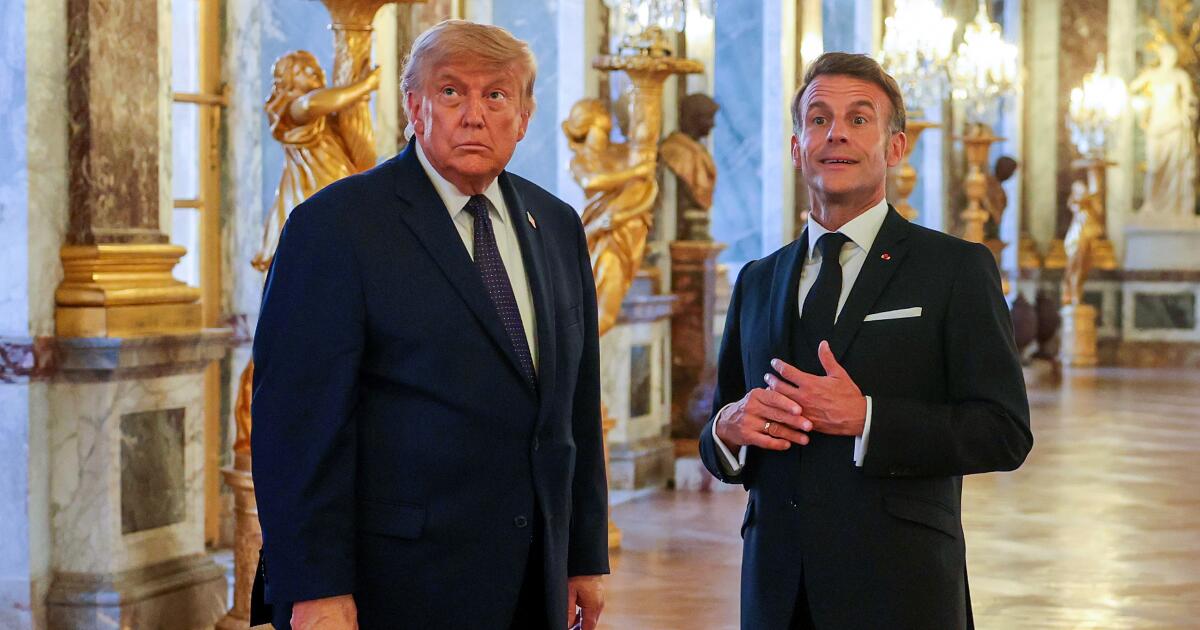
Despite mounting criticism, Trump put his signature to the memorandum on Wednesday night while attending a dinner with the French president in Versailles, a palace infamous for hosting a treaty signing that disgraced Germany at the end of the First World War.
He defended the agreement while in Europe and suggested further concessions might be forthcoming, including recognition of Iran’s claimed right to enrich uranium and a new willingness to tolerate its continued ballistic missile development — another program that Trump had vowed to eliminate as a central war aim.
“He took America to war — killing 13 soldiers, thousands of Iranian civilians and costing taxpayers $60 billion — to get rid of Iran’s missile program. And now that he’s lost the war, he pretends like it’s no big deal,” said Sen. Chris Murphy, a Democrat from Connecticut.
“Just unforgivable,” he added. “What a charlatan.”
-

 New York58 minutes ago
Video: Knicks Fans Celebrate With Ticker-Tape Parade
-

 Los Angeles, Ca1 hour ago
Armed, dangerous CHP pursuit suspect tied to double homicide in Pomona
-

 Detroit, MI1 hour ago
First responders honored after rescuing 12 people from capsized sailboats near Belle Isle
-

 San Francisco, CA2 hours ago
Oakland man faces hate crime charges for Castro District attack
-

 Dallas, TX2 hours ago
At least 4 injured after vehicle drives into Dallas crowd, driver arrested
-

 Miami, FL2 hours ago
Miami Central students prepare for life changing trip to Zimbabwe amid funding challenges
-

 Boston, MA2 hours ago
Giannis to Boston is a possibility. Should the Knicks be worried?
-

 Denver, CO2 hours ago
Denver Public Schools’ decline in enrollment continues to reshape district

