Politics
In California, Confusion Abounds Over Status of 2 National Monuments


A week after the White House indicated it would eliminate two national monuments in California, many remain unsure whether President Trump has actually revoked the lands’ protected status.
Mr. Trump announced last Friday that he would rescind a proclamation signed by former President Joseph R. Biden Jr. a week before he left office that established the Chuckwalla and Sáttítla national monuments, which encompassed more than 848,000 acres of desert and mountainous land.
The White House then released a fact sheet that included a bullet point stating that Mr. Trump would be “terminating proclamations” declaring monuments that safeguarded “vast amounts of land from economic development and energy production.”
The New York Times confirmed last Saturday that Mr. Trump had indeed rescinded that proclamation. But later that day, the bullet point listing termination of national monuments disappeared from the White House fact sheet.
A post on X sent by a verified White House account last week still included the terminations of national monuments, and has not been edited or removed as of Saturday morning.
The White House declined to answer questions about the discrepancy.
“We were obviously very disappointed to see that fact sheet go up and then confused to see it come back down,” Mark Green, the executive director of CalWild, a nonprofit in California that advocates for wild spaces on public lands. “There’s very little clarity about what’s going on, and there’s such a lack of transparency with this administration that it’s just really hard to know what’s happening.”
Representative Raul Ruiz, Democrat of California, said his office was working to understand what was happening. He helped push for the creation of the Chuckwalla National Monument within his district.
“One thing is for sure,” Dr. Ruiz said. “If the designation is rescinded, we’re going to fight like hell to defend it.”
Mr. Biden designated the Chuckwalla and Sáttítla national monuments in January to protect wildlife habitats and ancestral lands, and to help prevent mining, drilling and energy development.
The Chuckwalla National Monument encompasses about 644,000 acres south of Joshua Tree National Park, and the Sáttítla National Monument north of Mount Shasta, near the Oregon border, is roughly 200,000 acres. The land includes mountain ranges, canyons, desert landscapes, and more than 50 rare species of plants and animals.
State lawmakers, conservationists, renewable energy companies and Native tribes had jointly advocated for the protection of the land.
Mr. Biden protected about 674 million acres of federal land, more than any other president. He was able to do so by using the Antiquities Act, a 1906 law that gives presidents unilateral power to protect lands and waters for the benefit of Americans.
But Mr. Trump said he would undo much of Mr. Biden’s environmental work when he was sworn into office — withdrawing from the Paris Agreement and ending climate regulations, to start — and in early January he said that he wouldn’t tolerate the withdrawal of waters from oil and gas drilling.
“I will reverse it immediately,” Mr. Trump said. “It will be done immediately and we will drill, baby, drill.”
The question is whether Mr. Trump has the authority to reverse the creation of a national monument that was created by a previous president.
During his first term, Mr. Trump shrunk the size of two national monuments — Bears Ears and Grand Staircase-Escalante in Utah — by some two million acres. A lawsuit was filed arguing the Antiquities Act did not grant a president the power to reduce a national park, but the case was moot after Biden re-established and slightly expanded the national monuments.
Mr. Green is confident that rescinding Mr. Biden’s proclamations could place Mr. Trump in court.
“We believe that these monuments exist in a legal sense, and that there’s nothing the Trump administration will be able to do about that short of violating the law,” Mr. Green said.



Politics
Hegseth announces joint task force with DOJ to prosecute leaks to journalists ‘with the full force of the law’

NEWYou can now listen to Fox News articles!
Pentagon chief Pete Hegseth on Monday announced the creation of a joint task force with the Department of Justice to identify and prosecute officials who leak “sensitive information” to the media.
Hegseth said the Pentagon’s Office of General Counsel (OGC) may request and receive all information, support and records across the department regarding news media leak investigations.
“To combat the dangers that leaks pose, effectively immediately, I have delegated tasking authority to the war department’s office of general counsel, empowering OGC to request and receive all information, records and support across the department concerning media leak investigations,” he said in a video shared on X.
“Leaked information risks lives, these new tools and processes will greatly assist us in protecting our joint force,” Hegseth continued. “The security of our nation cannot be a bargaining chip for those who seek momentary headlines, access to confidential and secret information is a sacred trust, and those who betray that trust will be met with the full force of the law.”
TRUMP ADMINISTRATION SUBPOENAS NY TIMES JOURNALISTS IN GRAND JURY LEAK PROBE TIED TO AIR FORCE ONE REPORT
Pentagon chief Pete Hegseth on Monday announced a joint task force with the Department of Justice to identify and prosecute leakers. (Reuters/Kevin Lamarque)
The secretary also thanked Acting U.S. Attorney General Todd Blanche for his support, adding that he was “proud that our departments are working together closer than we have ever before.”
Hegseth’s announcement comes just days after the DOJ issued subpoenas to four reporters at The New York Times, attempting to force them to testify before a federal grand jury after the newspaper reported on the security concerns involving the plane gifted to President Donald Trump by Qatar that he flew on to Turkey for a recent NATO summit.
The subpoenas were widely criticized by The New York Times, journalists at various news outlets and press freedom groups, arguing that the Trump administration is attempting to intimidate reporters conducting legitimate news-gathering about the government.
NEW YORKER SUING ICE AFTER OFFICERS WENT TO HIS HOME TO WARN HIM OVER CRITICISM OF AGENCY
The announcement comes just days after the DOJ issued subpoenas to four reporters at The New York Times. (Kevin Wolf/AP)
“The appearance of federal law enforcement agents on the doorstep of news reporters should shock the conscience of any American who believes in the Constitution and the press freedom it protects,” an attorney for the newspaper, David McCraw, said in a statement.
“Our journalists report the facts and advance the American public’s right to know how their government is operating and their taxpayer dollars are being used,” McCraw added. “This brazen act should be seen as nothing more than an attempt to prevent the public from knowing what is happening in their country by intimidating journalists from doing their jobs.”
Since taking over as head of the Pentagon last year, Hegseth has sought to crack down on leaks to the media.
Last year, the department opened investigations into those accused of leaking classified information to the press and threatened to conduct polygraphs to identify leakers.
The secretary thanked Acting U.S. Attorney General Todd Blanche for his support. (Kent NISHIMURA / AFP via Getty Images)
CLICK HERE TO DOWNLOAD THE FOX NEWS APP
Hegseth has also attempted to impose restrictions on reporters covering the Pentagon. He had forced them to sign a pledge stating that they would not solicit any unauthorized material, even if the information was unclassified. Most Pentagon reporters turned in their press badges rather than accept the department’s restrictions on news-gathering.
That policy is facing lawsuits, and a judge last month granted a preliminary injunction, ruling that the department’s requirement that journalists be accompanied by an official chaperone at all times violated the First Amendment in response to a case brought by The New York Times.
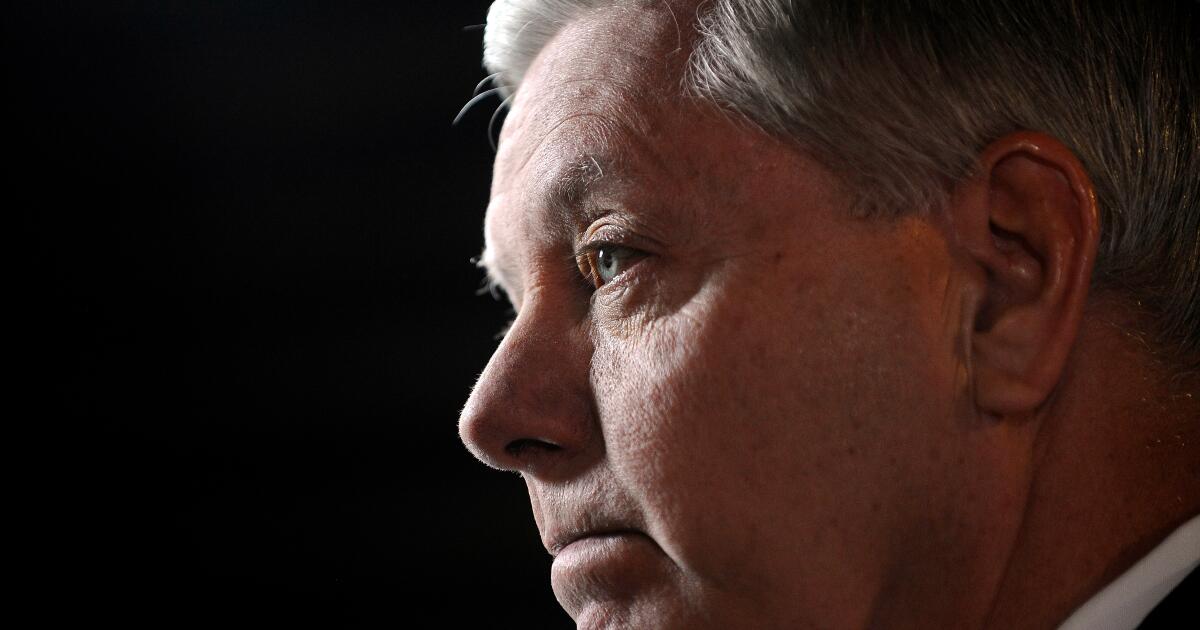
Sen. Lindsey Graham, the prominent Republican from South Carolina who served in the Senate for more than two decades, died after suffering an aortic dissection, his office said Sunday.
Graham died unexpectedly Saturday night, his office announced, shortly after he had returned to Washington after a trip to Ukraine.
In a statement, his spokesperson said a preliminary report from the medical examiner for the District of Columbia found that the 71-year-old senator died of aortic dissection due to arteriosclerotic cardiovascular disease. With aortic dissection, a tear occurs in the wall of the aorta.
According to the Mayo Clinic, aortic dissection is not very common, and its symptoms may be mistakenly attributed to other health conditions. It usually affects men in their 60s and 70s. If the blood from the dissection travels outside the artery, the condition is often fatal.
A former military lawyer who reached the rank of colonel in the Air Force, Graham ran for the Republican nomination for president in 2016. Initially a cutting, vocal critic of then-candidate Donald Trump during the election, Graham became one of the president’s staunchest allies after Trump’s election.
“Senator Lindsey Graham, one of the greatest people and Senators I have ever known, is dead!” Trump posted on his social media platform, Truth, on Sunday. “He was always working, and was a true American Patriot.”
Graham was known as a C student in high school, and was the first member of his family to attend college. His mother died while he attended the University of South Carolina, and his father died of a heart attack during Graham’s first semester of law school.
He served as a judge advocate in the Air Force, eventually becoming the chief prosecutor for the Air Force in Europe.
He was first elected to serve as senator for South Carolina in November 2002.
In a social media post on X, Vice President JD Vance described Graham as one of the most powerful lawmakers, and recalled an incident where he and Graham got into a shouting match over a funding bill for the war in Ukraine.
Later the same day, he wrote in the post, Graham was advocating for rail legislation that Vance supported.
“That was Lindsey Graham,” he wrote. “He fought like hell for the things he believed in, and he was just as willing to go to bat for you when it counted.”
Graham had been scheduled to appear on NBC’s “Meet the Press” on Sunday to discuss his trip to Ukraine. Instead, President Trump appeared in his stead, where he said the senator had been “like a member of the family.”
Trump called into several Sunday news programs to discuss Graham’s death, and said he had spoken to Graham on Saturday evening.
Trump told CNN’s Jake Tapper that the South Carolina senator had said he was “tired.”

NEWYou can now listen to Fox News articles!
President Donald Trump is pushing for an unexpected replacement to fill the vacancy left by the late Sen. Lindsey Graham, R-S.C., in the Senate.
Trump wants South Carolina Gov. Henry McMaster to tap Graham’s sister, Darline Graham Nordone, to be appointed to the lawmaker’s suddenly open seat for the remainder of his term.
“I recommended, to Governor Henry McMaster, Lindsey Graham’s wonderful sister, Darline, to serve as interim Senator from the Great State of South Carolina,” Trump said on Truth Social on Monday. “This would be a fabulous tribute to Lindsey, who loved her dearly!”
Graham and his younger sister, Darline, had a unique bond, given that, after their parents died, the lawmaker legally adopted and raised her.
GRAHAM’S DEATH IGNITES GOP SCRAMBLE FOR SENATE SEAT AS TRUMP HINTS HE ALREADY HAS A FAVORITE
President Donald Trump wants to see Lindsey Graham’s sister, Darline Graham Nordone, appointed to his vacant seat in the Senate to act as caretaker for the remainder of his term. (Justin Sullivan/Getty Images)
Trump’s announcement comes as a scramble behind the scenes is taking place to fill Graham’s spot, and further, find a new GOP nominee to run in November to keep his seat in the hands of Republicans.
McMaster is expected to announce his pick for the seat at 4 p.m. on Monday. He has so far kept quiet about who he would prefer. Fox News Digital did not immediately hear back from McMaster’s office on who he is eyeing in the interim.
Meanwhile, a key Republican, Sen. Tim Scott, R-S.C., also wants to see Graham’s sister get the nod for his seat.
GRAHAM REPORTEDLY REFUSED MEDICAL HELP BEFORE SCHEDULED TV APPEARANCE
“Lindsey Graham’s sister, Darline Graham Nordone, would be a fantastic pick to serve out the remainder of the Senate term,” Scott said on X. “After speaking with Darline, there is no one better who understands Lindsey’s love for family, our state, and our country.”
Scott, earlier in the day, floated both former Rep. Trey Gowdy and former Sen. Jim DeMint as possible replacements in the interim. He hoped that McMaster would “put a placeholder and let the voters decide” later during a forthcoming special election.
“I think in the next several hours or next day or so we’ll figure out who that person is,” Scott said. “I love Trey Gowdy and Jim DeMint has been in the conversation.”
“[Graham’s] sister would be a wonderful placeholder as well,” he continued. “So we’ve got lots of candidates who could hold the place so that the voters decide. And remember the election starts August the 11th in South Carolina, three weeks from now, we’ll have a primary process.”
FROM ‘DISGRACE’ TO ‘FAMILY’: TRUMP’S REMARKABLE JOURNEY WITH LINDSEY GRAHAM
Sen. Lindsey Graham speaks with reporters aboard Air Force One with President Donald Trump and Secretary of Commerce Howard Lutnick on the way back to Washington, D.C., on Jan. 4, 2026. (Jim Watson/AFP via Getty Images)
Both Gowdy and DeMint have served in Congress — Gowdy in the House and DeMint in the Senate, preceding Scott. Graham Nordone, however, has never held public office.
Multiple sources close to Scott, who chairs the National Republican Senatorial Committee (NRSC) told Fox News Digital that he is pushing McMaster to choose one of the three to effectively be a placeholder and not seek a six-year term in the Senate.
CLICK HERE TO DOWNLOAD THE FOX NEWS APP
While the appointment race nears its conclusion, the race for the GOP nomination to run in South Carolina is still wide open.
Reps. Nancy Mace, R-S.C., and Ralph Norman, R-S.C., are already hinting at leaping into the special election, which is set for Aug. 11. Rep. Joe Wilson, R-S.C., said that he would stay in the House, but the rest of the Palmetto State’s GOP congressional delegation have not said what their plans are.
-

 Minnesota5 minutes ago
Blazers, Yang Get First Summer League Win Over Minnesota
-

 Mississippi11 minutes ago
Mississippi AI task force hears competing claims on data center costs, community impacts
-
Missouri17 minutes ago
Missouri Lottery Powerball, Pick 3 winning numbers for July 13, 2026
-

 Montana23 minutes ago
Missoula and Western Montana neighbors: Obituaries for July 14
-

 Nebraska29 minutes ago
Cyclospora outbreak reaches Nebraska as health officials investigate source
-

 New Hampshire41 minutes ago
Thousands Of Sunflowers Hit Peak Bloom For Limited Time At Coppal House Farm In Lee
-

 New Jersey47 minutes ago
NJ fines Sen. Wimberly $24K after use of donations for hotels, airfare
-

 New Mexico53 minutes ago
New Mexico wants to get orphaned wells plugged — but did contractors get the word?

