Politics
'How are we going to defend ourselves?' Inside the Capitol during the Jan. 6 insurrection


Many Americans watched video footage of the crowd attacking the Capitol on Jan. 6, 2021, but few have a firsthand account of what happened inside. Three years ago, Times reporter Sarah D. Wire wrote about her experience, typing it out on a cellphone from the House safe room. She was one of three reporters to make it inside.
Now, with the aid of time and surveillance footage recently made available by the House, along with additional firsthand accounts from Rep. Norma Torres (D-Pomona), Sen. John Boozman (R-Ark.) and freelance congressional correspondent Matt Laslo, Wire provides a more expansive view of what it was like inside the Capitol that day.
Protesters gather Jan. 6, 2021, outside the Capitol, fueled by President Trump’s continued claims of election fraud.
(Kent Nishimura / Los Angeles Times)
I knew there was going to be a massive protest in Washington on Jan. 6, 2021. Then-President Trump had been talking about it for weeks. I knew violence was likely. A mid-December MAGA event had become violent. Social media platforms were full of open calls for civil war and revolution, and dozens of news outlets had written about it.
But I worked inside the U.S. Capitol, the safest place on Earth, as I reminded my husband the night before — I was worried about the reporters who would be outside. While I obliged my husband’s pleas to wear plain clothes and get into the building as swiftly as possible, I never thought twice about working that day.
There was nothing I loved more than being in the House or Senate chambers for important events, including a ceremonial moment like the counting of the electoral college votes. Many Americans never get to set foot in their Capitol, and I felt a responsibility to tell them what happens there.
I arrived about 11:15 a.m. COVID-19 restrictions had greatly reduced the number of people allowed on Capitol Hill. Rather than the thousands of staff members and tourists who typically fill the building, I passed just handfuls of people on their way to offices or the Capitol.
The protest ramps up as Congress finalizes the results of the 2020 presidential election.
(Kent Nishimura / Los Angeles Times)
Rep. Norma Torres (D-Pomona), worried that protesters might cause traffic, had arrived early. She bought a Boston cream pie doughnut on her way in, a nod to the Día de Los Tres Reyes celebration she would normally have on Jan. 6 with her staff, who were working from home.
Rep. Norma Torres (D-Pomona) in her office on Capitol Hill.
(Kent Nishimura / Los Angeles Times)
Since then, she’s been unable to eat Boston cream pie doughnuts.
“I have purchased at least half a dozen, and they stay and rot in my bag,” she said.
The joint session begins
I settled into my seat in the press gallery above the speaker’s dais at about 12:45 p.m. and prepared to watch the joint session of Congress convene for the electoral vote count. I’ll always consider that front-row spot my seat.
Capitol Police lost control of the first barrier on the west side of the building at 12:53 p.m. as senators walked to the House chamber.
Rioters were streaming over fences and barricades by the time then-House Speaker Nancy Pelosi (D-San Francisco) gaveled in the joint session of Congress at 1:05 p.m.
House Speaker Nancy Pelosi (D-San Francisco) and Vice President Mike Pence officiate Jan. 6, 2021, as a joint session of the House and Senate convenes to confirm the electoral college vote.
(Jim Lo Scalzo / Associated Press)
Because of COVID-19 precautions, only members chosen to present for their states were allowed on the House floor. Many watched from their offices. Torres joined the members sitting in the gallery above the chamber.
Senators and representatives counted the votes in alphabetical order of states. When they reached Arizona, Sen. Ted Cruz (R-Texas) and Rep. Paul Gosar (R-Ariz.) objected to recording the state’s 11 electoral votes. The House and Senate retired to their respective chambers to debate the objections.
I stayed in the House. Just half a dozen lawmakers had spoken when I learned there might be trouble. My phone buzzed at 1:41 p.m. — I received a Capitol Police alert saying House office buildings had been locked down.
Sen. John Boozman (R-Ark.) said he had no inkling of what was happening as senators headed back to their chamber to debate. He’s used to the noise; protests are common on Capitol Hill.
Boozman joked with his old friend Mike Pence before the then-vice president ascended the dais that they needed to go golfing.
“He said, ‘Well, I’ve got plenty of time to do it now,’” Boozman recalled.
At 1:42 p.m., congressional correspondent Matt Laslo noticed Pence’s Secret Service detail in the hallway outside the Senate chamber.
“You could feel their nervousness,” Laslo said.
Vice President Mike Pence’s Secret Service detail speak in a Capitol hallway on Jan. 6, 2021. Rioters breached the building moments after this image was taken.
(Matt Laslo)
He watched through a second-floor window as the crowd surged up the steps under the inaugural platform to reach the West Terrace. The Capitol shook with the force of percussion grenades, and smoke rose above the crowd. At 2:11 p.m., Laslo recorded the rioters’ first breach of the Capitol, at the Senate-wing doors.
“You felt the roar of the crowd as they entered,” he said.
Meanwhile, inside the Senate chamber, Boozman realized something was wrong when he saw someone whisper in Pence’s ear.
Senate Parliamentarian Elizabeth MacDonough works beside Pence during the certification of electoral college ballots, shortly before the Capitol was stormed by rioters.
(J. Scott Applewhite / Associated Press)
“We have lots of drills around here. And there’s a difference in having a drill and then looking at the sergeant of arms … seeing a look of worry on their face,” he said. “You could just tell that they were very concerned.”
Officers scrambled to lock the chamber doors at 2:13 p.m.; Sen. Charles E. Grassley (R-Iowa), third in line for the presidency, was pulled out of the chamber one minute later. Senate staff members scurried to gather their belongings and raced into the chamber. Capitol Police officers barricaded one of the senators-only stairways with office furniture.
Laslo saw Capitol Police officer Eugene Goodman tell Sen. Mitt Romney (R-Utah), who was leaving the chamber, to turn around because he would be safer inside. Goodman ran downstairs and slowed rioters’ ascent to the second floor, buying time to lock the Senate chamber.
Matt Laslo, a congressional reporter, documented the events during the riot at the Capitol.
(Matt Laslo)
Laslo raced up the stairs to the third-floor windows to take photos of what was happening outside. The hallway was empty; the officers who’d been stationed outside the Senate public galleries had been called elsewhere.
“There was this weird calm before the storm” on the third floor, he told me. “You could tell stuff was happening down there, but up here was just dead quiet.”
The Capitol locks down
At 2:13 p.m., I walked into the House press offices in time to hear the emergency radio crackle to life.
“Due to an external security threat located on the West Front of the U.S. Capitol Building, no entry or exit is permitted at this time,” a panicked voice said. “You may move throughout the building[s], but stay away from exterior windows and doors. If you are outside, seek cover.”
I ran back to my seat in the House gallery to alert my editors. I looked over the railing into the chamber and noticed that Pelosi, second in line to the presidency, had been spirited away by her security detail.
Torres received a text at 2:18 p.m.: “Capitol: Internal security threat: move inside office/lock doors, seek cover and remain silent. USCP.”
Behind me, about a dozen reporters were ushered into the gallery from the press offices before police shut and locked the doors. Officers interrupted the proceedings to announce that tear gas had been deployed in the Capitol rotunda. They told representatives to pull air filtration hoods from beneath their seats.
Riot police clear a hallway inside the Capitol.
(Kent Nishimura / Los Angeles Times)
A staff member handed out more hoods in the gallery, and we passed them down the row until everybody had one.
Rep. Ruben Gallego (D-Ariz.), a former combat Marine, stood on a table and yelled instructions to other members on how to use the hoods.
Suddenly, the doors to the chamber closed one by one. It was about 2:20 p.m.
“When these wooden doors that are 8 foot tall slam, that echo is so disturbing,” Torres said.
Police began to escort lawmakers off the House floor through the Speaker’s lobby. Representatives in the gallery were told to get on their hands and knees and crawl. Suddenly there was a frantic demand to get up and run for the center door.
Representatives were ordered to put on emergency air filtration hoods because tear gas had been deployed to clear the rioters. Once activated, the motors emitted a high-pitched whine for hours. (Rep. Norma Torres)
Emergency air filtration hoods and other Capitol Police gear were strewn about. Reporters encountered the mess as they were escorted from the building. (Matt Laslo)
Torres stayed behind to help representatives who couldn’t run. The doors to exit the gallery slammed shut before she and the members could reach them.
“I didn’t think we were going to ever leave,” she said. “We started to look for [makeshift] weapons. How are we going to defend ourselves? How are we going to fight back?”
A few lawmakers still on the floor assisted plainclothes officers in shoving a bookcase in front of the chamber’s main entry — the same one the president passes through for the State of the Union address.
Officers on the floor shouted at reporters to move from their seats across from the main doors and get out of a direct line of fire. We scrambled over railings and chairs.
“Crouch on the floor!” an officer shouted. “Get as low as you can!”
I slid to my belly behind a row of chairs in the box where the first lady sits during the State of the Union.
Outside the chamber, Capitol Police were quickly overwhelmed as they fought to prevent access to the building at multiple points on the east and west fronts of the Capitol, while others worked to secure representatives and senators.
A Pro-Trump insurrectionist mob streams into the rotunda of the Capitol after breaking through the east door.
(Kent Nishimura / Los Angeles Times)
If COVID-19 hadn’t limited the number of people in the building that day, Torres said, there’s no telling what might have happened.
“I’m terrified what it would have been like if the gallery would have been full of people, innocent members of the public who come here to see … magic happen on this floor or to just participate in the ceremony,” Torres said. “And every member of Congress [would have been] here. What would Capitol Police have been able to do?”
The Senate evacuates
The Secret Service rushed Pence out of the Senate and down a private set of stairs at 2:25 p.m.
Five minutes later, officers moved the furniture barricading the stairs, and senators and staff evacuated, winding down several flights to reach the subway between the Capitol and Senate office buildings. Officers headed in the opposite direction and into the Capitol building.
Police arrive at the Capitol.
(Kent Nishimura / Los Angeles Times)
Women took off their heels to run down the lengthy tunnel to the Senate office buildings. Staff members carried large boxes full of electoral votes, preventing rioters from gaining control of the official records sent by the states declaring which candidate received the most votes.
Boozman noticed Sen. Dianne Feinstein (D-Calif.), who had been deteriorating physically and mentally, fall toward the back of the pack of senators. She was on the phone and looked confused, he said, ignoring a young staff member who urged her to hurry up.
“I could talk to her in a different way than he could,” Boozman said. “So I said, ‘Senator, you need to put your phone away. This is very serious. We need to go,’ essentially. And so she put her phone away, and I kind of grabbed her and started walking.”
Boozman placed his arm across Feinstein’s back and clasped his hand around her upper arm as he led her away.
As they walked down Senate tunnels toward a safe room, Feinstein recounted finding the bodies of San Francisco Mayor George Moscone and Supervisor Harvey Milk after they were assassinated in 1978. Boozman had heard the story many times during their time together in Washington.
“She was aware of what was going on in the sense that that immediately came to her mind,” he said.
Two floors above them, at 2:44 p.m., the first rioter reached the door Pence used to escape from the Senate. Realizing the door was locked, the rioter dropped to his knees and began to pray. More rioters arrived and rifled through staff desks in search of keys to get in.
Smoke fills the walkway outside the Senate chamber as rioters are confronted by U.S. Capitol Police officers.
(Manuel Balce Ceneta / Associated Press)
Soon rioters entered the Senate gallery. They jumped down onto the floor, looked through senators’ desks and opened the doors to let the waiting crowd inside.
Leaving the House gallery
Meanwhile, officers were doing everything they could to slow the crowd’s progress from the rotunda and buy time for representatives to evacuate the House floor, surveillance footage shows. In a burst of strength, the crowd shoved police officers backward until they reached the main House chamber doors at 2:36 p.m.
The glass on the main doors began to crack and shattered. I peeked over a chair into the chamber as then-Rep. Markwayne Mullin (R-Okla.) attempted to reason with the rioters who were trying to push their way in.
Inside the chamber, officers aimed their service weapons through the shattered glass.
“Oh, my God, they are going to fire on them,” Torres said in a video she recorded at the time.
An officer told representatives to get as low as possible. There was a frenetic pounding on the second-floor doors to the chamber and to the gallery doors on the third floor.
People shelter in the House chamber as rioters try to break in.
(Andrew Harnik / Associated Press)
The second-floor crowd expanded, filling the east hallway. The officers guarding the House chamber and the east exterior entrance doors had moved into the chamber. Rioters opened the exterior doors to the throngs outside.
The crowd reached the entrance to the Speaker’s Lobby behind the House chamber. The rioters pounded on the glass doors, which had been barricaded shut with antique furniture, and broke the glass with their fists, flagpoles and helmets. Just yards away, more than a dozen members of Congress evacuated through the lobby.
San Diego Air Force veteran Ashli Babbitt began crawling through a hole in the glass. She was struck by a single, fatal gunshot to her left shoulder, fired by a Capitol Police officer at 2:44 p.m.
A minute later, officers fired tear gas in an effort to break up the crowd outside the main House doors. After receiving little response, officers fired more canisters. A cloud of gas billowed to fill the hall. Finally, the crowd dissipated.
“You could see the smoke coming up [into the House chamber],” Torres said. “I couldn’t believe it, any of it.”
The gunshot and the tear gas immediately quieted the crowd. Representatives’ prayers and the whine of the air-filtration hood motors echoed in the chamber. That whine would be a constant throughout the day, and still haunts my nightmares.
I crawled over to Torres. She took a photo of me to share online so my bosses would know I was safe. I tried to shake the thought that it might be the last photo of me alive.
Torres took this photo of Times reporter Sarah D. Wire as they were locked in the House gallery and tweeted it to let Wire’s bosses know she was safe.
(Rep. Norma Torres)
“Can I do the hardest part of my job and ask you what you are thinking right now?” I asked her.
“It’s horrible that this is America, this is the United States of America, and this is what we have to go through because Trump has called homegrown terrorists to come to the Capitol and invalidate people’s votes,” she replied.
Feet from us, in the hallway outside the locked doors, the crowd on the third floor had grown. Security footage shows the rioters pounding on doors, rattling doorknobs and filing in and out of an unlocked office.
Officers started retaking control of the hall by 2:45 p.m.
Lawmakers and police officers argued inside about whether to run for it. One of the doors briefly opened, and a few people made it out before the rioters noticed. Officers locked the door from inside seconds before the rioters reached it.
Rep. Norma Torres shares video of members of Congress and reporters waiting to be evacuated from the gallery while rioters try to break into the House chamber on Jan. 6, 2021.
“We were saying, ‘Where are we going to go?’ We were scared what was going to be on the other side of the door,” Torres said. “The pounding on the doors was horrible.”
Video shot by Torres shows a female officer telling people in the gallery to prepare to move quickly and calmly once the door opened again.
“Wait for the direction. They are going to make sure it is clear first,” the unidentified officer said, her voice rising to be heard.
Security footage at that time shows a phalanx of officers carrying assault-style weapons marching up a flight of stairs and ordering rioters to the ground. One officer pointed a grenade or tear gas launcher at the rioters’ heads.
Capitol Police hold rioters at gunpoint near the House chamber.
(Associated Press)
The evacuation of the House gallery began at 2:51 p.m. I zeroed in on the rioters peering up at us from the floor and was shaken by how close they were. A few feet from me in the crowd, Torres first saw blood on an officer, she said.
Torres and other members screamed when white officers in plainclothes ran toward them, thinking they were rioters.
“I never thought I would be afraid of a person because of the color of their skin or how they look. These experiences were all new to me,” Torres said.
As my foot hit the first step of the marble staircase that was our escape route, I realized that I hadn’t told my husband I was safe.
“I’m ok. Being evacuated,” I texted him at 2:57 p.m., too overwhelmed to give details.
“Big exhale,” he replied. “Ok. Keep me updated. Love you.”
As she started down the stairs, Torres took a phone call from one of her sons.
“I regret so much saying to him that I was running for my life. He’s a police officer, and he was watching on TV, and it looked horrible,” she said.
Torres asked staff to update her family the rest of the day. She knew she would lose composure if she spoke to her husband or her other children.
We passed the tear-gas-filled hall on the second floor and made our way down a warren of hallways, a winding staircase and a long tunnel. I interviewed lawmakers on the way.
House members hustle down a tunnel under the Capitol complex to get to a safe room. The tunnels are normally used to move between buildings during bad weather.
(Rep. Norma Torres)
The representatives who had evacuated from the House floor carried gas masks and weapons made from broken furniture or anything else they found along the way. They reached the safe room by 2:50 p.m., security footage shows.
Somehow, I wasn’t blocked like other reporters and made it into the safe room, where I continued my interviews.
As members typed on their phones and received updates from security officials, staff handed out snacks and bottles of water.
A member pleaded with colleagues not to give interviews, worried we might accidentally betray our location.
“Lady, I’m in here too,” I thought.
Fleeing the Senate
Meanwhile, in the Senate safe room, senators, reporters and staff watched coverage of the riot happening around them.
Laslo, a congressional reporter and new media professor at John Hopkins University, documented the events. (Matt Laslo)
Laslo at the Capitol. (Matt Laslo)
“You could actually see on television what was happening to the areas that you just left,” Boozman said. “I think that’s really when we realized the full extent of what was going on.”
Surveillance footage shows officers clearing Senate staff and reporters from third-floor offices at about 3:20 p.m.
While reporters waited to be evacuated, they pulled down signs on desks identifying the news organizations that used them, turned off lights and hid so they couldn’t be seen through a window in the door.
Laslo hung a blazer over the sign for the radio-TV press gallery. He prepared for the possibility that reporters would have to get out of the building on their own by hiding his press pass and ripping his shirt to expose his tattoos. He armed himself with a wrench and a wooden doorstop that he fashioned into a shiv.
“I was walking around all the booths looking for anything that could be a makeshift weapon,” he said.
Laslo took a shot of moonshine from the bottle in his desk and left with another reporter at 3:54 p.m. He spotted a Gadsden flag left behind by rioters and ripped it from its pole, thinking he might drape it over himself to blend into the crowd.
At 4:01 p.m., Laslo passed the Senate-wing windows from which he had filmed rioters breaking in hours before, finding they were blocked with broken furniture. Officers braced the barricade with their bodies as the crowd outside screamed at them through broken panes.
Moments later, Laslo caught up with a group of about 25 staffers who had hidden under a conference-room table for hours as the mob ransacked Pelosi’s suite. Security footage shows officers amassing on the upper West Terrace around the same time to repel rioters who remained on the presidential inauguration stand or the West Lawn.
After police separated Laslo from Pelosi’s team, he spent hours waiting in a cafeteria with dozens of other reporters and staffers, watching teams of armed federal agency officers rush down the halls toward the Capitol or up the stairs of the office building to look for rioters hiding inside.
At one point, Laslo climbed out an upper-story window, planning to jump to a nearby tree in order to get off Capitol grounds.
“I was getting claustrophobic,” he said. “I needed to be gone.”
An officer at the street level waited for Laslo to finish a cigarette, then ordered him back inside.
In the House safe room, then-Rep. Jackie Speier (D-Hillsborough) repeatedly put her hand on my shoulder as she walked by. I realized I was visibly trembling. It would be hours before I stopped.
Congress finishes its work
Around 5:30 p.m., the House’s top security official announced that the Capitol was secure. He urged members to stay in the safe room until the grounds were cleared. At 5:45 p.m., police regained control of the West Terrace and West Lawn.
At about 6:30 p.m., Pelosi entered the room. She condemned the “mobs desecrating the halls of the Capitol of the United States” and declared that the House and Senate would return immediately to finish their work.
Pelosi tells representatives that they are immediately going back to the chamber to finish certifying the results of the 2020 presidential election.
(Rep. Norma Torres)
Laslo and others in the cafeteria were allowed to leave at 7:14 p.m. He walked to the edge of the Capitol campus and hailed a taxi. It took him hours to make it home.
Representatives were allowed to leave the safe room at roughly the same time.
On my way back to the House gallery to finish covering the electoral count certification, I slipped in the tear gas and fire extinguisher residue that coated the floors. Custodial staff who had remained hidden for hours as the insurrection raged worked quickly to clean up glass shards, broken furniture, blood and even feces smeared on the walls so that Congress could resume its work.
At 8 p.m., the Capitol complex was officially declared secure.
“Today was a dark day in the history of the United States Capitol,” Pence said when he gaveled the Senate back into session six minutes later.
Pence looks at a mobile device from a secured loading dock at the Capitol.
(Associated Press)
Boozman said he stayed until the very end.
“I think the consensus on both sides was, ‘We’re going to do our job,’” he said. “‘We’re not going to succumb to any delay based on that kind of activity.’”
Torres sat in the last row of seats on the House floor as deliberations resumed.
“That’s when my skin started burning,” she said. A few minutes later, an officer cautioned members that the tear gas hadn’t been cleaned off the chairs.
Debate continued for hours. Torres headed back to her office around midnight.
“I felt so scared and alone,” she said. “I grabbed a baseball bat from the [congressional] women’s softball team, and I cleared my offices with that to make sure nobody was in there, nobody had gotten in there. And once I did that, I sat down and cried, and I finally called my husband.”
At 3:44 a.m., Congress certified Joe Biden’s win.


NEWYou can now listen to Fox News articles!
The Trump administration is set to unveil a sweeping overhaul of federal appliance efficiency rules that officials say will end “Green New Scam” appliance mandates, restore consumer choice, and block future federal crackdowns on gas stoves, fluorescent lightbulbs, HVAC systems, and other household appliances.
“In America, you should be able to choose between a drying machine that takes multiple cycles to dry your clothes and one that does it on the first try — unfortunately, past administrations thought otherwise,” Department of Energy Secretary Chris Wright told Fox News Digital.
The Department of Energy is expected to propose a sweeping rewrite of federal appliance regulations that would change how energy-efficiency standards are written, creating what the Trump administration says is a permanent safeguard against future efforts to regulate household appliances. The proposal was viewed by Fox News Digital.
TRUMP ADMIN AXES TIES TO DOZENS OF PROGRESSIVE GROUPS IN ‘DIRECT OPPOSITION’ TO MISSION: ‘DECISIVE ACTION’
The Trump administration plans a sweeping overhaul of federal appliance efficiency rules. (Adobe Stock)
“For too long, the American people paid the price for mandates that restricted consumer choice and drove up costs. President Trump promised to end this nonsense and that is exactly what we are doing. This proposed rule will preserve the American people’s ability to choose home appliances and equipment that actually work — at prices they can afford. It’s called commonsense.”
Officials said previous Obama and Biden administrations interpreted Energy Policy and Conservation Act (EPCA) standards as requiring increasingly stringent efficiency standards that made some appliances more expensive or less functional.
Biden-era changes in 2021 and 2024 that loosened the Trump administration’s 2020 rules by making the procedures non-binding and removing several provisions, including a significant energy savings threshold and other procedural requirements.
FAMOUS LANDMARKS SLASH VISITING HOURS AS DEADLY HEAT WAVE THREATENS TOURISTS
Energy Secretary Chris Wright says past mandates drove up consumer costs. (Jakub Porzycki/NurPhoto via Getty Images)
The proposal is open for public comment for 30 days before being made an official rule. It comes as the U.S. and Europe face a major heat wave.
Paris Deputy Mayor Audrey Pulvar recently released a statement blaming the United States for the deadly heat wave over France by saying the issue is climate change – not the lack of air conditioning in Europe.
“Dear American journalists and social media ‘influencers’: for days, some of you have been criticizing and making fun of Paris because the city does not have A/C in every room. OMG, this is so rich!” she wrote on Instagram.
BIDEN-HARRIS STILL HATE YOUR GAS STOVE, YOU WON’T BELIEVE HOW MUCH
People cool off in the Trocadero Fountain next to the Eiffel Tower in Paris as temperatures rise during a heatwave affecting a large part of France. (Abdul Saboor/Reuters)
Due to regulations, only 20% of households have air conditioning compared to 88% in the U.S., according to the U.S. Energy Information Administration.
CLICK HERE TO DOWNLOAD THE FOX NEWS APP
She added, “As the second-largest emitter of greenhouse gas emissions in the world, you bear a significant amount of responsibility for global warming and the consequences we, in France, are experiencing. Your cities ‘90% air-conditioned’ are not unrelated to this. In Paris, we take responsibility.”
Fox News Digital’s Lindsay Kornick contributed to this report.

WASHINGTON — As America’s 250th birthday arrives this weekend, President Trump’s mark is clearly visible on Washington.
Visitors to the nation’s capital are being met with cranes hanging over the White House and construction at the site of the demolished East Wing. Fences crisscrossing the National Mall to hem in the Great American State Fair have blocked the famed sightline from the U.S. Capitol to the Washington Monument to the Lincoln Memorial.
Some fountains newly sparkle as a result of Trump’s renovations. National Guardsmen patrol the sidewalks. The partisan flavor of the Trump-aligned Freedom 250 organization’s events is on display, and the fireworks show Saturday will feature a rally-style speech from Trump, with fireworks reportedly pushed back to 11 p.m.
President Trump examines the maintenance work Wednesday on the exterior of the White House.
(Alex Wong / Getty Images)
The memorial’s Reflecting Pool, where fireworks will be set off Saturday, was barricaded from the public earlier than usual after onlookers flocked last week to see the algae and peeling paint that followed Trump’s renovation, and Trump accused vandals of tampering with it.
“You don’t have a sense of ‘land of the free’ here,” said Melissa McFarlane, 61, standing along the fencing on the Mall. She said she was born in Silver Spring, Md., and she grew up watching July 4 fireworks on the Mall with her parents.
She recalled the nation’s 200th anniversary celebrations as “open and inviting” but said this year’s “heavy-duty fencing” and the presence of National Guardsmen made it feel different.
“It’s majorly disorganized, which is weird for our country,” McFarlane added.

A sign outside Lafayette Park near the White House.
(Julia Demaree Nikhinson / Associated Press)
Trump has fixated on making changes to the nation’s capital in his second term, declaring in an early executive order that his administration would make the district “safe and beautiful.” Some of the renovations have been successful; fountains are running anew, including the long-dormant cascading water feature at the city’s popular Meridian Hill Park.
Interior Secretary Doug Burgum said Sunday on “Fox & Friends” that more than 50 parks and circles have been restored and 22 fountains, along with repairs to lights on the National Mall.
“President Trump should be thanked for all he is doing to leave things better than he found them for the good of our great nation,” an Interior Department spokesperson said in a statement. “D.C. residents and visitors are experiencing working fountains, clean parks and safe streets across the district for the first time in decades, all thanks to President Donald J. Trump.”
But Trump’s growing slate of projects has drawn legal challenges from preservationist groups and raised questions about the cost to taxpayers. The $14.7-million repainting of the Reflecting Pool became particularly controversial last month after algae overtook the renovated pool and the new paint appeared to peel off.
On Sunday, the president took a tour of some of his construction sites, walking through Lafayette Park with Burgum before traveling to the East Potomac golf club he plans to renovate, which sits on federal land. Trump walked part of the property and inspected blueprints in view of reporters; he was then driven by the site where he wants to erect a marble arch.
Over the weekend, he posted on Truth Social about his improvements to the city in a post about D.C. mayoral candidate Janeese Lewis George, casting it as a “Safe and Prestigious Community” that is now at risk of being “destroyed” by Lewis George.
“I have worked too hard to make Washington, D.C., the Envy of the World, with almost No Crime, and a Beautification process that has been second to none,” Trump wrote.

Construction crews build scaffolding outside the Kennedy Center on June 13 before removing President Trump’s name from the venue’s exterior.
(Tasos Katopodis / Getty Images)
Involvement by presidents in the city’s plan goes back to George Washington, said Matthew J. Bell, an architecture professor at the University of Maryland. That is not unusual, nor is it strange for cities, including Washington, to change over time, he said.
“It’s probably more a matter of timing in terms of inconvenience for people coming for the Fourth,” Bell said of the ongoing construction. “If there had been a more coordinated plan for some of these things … it probably could’ve been managed better.”
At the National Mall, the fencing design for the state fair drew head shakes and confusion from some tourists. Visitors are corralled into a walkway by the Freedom 250-branded fencing on one side and low metal barriers on the other.
It’s normal for fencing to be used to control foot traffic for events on the mall, said Charles A. Birnbaum, chief executive of the Cultural Landscape Foundation, but he perceived the problem as slapdash placement, including of the Ferris wheel, which was put on the mall’s axis.
“Things are being plopped down,” said Birnbaum, whose organization sued the administration over the repainting of the Reflecting Pool. “It speaks to what Trump is doing at the ballroom, what he’s proposed [with] the arch — he’s just plopping these things down in major view sheds that have major historical and cultural significance.”

People walk past the Ferris wheel at the Great American State Fair on the National Mall.
(Jen Golbeck / Associated Press)

The fountains in Lafayette Park are running again near the White House on June 23.
(Andrew Harnik / Getty Images)
The state fair itself has drawn relatively few crowds, though some attendees have been enthusiastic.
On Monday, McFarlane and two friends were outside the fencing, leaning against the metal barriers in front of the Department of Agriculture, which faces the National Mall.
“It’s a little too secure,” said one of them, John, 60, who was visiting from Burbank and declined to give his last name.
He gestured over the barrier to a manicured plot with shady benches. “Here’s the People’s Garden,” he said, reading its sign, “and we can’t go in.”
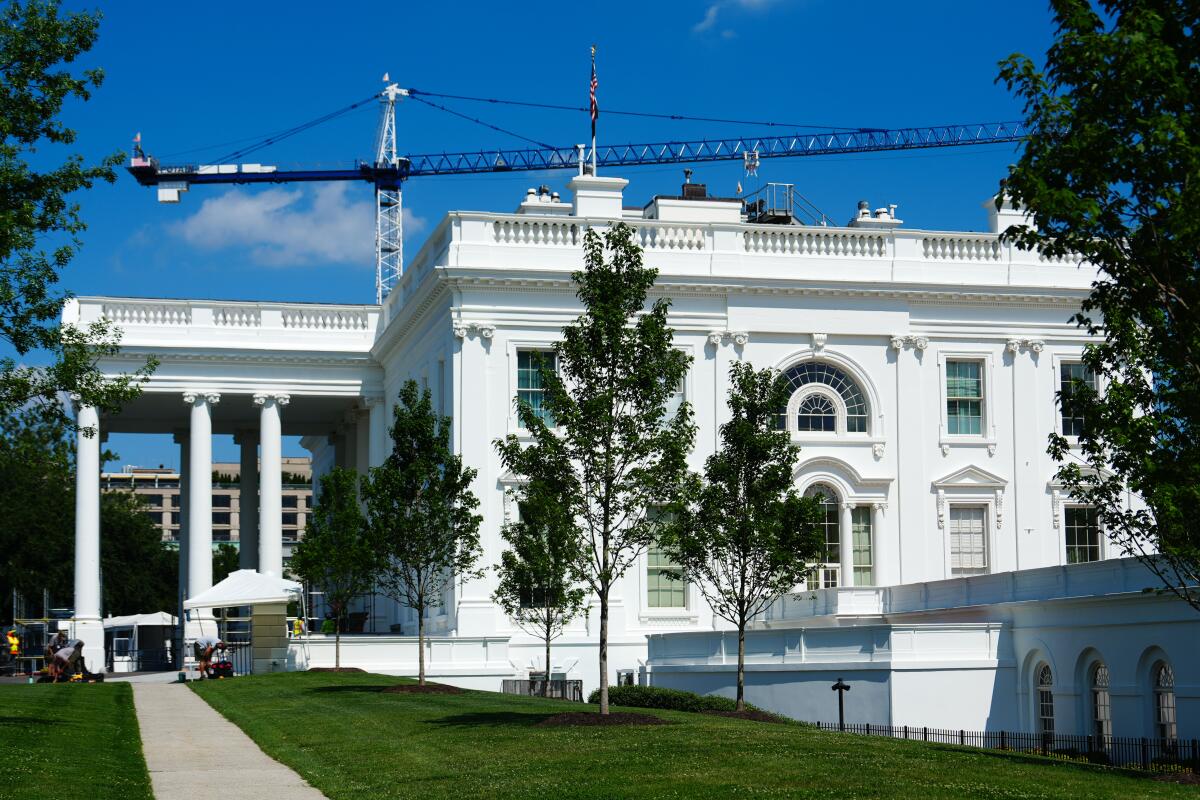
A construction crane works on the White House ballroom on Monday.
(Julia Demaree Nikhinson / Associated Press)
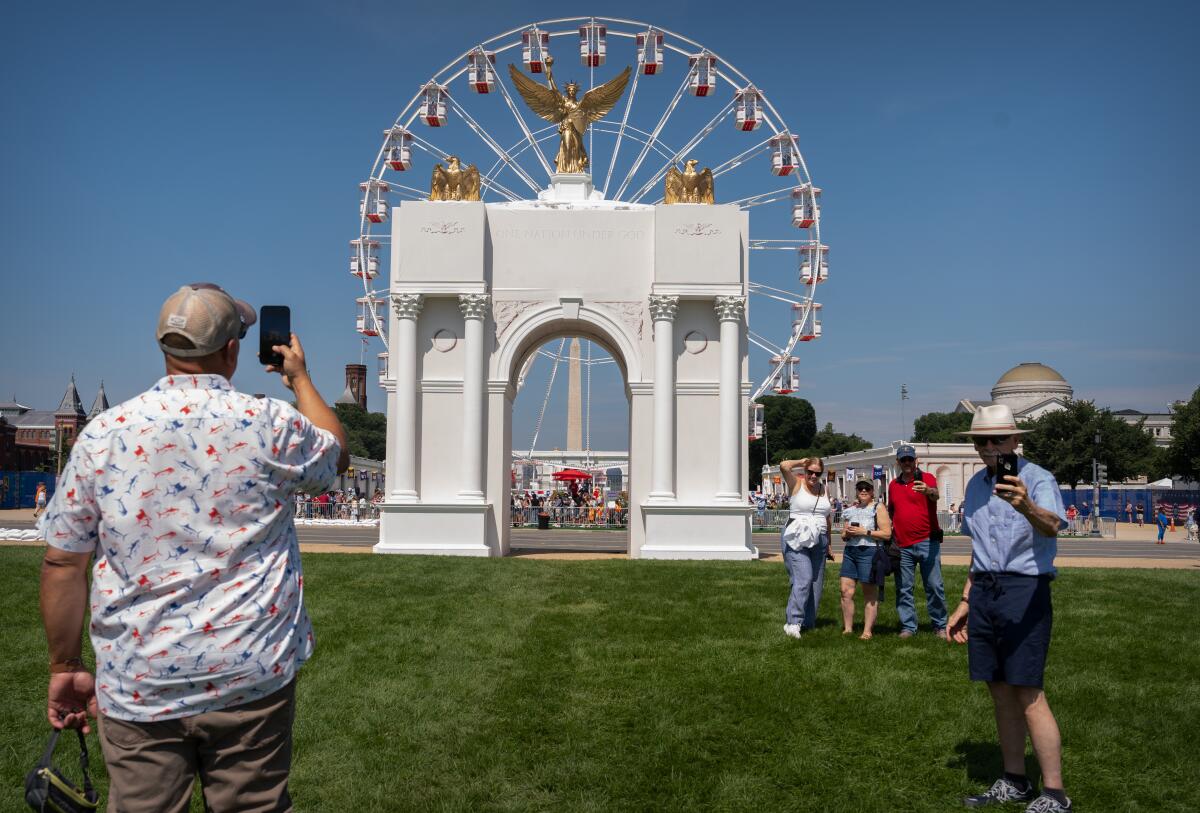
Visitors take photos Tuesday of a model of President Trump’s proposed marble arch at the Great American State Fair on the National Mall.
(Mark Schiefelbein / Associated Press)

Early-morning joggers observer the refilling of the Lincoln Memorial Reflecting Pool on June 5.
(John McDonnell / Associated Press)
The anniversary celebrations also come on the heels of the reflecting pool controversy. Last week, after chunks of paint were spotted in the water, Trump blamed vandals for tampering with the pool and said people had been arrested at the site. Two dead ducks were found in a pond about 250 feet away from the pool.
The area last week was surrounded by surveillance cameras and patrolled by National Guardsmen as lifelong resident John Cates strolled the area.
“It’s kind of creepy,” Cates said about the security cameras mounted around the pool. “It is unnecessary that we have to have this pond deemed a high security risk. That is weird.”
The area was fenced off at the end of last week. Fencing normally occurs in preparation for the July 4 fireworks show, but it went up “a couple days early to protect the pool,” Burgum said in the Fox News interview. He said seven people had been arrested in connection with the pool.
Tom Ayers, 34, was disappointed to find the fences already up on Monday. He traveled with his father from Wisconsin for the 250th, but they were finding it difficult to get around the Mall and they were upset to see the East Wing gone.
When they reached Lafayette Park, where the fencing had yet to be removed, they were again disappointed by the obscured view of the White House. Ayers’ father recalled a different scene in 1976, when he visited as a child for the nation’s bicentennial.
“I was kind of hoping for a summer similar to that,” Ayers said, “but overall, it seems nowhere close.”
Times staff writer Ana Ceballos in Washington contributed to this report.

NEWYou can now listen to Fox News articles!
A coalition of blue states and jurisdictions is suing the Trump administration over new Medicaid work requirements designed to prevent fraud, arguing the policy unlawfully restricts access to health care coverage.
The lawsuit, filed by at least 25 states and the District of Columbia, alleges the newly implemented Interim Final Rule (IFR) — issued by the Centers for Medicare & Medicaid Services (CMS) — violates federal law and departs from Congress’ original intent and early CMS guidance.
The IFR requires certain individuals to provide documentation proving they are exempt from Medicaid rules requiring enrollees to work, volunteer or attend school due to severe medical conditions.
Before the rule was issued in early June, highly vulnerable Medicaid recipients were set to be automatically exempt from such requirements. Agencies would have granted those exemptions by reviewing existing health records, without requiring individuals to complete additional paperwork ahead of the requirements taking effect in January 2027.
DR. OZ UNVEILS MEDICAID OVERHAUL, CLAMPS DOWN ON $2B FOR ILLEGAL IMMIGRANTS AND MANDATES WORK FOR ABLE-BODIED
Dr. Mehmet Oz, administrator of the Centers for Medicare & Medicaid Services, discussed a number of healthcare topics during a news conference with reporters on Tuesday, June 2, 2026. (Aaron Schwartz/CNP/Bloomberg via Getty Images)
The lawsuit names Dr. Mehmet Oz, administrator of the Centers for Medicare & Medicaid Services (CMS), which issued the IFR, and Robert F. Kennedy Jr., secretary of Health and Human Services (HHS), as defendants.
Oz previously argued that such guardrails are designed to prevent programs from being “defrauded into a turmoil,” adding that able-bodied enrollees receiving American tax dollars should contribute to society.
“If you can work, you should get up and work,” Oz said.
“If we put guardrails around these programs, we’ll allow them to thrive. I’m here because I love Medicaid. The president has already said he loves and cherishes Medicaid and Medicare. … We cannot allow these programs to be defrauded into a turmoil that they cannot pull up from. If we love these programs, we will make the difficult decisions.”
The new rule would require able-bodied individuals to work 20 hours a week, volunteer, or pursue education while enrolled in free healthcare coverage.
Fox News reached out to the White House and HHS for comment.
FED AUDIT, EMERGENCY MEDICAID UNDERCUT DEMS ON ILLEGAL IMMIGRANT HEALTH COVERAGE
Health and Human Services Secretary Robert F. Kennedy Jr. speaks during an interview. ((Photo by Jason Mendez/Getty Images))
The plaintiffs involve California, Connecticut, Delaware, the District of Columbia, Hawaii, Illinois, Maine, Maryland, Massachusetts, New Jersey, New York, Oregon, Rhode Island, Vermont, Washington, Arizona, Colorado, Michigan, Minnesota, Nevada, New Mexico, North Carolina, Pennsylvania, Virginia, Wisconsin and Kentucky.
“People with disabilities, patients in the middle of cancer treatment, or those struggling with another serious or complex health condition, shouldn’t be at risk of losing the care that helps maintain their health,” the suit stated.
REPUBLICANS PRAISE ‘BIG, BEAUTIFUL BILL’S’ WORK REQUIREMENT FOR MEDICAID: ‘WE’VE GOT TO GET BACK TO WORK’
According to the suit, CMS’s own projections estimate that 2.3 million enrollees will lose Medicaid coverage in the first year alone.
The agency also estimates that 7% of enrollees who are working or qualify for an exemption will lose coverage due to confusing paperwork requirements, strict deadlines or missing documentation, according to the document.
Beginning in 2028, enrollees who do not have immediate medical records on file would be limited to a single opportunity to submit a “self-attestation” form declaring, under penalty of perjury, that they are too sick to work.
Under previous guidance, enrollees were allowed to use self-attestation multiple times as their medical needs evolved.
An examination bed sits inside a medical clinic. (AP Photo/Matt York)
CLICK HERE TO DOWNLOAD THE FOX NEWS APP
In addition, plaintiffs said the new rules would force states to abandon automated systems they have already invested in and instead build more complex and costly manual review processes.
As the Aug. 31 deadline to mail notices to Medicaid enrollees approaches, the plaintiffs are seeking a temporary stay and a preliminary injunction to block CMS and HHS from enforcing the rules.
-

 Lifestyle26 minutes ago
Map: See Taylor Swift’s NYC Hotspots Ahead of Her MSG Wedding
-

 Education31 minutes ago
Opinion | 13 George Washington Interpreters on Embodying an Icon
-

 Technology38 minutes ago
Mystery box shows are complicated for everyone — even the actors
-

 World41 minutes ago
After 1,000 days of war: Many Israeli children carry trauma into summer break
-

 Politics53 minutes ago
Trump admin axes ‘Green New Scam’ appliance rules as Europe bakes in brutal heat
-

 Health56 minutes ago
5 of America’s greatest medical breakthroughs revealed as the nation marks 250 years
-

 Sports1 hour ago
USA World Cup star calls lack of appeal process for teammate’s red card ‘bogus’
-

 Technology1 hour ago
Booking a summer trip? Here’s what you’re giving scammers

