Politics
He took on L.A.’s street gangs. For Mayorkas, impeachment ‘does not rattle me’

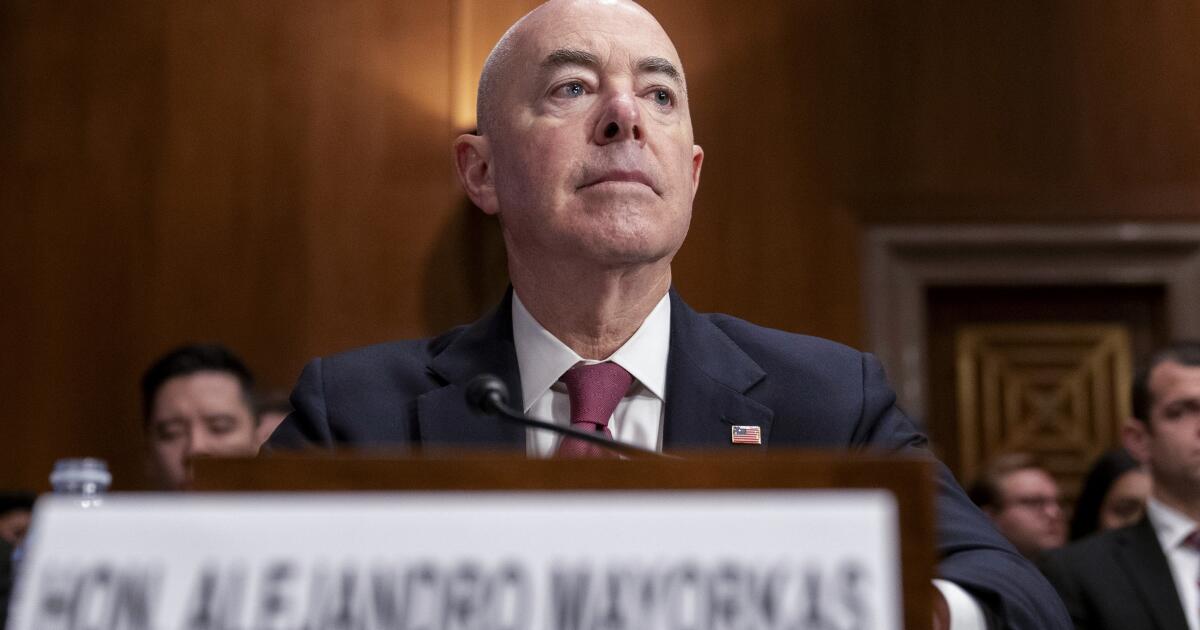
This isn’t the kind of history Alejandro N. Mayorkas wanted to make.
The son of immigrants who fled Cuba and settled in Beverly Hills when he was a child, Mayorkas was tapped in 2021 by President Biden to become the first Latino head of the nation’s Department of Homeland Security.
Decades earlier, he made a reputation as the country’s youngest U.S. attorney in 1998, leading the Central District of California based in Los Angeles at 38.
In recent months, however, Mayorkas, 64, has found himself in a far less flattering historical spotlight: targeted to become the first U.S. Cabinet official impeached in nearly 150 years.
“I knew I was entering an extraordinarily polarizing environment, an environment where norms were in jeopardy, where civility was not always respected,” he said of his mind-set when he became secretary. “I didn’t assume this. It doesn’t rattle me, though.”
House Republicans, eyeing chaos at the border as a path to regain control of the White House and Senate, say Mayorkas’ failure to prevent record arrivals of migrants meets the constitutional bar for impeachment of “high crimes and misdemeanors.”
Democrats call the impeachment effort a vast, politically motivated overreach, characterizing Mayorkas as a committed government servant being used as a pawn in the 2024 presidential race.
To the surprise of many, the embattled secretary on Tuesday narrowly escaped impeachment by the House when three GOP lawmakers — including one from California — broke ranks with their party and joined all Democrats to vote no.
But House Republican leaders have vowed to try again, perhaps as soon as next week, even though the Democratic-controlled Senate is certain not to convict and remove him from office.
In his first extensive, sit-down interview since the vote, Mayorkas told the Los Angeles Times on Thursday that he did not watch the impeachment proceedings. Instead, he was in a meeting in the San Francisco Bay Area discussing the agency’s prioritization of artificial intelligence. He broke away for a call and was informed the vote had failed.
Mayorkas, who insists he will not resign even if impeached, says he inherited a broken and outdated immigration system that can’t adequately respond to what has become a global migration crisis brought on by violence, poverty, authoritarian regimes and climate disasters.
He called the impeachment proceedings baseless, the accusations false and blamed Congress for failing to allocate enough funding to address the issue.
After devoting his life and career to public service and law enforcement, Mayorkas said the threat of impeachment, one of the rarest, most shameful rebukes a government official can face, is disappointing but has not shaken his commitment.
Respect for the law and service to democracy are themes that run deep in Mayorkas’ upbringing.
As a boy in Los Angeles, Mayorkas recalls his mother encouraging him to approach police officers in uniform, extend his hand and thank them. After escaping Fidel Castro’s regime in Cuba, American police were, to her, a symbol of safety and the rule of law.
Mayorkas was born in Havana. His Jewish Cuban father owned a steel wool factory; his mother, a Jewish Romanian, narrowly survived the Holocaust when her family caught one of the last ships to Cuba.
In Beverly Hills — where his parents were drawn because of the education system — the family lived in a two-bedroom apartment before later moving to a modest home, where Mayorkas shared a bedroom with his two younger brothers. They attended a local synagogue twice a year for High Holy Days and frequented El Colmao, a Cuban restaurant in Pico Union.
Mayorkas attended Beverly Hills High School, UC Berkeley and Loyola Law School.
As a promising young federal prosecutor in Los Angeles, Mayorkas pursued the death penalty against members of the Mexican Mafia, brought organized crime charges against a Los Angeles street gang and prosecuted Hollywood madam Heidi Fleiss for tax fraud and money laundering.
Time in the courtroom, where he said defense attorneys lobbed heated verbal missiles at him, prepared him for what was to come.
“When I was in the courtroom, and the arrows are flying, what one is representing is the truth,” he said. “To have to fight to have that truth prevail is, I thought, what a privilege. And the arrows? Let the arrows come. We will deflect them, and break them.”
David Lash, then-chief executive officer of Bet Tzedek Legal Services, a nonprofit law firm in Los Angeles, remembers consulting with Mayorkas on a series of fraud cases targeting elderly people. “Ali,” as Mayorkas is known to friends, was instrumental in the success of those cases, Lash said.
Lash and Mayorkas, who lived five blocks from each other, had children around the same ages. They became close friends, getting together for backyard barbecues over the years.
Mayorkas helped recruit Lash to the pro bono program at O’Melveny, the Los Angeles law firm Mayorkas joined after President Clinton left office in 2001.
Just walking to lunch might take 20 minutes, Lash recalled, because Mayorkas seemed to know every third person on the street, and would stop to shake their hands and ask how their families were doing.
“I think that comes from himself being an immigrant and working in the public interest,” Lash said. “It’s so important to him that he’s just imbued with this respect for people who are everyday folks working to make a life.”
President Obama appointed Mayorkas to lead U.S. Citizenship and Immigration Services in 2009. There he led implementation of Deferred Action for Childhood Arrivals, or DACA, the program that offered work permits and deportation protections to hundreds of thousands of immigrants brought to the country as children.
He also led talks with the Cuban government on import security and travel as tensions between the U.S. and Cuba thawed. In 2015, he revisited his birth country for the first time.
The trip was personally difficult. His father had made the painful decision to leave Mayorkas’ grandmother, who was badly ill, when they fled Cuba and never got the chance to return. When Mayorkas visited his grandmother’s grave, it was in disrepair. He asked whether he could pay for landscaping at the cemetery but was refused permission, he said.
“It was a very difficult reminder of the loss and hardship of that exodus,” he said.
Four years later, Mayorkas was confirmed by the Senate as deputy secretary of Homeland Security. He led the agency’s response to the Ebola and Zika virus epidemics, built up the agency’s cybersecurity capabilities and targeted drug cartels.
His tenure wasn’t without controversy. A 2015 DHS inspector general’s report accused Mayorkas of creating “an appearance of favoritism and special access” for politically connected businesses under a visa program that provided a path to citizenship for wealthy foreign investors.
Mayorkas returned to private practice during Trump’s administration as a partner at WilmerHale. But he appeared, to his friends, unsatisfied.
“He felt like there was unfinished business there, and that he could get the job done,” said Jim Pasco, executive director of the national Fraternal Order of Police. He and Mayorkas have been friends since Mayorkas led the citizenship services agency.
Pasco said Mayorkas has a real reverence and affinity for law enforcement.
“His whole worldview, his whole approach to life was really imprinted on him in his early childhood and early adulthood,” Pasco said. “His family, particularly his mother, and his father, were very, very patriotic and raised him to be patriotic and appreciative of the things that the government did for them and the things that [it] protects them from.”
Mayorkas returned to the Homeland Security Department with Biden’s administration, faced with the challenge of undoing many of Trump’s policies, including travel bans for people from certain Muslim-majority countries, and with the aftermath of others, such as the separations of migrant children from their parents.
Mayorkas was faced with the unprecedented arrival of migrants at the southern border, not just from Central America but now also in greater numbers from places like China, India and Afghanistan. Republicans quickly put him, and his impeachment, in their sights after taking control of the House in 2023.
Rhetoric against Mayorkas has turned ugly at times. The morning of the impeachment vote, House Homeland Security Committee Chair Mark Green (R-Tenn.) behind closed doors called Mayorkas a “reptile with no balls” because he has refused to resign, according to Politico. Several House members, including Rep. Josh Gottheimer (D-New Jersey), quickly condemned the statement as antisemitic.
The attacks against Mayorkas have led even some conservatives to come to his defense.
Pasco’s organization, the Fraternal Order of Police, sent a letter to Congress just before the House vote Tuesday praising Mayorkas and the partnership between the DHS and local law enforcement to combat the fentanyl epidemic and violent crime. The FOP, the country’s largest police union, endorsed Trump in 2016 and 2020.
Trump’s impeachment lawyer, Alan Dershowitz, urged Republicans not to “apply a double standard” by impeaching Mayorkas.
In a letter to his colleagues Tuesday morning, Rep. Tom McClintock (R-Elk Grove) said Mayorkas’ policies have damaged the country, but malpractice is not an impeachable crime. Homeland Security Committee members, he said, “stretch and distort the Constitution in order to hold the administration accountable for stretching and distorting the law.”
Three former Homeland Security secretaries, from Democratic and Republican administrations, said the impeachment jeopardized national security and undermined the department’s mission, including counterterrorism efforts.
And groups on the left, some of which have stridently criticized policies under Mayorkas, extended olive branches in support of the secretary, one of the highest ranking Latinos in government.
A coalition of 18 Latino-led civil rights and advocacy groups, including the Coalition for Humane Immigrant Rights of Los Angeles, wrote to House Speaker Mike Johnson (R-La.) on Tuesday calling the impeachment effort a sham.
“While not all his decisions have been met with unanimous approval, including from the signers below and other voices within our community, we strongly urge Congress to redirect their efforts to working in a bipartisan manner toward humane and effective immigration reform that helps move the American people forward,” the groups wrote.
At the same time the House was advancing impeachment proceedings against Mayorkas, the Senate released a bipartisan $118-billion border and foreign aid bill, supported by Biden and which Mayorkas consulted on.
“The irony is not lost on me,” said Sen. Alex Padilla (D-Calif.), who opposed the bill, in part because it failed to include a legalization component for immigrants including so-called Dreamers, as previous negotiations have. “Republicans can’t have it both ways,” he said.
Nonetheless, Padilla said running Homeland Security is one of the toughest jobs in America, made even tougher when Congress plays politics.
Republicans, he said, “can’t bring forward meaningful solutions — so they pivot to trying to scapegoat somebody through the impeachment process.”
Times staff writer Sarah D. Wire contributed to this report.

The Supreme Court ruled 6-3 that President Trump could fire independent regulators for any reason. But the justices carved out an exception for the Federal Reserve, preventing the immediate removal of Lisa D. Cook, a Federal Reserve governor.
Politics
Emotion and feelings: How Democratic Socialists’ congressional insurgency could come back to bite them

NEWYou can now listen to Fox News articles!
Democratic Socialists of America are on the charge, running hot off their wins in the New York Democratic primaries last week. Their victories in multiple Congressional seats – felling both Reps. Adriano Espaillat, D-N.Y., and Dan Goldman, D-N.Y. – signals that the party is ready to move on from the same old, same old.
Espaillat chaired the Congressional Hispanic Caucus. Goldman was a key House staffer during the first impeachment of President Donald Trump.
“Even Dan Goldman’s not good enough for them,” said House Judiciary Committee Chairman Jim Jordan, R-Ohio, on Fox. “That is how radical it’s become.”
Some moderate Democrats are trying to distance themselves from the left.
MAMDANI-BACKED SOCIALISTS LOOK TO TAKE NEW YORK PLAYBOOK NATIONWIDE AFTER PRIMARY VICTORIES
The left flank of the Democratic Party has surged to the top of the nation’s most hotly-contested primaries. (Michael M. Santiago/Getty Images)
“That’s not the same brand of politics that we have. We’re not those type of Democrats,” said Rep. Tom Suozzi, D-N.Y., who represents a battleground district.
“There’s a new group of Democratic Socialists who are socialists who are not commonsense Democrats. Who are not interested in getting things done. They’re interested in throwing bombs. Not actually solving problems,” said Rep. Josh Gottheimer, D-N.J.
LURCHING LEFT: MAMDANI-BACKED CANDIDATES OUST ESTABLISHMENT DEMOCRATS
Some Democrats are worried how far left candidates command more attention than those in the middle. Rep. Kristen McDonald Rivet, D-Mich., worries that the outsized attention garnered by the left sends the wrong impression to voters.
“What they don’t want is divisiveness. They don’t want screaming and yelling,” said McDonald Rivet.
Mainstream Democrats feel trapped in the middle as the left – specifically the New York City left – wields an outsized media and political megaphone.
“Those candidates would not have won in Virginia where I live,” said Rep. Suhas Subramanyam, D-Va.
Rep. Tom Suozzi, D-N.Y., is among the moderate Democrats trying to distance themselves from the party’s insurgent wing. (Nathan Posner/Anadolu via Getty Images)
Republicans believe they are primed to nationalize the midterms. Republicans can do that by highlighting the extreme views of Democratic Socialists who captured primary victories in New York City. The GOP wants to portray their opponents as veering left.
“These are board-certified communists, right?” asked Sen. Roger Marshall, R-Kan. “They want no police. They want no private property.”
President Trump capitalized on the Democratic outcomes in his home city.
“The Democrat party is in big trouble because this isn’t stopping with New York,” he forecast.
VICTORIES BY MAMDANI-BACKED CONGRESSIONAL CANDIDATES SPOTLIGHTS GROWING RIFT IN DEMOCRATIC PARTY
This shakeup has progressive leaders demanding transformation at the top.
“You’re going to see, I think, people voting for new leadership and to change their representation,” said Rep. Alexandria Ocasio-Cortez, D-N.Y.
The Democratic Party tapped Sen. Elissa Slotkin, D-Mich., to deliver their official response to President Trump’s 2025 State of the Union speech. Slotkin is a moderate who won in a battleground race in 2024 – even as the President prevailed in the Wolverine State. But during an appearance on SiriusXM, Slotkin insists on a Democratic Party management switch.
“If people can’t understand that the game has fundamentally changed and they can’t adapt, then they need to let others,” said Slotkin. “The old models do not work for people.”
House Minority Leader Hakeem Jeffries, D-N.Y., is perceived by Republicans as vulnerable after his preferred candidates failed in their congressional primaries. (Roberto Schmidt/Getty Images)
Republicans believe House Minority Leader Hakeem Jeffries, D-N.Y., is vulnerable after the DSA elected their candidates over his preferred picks in New York City.
“I think Hakeem Jeffries’ friends and neighbors gave him a big middle finger,” said House Oversight Chairman James Comer, R-Ky. “If you lose three elections in your hometown, that’s a pretty big slap in the face.”
He added that Democrats “are going further and further to the left to the point where they are full-blown, card-carrying socialists.”
And then there is the anti-Israel, anti-Jewish, and in some cases, antisemitic take by some of these candidates. Rep. Greg Landsman, D-Ohio, is a moderate Democrat from a swing district. He’s Jewish and one of the most pro-Israel Democrats in the House.
“There are some on the left who use Israel the way that some on the right use immigrants or trans kids as a way to divide. And I think it’s terrible. It’s also just not what voters want us talking about,” said Landsman.
HOUSE DEMOCRAT LASHES OUT WHEN GRILLED ON WHETHER SOCIALIST VICTORIES WOULD THREATEN DEM UNITY
Yours truly tangled with Rep. John Larson, D-Conn. – who once chaired the House Democratic Caucus. I pressed him about what the party would do about some candidates “who are too far to the left.”
“What does that mean? That’s your statement. Did the people of New York vote?” queried Larson.
I assured him that they did.
“Is that democracy?” asked Larson.
“But if some of them are antisemitic,” I countered.
“Is that a democracy?” continued Larson.
“Will you stand by people if they have antisemitic views?” I followed up.
Larson finally addressed my inquiry. His answer crystallized the schism the Democratic Party now faces.
“I’m against antisemitism, if that’s your question,” Larson declared.
Rep. John Larson, D-Conn., got into a heated exchange with Fox News’ Chad Pergram over the views of some likely members of his party’s next freshman class. (Bill Clark/CQ-Roll Call, Inc via Getty Images)
The fact that Democrats are now facing this debate robs them of valuable time on economic issues.
Landsman argued that voters would prefer candidates to stick to groceries and the price of gas.
Gottheimer echoed Landsman on kitchen table subjects.
“We should be focused on ways to actually solve problems like that. Not coming in here and using tea party tactics and trying to divide up the country and pray to socialist ideals,” said Gottheimer.
So what is the party to do?
DEMOCRACY ’26: STAY UP TO DATE WITH THE FOX NEWS ELECTION HUB
“They’re our nominees. We’re going to support them. We’re going to welcome them. They’re going to be part of our caucus and we’re going to unite behind Leader Jeffries,” said Rep. Robert Garcia, D-Calif., the top Democrat on the Oversight panel.
But that doesn’t address the fissures. It doesn’t address how voters may perceive the party. And it doesn’t establish if these new Democratic nominees will work on behalf of the party to raise money and advocate for Democrats across the board. Or, will they become professional bomb throwers – ala what the right has endured for a while.
“It’s going to be a lot harder to get things done when you get more and more extreme candidates who are here because they’re interested in political celebrity. They are interested in fighting. They’re interested in making points,” asserted Rep. Dusty Johnson, R-S.D.
Republicans have had an abysmal week themselves – President Donald Trump and Sen. Bill Cassidy, R-La., for instance, got into a shouting match over Iran. (Chip Somodevilla/Getty Images; Tyler Kaufman/Getty Images)
Republicans suffered through an absolutely abysmal week. House GOP leaders had to yank multiple bills off the floor and send lawmakers home early because of internal disputes. President Trump and Sen. Bill Cassidy, R-La., got into a shouting match about Iran. And the president even threatened to veto a bipartisan housing bill. President Trump then refused to sign the bill at the Capitol, despite his aides touting the bill and House Republicans tricking out Statuary Hall for a signing ceremony.
The President characterized the housing bill as “a yawn.”
But the Democrats’ internal fractures may have superseded any internecine fighting among Republicans.
“While it’s not been a great week for Republicans, I think it’s been a much worse week for Democrats because of these primary elections,” observed Rep. Mario Diaz-Balart, R-Fla.
CLICK HERE TO DOWNLOAD THE FOX NEWS APP
Democrats will certainly run on economic issues and capitalize on statements by the President about basic issues like housing. But will a genuine policy debate outweigh fears about progressives nationwide?
Emotion and feelings rule in politics. And it could be a problem for Democrats if Republicans appropriate what happened in New York and Xerox it onto battleground districts across the country.

Anthropic teamed up with California to get more state workers to use its artificial intelligence assistant Claude as part of an effort to leverage technology to make the government more efficient.
Gov. Gavin Newsom, who announced the partnership on Monday, said state agencies will be able to access Claude at a 50% discount. Free training and other assistance will also be available to the workers. California’s local governments will also get the same discount under the agreement.
Government workers can use Claude to draft and summarize documents, analyze information and do other tasks.
Anthropic, an AI company based in San Francisco, has a version of its AI assistant for government clients that provides more security than what it provides other consumers.
The new partnership shows how AI is playing a bigger role at work as tech companies market their tools as ways to complete tasks more quickly. Last year, San Francisco made Microsoft 365 Copilot Chat, which is powered by OpenAI’s model, available to nearly 30,000 city employees.
Still, the rise of automation at work has heightened concerns that people will lose their jobs. There are also worries that there are not yet adequate guardrails in place to mitigate data privacy and security risks.
Anthropic and the governor said that they’re focused on the responsible use of AI.
“AI should not replace the human work of government; it should help our workers move faster, solve problems more effectively, and deliver better results for Californians,” Newsom said in a statement.
The remarks didn’t appear to comfort union leaders.
“Wow. Look local government, the Gov is giving you a 50% off coupon to give up your residents’ private data, outsource your jobs to big tech. Isn’t that cool? Because California basically invented AI slop!” said Lorena Gonzalez Fletcher, president of the California Federation of Labor Unions, AFL-CIO, in a post on X.
Anthropic has faced political hurdles as it pushes to get more companies and government agencies to use its products.
Most notable, it’s sparred publicly with the Trump administration, which ordered the company to cut off foreign access to its most powerful AI systems this month.
The Trump administration cited potential national security risks, but Anthropic disagreed with the findings. Last week, tensions decreased after the U.S. government gave Anthropic permission to restore access to its AI model Mythos to certain clients.
Valued at nearly $1 trillion, Anthropic has also signaled it plans to become a publicly traded company.
California has already started using Claude more in state government to develop tools to get the public to engage more in AI policy discussions and assist state workers, the governor’s office said in its news release.
State agencies, including the Department of Motor Vehicles, are also using AI to reduce wait times and improve customer service.
“As state employees, our goal is to provide our fellow Californians with the best possible service,” Government Operations Agency Secretary Nick Maduros said in a statement. “To do that, we need to make sure our teams have access to the best modern tools, including Claude and other emerging technologies.”
-

 Maine2 minutes ago
Maine driver to honor friend Kyle Busch during Celebration of America 300
-

 Maryland7 minutes ago
Maryland man sentenced for making online threats toward Black and Muslim communities
-

 Michigan14 minutes ago
Michigan Lottery Daily 3, Daily 4 results for June 29, 2026
-

 Massachusetts17 minutes ago
Millions of gallons of wastewater discharged into Merrimack River due to broken pipe
-

 Minnesota22 minutes ago
Driver in fatal crash near Belview, Minnesota, was fleeing law enforcement
-

 Mississippi29 minutes ago
Mississippi gas prices drop ahead of Fourth of July weekend
-

 Missouri32 minutes ago
Gas prices falling in Missouri despite U.S. conflict with Iran
-

 Montana37 minutes ago
June 29 recap: Missoula and Western Montana news you may have missed today

