Politics
Contributor: Remember when it was the right that got outraged over 'banned words'?


Some of the fiercest blowback in recent years against “diversity, equity and inclusion” greeted Stanford University in 2022 when it launched the website of its Elimination of Harmful Language initiative. Back then, it was the right that was appalled by the efforts to limit language.
Developed by campus experts in technology and inclusion, the site labeled hundreds of words and phrases “harmful,” urging the use of alternatives. While the list included some terms widely considered offensive (such as “cripple” for disabled or “shemale” for transgender) it also cited a baffling array of anodyne terms — “immigrant,” “grandfather,” “Hispanic” and scores of others. The word “American” was cast out in favor of “U.S. citizen,” lest the former be construed to overlook the existence of the rest of the Americas. “Tribe” was rejected as “equating indigenous people with savages.” While the list was not official university policy, the message was clear: To be an upstanding Stanford citizen, these lines ought not be crossed.
The Wall Street Journal editorial board excoriated the list as self-parody, saying “you used to have to get a graduate degree in the humanities to write something that stupid.” Conservative websites and podcasters had a field day, calling the site “Orwellian.” Stanford Professor Jay Bhattacharya, now President Trump’s head of the National Institutes of Health, called the list “ham handed” and “crazy.” Amid the uproar, Stanford sheepishly pulled down the website, citing the university’s commitment to academic freedom.
Now the left is making a lot of the same critiques, noting that this time the dystopian directive comes from the top of the federal government. As part of its crusade to wrest America from the clutches of “wokeness,” the Trump administration is discouraging federal agencies, grantees and contractors from using a long list of ordinary words like “accessible,” “female,” “women,” “political” and “pollution.” These words have been scrubbed from government policy statements and websites; government affiliates are effectively on notice that their use could result in discipline or punishment.
Some of the words on the Stanford and Trump lists overlap, including variations of “Hispanic,” “victim,” “pronouns” and “transexual,” a vivid illustration of where the extremes of right and left tilt so far as to appear to converge. After ridiculing Stanford’s censorious overreach, a right-wing movement supposedly bent on freeing Americans from intrusive controls on speech is indulging in precisely the methods it excoriated.
Trump has made the war on woke a centerpiece of his early weeks in office. He has banned diversity, equity and inclusion policies, eliminated transgender protections, and targeted universities, law firms and government bodies accused of resisting such efforts. The MAGA movement’s disdain for DEI is grounded partly in concerns over sidelining of merit in favor of diversity, and on what it sees as the unfairness of using race or gender to advantage some at the expense of others.
But a second major critique of DEI focuses on the heavy-handed policing of ideas. While the Stanford list was particularly egregious, it is not the only such policy to exert pressure on open discourse. Some see the very adoption of institutional commitments to diversity, equity and inclusion as the imposition of a singular ideology in settings like the university that should be open to all perspectives, including critics of such policies. Arguments over the legitimacy of affirmative action, transgender participation in sports or immigration policy can be stifled when people fear being accused of racism or bigotry for voicing dissenting views.
Overreaching diversity strategies can not only suppress speech, but also compel it. When some universities began to require faculty job applicants to submit personal statements outlining how they support diversity, equity and inclusion, the policies were rightly criticized as signaling to candidates that there was only one right answer when it came to DEI: full-throated embrace.
That the ridiculed Stanford list of harmful words has now been met by an opposing list of disfavored terms reflects the MAGA movement’s conviction that the fire in the belly of diversity advocates can only be fought with more fire. Opponents are convinced that the dangerous entrenchment of DEI in educational institutions, media companies and workplaces must be stopped by any means necessary. To match the implicit censoriousness of the Stanford list and similar approaches never enshrined into law, the Trump administration is resorting to out-and-out censorship.
While the Stanford list, by offering alternate formulations with similar meanings, aimed to declare off-limits specific words rather than entire concepts or ideas, the Trump list does the opposite. Its entries are proxies for whole areas of scholarship, research and policymaking that are now verboten. By instilling fear in government officials, educators and scientists, the Trump administration not only chills speech but also impairs essential work in areas including gender and racial differences in medicine, violence against women and mental health.
At a time when Vice President JD Vance is lecturing Europe about its supposed betrayal of free speech values, the Trump administration has made clear its unwillingness to live by the openness it expects from, say, the German political system. If free speech is a casualty of MAGA’s war to protect free speech, so be it, apparently.
Stanford’s list and other taboos did not succeed in stamping out bias. After strides toward diversity and inclusion on campuses and at corporations, now comes a ferocious counterattack. The retort is fueled in part by the belief that a past commitment to diversity threatened free speech. Now some are rushing to voice opinions that they felt were once muzzled.
Back in 2022, when Stanford professor Bhattacharya was interviewed on Fox News about the university’s harmful language list, he brought up one of the oft-cited risks of declaring words and ideas forbidden, saying: “I see a list of words like that and I want to say those words. I can’t be the only one.”
He is certainly not the only one. And nor is Stanford’s list the only one sure to provoke that reaction. The current chilling of discussions of racial and gender equality may ultimately only make support for such causes hotter.
Suzanne Nossel is a member of Facebook’s Oversight Board and the author of “Dare to Speak: Defending Free Speech for All.”

President Trump has promoted a chain of newly rebranded gas stations across the Philadelphia area with lower gas prices. The New York Times has not been able to get detailed information about who is behind the stations. The Trump administration says it did not fund or subsidize the company.

NEWYou can now listen to Fox News articles!
Kelley Paul is no stranger to the American political scene. As the wife of Senator Rand Paul (R-Ky.), and the daughter-in-law of longtime former Congressman Ron Paul (R-Texas), she has seen her fair share of the campaign trail, emerging as a powerful surrogate during her husband’s 2016 presidential run.
She is also an accomplished writer, speaker, and public relations professional. As America ushers in its 250th anniversary, Paul saw the perfect opportunity to branch out into the world of children’s literature. Recently she sat down with Fox News Digital in Las Vegas at Freedom Fest to discuss her new book, “Good Night, Young American.”
Kelley Paul is the wife of Sen. Rand Paul and author of two books. (Courtesy Kelley Paul)
Paul credits her family for giving her the inspiration for the new project:
“I have to give a lot of credit to my daughter-in-law, Kate. She and our son were over for dinner last summer with our grandson, who was only six months old at the time. And Kate was like, you know, we need more patriotic books for babies. She wasn’t really happy with a lot of the book options she was seeing. And that night at dinner, we kind of played around with some ideas. And I came up with ‘Good Night Young American.’ And a year later, here it is.”
EXCLUSIVE: RAND AND KELLEY PAUL OPEN UP ABOUT 2016 RACE
“Good Night, Young American,” recommended for children ages 4–8, takes kids on a visually and thematically engaging journey through early and colonial history.
“Well, our revolutionary history is such a great adventure, right? So when I came up with the concept that my little boy would start out on the 4th of July with his parents, asking, what is it all about? I knew we’d be celebrating the 250th. Kids ask, what are we really celebrating?
And his dad describes the Declaration of Independence to him in the signing. So I tried to think what is going to appeal to children in this great adventure of our revolution. So when he falls asleep that night, he’s in the crow’s nest of the Mayflower. He is a pilgrim, he’s a colonist, and then he makes friends with all the great revolutionary heroes that we know. So he makes friends with Sam Adams, he joins the Sons of Liberty, he meets at the Green Dragon. This is so exciting for children, right?
It’s visual stuff. He makes friends with Ben Franklin, and he’s flying the kite. Dramatically rides on the midnight ride with Paul Revere. He and his dog, his little dog, are with him for all the adventures. And of course, he crosses the Delaware with George Washington. And I wanted to make the signing of the Declaration of Independence and the writing of it something that was dynamic and exciting visually. So I have him swinging on the Liberty Bell when the declaration is signed.”
Paul worked closely with the illustrator, Marika Monesi, to bring the events of America’s founding to life in an engaging and visually appealing way for children.
The Liberty Bell, originally saved from the British by Lynnport farmer Frederick Leaser, sits in its Philadelphia shrine. (iStock)
“She really captured the excitement on the little boy’s face, his personality, but I worked very close with her,” Paul said. “I wanted there to be a lot of movement, a lot of dynamic images. So, for example, with the Liberty Bell, for kids, a bunch of men standing around writing a document…I wanted to bring it to life. So I said, let’s have him running up to the top of the bell tower in Philadelphia at Freedom Hall and swinging on the Liberty Bell. And she was just such a great artist. With the George Washington scenes, he’s crossing the Delaware because that, again, is so visual. I wanted drive home to children the incredible bravery and courage of our founders, how cold and miserable and hard that war was.
“Also, I love the illustration that she did of the King of England reading the Declaration of Independence. I have to give my husband Rand a little credit there. On the first couple of drafts that she did, Rand was like, ‘He needs to be fatter. King George was famously fat!’ So it was a lot of fun. It was very collaborative.”
KELLEY PAUL ‘EXHAUSTED AND ANGRY’ THAT THOSE WHO HARASSED HER AND HER HUSBAND FACE NO CHARGES
Part of Paul’s motivation for the book was related to the teaching of American history today, and the controversies therein:
“I do think that we’ve gotten away from really celebrating our founders and our heroes. What they were doing in 1776 was incredibly radical, if you think about it. At that time, everyone accepted the divine right of kings. Everyone accepted hereditary rule. And our founders took Enlightenment ideas from John Locke and philosophers, and they turned it into the framework for a government. The idea of self-government and that our rights come from our Creator, that we have inalienable rights that are given to us by God and not from a king. Those were radical ideas of the time.
Historians say an early draft of the Declaration of Independence offered new insight into how Thomas Jefferson refined the nation’s founding document. (Stock Montage/Stock Montage/Getty Images)
I like to say our founders were the first civil rights heroes, the first civil libertarians. And I think our education system has gotten away from that. They don’t view them in the time that they existed, and suddenly now everything is oppressor versus oppressed narrative. And they are labeled more like colonizers or enslavers, and that’s the only view that they’re looked at, and not as human beings who sacrificed their very lives to write the Declaration of Independence, to form this country…it was an incredible, bold, and courageous act, but it was also an act of moral courage and philosophical courage.”
Ultimately, Paul hopes that her books will stimulate the natural curiosity of America’s youth to learn more about their rich history:
Participants carry the City of Cumberland’s “America 250” parade banner down Baltimore Street during the America 250 parade in downtown Cumberland, Maryland, on June 27, 2026. Spectators line both sides of the street as American and Maryland flags lead the procession. (Fox News Digital/ David Marcus)
“Well, I hope that my books, especially with America’s 250, will spark a lot of questions and that they will give a framework for parents to talk to their kids about the founding of this country. And I hope children from a very, very young age will come away with this idea that they are a part of America’s story, that they as Americans can take pride in the heroism of our revolutionary founders. That as Americans, this is all of our story. So that’s really my goal with the books.”
One of the biggest challenges Paul faced was taking big ideas that may be hard for a four or five-year-old to grasp, like the Declaration of Independence or the Constitution, and distilling them down into an accessible format for kids:
“Well, I try to use language that kids could understand, and very much use simple terms. But if you think about it, it is simple. Our rights come from God. And when he makes friends with Thomas Jefferson, he says, Thomas Jefferson has written this amazing document that says that we can all be free to live our lives the way we choose, and no government can take our rights to, you know, to life, liberty, and the pursuit of happiness away from us.
He also talks about James Madison and the Bill of Rights and the most important right is freedom of speech. That is that no government can tell you what to say or what not to say.”
Rand Paul, who famously puts Constitutional principles front and center in the public square, also played a key role in the book’s thematic development.
Kelley Paul and her husband Kentucky Republican Sen. Rand Paul. (Courtesy Kelley Paul)
“Rand has been incredibly supportive. I’m just so grateful and blessed to have had an amazing, now 36-year marriage to Rand Paul. And he was very involved. He would read over the drafts and gave me a lot of, like I said, good advice about things in history that he thought I should include.
CLICK HERE TO DOWNLOAD THE FOX NEWS APP
And I’m also just very grateful to be the daughter-in-law of Ron Paul. And so, I wanted these books to be there for our little grandson who I call ‘my favorite little American’ and help him from an early age be educated in the legacy that, the Paul family has in this country.”
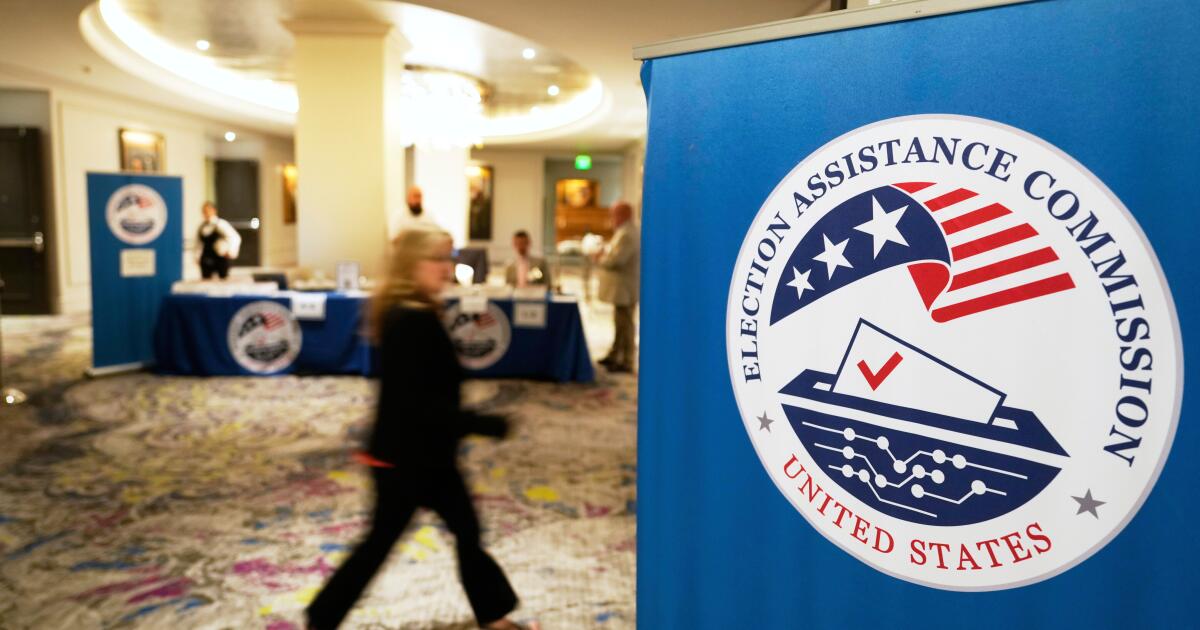
WASHINGTON — President Trump dismissed all remaining members of the bipartisan U.S. Elections Assistance Commission this week, his latest move to assert control over national elections in the final months before midterm voting.
The White House defended the move as justified by a recent U.S. Supreme Court decision handing the president greater authority to reshape independent government agencies, including by replacing appointed leaders.
Democrats and some independent elections experts blasted it as politically motivated, counter to the interests of voters and foolhardy with the November election so close.
“Purging commissioners just months before the midterm elections and further gutting support for our state and local elections officials is a blatant part of his plan to politicize our elections and enable more unlawful and dangerous election interference,” said Sen. Alex Padilla (D-Calif.), the top Democrat on the Senate Rules Committee, which oversees federal elections.
Padilla alleged the dismissals are an attempt by Trump “to dismantle yet another independent guardrail of our democracy designed to keep elections fair and secure.”
A White House official framed the dismissals in starkly different terms, saying the departing commissioners were “not totally aligned with the important task of securing America’s elections and ensuring every legal vote is counted.” It did not say when the president planned to appoint new commissioners.
The four-member commission was created by Congress in 2002 as part of the Help America Vote Act to help states improve their voting systems and voter access. By law, no more than two commissioners may belong to the same political party.
Historically, it has provided voluntary guidance and best practices for voting systems, and served as a sort of clearinghouse for election performance around the country — so that states and localities can learn from one another.
Since 2018, the panel has also disbursed more than $1 billion in election security grants, according to a report by the Bipartisan Policy Center. Those grants are then used to protect IT systems from foreign and domestic cyberattacks, update voting systems, ensure the accuracy of voter rolls and protect the integrity of ballots after they are cast.
Without leadership, the panel cannot take any official action until new members are nominated and confirmed by the Senate.
Benjamin W. Hovland, one of the Democratic commissioners removed by Trump, told NBC News that taking away a key federal agency designed to help state and local election administrators will have a negative effect on already strained elections officials.
“When you’re asking more and more of people without giving them the necessary resources, you know, mistakes happen,” he said.
California Secretary of State Shirley Weber, in a statement to The Times, said Trump was “injecting unnecessary chaos, confusion and instability into the very systems that Americans rely on to make their voices heard,” but that California “will not be intimidated or deterred” from maintaining elections “in which everyone can fairly and securely participate.”
California Atty. Gen Rob Bonta — whose office has already blocked federal agencies from implementing most of Trump’s election orders in court — called Trump’s firings “deeply troubling,” and said his office “will continue to closely monitor any efforts to weaken our democracy and fight back with every tool at our disposal.”
Gov. Gavin Newsom’s office said on X that “Newsom’s election protection efforts become more important by the day” — a reference to his recent push for state legislation that would make it a felony in California for anyone to seize ballots before a vote has been certified.
Newsom had said Thursday that Trump’s efforts to seize control over elections represented a “five-alarm fire” that must be confronted.
Trump’s dismantling of the commission comes as he wages a much broader campaign to rewrite voting rules. He has sought to place new restrictions on mail ballots, to tighten voter ID and proof of citizenship requirements for voters, to subject state voter rolls to federal oversight and purges, and to assert federal control over how and whether the U.S. Postal Service delivers mail ballots.
Much of that agenda, pushed through executive orders and other administrative actions, has been stymied by the courts, while stalling out in Congress, where it lacks support.
Whether Trump’s move to dismantle and reconstitute the commission will prove an effective path to instituting his election agenda remains unclear, experts said.
David Becker, the executive director of the nonpartisan Center for Election Innovation & Research, said the election commission has always had a “very limited mandate,” can’t dictate policy to the states and has no law enforcement powers — meaning Trump’s dismissals will have little real effect on elections.
Rick Hasen, an election law expert and director of the Safeguarding Democracy Project at UCLA Law, wrote that Trump could try to illegally direct the commission to “do his bidding” by amending the federal voter registration form to require proof of citizenship — though that would also have limited effect and would be challenged in court.
Sen. Adam Schiff (D-Calif.) said Trump’s firing of the commissioners was part of a broader effort by the president to “sow distrust in our voting system so he can contest the results if they are not to his liking.”
Kim Alexander, president of the California Voter Foundation, said California has “the most robust standards” for elections in the country, which won’t change with the removal of the commissioners.
Still, she said word of the firings rocketed around a conference of county elections officials in San Diego on Thursday — with some wondering whether the dismissals would threaten federal election funding, and others lamenting the loss of the ousted commissioners’ deep experience.
Dean Logan, head of the L.A. County Registrar-Recorder/County Clerk’s office, said in a statement to The Times that “any sudden change to the support structure for elections in the middle of an election cycle is concerning,” but that California “has a strong local and state foundation for election administration and voting systems support, and that will minimize any potential disruption caused by this action.”
In recent months, Trump has leveraged federal agencies to overhaul the nation’s voting rules in ways no previous president has attempted.
He has repeatedly pressured Republican lawmakers to pass a federal law that would require voters to provide proof of citizenship when they register, show identification when casting a ballot and force states to send voter data to the Department of Homeland Security.
Republican leaders have said the proposed SAVE America Act does not have enough votes to pass in the Senate. The GOP resistance has angered Trump, who on Friday said he was refusing to sign a bipartisan housing bill in protest.
The housing bill, which Trump called a “big yawn” last month, was to become law at midnight Friday without Trump’s signature.
-

 Texas4 minutes ago
Texas Rangers investigating City of Trinidad after water issues, controversial arrests, firings
-

 Utah7 minutes ago
President Trump expected to reduce the size of Utah monuments
-

 Vermont12 minutes ago
Vermont marks fourth straight year of July flooding as recovery drags on
-

 Virginia19 minutes ago
Vance leasing part of multimillion-dollar Virginia farm as an additional residence | CNN Politics
-

 Washington22 minutes ago
Washington State Democratic Party draws criticism over reparations, antisemitism language
-

 Wisconsin27 minutes ago
What’s new to eat and drink at the 2026 Wisconsin State Fair?
-

 West Virginia34 minutes ago
West Virginia to launch school clothing allowance program
-

 Wyoming37 minutes ago
Election Q&A: Laurie Longtine for Wyoming House District 59

