Politics
Commentary: Half a century ago, Californians saved the coast. Will Trump threats spark another uprising?

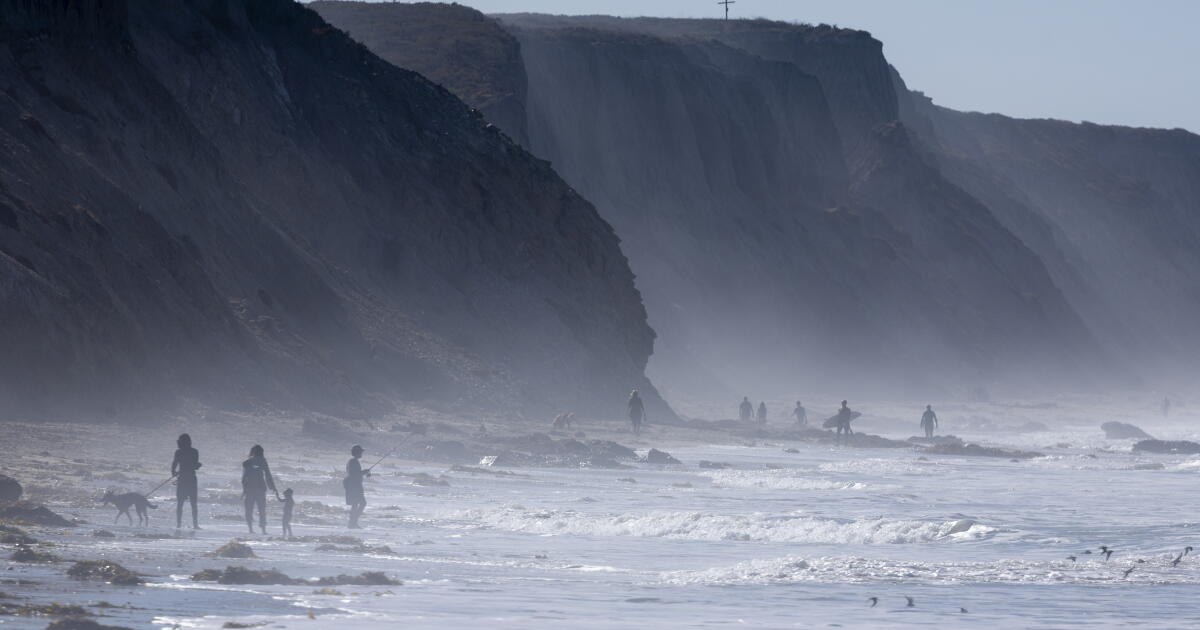
In 1972, thousands of Californians came together in what was a defining moment in state history. They were united by fears that the spectacular coast was in danger of becoming overdeveloped, heavily industrialized, ecologically diminished and irreversibly privatized.
Rue Furch, a Sonoma State University student, signed on as a volunteer for Proposition 20, which called for a commission to “preserve, protect, restore, and enhance the environment and ecology of the coastal zone.”
“I was just one of the worker bees, and it felt great to be doing something positive,” said Furch, whose role was “collecting signatures and holding signs and showing up to rallies.”
Steve Lopez
Steve Lopez is a California native who has been a Los Angeles Times columnist since 2001. He has won more than a dozen national journalism awards and is a four-time Pulitzer finalist.
In Sacramento, a young legislative assistant named Sam Farr (who would later become a U.S. congressman), helped organize a coastal bike ride, led by state Sen. Jim Mills, that galvanized Proposition 20 support and drew hordes of reporters as cyclists pedaled from Land’s End in San Francisco to Balboa Park in San Diego.
“The highway patrol kind of designed the route,” said Farr, who recalled that cyclists camped at state parks along the way and dined on food donated by supporters of the rolling “save our coast” call to arms.
In Los Angeles, teams of young environmentalists sabotaged dozens of campaign billboards, hung by the opposition, which originally said,“The Beach Belongs to You – Don’t Lock it Up. Vote No on Proposition No. 20.” The activists painted the word “Yes” over the word “No.”
So why am I telling you this a half-century later?
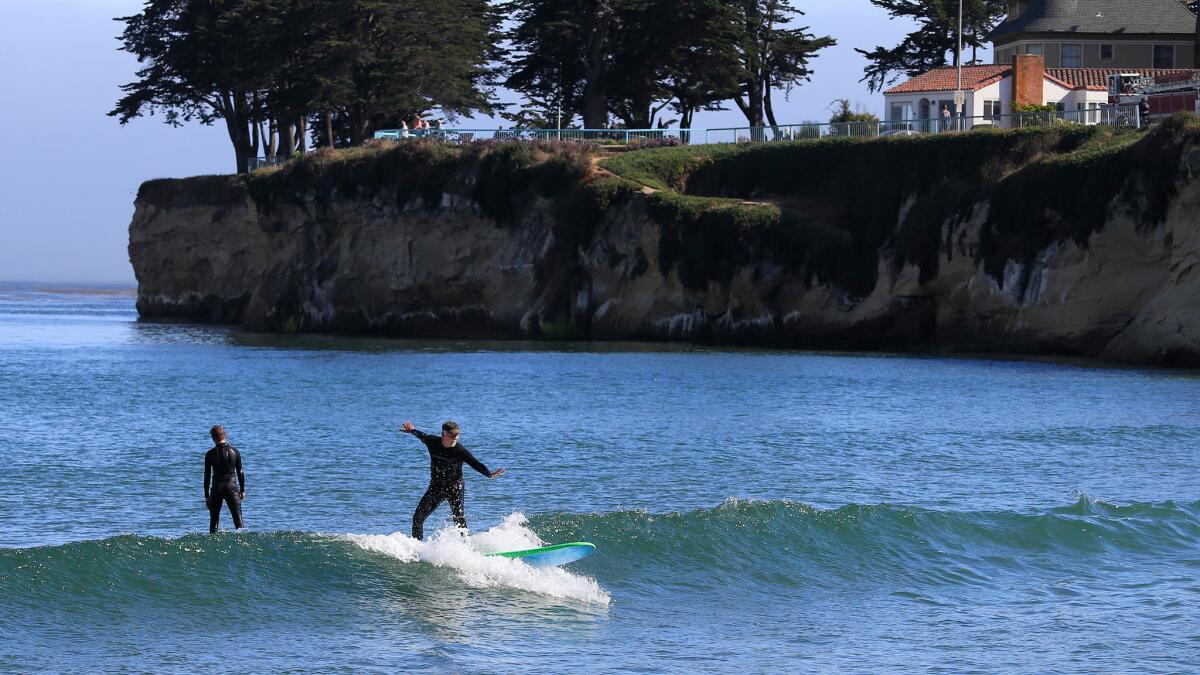
Los Angeles Times columnist Steve Lopez, who traveled the California coast for several weeks in 2016, finally realizes his childhood dream to surf in Santa Cruz. The coastal tour marked the 40th anniversary of the Coastal Act. (Allen J. Schaben / Los Angeles Times)
(Allen J. Schaben/Los Angeles Times)
Because voter-approved Proposition 20 led to the 1976 California Coastal Act and the creation of the Coastal Commission, which is now under threat like never before, targeted by the Trump administration, federal legislation and other critics.
In a January visit to Los Angeles after the devastating wildfires, Trump said the Coastal Commission is “considered the most difficult in the entire country” and said when it comes to rebuilding, “we are not going to let them get away with their antics.”
If that seems personal, it is. Trump, who bought a Ranch Palos Verdes golf course at a discounted price in 2002, after the 18th hole fell into the ocean, has had disputes with the Coastal Commission over waterfalls on the property and a 70-foot tall flagpole erected without a permit.
In February, Trump special missions envoy Ric Grenell painted a bullseye on the coastal commission, saying that fire relief assistance could be held up if California doesn’t bow to the administration’s wishes. He called the Coastal Commission “an unelected group of people who are crazy woke left” and said that “putting strings on them to get rid of the California Coastal Commission is going to make California better.”

The iconic Bixby Creek Bridge in Big Sur. California’s Coastal Commission is now under threat like never before, targeted by the Trump administration, federal legislation and other critics.
(apollo(c)/beketoff – stock.adobe.com)
To be clear, the commissioners are selected by elected people, which is often how commissions work. And speaking of powerful unelected people, the name Elon Musk comes to mind, and Trump’s Oval Office playmate has his own beef with the Coastal Commission. Musk’s SpaceX company sued the commission last fall after commissioners rejected a bid to increase the number of rocket launches from the U.S. military’s Vandenberg Space Force Base near Lompoc.
Military officials have said in support of SpaceX that they’d like to increase the number of launches from a handful to as many as 100 annually. The commission argued that most of the launches are for private interests rather than for military purposes, and that sonic booms and environmental impacts are a problem.
And it might be wise to hold off on increased launches following Thursday’s explosion of a SpaceX craft that ripped apart after takeoff from Texas. A shower of debris led to the grounding of flights at several Florida airports, and this was the second such SpaceX disaster in seven weeks. At the very least, SpaceX employees — just like federal employees targeted by Musk — should get memos asking what they had done in the seven days prior to each crash to justify keeping their jobs.
To be fair, the Coastal Commission staff and its commissioners are not beyond reproach, nor have commissioners always served with honor, so scrutiny and pushback ought to be part of the process. Nearly a decade ago, my Times colleagues and I examined the ways in which wealthy property owners and developers used lawyers, lobbyists and political connections in attempting to influence commission decision-making.
In the case of the recent SpaceX case, commissioners made bone-headed political comments about Musk in rejecting the bid for more launches, naively handing him lawsuit fodder.
And the commission — which is made up of more than 100 staff members and 12 voting commissioners — has a history of irritating property owners and even governors with painfully long reviews of applications (caused, in part, by decades of under-staffing) for everything from new coastal construction to property improvements of various types.

Dogs competed in the 14th annual Imperial Beach Surf Dog Competition in August 2019.
(Rick Nocon/For The San Diego Union-Tribune)
Several recent bills by Democratic legislators have tried (with limited success) to chip away at agency authority and clear the way for more housing, and Gov. Gavin Newsom recently signed an executive order limiting commission oversight in the interest of speeding up rebuilding in the Palisades fire zone.
Republicans, meanwhile just want to tear it all apart. On March 5, U.S. Rep. Kevin Kiley (R-Rocklin) called for stripping the commission of its power, saying the agency is “out of control and has veered from its purpose of protecting the coast.”
Susan Jordan of the nonprofit California Coastal Protection Network, quickly sized up what that would mean.
“This is like the federal government putting a big for-sale sign on the California coast,” she said. “It basically takes away the state’s ability to comment on and provide feedback on projects … It’s like an open invitation to oil drilling, to any commercial venture, to liquefied natural gas terminals.”
There’s a reason that has not already happened, and it has a lot to do with that movement that began in 1972 (the story has been captured in a new documentary on the people who were determined to save the coast).

A whimbrel flies along the beach at the Jalama creek estuary at Jalama State Beach.
(Allen J. Schaben/Los Angeles Times)
There’s a reason that as you travel the coast, you see all those roadside beach access signs.
There’s a reason that when beachfront property owners put up illegal “private property” signs or otherwise attempt to drive away those who have a right to enjoy the beach, they’re cited and fined.
There’s a reason the 1,100-mile natural wonder that stretches from the Oregon border to the Mexico border does not, for the most part, resemble the blighted, overdeveloped coasts of other states.
There’s a reason any and all development proposals are exhaustively reviewed, with the perils of sea level rise in mind, and in the interest of protecting marine and shore habitats.
The reason is the California Coastal Act of 1976, a people-inspired, legislatively approved framework that guides state and local governments on the use of land and water in the coastal zone, and embodies the idea that this natural wonder is not owned by anybody, but by everybody, and that it must be treated — with careful, unwavering stewardship — like the public treasure that it is.
One of the first directors of the agency, the late and legendary Peter Douglas, recognized that there would always be threats to the commission and to the shore.
It’s why he said:
“The coast is what it is because a lot of people worked really hard and sacrificed to protect it. And if we want it to be there for our children, we have to keep fighting to protect it. In that way, the coast is never saved, it’s always being saved.”
If it takes another bike ride, I’m ready to roll.
steve.lopez@latimes.com



President Trump has promoted a chain of newly rebranded gas stations across the Philadelphia area with lower gas prices. The New York Times has not been able to get detailed information about who is behind the stations. The Trump administration says it did not fund or subsidize the company.

NEWYou can now listen to Fox News articles!
Kelley Paul is no stranger to the American political scene. As the wife of Senator Rand Paul (R-Ky.), and the daughter-in-law of longtime former Congressman Ron Paul (R-Texas), she has seen her fair share of the campaign trail, emerging as a powerful surrogate during her husband’s 2016 presidential run.
She is also an accomplished writer, speaker, and public relations professional. As America ushers in its 250th anniversary, Paul saw the perfect opportunity to branch out into the world of children’s literature. Recently she sat down with Fox News Digital in Las Vegas at Freedom Fest to discuss her new book, “Good Night, Young American.”
Kelley Paul is the wife of Sen. Rand Paul and author of two books. (Courtesy Kelley Paul)
Paul credits her family for giving her the inspiration for the new project:
“I have to give a lot of credit to my daughter-in-law, Kate. She and our son were over for dinner last summer with our grandson, who was only six months old at the time. And Kate was like, you know, we need more patriotic books for babies. She wasn’t really happy with a lot of the book options she was seeing. And that night at dinner, we kind of played around with some ideas. And I came up with ‘Good Night Young American.’ And a year later, here it is.”
EXCLUSIVE: RAND AND KELLEY PAUL OPEN UP ABOUT 2016 RACE
“Good Night, Young American,” recommended for children ages 4–8, takes kids on a visually and thematically engaging journey through early and colonial history.
“Well, our revolutionary history is such a great adventure, right? So when I came up with the concept that my little boy would start out on the 4th of July with his parents, asking, what is it all about? I knew we’d be celebrating the 250th. Kids ask, what are we really celebrating?
And his dad describes the Declaration of Independence to him in the signing. So I tried to think what is going to appeal to children in this great adventure of our revolution. So when he falls asleep that night, he’s in the crow’s nest of the Mayflower. He is a pilgrim, he’s a colonist, and then he makes friends with all the great revolutionary heroes that we know. So he makes friends with Sam Adams, he joins the Sons of Liberty, he meets at the Green Dragon. This is so exciting for children, right?
It’s visual stuff. He makes friends with Ben Franklin, and he’s flying the kite. Dramatically rides on the midnight ride with Paul Revere. He and his dog, his little dog, are with him for all the adventures. And of course, he crosses the Delaware with George Washington. And I wanted to make the signing of the Declaration of Independence and the writing of it something that was dynamic and exciting visually. So I have him swinging on the Liberty Bell when the declaration is signed.”
Paul worked closely with the illustrator, Marika Monesi, to bring the events of America’s founding to life in an engaging and visually appealing way for children.
The Liberty Bell, originally saved from the British by Lynnport farmer Frederick Leaser, sits in its Philadelphia shrine. (iStock)
“She really captured the excitement on the little boy’s face, his personality, but I worked very close with her,” Paul said. “I wanted there to be a lot of movement, a lot of dynamic images. So, for example, with the Liberty Bell, for kids, a bunch of men standing around writing a document…I wanted to bring it to life. So I said, let’s have him running up to the top of the bell tower in Philadelphia at Freedom Hall and swinging on the Liberty Bell. And she was just such a great artist. With the George Washington scenes, he’s crossing the Delaware because that, again, is so visual. I wanted drive home to children the incredible bravery and courage of our founders, how cold and miserable and hard that war was.
“Also, I love the illustration that she did of the King of England reading the Declaration of Independence. I have to give my husband Rand a little credit there. On the first couple of drafts that she did, Rand was like, ‘He needs to be fatter. King George was famously fat!’ So it was a lot of fun. It was very collaborative.”
KELLEY PAUL ‘EXHAUSTED AND ANGRY’ THAT THOSE WHO HARASSED HER AND HER HUSBAND FACE NO CHARGES
Part of Paul’s motivation for the book was related to the teaching of American history today, and the controversies therein:
“I do think that we’ve gotten away from really celebrating our founders and our heroes. What they were doing in 1776 was incredibly radical, if you think about it. At that time, everyone accepted the divine right of kings. Everyone accepted hereditary rule. And our founders took Enlightenment ideas from John Locke and philosophers, and they turned it into the framework for a government. The idea of self-government and that our rights come from our Creator, that we have inalienable rights that are given to us by God and not from a king. Those were radical ideas of the time.
Historians say an early draft of the Declaration of Independence offered new insight into how Thomas Jefferson refined the nation’s founding document. (Stock Montage/Stock Montage/Getty Images)
I like to say our founders were the first civil rights heroes, the first civil libertarians. And I think our education system has gotten away from that. They don’t view them in the time that they existed, and suddenly now everything is oppressor versus oppressed narrative. And they are labeled more like colonizers or enslavers, and that’s the only view that they’re looked at, and not as human beings who sacrificed their very lives to write the Declaration of Independence, to form this country…it was an incredible, bold, and courageous act, but it was also an act of moral courage and philosophical courage.”
Ultimately, Paul hopes that her books will stimulate the natural curiosity of America’s youth to learn more about their rich history:
Participants carry the City of Cumberland’s “America 250” parade banner down Baltimore Street during the America 250 parade in downtown Cumberland, Maryland, on June 27, 2026. Spectators line both sides of the street as American and Maryland flags lead the procession. (Fox News Digital/ David Marcus)
“Well, I hope that my books, especially with America’s 250, will spark a lot of questions and that they will give a framework for parents to talk to their kids about the founding of this country. And I hope children from a very, very young age will come away with this idea that they are a part of America’s story, that they as Americans can take pride in the heroism of our revolutionary founders. That as Americans, this is all of our story. So that’s really my goal with the books.”
One of the biggest challenges Paul faced was taking big ideas that may be hard for a four or five-year-old to grasp, like the Declaration of Independence or the Constitution, and distilling them down into an accessible format for kids:
“Well, I try to use language that kids could understand, and very much use simple terms. But if you think about it, it is simple. Our rights come from God. And when he makes friends with Thomas Jefferson, he says, Thomas Jefferson has written this amazing document that says that we can all be free to live our lives the way we choose, and no government can take our rights to, you know, to life, liberty, and the pursuit of happiness away from us.
He also talks about James Madison and the Bill of Rights and the most important right is freedom of speech. That is that no government can tell you what to say or what not to say.”
Rand Paul, who famously puts Constitutional principles front and center in the public square, also played a key role in the book’s thematic development.
Kelley Paul and her husband Kentucky Republican Sen. Rand Paul. (Courtesy Kelley Paul)
“Rand has been incredibly supportive. I’m just so grateful and blessed to have had an amazing, now 36-year marriage to Rand Paul. And he was very involved. He would read over the drafts and gave me a lot of, like I said, good advice about things in history that he thought I should include.
CLICK HERE TO DOWNLOAD THE FOX NEWS APP
And I’m also just very grateful to be the daughter-in-law of Ron Paul. And so, I wanted these books to be there for our little grandson who I call ‘my favorite little American’ and help him from an early age be educated in the legacy that, the Paul family has in this country.”
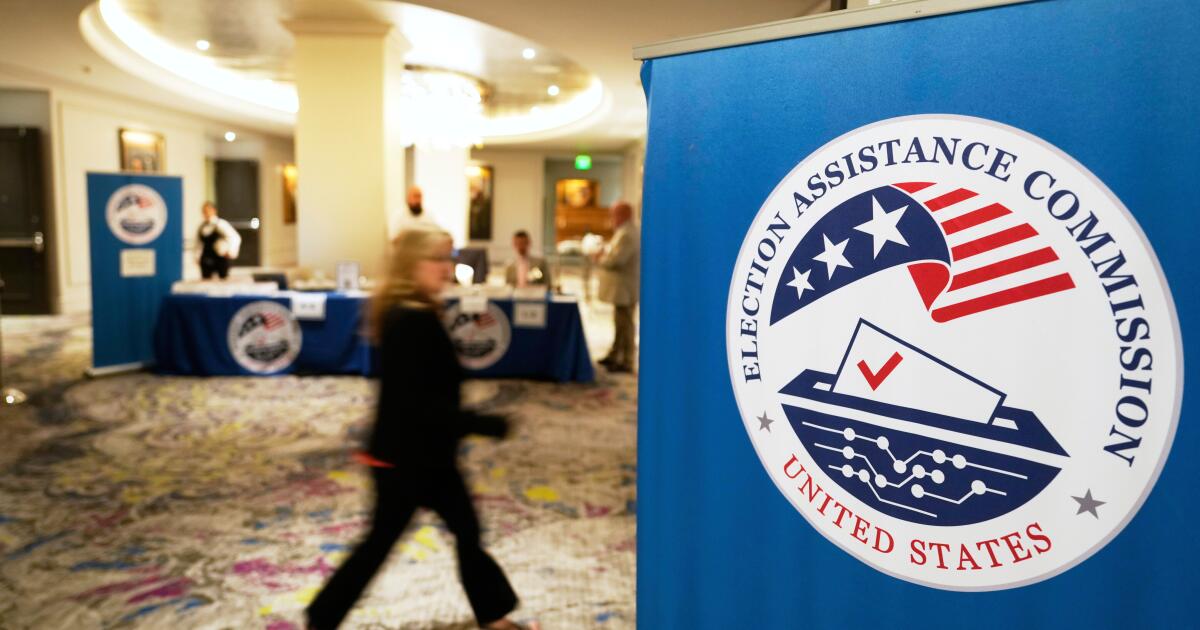
WASHINGTON — President Trump dismissed all remaining members of the bipartisan U.S. Elections Assistance Commission this week, his latest move to assert control over national elections in the final months before midterm voting.
The White House defended the move as justified by a recent U.S. Supreme Court decision handing the president greater authority to reshape independent government agencies, including by replacing appointed leaders.
Democrats and some independent elections experts blasted it as politically motivated, counter to the interests of voters and foolhardy with the November election so close.
“Purging commissioners just months before the midterm elections and further gutting support for our state and local elections officials is a blatant part of his plan to politicize our elections and enable more unlawful and dangerous election interference,” said Sen. Alex Padilla (D-Calif.), the top Democrat on the Senate Rules Committee, which oversees federal elections.
Padilla alleged the dismissals are an attempt by Trump “to dismantle yet another independent guardrail of our democracy designed to keep elections fair and secure.”
A White House official framed the dismissals in starkly different terms, saying the departing commissioners were “not totally aligned with the important task of securing America’s elections and ensuring every legal vote is counted.” It did not say when the president planned to appoint new commissioners.
The four-member commission was created by Congress in 2002 as part of the Help America Vote Act to help states improve their voting systems and voter access. By law, no more than two commissioners may belong to the same political party.
Historically, it has provided voluntary guidance and best practices for voting systems, and served as a sort of clearinghouse for election performance around the country — so that states and localities can learn from one another.
Since 2018, the panel has also disbursed more than $1 billion in election security grants, according to a report by the Bipartisan Policy Center. Those grants are then used to protect IT systems from foreign and domestic cyberattacks, update voting systems, ensure the accuracy of voter rolls and protect the integrity of ballots after they are cast.
Without leadership, the panel cannot take any official action until new members are nominated and confirmed by the Senate.
Benjamin W. Hovland, one of the Democratic commissioners removed by Trump, told NBC News that taking away a key federal agency designed to help state and local election administrators will have a negative effect on already strained elections officials.
“When you’re asking more and more of people without giving them the necessary resources, you know, mistakes happen,” he said.
California Secretary of State Shirley Weber, in a statement to The Times, said Trump was “injecting unnecessary chaos, confusion and instability into the very systems that Americans rely on to make their voices heard,” but that California “will not be intimidated or deterred” from maintaining elections “in which everyone can fairly and securely participate.”
California Atty. Gen Rob Bonta — whose office has already blocked federal agencies from implementing most of Trump’s election orders in court — called Trump’s firings “deeply troubling,” and said his office “will continue to closely monitor any efforts to weaken our democracy and fight back with every tool at our disposal.”
Gov. Gavin Newsom’s office said on X that “Newsom’s election protection efforts become more important by the day” — a reference to his recent push for state legislation that would make it a felony in California for anyone to seize ballots before a vote has been certified.
Newsom had said Thursday that Trump’s efforts to seize control over elections represented a “five-alarm fire” that must be confronted.
Trump’s dismantling of the commission comes as he wages a much broader campaign to rewrite voting rules. He has sought to place new restrictions on mail ballots, to tighten voter ID and proof of citizenship requirements for voters, to subject state voter rolls to federal oversight and purges, and to assert federal control over how and whether the U.S. Postal Service delivers mail ballots.
Much of that agenda, pushed through executive orders and other administrative actions, has been stymied by the courts, while stalling out in Congress, where it lacks support.
Whether Trump’s move to dismantle and reconstitute the commission will prove an effective path to instituting his election agenda remains unclear, experts said.
David Becker, the executive director of the nonpartisan Center for Election Innovation & Research, said the election commission has always had a “very limited mandate,” can’t dictate policy to the states and has no law enforcement powers — meaning Trump’s dismissals will have little real effect on elections.
Rick Hasen, an election law expert and director of the Safeguarding Democracy Project at UCLA Law, wrote that Trump could try to illegally direct the commission to “do his bidding” by amending the federal voter registration form to require proof of citizenship — though that would also have limited effect and would be challenged in court.
Sen. Adam Schiff (D-Calif.) said Trump’s firing of the commissioners was part of a broader effort by the president to “sow distrust in our voting system so he can contest the results if they are not to his liking.”
Kim Alexander, president of the California Voter Foundation, said California has “the most robust standards” for elections in the country, which won’t change with the removal of the commissioners.
Still, she said word of the firings rocketed around a conference of county elections officials in San Diego on Thursday — with some wondering whether the dismissals would threaten federal election funding, and others lamenting the loss of the ousted commissioners’ deep experience.
Dean Logan, head of the L.A. County Registrar-Recorder/County Clerk’s office, said in a statement to The Times that “any sudden change to the support structure for elections in the middle of an election cycle is concerning,” but that California “has a strong local and state foundation for election administration and voting systems support, and that will minimize any potential disruption caused by this action.”
In recent months, Trump has leveraged federal agencies to overhaul the nation’s voting rules in ways no previous president has attempted.
He has repeatedly pressured Republican lawmakers to pass a federal law that would require voters to provide proof of citizenship when they register, show identification when casting a ballot and force states to send voter data to the Department of Homeland Security.
Republican leaders have said the proposed SAVE America Act does not have enough votes to pass in the Senate. The GOP resistance has angered Trump, who on Friday said he was refusing to sign a bipartisan housing bill in protest.
The housing bill, which Trump called a “big yawn” last month, was to become law at midnight Friday without Trump’s signature.
-
 Idaho1 minute ago
Claremont Fire evacuation zones drop to Level 1 as crews work to clear spot fire
-

 Illinois8 minutes ago
Illinois Senator opposes Shah Senate bid, cites 2015 Legionnaires’ outbreak
-

 Indiana11 minutes ago
Indiana State Police sergeant recovering, suspect killed in Michigan City
-

 Iowa16 minutes ago
Gelita USA opens new wastewater treatment plant near Sergeant Bluff after Iowa DNR violations
-
Kansas23 minutes ago
Kansas Lottery Mega Millions, Pick 3 winning numbers for July 10, 2026
-
Kentucky25 minutes ago
Trooper still recovering 1 year after fatal Lexington shooting spree
-

 Louisiana31 minutes ago
6 Best Out-of-State 529 Plans for Louisiana Residents (Beyond START Saving) – Big Easy
-

 Maine38 minutes ago
Maine Resiliency Center launches survey to gauge Lewiston shooting’s impact

