Politics
Commentary: A California lawyer takes the civil rights fight home to Minneapolis

How do you find the missing?
If you do find them, how can you help?
Oakland civil rights attorney James Cook has been on the ground in Minnesota for months figuring out answers to these question as he goes.
A fast-talking Minneapolis native who still lives in the Twin Cities part time, Cook is one of a handful of attorneys who have dropped everything to aid (for free) those caught up in the federal crackdown — protesters, immigrants and detained citizens — too many of whom have found themselves facing deportation, arrest or even been disappeared, at least for a time.
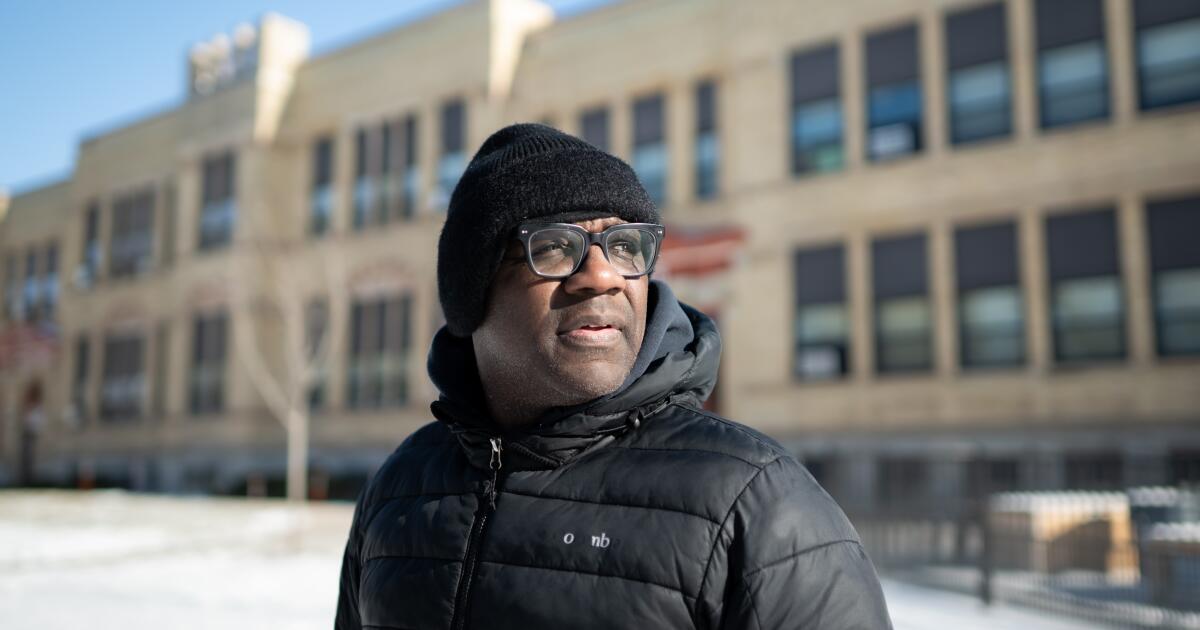
Civil rights attorney James Cook in the rear view mirror as he makes phone calls in his car in Minneapolis.
(Caroline Yang/For The Times)
“They are leaders that are on the ground really helping people through this process,” Minnesota school board member Chauntyll Allen told me.
She’s one of the protesters arrested inside a local church, charged with conspiracy to deprive others of their constitutional rights by Pam Bondi’s politicized Department of Justice, which also Friday arrested journalist Don Lemon for the same incident. Cook is one of the lawyers now representing Allen.
“It shows us that the judicial arm, or some of the judicial arm of our democracy, is willing to step up and ensure that our democracy stands strong,” Allen said of Cook and others like him.
While it’s the images of clashes in the streets that captivate media and audiences, it’s lawyers like Cook who are fighting an existential battle in the background to preserve the rule of law in a place where it is increasing opaque, to put it gently.
The legal work behind detentions has largely been an overlooked battlefield that will likely rage on years after ICE departs the streets, leaving in its wake hundreds if not thousands of long-and-winding court cases.
Beyond the personal fates they will determine, the outcome of the civil litigation Cook and others are spearheading will likely force whatever transparency and accountability can be pulled from these chaotic and troubling times.
It’s time-consuming and complicated work vital not just to people, but history.
Or, as Cook puts it, “I’ll be 10 years older when all this s— resolves.”
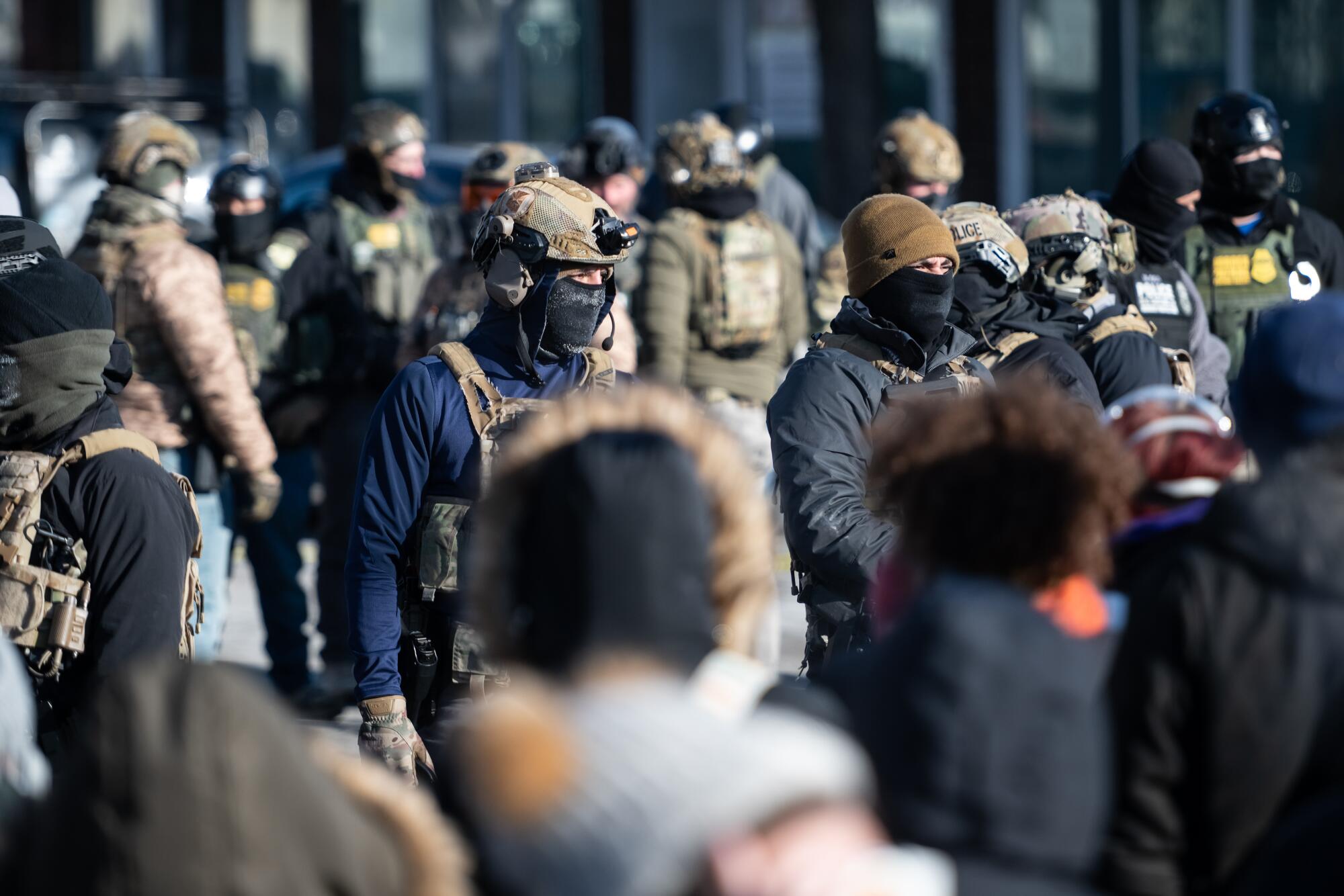
Federal agents stand guard against a growing wall of protesters on Jan. 24 in Minneapolis, just hours after Alex Pretti was shot by federal agents.
(Caroline Yang/For The Times)
Cook told me this while on his way to the Bishop Henry Whipple Federal Building where some detainees are being held, maybe. It’s hard to find out. A few years ago, when immigration enforcement in Minnesota ramped up under the first Trump term, activists tried to get the name of the building changed, arguing Whipple, the first Protestant Episcopal bishop in the state, had been an advocate of the marginalized and wouldn’t want his name associated with what the feds were up to.
It didn’t work, but the movement’s slogan, “What would Whipple do?” still has resonance in this town, where two American citizens, Alex Pretti and Renee Good, have been fatally shot while protesting — incidents ugly enough that Bruce Springsteen wrote a song about them.
Cook is well aware that the guns carried by the federal agents are not for show, even without the Boss’ new ballad. Just a few days ago, one of the first times he drove his beat-up truck up to the gate, the federal guards at Whipple pointed their guns at him.
“I’m like, ‘Hey, I’m going to take my keys out of the ignition, drop them on the ground. So please don’t shoot,’” he said.
They lowered the guns, but Cook was scared, a feeling that doesn’t come easy.
Long before his law degree, when he was a punk-rock loving teen in the 1980s, fresh out of Southwest High, the public school not too far from Whipple, a former coach convinced him to give up college dreams and instead pursue a shot at making the first Muay Thai kickboxing team at the Olympics.
The martial art ended up not making it as an official Olympic sport, but the experience launched Cook into a professional boxing and kickboxing career that took him to competitions around the world, and taught him fear is not a reason to back down.
But, “Father Time is undefeated,” Cook said. “I got older and I started losing fights, and I was like, all right, time to get back to life.”
That eventually led him to obtaining a law degree in San Francisco, where after an intern stint as a public defender, he decided he wanted to be a trial attorney, fighting in court.

Civil rights attorney James Cook has been doing pro bono immigration work since the crackdown began in Minneapolis.
(Caroline Yang/For The Times)
He started cold-calling John Burris, another Bay Area lawyer who is an icon of civil rights and police misconduct cases. Burris, who has been called the “Godfather of Police Litigation,” was involved in the “Oakland Riders” case in 2000, when officers were discovered to have planted evidence. He also represented Rodney King, the family of Oscar Grant, and the family of Joseph Mann among many others.
But Burris, a boxing fan, didn’t respond to Cook’s calls until the young lawyer offered him free tickets to one of his fights, which he was still doing on the side.
“And then immediately I got a call back,” Cook said.
Burris said Cook’s history as a fighter intrigued him, but “I did say to James, you can’t be a fighter and lawyer. You can’t get punched in your head all the time.”
Cook did not take this advice.
Still, Burris said, “It was his persistence that I admired, because the type of work we’re involved in, you need people who are dedicated, who have some real commitment to the work, and he showed that kind of consistency and dedication.”
Cook’s been working with Burris more than 20 years now, but until recently, the labyrinth of the immigration system wasn’t his area of expertise. It’s been a crash course for him, he said, on the often arcane laws that govern who gets to stay in America and who doesn’t.
It’s also been a crash course on what a civil rights emergency looks like. Along with his work looking for locked-up immigrants, Cook spends a lot of time on the streets at protests, helping people understand their rights — and limitations — and seeing first hand what is happening.
“If you ever wondered what you would have done in Germany, now is the time,” he said. “Now is the time to do something. People are being interned.”
In the hours after Pretti was shot, Cook was at the location of the shooting, in the middle of the tear gas, offering legal help to anyone who needed it and bearing witness to conduct that will almost certainly face scrutiny one day, even if government leaders condone it now.

Law enforcement officers launch tear gas canisters as they work to push the crowd back and expand their perimeter in Minneapolis on Jan. 24.
(Caroline Yang/For The Times)
“The way the officers chase people down, protesters who were really just protesting lawfully and were beaten and pepper sprayed and gassed — all those are civil rights violations,” Burris said. “And so the law is the guardrails. So there has to be lawyers who are prepared to protect those guardrails and to stand as centurions, as I refer to us.”
Cook has tried to calm protesters, he told me, and prevent clashes. But people are mad, and resolute. His greatest fear is summer — when warm weather could bring even larger crowds if enforcement is still ongoing. He’s worried that the actions of the federal agents will spill over into anger at local cops enforcing local laws, leading to even more chaos.
“I’ve always supported cops as long as they do their job correctly,” Cook said.
For now, he’s taking it one day at a time, one case at a time, one name at a time.
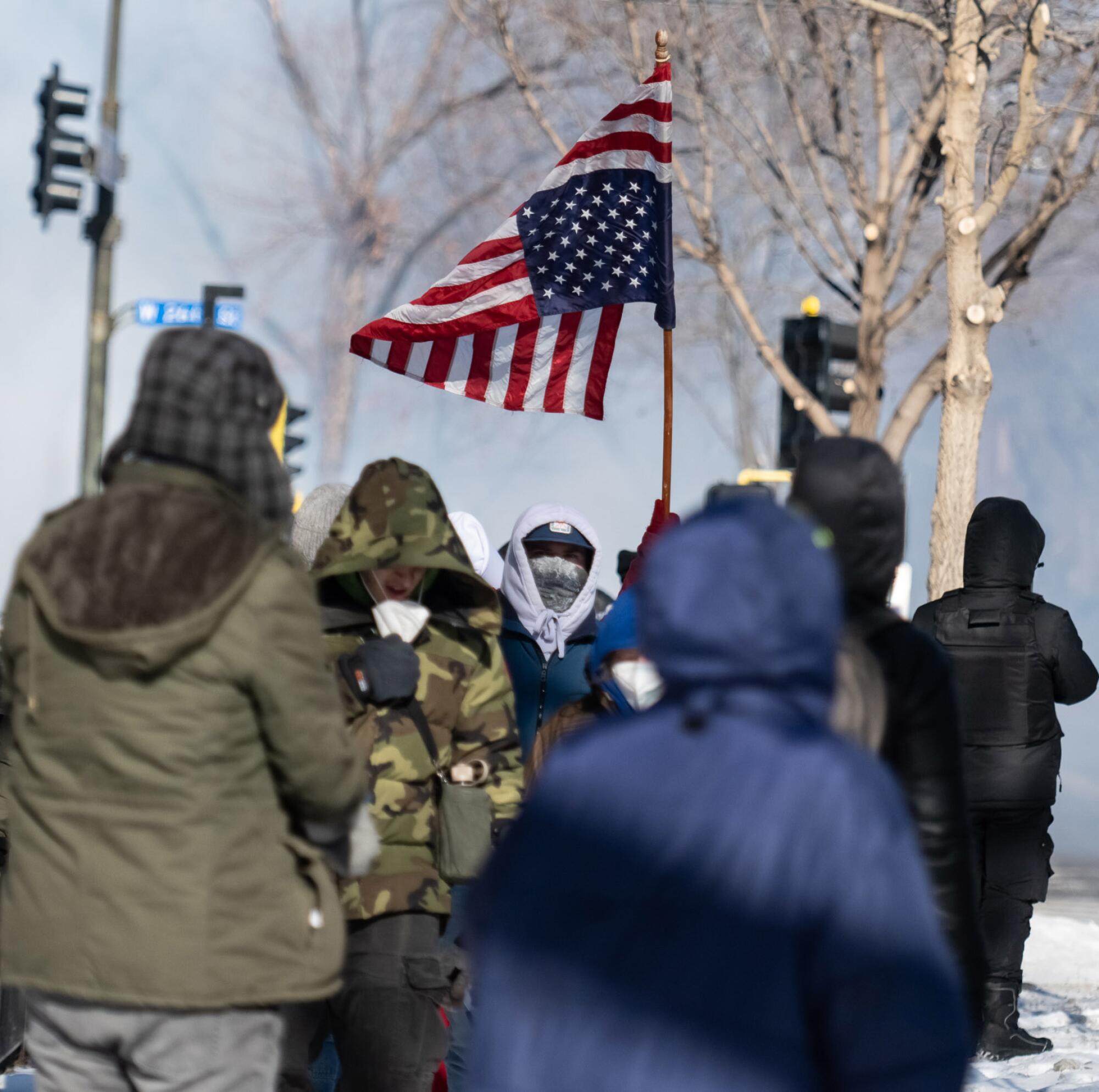
Protesters raise an inverted American flag as law enforcement officers launch tear gas canisters in Minneapolis after Alex Pretti was killed by federal agents.
(Caroline Yang/For The Times)
Tuesday, Cook passed through the armed checkpoint at Whipple carrying a list of about seven people, folks who have been picked up by federal agents for one reason or another, or reasons unknown, and now cannot be located. They are not in the public online system that is meant to track detainees, and family and friends have not heard from them.
If he’s lucky, Cook will get information on one or two, that they are indeed inside, or maybe at a detention center in Texas, where many have been sent. But there will be more whose location remains unknown. He’ll make calls, fill out forms and come back tomorrow. And the tomorrow after that.
“This is what we do,” he said. “I’m always in it for the long run. I mean, you know, shoot, yeah, that’s kind of the way it works.”



new video loaded: U.S. ‘Accelerating’ Military Assault in Iran, Hegseth Says
By Christina Kelso
March 4, 2026

NEWYou can now listen to Fox News articles!
A U.S. submarine sank a prized Iranian warship by torpedo, the first such sinking of an enemy ship since World War II, Secretary of War Pete Hegseth said Wednesday morning.
Hegseth joined Chairman of the Joint Chiefs of Staff Gen. Dan Caine at the Pentagon to provide an update to reporters on “Operation Epic Fury” in Iran.
“An American submarine sunk an Iranian warship that thought it was safe in international waters,” Hegseth said. “Instead, it was sunk by a torpedo. Quiet death. The first sinking of an enemy ship by a torpedo since World War Two. Like in that war, back when we were still the War Department. We are fighting to win.”
Caine said that an Iranian vessel was “effectively neutralized” in a Navy “fast attack” using a single Mark 48 torpedo. He added that the U.S. Navy achieved “immediate effect, sending the warship to the bottom of the sea.”
WATCH HEGSETH’S ANNOUNCEMENT:
Hegseth said that the U.S. Navy sank the Iranian warship, the Soleimani. The flagship was named for Qasem Soleimani, an Iranian military officer who served in the Islamic Revolutionary Guard Corps who the U.S. killed in a January 2020 drone strike during President Donald Trump’s first term.
“The Iranian Navy rests at the bottom of the Persian Gulf. Combat ineffective, decimated, destroyed, defeated. Pick your adjective,” Hegseth said. “In fact, last night we sunk their prize ship, the Soleimani. Looks like POTUS got him twice. Their navy, not a factor. Pick your adjective. It is no more.”
This map shows U.S. and Israeli strikes against Iranian naval forces as of March 1. (Fox News)
Hegseth also told reporters at the briefing that the U.S. and Israel will soon achieve “complete control” over Iranian airspace after Iran’s missile capabilities were drastically diminished in the four days of fighting.
US ‘WINNING DECISIVELY’ AGAINST IRAN, WILL ACHIEVE ‘COMPLETE CONTROL’ OF AIRSPACE WITHIN DAYS, HEGSETH SAYS
“More bombers and more fighters are arriving just today and now, with complete control of the skies, we will be using 500 pound, one thousand pound and 2,000 pound laser-guided precision gravity bombs, of which we have a nearly unlimited stockpile,” he said.
The war has killed more than 1,000 people in Iran and dozens in Lebanon, while U.S. officials said six American troops were killed in a fatal drone strike in Kuwait.
Thousands of travelers have been left stranded across the Middle East.
This map shows security and travel updates for Americans regarding countries in the Middle East region. (Fox News)
CLICK HERE TO DOWNLOAD THE FOX NEWS APP
Caine told reporters that the U.S. military is helping thousands of Americans stranded in the Middle East after the U.S. State Department urged citizens to leave more than a dozen countries.
Fox News Digital’s Ashley Carnahan contributed to this report.
Related Article


Sen. Alex Padilla (D-Calif.) is preparing for President Trump to declare a national emergency in order to seize control of this year’s midterm elections from the states, including by bracing his Senate colleagues for a vote in which they would be forced to either co-sign on the power grab or resist it.
In the wake of reporting last week that conservative activists with connections to the White House were circulating such an order, Padilla sent a letter to his Senate colleagues Friday stating that any such order would be “wildly illegal and unconstitutional,” and would no doubt face “extremely strict scrutiny” in the courts.
“Nevertheless, if the President does escalate his unprecedented assault on our democracy by declaring an election-related emergency, I will swiftly introduce a privileged resolution [and] force a vote in the Senate to terminate the fake emergency,” wrote Padilla, the ranking Democrat on the Senate Committee on Rules and Administration.
Padilla wrote that such an order — which could possibly “include banning mail-in voting, eliminating major voting registration methods, voter purges, and/or new document barriers for registering to vote and voting” — would clearly go beyond Trump’s authority.
“Put simply, no President has the power under the Constitution or any law to take over elections, and no declaration or order can create one out of thin air,” Padilla wrote.
The same day Padilla sent his letter, Trump was asked whether he was considering declaring a national emergency around the midterms. “Who told you that?” he asked — before saying he was not considering such an order.
The White House referred The Times to that exchange when asked Tuesday for comment on Padilla’s letter.
If Trump did declare such an emergency, a “privileged resolution,” as Padilla proposed, would require the full Senate to vote on the record on whether or not to terminate it — forcing any Senate allies of the president to own the policy politically, along with him.
Experts say there is no evidence that U.S. elections are significantly affected or swung by widespread fraud or foreign interference, despite robust efforts by Trump and his allies for years to find it.
Nonetheless, Trump has been emphatic that such fraud is occurring, particularly in blue states such as California that allow for mail-in ballots and do not have strict voter ID laws. He and others in his administration have asserted, again without evidence, that large numbers of noncitizen residents are casting votes and that others are “harvesting” ballots out of the mail and filling them out in bulk.
Soon after taking office, Trump issued an executive order purporting to require voters to show proof of U.S. citizenship before registering and barring the counting of mail-in ballots received after election day, but it was largely blocked by the courts.
Trump’s loyalist Justice Department sued red and blue states across the country for their full voter rolls, but those efforts also have largely been blocked, including in California. The FBI also raided an elections office in Georgia that has been the focus of Trump’s baseless claims that the 2020 presidential election was stolen from him.
Trump is also pushing for the passage of the SAVE Act, a voter ID bill passed by the House, but it has stalled in the Senate.
In recent weeks, Trump has expressed frustration that his demands around voting security have not translated into changes in blue state policies ahead of the upcoming midterm elections, where his shrinking approval could translate into major gains for Democrats.
Last month, Trump wrote on his Truth Social platform, “I have searched the depths of Legal Arguments not yet articulated or vetted on this subject, and will be presenting an irrefutable one in the very near future. There will be Voter I.D. for the Midterm Elections, whether approved by Congress or not!”
Then, last week, the Washington Post reported that a draft executive order being circulated by activists with ties to Trump suggests that unproven claims of Chinese interference in the 2020 election could be used as a pretext to declare an elections emergency granting Trump sweeping authority to unilaterally institute the changes he wants to see in state-run elections.
Election experts said the Constitution is clear that states control and run elections, not with the executive branch.
Democrats have widely denounced any federal takeover of elections by Trump. And some Republicans have expressed similar concerns, including Sen. Mitch McConnell (R-Ky.), who chairs the Senate rules committee.
In the Wall Street Journal last year, McConnell warned against Trump or any Republican president asserting sweeping authority to control elections, in part because Democrats would then be empowered to claim similar authority if and when they retake power.
McConnell’s office referred The Times to that Journal opinion piece when asked about the circulating emergency order and Padilla’s resolution.
Padilla’s office said his resolution would be introduced in response to an emergency declaration by Trump, but hoped it wouldn’t be necessary.
“Instead of trying to evade accountability at the ballot box,” Padilla wrote, “the President should focus on the needs of Americans struggling to pay for groceries, health care, housing and other everyday needs and put these illegal and unconstitutional election orders in the trash can where they belong.”

In a first for Nebraska, federal judge awards attorney’s fees to immigrant who was detained without bond hearing

Second annual Nevada Nordic Freeheel Festival celebrates Tahoe winter recreation at SnowFest

Woman dies in Wilton, NH house fire – Boston News, Weather, Sports | WHDH 7News

NJ’s biggest Catholic diocese hits pause on plan to merge parishes

Retired Wright-Patterson general mentioned in UFO report missing in NM

Florida High School Football Rankings: Top 25 teams – Oct. 21

Cleary's 21 help Le Moyne down Central Connecticut State 69-64 in OT

How old is Bo Nix? What to know about Oregon quarterback ahead of 2024 NFL Draft

99th annual Pony Swim held in Virginia

Indiana Members Credit Union announced as new anchor tenant at Bottleworks District

US submarine sinks Iranian warship by torpedo in a first since World War II

Which oil and gas facilities in the Gulf have been attacked?

Mojtaba Khamenei, son of former supreme leader, tipped to become Iran’s next head of state

Video: Senators Question Kristi Noem on ICE Immigration Tactics

Combustible Republican Senate primary in Texas heading into overtime
-

 World7 days ago
Exclusive: DeepSeek withholds latest AI model from US chipmakers including Nvidia, sources say
-

 Massachusetts1 week ago
Mother and daughter injured in Taunton house explosion
-

 Denver, CO7 days ago
10 acres charred, 5 injured in Thornton grass fire, evacuation orders lifted
-

 Louisiana1 week ago
Wildfire near Gum Swamp Road in Livingston Parish now under control; more than 200 acres burned
-

 Florida3 days ago
Florida man rescued after being stuck in shoulder-deep mud for days
-

 Maryland4 days ago
AM showers Sunday in Maryland
-

 Oregon5 days ago
2026 OSAA Oregon Wrestling State Championship Results And Brackets – FloWrestling
-

 Wisconsin3 days ago
Setting sail on iceboats across a frozen lake in Wisconsin