Politics
Column: Will Trump's conviction survive the Supreme Court's immunity ruling? It's complicated

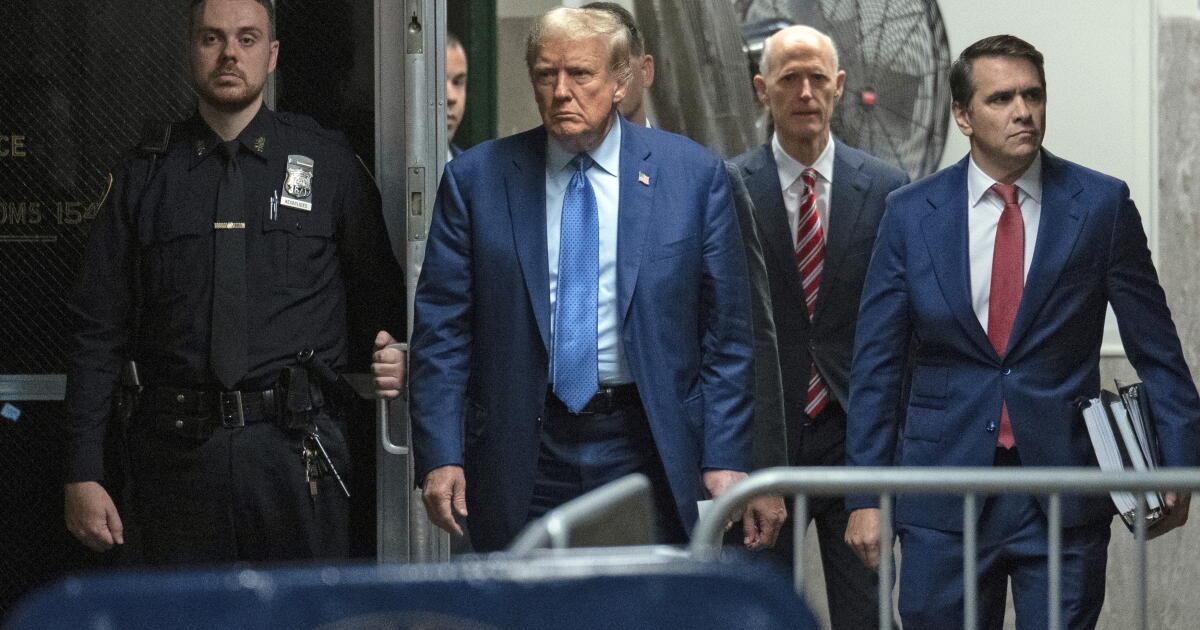
It was only hours after the Supreme Court issued its staggering term-ending opinion on presidential immunity when Donald Trump invoked it in an attempt to set aside his criminal conviction in New York.
On the surface, the effort would seem ill-fated and even brazen.
The opinion made a top-line distinction between “official actions” — which are either immune or presumed immune from criminal prosecution — and “unofficial actions,” which are not. And it’s hard to imagine more prototypically unofficial actions than those of which Trump was convicted in the New York case. While still running for president, Trump devised a scheme to suppress stories of his alleged trysts — in particular with the adult film actor Stormy Daniels — and falsified business records to further the cover-up.
Most of the critical conduct took place before Trump was in office, the exception being the payments to his fixer, Michael Cohen, that generated the false paperwork. And the reimbursement of Cohen from a personal bank account was patently unofficial conduct even though it coincided with Trump’s presidency.
So Judge Juan M. Merchan, who presided over the trial, might be expected to make quick work of Trump’s effort to shoehorn the conviction into the sphere of “official action” for which the court prescribed immunity.
In fact, however, the court’s opinion is strewn with mines and sinkholes that Trump might be able to use to gain a new trial or at least render his conviction provisional for an extended period. These facets of the opinion are part and parcel of its enormous scope and overreach, all to protect a party of exactly one: the only president ever to be charged with a crime.
The court’s revolutionary holding places the president largely outside the reach of criminal law, but the conservative majority wasn’t content to stop there. Its expansive guidance “for the ages,” as Justice Neil M. Gorsuch put it at oral argument, dictates that a jury may not even consider a president’s official acts as evidence to prove a crime involving unofficial conduct.
The court’s reasoning here is particularly threadbare, simply asserting that allowing evidence of official actions would undo the protections of immunity, which the conservative majority considers necessary to ensure a nimble and vigorous presidency. Yet it makes little sense to suggest that a president would be constrained by the prospect that a jury might one day hear about their official actions. Most official actions are public anyway, and those that aren’t can be protected by executive privilege and other means when there is a particular need to to so.
This is where Justice Amy Coney Barrett parted with her fellow conservatives, noting that “the Constitution does not require blinding juries to the circumstances surrounding conduct for which Presidents can be held liable.”
In the context of Trump’s motion to set aside his New York conviction, a fair-minded court should have little trouble concluding that the conduct at issue was unofficial and therefore not subject even to the generous immunity protections prescribed by the justices. However, some of the evidence presented at trial at least arguably concerned official conduct, particularly under the Supreme Court’s wide-ranging, categorical definition of the term.
Most notably, the jury heard testimony from Hope Hicks about a conversation she had with Trump in 2018, when she was the White House communications director, about a report on Cohen’s hush money payments to Daniels and its public opinion repercussions. Prosecutors described Hicks’ testimony, which ended with her breaking down in tears, as “devastating.”
So was Trump’s conversation with Hicks in the White House “official conduct” that, under the immunity opinion, never should have been presented to the jury? And if so, do the convictions have to be set aside?
Those questions are far from straightforward. The answers depend not only on how the Hicks conversation is characterized but also on a thicket of procedural issues. Those include whether Trump may have waived the issue, whether any waiver applies under the Supreme Court’s holding and whether any error in allowing the testimony could be deemed harmless given the strength of the rest of the evidence.
Trump’s conviction may well survive the Supreme Court ruling in the end, but getting to that point won’t be quick or simple. Moreover, Merchan’s ruling is likely to be appealed to higher courts in New York and eventually the U.S. Supreme Court. That prospect could well temper the analysis of lower courts that now understand the breadth and zeal of the justices’ determination to shield Trump from accountability.
It appears as if the Supreme Court has dealt Trump not just a get-out-of-jail-free card but a whole deck of them, allowing him to contest and delay multiple facets of the nearly 100 criminal counts against him. If it turns out that he can use it to his advantage in New York, where he stands already convicted of manifestly personal conduct, it’s hard to imagine a case where he can’t.
Harry Litman is the host of the “Talking Feds” podcast and the “Talking San Diego” speaker series. @harrylitman

Construction workers unfurled a large printed tarp to cover scaffolding installed at the White House’s front entrance. Doug Burgum, the interior secretary, said President Trump had ordered the repairs after noticing damage to columns.
Politics
WATCH: Trump’s Energy chief reveals what escalating Iran tensions could mean for gas prices

NEWYou can now listen to Fox News articles!
Energy Secretary Chris Wright is telling Americans not to be concerned about the possibility of another surge of sharp increases in gasoline prices as tensions with Iran have started to escalate once again.
Asked whether Americans should worry about higher prices at the pump and how the Trump administration is preparing to keep the economy stable if the conflict continues to worsen, Wright told Fox News Digital: “It has not been any good behavior from Iran that’s allowed oil to flow. It’s been the United States military.”
“That’s not changing,” he assured, speaking from the Great American State Fair on the National Mall this week.
US CLAWS BACK KEY CONCESSION TO IRAN AFTER FRESH ATTACKS ON COMMERCIAL SHIPS IN STRAIT OF HORMUZ
(Mario Tama/Getty Images) (Mario Tama/Getty Images)
With Iran striking three commercial vessels transiting the Strait of Hormuz on Monday and Tuesday, Wright doubled down in urging citizens to not credit Iran for the U.S. military’s work to ensure oil shipments continue flowing through the strait.
“Look, the U.S. Military has been the key asset here,” he said. “They have assured the flow of oil and gas through the Strait of Hormuz throughout. Not at the beginning of this conflict, but through the last six weeks.”
Wright said the administration is closely monitoring global oil supplies as the tentative ceasefire with Iran seemingly came to come to a halt, with President Donald Trump telling Secretary-General Mark Rutte the call for peace with Iran is “over” at the NATO Summit in Turkey on Wednesday.
But, he pointed to the continued shipping through the Strait as evidence that markets should remain stable.
TRUMP SAYS IRAN CEASEFIRE IS ‘OVER’ AFTER IRANIAN ATTACKS TRIGGER MASSIVE US RESPONSE
President Donald Trump speaks at the White House on Tuesday, April 22. (AP/Alex Brandon)
“We’re of course constantly watching the supply of oil, the supply of refined products and what’s going on there,” Wright said. “And I think still all positive trends.”
Beyond geopolitical concerns, Wright also praised the new chain of discounted gas stations across Pennsylvania and New Jersey, Freedom Fuel, which promises customers prices below the national average.
The Trump administration, though not involved with the network, has heavily endorsed the new chain and its 25 locations.
“We love it,” Wright said when asked about Freedom Fuel. “I mean, look, any mechanism we can to lower energy costs for Americans of all kinds, we’re all in on.”
“With Freedom Fuels, they’re just lowering it down to their wholesale price of gasoline,” Wright said. “So they’re not making any money selling gasoline, but they’ve got convenience stores. That’s how most gas stations make money.”
NEWSOM UNDER FIRE AS CALIFORNIA GAS TAX HIKE SENDS PUMP PRICES EVEN HIGHER
Gasoline costs are a known concern for many Americans, and amid surging prices there has been a considerable increase in those opting to purchase electric vehicles to save money long-term at the pump — with Tesla dominating the market for these types of models.
Wright argued one of the benefits to living in America is having the option to choose what type of vehicle you drive.
CLICK HERE TO DOWNLOAD THE FOX NEWS APP
“We just want people to buy what they would prefer,” he told Fox News Digital when asked his thoughts on increasing calls for support of the electrification of cars. “Consumer choice — you wanna buy an electric car, you wanna buy a gas powered car, diesel powered car, buy a big truck. That’s the choice.”
“That’s why you live in America. You get the choice of all those.”

In 2023, California regulators levied more than $100,000 in fines against the private operator of a federal immigration facility, kicking off a three-year battle over whether detainees who do work at the facilities should be considered employees.
The question went beyond semantics: If considered employees, the detainees would be subject to state worker protection laws.
A legal settlement announced this week now affirms that private immigrant detention facilities are subject to California’s workplace safety and health requirements.
“Every worker deserves a safe and healthy workplace and should be able to report workplace hazards without fear of retaliation,” said Denisse Gómez, spokesperson for the California Division of Occupational Safety and Health or Cal/OSHA.
“Individuals who perform work in these facilities are entitled to workplace safety protections, and this settlement reinforces Cal/OSHA’s commitment to enforcing those protections and safeguarding vulnerable workers,” she added.
Under the settlement between California and the GEO Group, a Florida-based private prison company, the company recently withdrew its legal challenges and agreed to pay more than $100,000 in the fines.
The GEO Group did not respond to requests for comment.
Back in 2023, Cal/OSHA issued $104,510 in fines against the GEO Group. The agency had found six violations of state code by the company after detainees complained about a lack of protective equipment and proper training while cleaning the facility for $1 per day.
Detainees alleged they routinely wiped black mold off shower walls at the facility, saw black dust spew from air vents and used cleaning solutions that lacked instructions during the COVID-19 pandemic.
The biggest fine levied against the GEO Group was for failure to establish and maintain “effective written procedures to reduce employee risk of exposure to aerosol transmissible disease.”
Advocates viewed Cal/OSHA’S recognition of the detainees as workers as a victory that could pave the way for future labor rights fights at other detention centers in the state.
But the GEO Group appealed, arguing that detainees participating in ICE’s voluntary work program make their own schedules and aren’t employees, so hazard exposure couldn’t be “as a result of assigned duties,” as California law states. Plus, the company argued, there wasn’t enough evidence that detainees were exposed to any hazard.
Early last year, the state’s Occupational Safety and Health Appeals Board rejected the GEO Group’s argument and found that detainees should be considered “affected employees.”
The GEO Group sued, but three days before a California Superior Court hearing in May, the company and Cal/OSHA reached the settlement.
Along with paying the fines, the GEO Group agreed to draft plans for avoiding aerosol transmissions at 12 secure and reentry facilities in California, including five detention centers that hold immigrants.
“GEO ensures detainees are afforded the necessary tools, equipment, and personal protective equipment … to safely and effectively perform any necessary tasks,” the settlement states.
Gómez said the settlement also leaves intact the appeals board’s ruling that civil immigration detainees who participate in work programs can participate in proceedings anonymously, “acknowledging the potential for retaliation when individuals raise workplace safety concerns.”
But the question of whether detainees are employees and deserve certain protections isn’t entirely resolved — at least not for the federal government.
Last month, U.S. Immigration and Customs Enforcement released new standards for detention facilities across the country. The revised guidelines “emphasize that detainee volunteers participating in the voluntary work program are not considered facility and/or government employees” and thus not entitled to labor regulations.
Attorney Mariel Villarreal said the timing of the new detention standards made her question whether the GEO Group had asked ICE to specify in its standards that detainees are not workers in response to its battle with Cal/OSHA.
“To me, it’s a reaction to this very settlement,” she said. Villarreal works for the California Collaborative for Immigrant Justice, which filed the original complaint on behalf of detainees who said they worked in unsafe conditions.
Villarreal pointed to a Washington Post report that GEO Group executives privately asked ICE to specify that detainees are not employees of the facilities where they work. Two top Trump administration officials, border czar Tom Homan and acting ICE director David Venturella, previously worked for the GEO Group.
New versions of ICE detention standards take effect as contracts are established or modified, so this year’s rules won’t immediately apply to every facility.
An ICE spokesperson did not comment about the settlement. The spokesperson, who did not provide their name in an emailed statement Wednesday, said the agency has begun transitioning detention facilities to meet the 2026 standards, “building on its longstanding commitment to safe, secure, and professional detention operations.”
“ICE has consistently implemented many of these best practices independently, reinforcing its role as the leader in detention operations,” the spokesperson added.
The GEO Group and other immigrant detention center operators have faced other legal battles over workers’ rights, including lawsuits in Washington, Colorado and California over the $1-per-day payment.
Villarreal said she’s confident that the Cal/OSHA settlement would continue to hold even if California facilities incorporated the new standards. But she said she believes the statements are an attempt by the GEO Group to “sidestep responsibility” and avoid the possibility of being fined under similar circumstances in other states.
“These statements in the new standards are a way for them to try and preserve profits as much as possible,” she said. “GEO and ICE are so intertwined at this point that they have the same motives.”
-

 Rhode Island3 minutes ago
Our Favorite Write-Ins From the 2026 Best of Rhode Island Readers’ Poll – Rhode Island Monthly
-

 South-Carolina10 minutes ago
South Carolina National Guard lifts suspensions for pilots in July Fourth flyover
-

 South Dakota13 minutes ago
South Dakota T. rex could bring $30 million or more at auction
-

 Tennessee18 minutes ago
Rescue teams pull kayakers and dog from Red River in Tennessee
-

 Texas25 minutes ago
Fetus found deceased along Lewisville Lake shoreline was discarded intentionally, police say
-

 Utah28 minutes ago
Tyler Robinson preliminary hearing expected to wrap up Friday – KSLNewsRadio
-
Washington33 minutes ago
Bengals 2026 Opponent Preview: Washington Commanders
-

 Vermont33 minutes ago
Beau Welling’s Stowe Country Club Revamp Signals New Vermont Golf Era


