Politics
Column: Trump's antics didn't stop his New York hush money trial. Here's why he'll keep them up

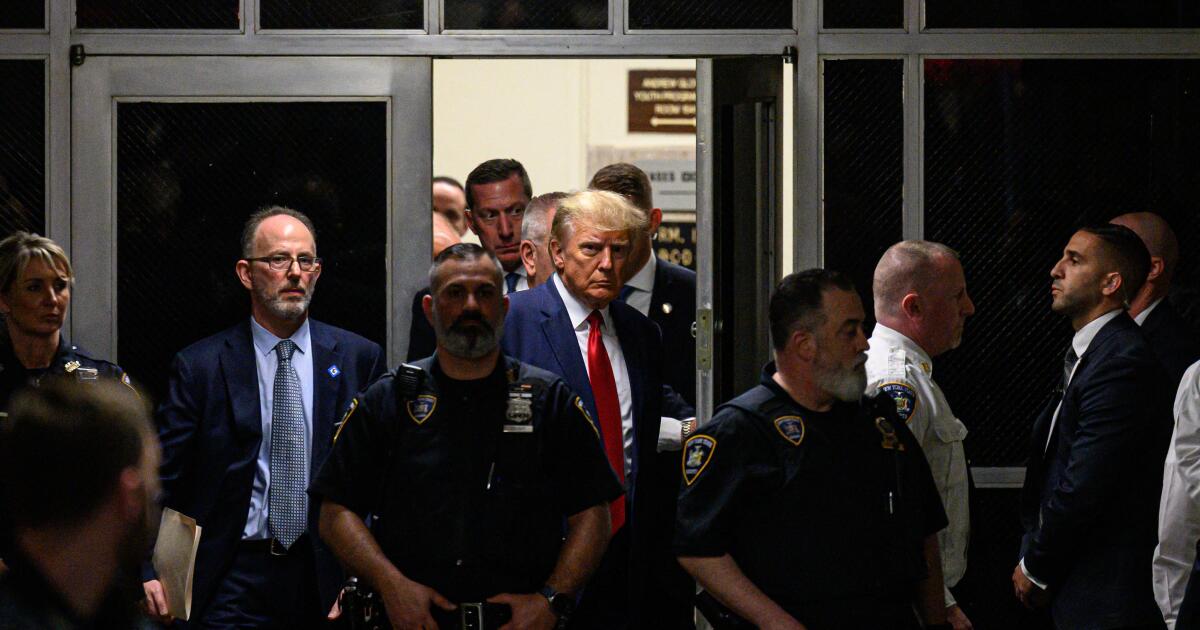
After a pretrial period replete with juvenile tantrums, nonstarter attempts to delay the proceedings, and savage attacks on prosecutors, the presiding judge and New Yorkers in general, Donald Trump is about to face the men and women who will decide whether he is guilty of 34 felony charges.
With the start of his historic hush money trial in Manhattan on Monday, the former president might be expected to abandon these so far unsuccessful tactics. But don’t bet on it.
The trial’s opening act will likely feature much the same brand of petulance and vituperation from the defendant, now redirected to the jury selection process.
Expect Trump to beat the same drum he has for several months, savaging anyone within legal reach — that is, not expressly off limits under the gag orders Justice Juan M. Merchan has imposed — and playing the martyr suffering for his followers at the hands of the anti-MAGA elite.
Even as he faces the tangible prospect of a conviction and prison sentence — though appeals could take several years — his strategy will continue to be more political than legal. He’s hoping to win the presidency and then figure out how to clean up the various train wrecks left in his path.
To begin with, that means Trump and his legal team can be expected to rail at Merchan’s decisions about whom to seat on the jury.
Like most jurisdictions, Manhattan follows a set of rules that impose a rigorous strategy on the litigants. Each side has 10 golden tickets known as peremptory challenges, which can be used to exclude a prospective juror for any or no reason (so long as it is not unconstitutionally based on race). In addition, each side can argue for an unlimited number of challenges “for cause.”
The latter are for jurors the litigants argue are unfit to serve for any number of reasons. They could have a close relationship with a party or lawyer in the case, personal experience with the type of crime alleged or some other conflict or bias. In general, the court must agree that they are incapable of carrying out the juror’s core responsibility of applying the law fairly to the evidence.
The prosecution and defense will have disparate strategies. The prosecution will want reasonable and persuadable people who are able to collaborate collegially and come to a consensus. Their ideal candidate may be along the lines of a well-educated professional.
Trump, meanwhile, has little prospect of acquittal, so his team will search for a juror willing to buck the other 11 no matter how strong their consensus. That means a maverick whose life choices reflect indifference or even antipathy toward the crowd.
Given a defendant of Trump’s notoriety, the jury will inevitably include people with strong views about him. The quest of the jury selection process is not for people who have no views about the former president but rather those who can set aside whatever personal views they have and render a judgment based on the evidence and the law.
That means potential jurors may present themselves and express views — including negative views about Trump — but, on questioning from the judge and prosecutor, aver that they can apply the law and reach a verdict fairly.
Even if Trump’s side argues that a juror is inclined to convict, the judge may side with prosecutors and conclude that they can be trusted to do their duty. And then Trump’s counsel will have to decide whether to use one of their precious peremptory challenges. Eventually, they will be forced to accept jurors they don’t like.
Such losing arguments will be more fuel for Trump’s eternal fire of victimhood and grievance, and we can expect him to leverage them as supposed proof of the deep state conspiracy to take him down. And if his complaints cross the lines drawn by Merchan’s gag orders, they could set up an ancillary set of bitter legal battles. Prosecutors have already moved to have Trump held in contempt for incendiary social media messages on the eve and at the start of the trial.
Trump’s political strategy has always been in tension with his legal vulnerability, leading him to vilify the judges presiding over his cases and essentially dare them to hold him in contempt. Now that a jury is sitting in judgment of his conduct, that strategy will go from dubious to asinine. Still, he hasn’t given us any reason to expect him to abandon it.
Look for the jury selection process and the trial to feature more of Trump’s tantrums in court and tirades on the courthouse steps, sorely trying the patience of all involved, not least the judge.
Harry Litman is the host of the “Talking Feds” podcast and the Talking San Diego speaker series. @harrylitman

Politics
EXCLUSIVE: FBI adds alleged COVID fraudster accused of taking $5M from kids’ meal program to Most Wanted list

FBI makes first arrest from its ‘most wanted fraudsters’ list
FBI Director Kash Patel announces the first arrest on the “Most Wanted Fraudsters” list. Said Ereg, a Minneapolis man, is accused of stealing over $4.2 million from a federal child nutrition program during the COVID-19 pandemic. Minnesota Senate candidate Michele Tafoya emphasizes the need for accountability for fraudulent activities.
NEWYou can now listen to Fox News articles!
EXCLUSIVE: The FBI is adding Fahad Mohamed Nur to its Most Wanted Fraudsters List, accusing the Minnesota businessman of allegedly stealing more than $5 million that was intended to feed children during the COVID-19 pandemic.
Nur has been on the run since 2022 and is wanted for his alleged role in a fraud scheme that exploited Minnesota’s Federal Child Nutrition Program during the COVID-19 pandemic, according to the FBI. The bureau alleges he owned a vendor and purported food supplier that received more than $5 million in fraudulent program funds by submitting fake invoices before laundering the proceeds.
The Bureau believes Nur has ties to Somalia and may currently be living there.
The FBI is offering a reward of up to $150,000 for information leading to Nur’s arrest and conviction.
OWNER OF DAYCARE IN VIRAL NICK SHIRLEY VIDEO CHARGED IN $4.6M DAYCARE FRAUD SCHEME, PROSECUTORS SAY
Fahad Mohamed Nur has been on the run since 2022 and may be in Somalia, according to the FBI. (Federal Bureau of Investigation)
Nur is the latest addition to the FBI’s Most Wanted Fraudsters List, which officials say has already resulted in the arrests of two fugitives within weeks of its launch.
“Under President Trump’s and Vice President Vance’s leadership with the White House Task Force to Eliminate Fraud, the FBI’s historic ‘Most Wanted Fraudsters list’ has already seen tremendous success – with two subjects brought to justice in a matter of weeks, apprehended out of Somalia and the Philippines,” FBI Director Kash Patel said in a statement to Fox News Digital.
Patel said the early arrests demonstrate that the FBI is aggressively pursuing fugitives accused of stealing from American taxpayers.
FBI ADDS 2 FUGITIVES TO ‘MOST WANTED FRAUDSTERS’ LIST AMID HISTORIC $6.5B HEALTHCARE TAKEDOWN: PATEL
FBI Director Kash Patel conducts a news conference at the Department of Justice on Thursday, December 4, 2025. (Tom Williams/CQ-Roll Call, Inc via Getty Images)
“Our newest subject – Fahad Mohamed Nur – has been on the run since 2022 for allegedly stealing over $5 million from a child nutrition program in Minnesota.”
Patel added: “Collectively, the Task Force has already uncovered more than $13 billion in fraud, and the rapid success of the Most Wanted Fraudsters List should show all Americans that this FBI will [be] at the forefront pursuing the worst of the worst who stole from hardworking American taxpayers.”
DR OZ WARNS MEDICARE SCAMMERS ARE STEALING BILLIONS — AND YOUR PERSONAL INFORMATION COULD BE NEXT
Federal agents enter an office building as a search warrant is executed at Ultimate Home Health Services over potential Medicaid fraud, on December 18, 2025 in Bloomington, Minnesota, United States. (Christopher Juhn/Anadolu via Getty Images)
Federal officials say the investigation is part of a broader government effort targeting pandemic-era fraud.
“The Department’s robust partnership with the FBI and the White House Task Force to Eliminate Fraud has already delivered historic results. That partnership grows even stronger today with the addition of this latest subject to the Most Wanted Fraudsters list,” said Acting Attorney General Todd Blanche. “President Trump has made it clear: Fraudsters no longer have a safe haven in America. Law enforcement will continue to use every tool at its disposal to bring those who steal from American taxpayers to justice.”
The White House Task Force to Eliminate Fraud, led by Vice President JD Vance, has already uncovered more than $13 billion in fraud, according to the FBI.
CLICK HERE TO DOWNLOAD THE FOX NEWS APP
Anyone with information about Nur’s whereabouts is urged to contact the FBI at 1-800-CALL-FBI, their local FBI office, the nearest U.S. Embassy or Consulate, or submit a tip online at tips.fbi.gov.

With the 2026-27 season premiere of “60 Minutes” just two months away, CBS News leadership is getting closer to deciding who will fill the recent departures of longtime correspondents Scott Pelley, Sharon Alfonsi, Cecilia Vega and Anderson Cooper.
Seth Doane, a longtime correspondent based in Italy who is often seen on “CBS Sunday Morning,” is under consideration, along with chief investigative correspondent Jim Axelrod, who currently has a lead role in the “Eye On America” series featured on the “CBS Evening News with Tony Dokoupil.”
Sir Trevor Phillips, a British journalist and former politician who recently joined CBS News as senior global affairs correspondent, is expected to have a role on the program, according to people briefed on the plan. Phillips had a long career in the U.K., producing and writing documentaries and most recently hosted the Sky News program “Sunday Morning with Trevor Phillips.”
Phillips received a knighthood in 2022 for his service to equality and human rights for the U.K. But he also generated controversy over his career for comments about the British Muslim community, which led to a yearlong suspension from the Labour Party in 2020.
A CBS News representative declined comment beyond saying the division is looking at a number of internal and external candidates.
Dokoupil is expected to deliver four “60 Minutes” pieces a season. Major Garrett, the network’s chief Washington correspondent, will also have a contributor role.
Matt Gutman, hired from ABC News last year as national correspondent, is under strong consideration. He is being put in front of test audiences, according to several people at the network.
Holly Williams, a foreign correspondent working out of Istanbul for CBS News since 2012, and Mariana van Zeller, a journalist for National Geographic Channel, are both said to remain in contention.
The newcomers will join Bill Whitaker, Leslie Stahl, Jon Wertheim and Norah O’Donnell, who are all returning as correspondents. O’Donnell will also continue in her role as senior correspondent for the network, occasionally anchoring specials.
The rebuild of the talent line-up comes after the upheaval at the program that has occurred since Bari Weiss joined CBS News as edtior in chief in October.
Longtime correspondent Scott Pelley was fired last month after confronting management about the May 28 dismissal of his colleagues Alfonsi and Vega along with the program’s executive producer Tanya Simon and her second-in-command Draggan Mihailovich.
In February, Cooper decided not to sign a new deal as a “60 Minutes” contributor, as the CNN anchor cited a desire to spend more time with his family. But Cooper has reportedly told colleagues that he does not want to work for Weiss.
The internal disruption at “60 Minutes” followed a highly successful season. In its 57th season, “60 Minutes” was the most watched news program on television with an average of 9.1 million viewers a week according to Nielsen data. The program bucked the overall decline in traditional TV viewing by growing 9 percent over the previous season.
After the dismissal of his “60 Minutes” colleagues, Pelley accused Weiss of trying to “murder” the program and claimed she was putting “her thumb on the scale” for more favorable coverage of the Trump administration. He was fired with cause after confronting management at a June 1 meeting.
Weiss came to CBS when parent company Paramount acquired her digital web site The Free Press, known for its criticism of progressive policies and its strong support of Israel.
Weiss was hired by Paramount Chief Executive David Ellison with a mandate to move the news division to the political center. The pronouncement has created the perception that CBS News is looking to placate the Trump administration as Paramount sought regulatory approval for its $111 billion acquisition of Warner Bros. Discovery, which will also give the company ownership of CNN.
The noise surrounding Weiss has hurt CBS News despite strong reporting that is often far from being pro-MAGA. This past weekend’s “CBS Sunday Morning” featured a segment from national security correspondent David Martin about the Department of Defense interfering with the editorial independence of Stars & Stripes, the military newspaper.
Trump complained vehemently about his last interview with O’Donnell on “60 Minutes,” — conducted the day after a gunman tried to enter the White House Correspondents Assn. dinner in Washington on April 25.
Politics
Abbott orders probe after Texas hospital advertises ‘birth packages’ in Mexico: ‘Citizenship is not for sale’

NEWYou can now listen to Fox News articles!
Texas Gov. Greg Abbott ordered an investigation into a Texas hospital Tuesday after it confirmed to Fox News that it advertised Spanish-language “Birth Packages in South Texas” on billboards in Mexico promoting childbirth services to pregnant foreign nationals near the U.S.-Mexico border.
Mission Regional Medical Center confirmed to Fox News that it was responsible for the advertising campaign, which promoted deliveries starting at $3,950 for a natural birth and $5,525 for a C-section and directed viewers to a website, havemybabyinTEXAS.com, that has since been taken offline.
The billboards also displayed a telephone number beginning with “001,” the country code used to place calls to the United States from Mexico.
‘WEAPONS OF MASS REPRODUCTION’: WATCHDOG UNVEILS ACTION PLAN TO CURB BIRTH TOURISM AFTER SUPREME COURT RULING
Gov. Greg Abbott speaks during a bill signing in the State Capitol on April 23, 2025, in Austin, Texas. (Brandon Bell/Getty Images)
“The marketing materials regarding maternity services are no longer in use due to any unintended misunderstanding,” a hospital spokesperson said in a statement to Fox News. “We do not support or facilitate any unlawful activity and work to comply with all applicable federal and state laws and regulations.”
The spokesperson said the campaign included two billboards located within approximately five miles of the hospital near a U.S.-Mexico border crossing. The hospital said both billboards and the website were removed Monday after images began circulating on social media. The spokesperson also said the campaign began in 2021 but did not specify when the billboards were installed.
Abbott on Tuesday directed Texas Health and Human Services Commission Executive Commissioner Stephanie Muth to investigate Mission Regional Medical Center for potential violations of state law and contractual obligations.
REPUBLICAN ACCUSES SCOTUS OF BETRAYING US, PUSHES BILL RESTRICTING BIRTHRIGHT CITIZENSHIP, PREGNANT VISITORS
A Spanish-language billboard promotes birth packages at Mission Regional Medical Center, advertising pricing for natural deliveries and C-sections in South Texas. (Right Angle News)
Images of the billboard circulated on social media before the hospital said it removed the advertisements Monday.
“Birth tourism’ is an illegal practice that exploits the extraordinary hospitality that the United States and Texas offer to millions of foreign travelers each year,” Abbott wrote in a July 7 letter obtained by Fox News. “Unfortunately, thousands of foreign travelers come to the United States under false pretenses to give birth and secure citizenship for their children.”
TRUMP SUFFERS MAJOR SUPREME COURT DEFEAT AS JUSTICES UPHOLD BIRTHRIGHT CITIZENSHIP
An English-language billboard promotes birth packages at Mission Regional Medical Center, advertising pricing for natural deliveries and C-sections in South Texas. (Right Angle News)
Abbott directed HHSC to “immediately and thoroughly investigate” the hospital and said any violations should be referred to the Texas Attorney General for civil enforcement and to the appropriate district or county attorney for potential criminal prosecution.
“American citizenship is not for sale and Texas will not permit our healthcare system to be used as a magnet for birth tourism,” Abbott wrote.
The governor also said he plans to work with the Texas Legislature during its next session “to strengthen state law and eliminate birth tourism in Texas.”
“Unfortunately, birth tourism operations are not a new phenomenon,” General Counsel of the Oversight Project Kyle Brosnan said to Fox News Digital in a statement. “The Supreme Court’s egregiously wrong decision in the birthright citizenship case is going to open the floodgates to the birth tourism industry. Our country is much more than a pile of magic dirt. The only answer to these type of practices are criminal investigations and the mass deportation of illegal aliens.”
Mission Regional Medical Center also said it intends to cooperate with state officials.
CLICK HERE TO DOWNLOAD THE FOX NEWS APP
“We intend to work cooperatively and transparently with local and state officials,” the hospital said in a statement obtained by Fox News. “Our focus remains on delivering safe, high-quality care to every patient who seeks our services.”
The investigation comes as President Donald Trump’s executive order seeking to limit automatic birthright citizenship for some children born in the United States remains the subject of ongoing legal challenges.
-

 New Hampshire3 minutes ago
New hampshire set to approve world’s first $100 million bitcoin-backed municipal bond
-

 New Jersey6 minutes ago
Police conclude investigation at Walmart in Cherry Hill, officials say
-

 New Mexico11 minutes ago
Monsoon high shifts slightly west but rain is still possible Wednesday in New Mexico
-

 North Carolina18 minutes ago
North Carolina Republican operative shaping the state’s early voting plans is reassigned
-

 North Dakota21 minutes ago
West Fargo Attorney Chosen for North Dakota Ethics Commission Position
-

 Ohio26 minutes ago
Jeff’s Donuts opens first Ohio location, open 24 hours
-

 Oklahoma33 minutes ago
5 Things To Know: Oklahoma County inmate death, deadly OKC hit-and-run
-

 Oregon36 minutes ago
Oregon to ask court to delay Paramount deal for 60 days while it reviews records

