Politics
Column: Mea culpa: I got some things wrong in 2024. At least I hope I did

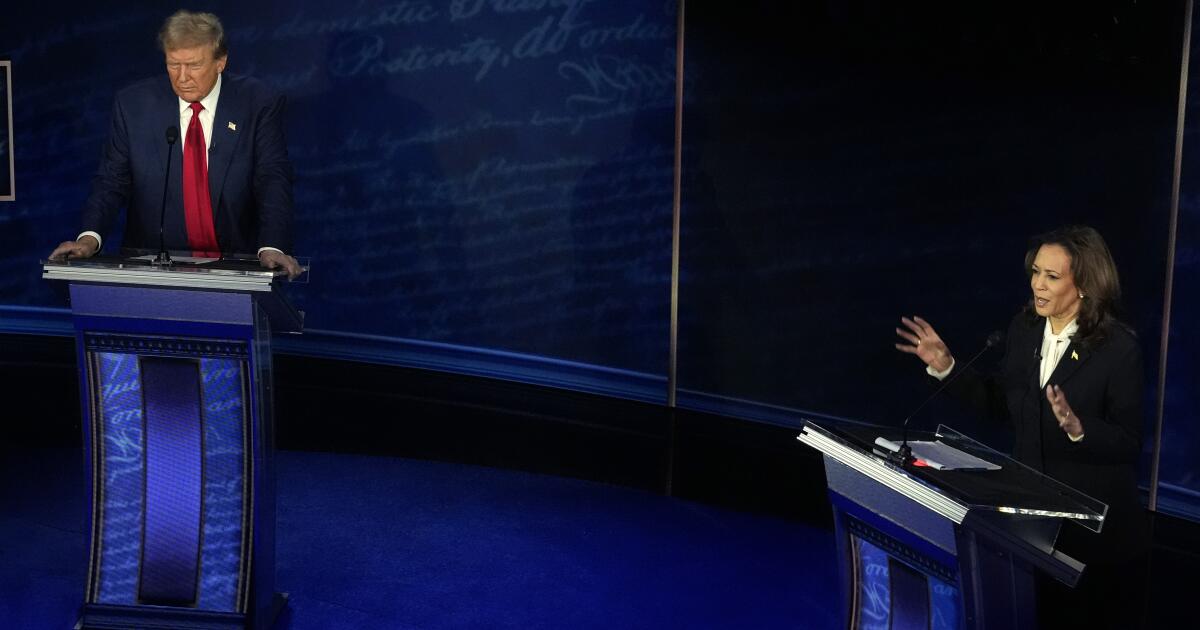
WASHINGTON — I spent much of 2024 warning readers that a second Trump presidency would do serious damage to American institutions, beginning with democracy and the rule of law.
“The former president neither understands nor respects the Constitution,” I wrote. “He would use the powers of the federal government as an instrument of his whims, prosecuting opponents and rewarding donors instead of serving the public interest.”
Judging from the election results, about half of America’s voters disagreed. Many of them wrote to tell me how wrong I was.
“Trump Derangement Syndrome,” a reader named Ed Osborne scoffed.
I hope he’s right and that I was wrong. A less destructive Trump would come as a relief.
This is my annual “mea culpa” column, an end-of-the-year look back at what I got wrong and what (if anything) I got right.
Writing a column is a recurring opportunity to make mistakes in plain sight and repent them at leisure. Election years offer even more chances than usual to make bad guesses.
A drawn-out finish and economic optimism?
Here’s one: I expected the presidential election to be closer — and to take longer to resolve — than it was. “We won’t know who won on election night,” I predicted.
Wrong! Trump swept all seven swing states in short order, piling up an impressive electoral vote majority. His popular vote margin turned out to be one of the narrowest in recent history, but that didn’t become clear until California finished its leisurely count this month.
One reason I forecast a razor-close election was that I believed Vice President Kamala Harris, the Democratic nominee, was successfully eroding Trump’s advantage on the most important issue: voters’ dissatisfaction with the economy.
“Maybe good economic news — a growing economy, easing inflation and lower interest rates — is finally seeping into voters’ consciousness, allowing Harris to reap some political benefit,” I wrote a month before the election.
Wrong again. Exit polls found that 45% of voters said they still felt worse off than they had during Trump’s first term. Only 24% said they were better off.
On one of the biggest stories of the year, President Biden’s disastrous performance in his June debate with Trump, another confession: I didn’t see it coming. Before the debate, I wrote that Biden’s age was clearly slowing him down; “he needs to show that he can not only find the stairs but think on his feet,” I advised. But I wasn’t concealing his condition; I never had a close enough look to support a tougher diagnosis.
To be fair (to myself, in this case), at least I didn’t commit the most basic error a reporter can make before an election: I didn’t predict who would win. In October, I wrote that the Trump-Harris race was too close to call — and it was.
I also noted that the Democratic nominee didn’t run a perfect campaign.
“She took a distressingly long time to define a clear, overarching vision,” I wrote. “Early in the campaign, her answers to tough questions often devolved into word salad. She struggled to explain how her presidency might differ from a second Joe Biden term.”
That made the election essentially a referendum on the Biden administration — a contest almost any Democrat was bound to lose.
A clear pattern and an unanswered question
When I sat in on focus groups of undecided voters last fall, a pattern became clear: Plenty had qualms about Trump, but they had confidence in his ability to improve the economy.
Many of them discounted Trump’s most worrisome proposals because they didn’t think he’d act on them — like Kevin, a home inspector in Atlanta, who said he thought Trump’s promise to slap huge tariffs on imports was “a bad idea, but I don’t think it’s going to really go anywhere.”
And that brings us back to the question of “Trump Derangement Syndrome.” Who was right: Kevin or me?
That depends on which version of Trump emerges once he’s in office.
Polls show that most of his voters elected him mainly to bring prices down and reduce illegal immigration. But many don’t support separating migrant families, imposing tariffs that would spike inflation, or prosecuting political opponents.
Will Trump moderate any of his campaign promises? So far, he’s having it both ways.
He’s stuck to his vow to launch mass deportations, but said he might make an exception for “dreamers,” migrants who came to the United States as children. He’s threatened massive tariffs against Mexico, Canada and China, but hinted that he might relent if they offer concessions. On some days, he says his critic former Rep. Liz Cheney (R-Wyo.) “should be investigated by the FBI”; on others, he tosses out a contradictory message of magnanimity, “Retribution will be through success.”
Here’s another prediction
Undaunted by my shaky track record, I’ve already made a prediction: Just as in his first term, Trump will try to carry out his promises, but will trim them back if he runs into opposition, especially from voters in his own party.
Mass deportation, for example, “is one promise Trump clearly intends to keep,” I wrote last month. “But there may be a debate in the new administration over how fast and how sweeping the deportation drive should be.” That debate, focusing mostly on the costs of a big operation, is already underway.
As for his most controversial Cabinet nominees — Pete Hegseth at Defense, Kash Patel at the FBI, Robert F. Kennedy Jr. at Health and Human Services, Tulsi Gabbard as director of national intelligence — my guess is that Gabbard is the only one whose confirmation is in serious jeopardy.
I’ll be glad if I was mistaken. If I was, I’ll be sure to let you know.

Politics
Trump-aligned House holdouts accused of holding ‘life-saving’ veterans bill ‘hostage’ over SAVE America Act

NEWYou can now listen to Fox News articles!
A sweeping veterans package supporters describe as the largest expansion of veterans’ health care and benefits in more than a decade is expected to return to the House floor when lawmakers come back from the July recess, but backers warn the legislation could once again become collateral damage in the Republican standoff over the SAVE America Act.
The Take Care of America’s Veterans Act rolls roughly 60 veterans bills into a package that would dramatically expand veterans’ health care and benefits. At its core, the legislation would cement veterans’ access to community care outside the VA while increasing benefits for combat-wounded veterans, caregivers and Gold Star families, expanding mental health services and enacting dozens of additional reforms.
House Veterans’ Affairs Committee Chairman Mike Bost, R-Ill., told Fox News Digital he intends to bring the Take Care of America’s Veterans Act back for a vote as soon as the House reconvenes next week.
WASHINGTON, D.C. – MARCH 17: Eugene Simpson, 29, from Dale City, Virginia goes through physical therapy at the Veterans Affairs Medical Center in Washington, D.C. with Michael Minor, a kinesiotherapist with the United States Department of Veterans Affairs on March 17, 2006 in Washington, D.C., USA. (Photo by Jeff Hutchens/Getty Images) (Jeff Hutchens/Getty Images)
HOUSE CONSERVATIVES DERAIL GOP AGENDA IN SAVE AMERICA ACT SHOWDOWN
The legislation was held up last month after a group of House Republicans joined Democrats to defeat a procedural vote, stopping the House from taking up the bill.
“I’m feeling good as long as my members stay with us on the rule,” Bost said. “Right now, there’s some politics being played, not about this bill, but just in general.”
The bill became entangled in a broader House Republican fight over the SAVE America Act, legislation championed by President Donald Trump that would require proof of U.S. citizenship to register to vote in federal elections.
On June 30, the House voted on H. Res. 1398, the procedural rule governing floor consideration of several bills, including the National Defense Authorization Act and the Take Care of America’s Veterans Act. The rule failed after 14 Republicans joined Democrats in opposition, preventing the House from taking up the veterans package and bringing floor business to a standstill. Rep. Anna Paulina Luna, R-Fla., claimed to have voted against the rules vote in protest against House leadership’s handling of the SAVE America Act. As a result, Speaker of the House Mike Johnson sent the members home early.
Bost accused the holdouts of effectively putting veterans legislation on hold.
The US Department of Veterans Affairs building is seen in Washington, DC, on July 22, 2019. (Photo by Alastair Pike / AFP) (Photo credit should read ALASTAIR PIKE/AFP via Getty Images) (Photo credit should read ALASTAIR PIKE/AFP via Getty Image)
‘IT’S A MESS’: GOP TURNS ON HOUSE CONSERVATIVES AS VOTER ID BLOCKADE STALLS TRUMP’S AGENDA
“They’re holding all bills hostage,” Bost said. “They’re not voting for any rule. Any bill that has to pass a rule before it comes to the floor—which this bill does because of its size—can’t move.”
Although Bost said he supports the SAVE America Act and has voted for it three times, he argued the Senate’s failure to act should not stop the House from advancing unrelated legislation.
“I agree with that bill,” Bost said. “But the Senate still has to do their work. We don’t stop our work because the Senate isn’t doing it.”
With 23 legislative days left in the Congressional session, Concerned Veterans for America Strategic Director John Byrnes, a supporter of the bill, said time is of the essence.
“There are lots and lots of things that have to get done,” Byrnes told Fox News Digital. “There’s also the National Defense Authorization Act, which is a must pass every year, so these things eat up time. There’s requirements to have debate on these, which eat up session time.”
Byrnes argued that every procedural delay pushes other legislation further down the calendar.
“This bill will save lives in 2027,” Byrnes said. “If we lose veterans because they could have had faster, better access to health care, we’re never going to get those veterans back.”
Rep. Mike Bost, R-Ill. ( )
TRUMP’S SAVE AMERICA ACT SHOWS SIGNS OF LIFE IN THE SENATE DESPITE REPUBLICAN REVOLT
But Rep. Chip Roy, R-Texas, who also voted no on the procedural vote, told Fox News Digital that he has concerns about how the bill is financed.
“I appreciate what the chairman’s trying to do in some respects, but there’s a few issues,” Roy said.
Among them, Roy pointed to provisions offsetting new spending through changes affecting other veterans.
“You’re taxing certain veterans to provide some sort of benefits and changes to other veterans,” Roy said. “There are concerns about some of the pay-fors.”
Veterans of Foreign Wars has also taken issue with Section 108 of the bill, warning that it would codify changes to future disability ratings for tinnitus and sleep apnea to help finance other veterans priorities.
But Bost said this is inaccurate.
“No veteran is going to have their benefits reduced,” Bost said. “If you’re receiving a benefit right now, that’s not going to be reduced at all.”
Roy, who previously served two years on the House Veterans’ Affairs Committee, said he supported a lot of what the bill was seeking to accomplish; but said other pieces of legislation are priorities, too.
CLICK HERE TO DOWNLOAD THE FOX NEWS APP
“There is a block of us for whom border security, the SAVE Act and demonstrating our leadership on major issues is critical,” Roy said. “Some of these other bills may or may not get hung up based on a desire of many in the conference to see movement on other things.”
Fox News Digital reached out to Luna’s office and the White House for comment.
WASHINGTON — Shortly before President Trump ended a ceasefire with Iran this week, Israeli officials presented his team with intelligence indicating Tehran was hatching new plots to kill him.
It was not the first such warning. U.S. law enforcement and intelligence agencies have tracked evidence for years of Iranian efforts to target the president, with signals only increasing since the start of the war.
Their desire to target Trump and his top aides began six years ago, just outside Baghdad International Airport, when the president ordered a drone strike that killed Iran’s most powerful general. The assassination of Qassem Suleimani brought the two countries to the brink of war.
Yet even as full-scale war was averted, top Iranian officials vowed revenge for the strike, authorizing attempts on the lives not just of the president, but of his secretary of State and national security advisor, among others, even after they had left office.
Now, calls for revenge have reached a sharper pitch in Tehran, after a joint U.S.-Israeli operation killed Iran’s supreme leader, Ayatollah Ali Khamenei, at the start of the war in February.
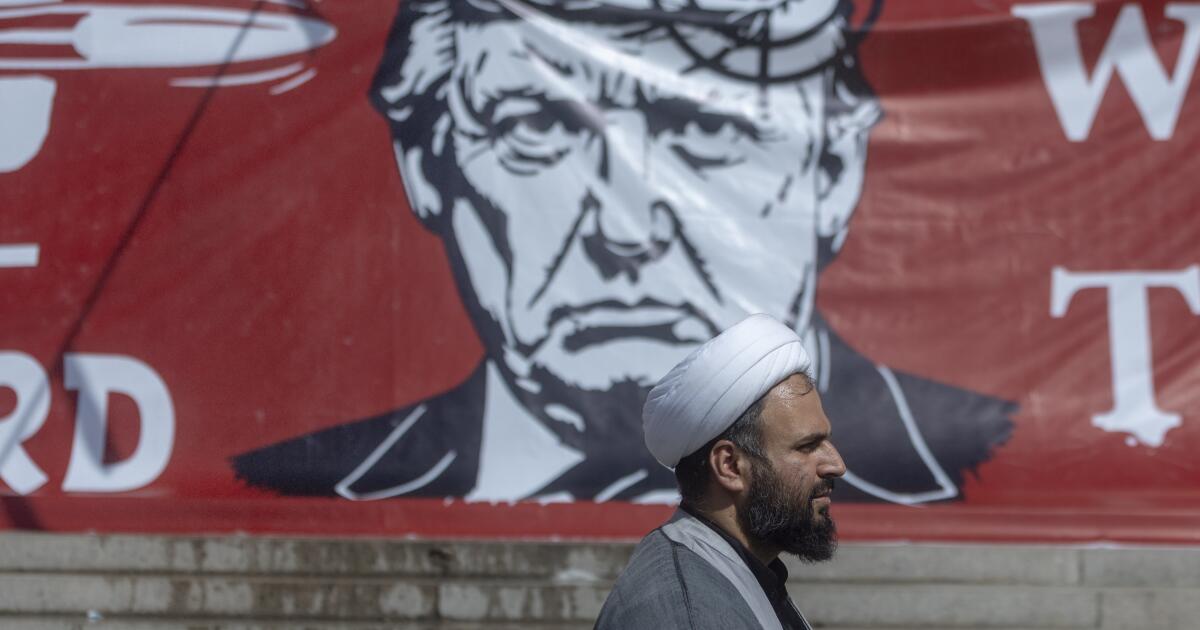
At Khamenei’s funeral ceremonies this week, red flags of vengeance flew throughout the capital as protesters explicitly called on their government to “kill Trump.” His son, Mojtaba, the new supreme leader, was absent from the commemorations, fearing assassination himself.
Mourners hold an anti-President Trump banner at the Imam Khomeini Grand Mosque during mass funeral prayers for Iran’s late Supreme Leader Ayatollah Ali Khamenei and his family in Tehran on Sunday.
(Morteza Nikoubazl / NurPhoto via Getty Images)
The prospect of foreign assassination plots targeting U.S. leaders puts the United States in dangerous new territory, where its embrace of political killings could ultimately place its own officials at unprecedented risk. And experts fear the existential threat of assassination has pushed peace further out of reach: When both sides believe their survival is at stake, the trust required for diplomacy becomes far harder to achieve.
Israeli news organizations have reported that Israel’s prime minister, Benjamin Netanyahu, cited Iranian attempts to kill Trump in recent years as part of his case to go to war in the first place.
A U.S. official told The Times that a range of serious threats exist against the president, including from Iran, but that Israel’s intelligence pointed to a more specific plot. The official did not provide further details. Israeli officials did not respond to requests for comment.
Iran’s president, Masoud Pezeshkian, has said in recent months that the government sees vengeance against U.S. officials as “its legitimate duty and right,” and “will fulfill this great responsibility and duty with all its might.”
“The Suleimani killing accelerated a lifting of restraints on foreign assassinations — and the taboo on targeting and killing foreign leaders, with U.S. military assets, has been more or less lifted,” said Matt Dallek, a political professor at George Washington University.
“If the United States sets the example of how to conduct international relations, and it is using assassination of foreign leaders as a political weapon, it’s only logical that other countries will be more inclined to also engage in assassinations,” Dallek added. “It does seem likely that Trump will have a bigger target on his back.”
Returning from a NATO summit in Turkey on Wednesday, Trump was forced to switch back to an old model of Air Force One — equipped with specialized defensive technologies — from a new plane given as a gift by Qatar, after the Secret Service warned of potential threats to the aircraft from Iran.
“They want to take out the U.S. leader — me,” Trump told reporters aboard the plane. “I’m on whatever list. I saw this morning I’m on every single one of their lists. And so far, I guess I’ve been a bit lucky, but maybe that doesn’t last very long.”
The threat has remained on his mind in the days since. In an interview with the New York Post, Trump told the reporter, “I hope you’ll miss me,” adding that he has “been on their list for a long time.” And in a subsequent social media post Friday night, he warned of a catastrophic response he instructed the administration to pursue in the event Tehran succeeds.
“1000 Missiles are Locked and Loaded and aimed at the Islamic Republic of Iran,” he wrote, “with thousands of more to immediately follow, should the Iranian Government act on its threat, pronounced in many corners of the Globe, to assassinate, or attempt to assassinate, the sitting President of the United States of America, in this case, ME!”
The United States had a decades-old prohibition against assassinating foreign leaders before Trump’s presidency, codified in an executive order signed by President Ford in 1976 over concerns of a CIA plot to kill Fidel Castro.
The policy was only strengthened further by subsequent administrations, fearing a new international standard for targeted killings could result in unintended consequences in the halls of Washington.
Other administrations have been accused of targeting foreign leaders before. Under the Obama administration, an international coalition targeting the Libyan regime of Moammar Kadafi during the country’s 2011 civil war struck his fleeing convoy, leading to his capture and killing by rebel fighters.
But experts say Trump’s explicit targeting of Suleimani and Khamenei — and his public celebration of their deaths — marks a new paradigm.
“Through words and actions, President Trump has done more to normalize political violence than any other U.S. president, certainly in modern times,” said Robert Pape, a professor at the University of Chicago and author of “Our Own Worst Enemies: America in the Age of Violent Populism.”
“On the international front alone, the president routinely brags about killing Iranian leaders and seizing the leader of Venezuela, among others,” he added, “to the point that assassination is becoming the new normal in international politics.”
Politics
Trump takes unusual step, lets bipartisan housing bill become law unsigned amid SAVE pressure campaign

NEWYou can now listen to Fox News articles!
A bipartisan housing bill became law Saturday at midnight after President Donald Trump declined to sign it, capping a weeks-long saga over whether the president would veto the measure amid frustrations with Congress over his stalled agenda.
Trump refused to sign the 21st Century ROAD to Housing Act — legislation aimed at expanding the nation’s housing stock and lowering costs — in an attempt to pressure Congress to pass the SAVE America Act, despite the housing bill clearing both chambers with overwhelming majorities.
“I will not sign the Housing Bill, which has been fully approved by Congress and sent to the White House, in PROTEST over the fact that the United States Senate is not capable of passing THE SAVE AMERICA ACT, which is polling at 97% with the Republican Party, and very high with the non-politician Dumocrats,” he declared on Truth Social Friday morning.
The Trump-backed election measure, which would require proof of citizenship to vote in federal elections and impose voter ID requirements, has struggled to overcome the Senate’s 60-vote threshold.
Meanwhile, the House has not passed a version of the bill that includes the president’s proposed crackdown on mail-in voting and banning men from women’s sports.
President Donald Trump speaks in the Oval Office of the White House, Wednesday, June 3, 2026, in Washington. (Alex Brandon/AP)
HOUSE CONSERVATIVES DERAIL GOP AGENDA IN SAVE AMERICA ACT SHOWDOWN
Under the U.S. Constitution, Trump had 10 days, not including Sundays, to sign or veto the housing measure after the House formally transmitted the legislation to the White House in late June. The president ultimately chose neither option, allowing the measure to become law without his signature.
Though Trump declined to veto the legislation, he sharply criticized elements of the bill and argued it should not have been a legislative priority in recent weeks.
“It’s so unimportant … compared to the SAVE America Act,” Trump told reporters in the Oval Office in late June. “I think the SAVE America Act is exactly what it says. It’s saving America from crooked elections.”
Trump went on to call the housing bill “a yawn,” adding, “compared to the SAVE America Act, just about everything is a big yawn.”
It would have taken a two-thirds majority in both chambers to override a veto — a margin the House and Senate exceeded when they passed the legislation. However, it remains unclear whether so many Republicans would have defied the president had he vetoed the bill.
Trump also appeared to criticize the bill over a provision restricting Wall Street investors from purchasing single-family homes — a policy he first proposed during his January State of the Union address and later urged Congress to pass. Trump previously argued the investor ban would give individual homebuyers a leg up against private equity firms in the housing market.
“I don’t want to hurt people that own houses, too,” Trump later told reporters, appearing to reference the provision. “These people, for the first time in their lives, they have valuable houses. They’ve become rich. I don’t want to hurt them either. What you want to do is what’s good for everyone, get the interest rates down.”
The law also aims to boost housing supply by streamlining federal environmental reviews, loosening rules around the construction of factory-built homes, and incentivizing local governments to modify their zoning laws to allow more housing, among roughly 60 provisions.
Trump’s souring on the legislation created headaches for Republicans, who touted the bill as an affordability win as voters grapple with high housing costs.
“It’s irresponsible to postpone signing the Housing bill due to the SAVE Act,” Sen. Bill Cassidy, R-La., a retiring lawmaker who lost re-election to a Trump-backed challenger, wrote on social media. “We need to start delivering relief to people for the high cost of housing ASAP!!”
Construction workers stand on the roof of homes under construction at a new housing development on June 24, 2026, in Valencia, Calif. (Justin Sullivan/Getty Images)
WARREN TELLS TRUMP TO ‘SIGN THE DAMN BILL’ AS BIPARTISAN HOUSING PACKAGE REMAINS STALLED IN WASHINGTON
Trump abruptly canceled a signing ceremony for the legislation at the U.S. Capitol in June with GOP leaders. The stage had already been set, with at least one senior Republican arriving unaware the president had called off the event shortly before it was scheduled to begin.
The president then declared he would not sign the legislation until Congress passed the SAVE America Act, despite Senate GOP leaders insisting the votes do not exist to advance the measure.
Trump has also expressed frustration with the Republican-controlled Senate for declining to weaken the legislative filibuster, which requires 60 votes to advance most legislation in the upper chamber.
“GET SMART REPUBLICANS, IF YOU DON’T, YOU WON’T BE IN OFFICE FOR LONG!” Trump wrote in a Truth Social post on Sunday.
Before Trump came out against the bill, White House Press Secretary Karoline Leavitt called it “one of the most significant pieces of housing affordability legislation in American history” and said it included an array of policies “long championed” by Trump.
House Speaker Mike Johnson, a Republican from Louisiana, speaks during a news conference at the U.S. Capitol in Washington, D.C., on Oct. 15, 2025. (Eric Lee/Bloomberg via Getty Images)
Meanwhile, Trump political operative James Blair touted the legislation for including the president’s Wall Street investor ban, which he referred to as a “signature commitment.”
House Speaker Mike Johnson, R-La., has argued that Republicans will still promote the landmark housing bill ahead of November.
CLICK HERE TO DOWNLOAD THE FOX NEWS APP
“We’ll still celebrate it, but he’s trying to make a point, and I think he’s making it very effectively,” the speaker recently told reporters, referring to Trump. “And the fact that you all ask me every three steps down the hallway illustrates that he has achieved the desired objective, and that is to make SAVE America the number one thing, because if we don’t get that right, everybody’s concerned about what happens next.”
-

 Crypto4 minutes ago
Ripple Swell 2026 Nears With Expanded Event Bringing Together Finance and XRP Ecosystem
-

 Finance10 minutes ago
Trump’s Financial Disclosure Revealed a $1.67 Million Micron Stock Stake | The Motley Fool
-

 Fitness14 minutes ago
Lawlor: It’s a fitness exercise, but there were lots of positives – Fleetwood Town Football Club
-

 Movie Reviews26 minutes ago
Unanswered//Butterfly: Sword Art Online Anime Film Review
-
World34 minutes ago
Iranians Bury Slain Leader Amid Renewed Fighting
-
 Lifestyle1 hour ago
Azar Nafisi on the movie adaptation of ‘Reading Lolita in Tehran’
-

 Technology1 hour ago
After years of teasing, the viral Nopia synth is ‘basically finished’
-

 World1 hour ago
Beloved musicians among victims in deadly Bahamas plane crash; aviation authority grounds flights

