Politics
Column: Listen to Trump's former aides: He'd be far more dangerous in a second term


Donald Trump’s former White House chief of staff, retired Marine Gen. John F. Kelly, broke a long silence and denounced his former boss as a man who fits “the general definition of fascist.”
The conservative, normally taciturn Kelly was moved to speak out after Trump condemned former House Speaker Nancy Pelosi, Rep. Adam B. Schiff and other Democrats as “the enemy from within” and said he would deploy troops onto the nation’s streets to suppress opposition.
“Using the military on, to go after, American citizens is … a very, very bad thing,” Kelly told the New York Times. “Even to say it for political purposes to get elected, I think it’s a very, very bad thing.”
Kelly wasn’t the only former Trump aide to warn that the GOP candidate shouldn’t be trusted with the nuclear codes. Dozens of people who worked in senior positions in the Trump administration have chimed in. Gen. Mark A. Milley, a former chairman of the Joint Chiefs of Staff, called him “fascist to the core … the most dangerous person to the country.” Former national security advisor John Bolton said he was “unfit to be president.”
Trump “never accepted the fact that he wasn’t the most powerful man in the world — and by power, I mean an ability to do anything he wanted, any time he wanted,” Kelly said.
Did those warnings from authoritative sources — eminent figures Trump once appointed to high-ranking jobs — have any effect on his voters as election day approaches?
Not as far as anyone can tell.
Readers of this column won’t be surprised to learn that I agree wholeheartedly with Kelly, Milley, Bolton and their colleagues: Trump is a danger to our democracy.
He neither understands nor respects the Constitution. He yearns openly to rule the way China’s Xi Jinping and Russia’s Vladimir Putin do, as an autocrat answerable to no one. “He controls 1.4 billion people with an iron fist,” he said admiringly of Xi.
Trump revels in divisiveness and cruelty. And his economic “program,” which boils down to massive tariffs on imports plus unlimited drilling for oil and gas, would be disastrous.
Why do millions of voters — many of them, as Trump might put it, very fine people — blow past the warnings of figures like Kelly, Milley and Bolton?
Over the last year, I’ve listened to dozens of Trump voters describe their reasons for sticking with him.
Some, his hardcore base, agree with everything the former president says right down to the coarsest insults.
Others admit to qualms about Trump’s style but say they support him because they hope he can bring back the low-inflation prosperity of his first two years in office.
But a third group, which includes many independents as well as moderate Republicans, is the most perplexing. Not only do they dislike Trump’s style, they worry about some of his positions: his desire to unravel Obamacare, his threats to deploy the military against domestic opponents, his indiscriminate tariffs, his plan to fire thousands of civil servants and replace them with MAGA loyalists.
But many say they don’t think Trump would — or could — actually make those things happen.
In a focus group last week organized for NBC News by the public opinion consulting firm Engagious, for example, an Atlanta home inspector named Kevin said he worried that Trump’s tariffs would make consumer prices go up.
“It’s a bad idea,” he said. “But I don’t think it’s going to really go anywhere. I think it’ll cost too much money. It’ll be too difficult politically.” He’ll probably vote for Trump anyway, he said.
Pollsters have called this Trump’s “believability gap.” Voters hear what he says, but they discount it — they think that “he’s just talking” or that surely somebody will stop his more outlandish ideas.
But there are two problems with those Trump voters’ self-comforting rationalizations.
The first is that Trump already has a track record of trying to do most of those things. He tried to repeal Obamacare, but a handful of moderate Republican senators got in his way. He issued an executive order that would have enabled him to replace civil servants with political appointees, but time ran out on his term before he could use it.
And when demonstrators assembled across the street from the White House, he urged military officials to deploy troops and shoot protesters in the legs — but Gen. Milley and Defense Secretary Mark Esper stopped him.
“When he starts talking about using the military against people … I think we should take that very seriously,” Olivia Troye, who served as an aide to Trump’s vice president, Mike Pence, told my colleague Noah Bierman recently. “He actually talked about shooting Americans. I was there … I witnessed that.”
The second problem with the “believability gap” is that if Trump gets back to the White House, he will be more likely to get his way.
He has frequently complained that he made a mistake in his first term by appointing aides like Kelly, Milley and Bolton, who believed it was their duty to restrain the president’s ill-considered impulses. If he gets a second term, he’ll surround himself with more people who will do his bidding without raising pesky questions.
He’ll run into less opposition from other institutions too.
Republicans in Congress, who occasionally restrained Trump when he was president, have purged most of the moderates from their ranks. Sen. Mitt Romney of Utah is retiring. Sen. Mitch McConnell of Kentucky, an occasional Trump critic, will no longer be his party’s leader in the Senate.
Federal courts may be more hospitable, too, thanks to judges Trump appointed his first time around.
So moderate Republicans and independents who are tempted to vote for Trump because they hope he will lower taxes or improve the economy should think long and hard about the risks of that bargain.
When Trump says he’ll order prosecutors to go after Joe Biden and “the Pelosis,” he means it. When Trump says he’ll punish businesses like Amazon if he doesn’t like their owners’ views, he means it. When Trump says he believes the Constitution gives him “the right to do whatever I want as president,” he means it.
And this time, he would know better how to turn his wishes into reality. A second Trump term wouldn’t be a benign rerun of the first version. As his former aides are trying their best to warn us, it would be far worse.



On January 21, ICE agents in Portland, Maine, arrested Emanuel Landila, an asylum seeker from Angola, legally working as a corrections officer recruit. “Good afternoon.” Hours later, Cumberland County Sheriff Kevin Joyce publicly defended the officer in training, whom he’d vetted and hired a year ago. “In fact, he was squeaky clean. Squeaky clean.” Sheriff Joyce then delivered one of the most scathing critiques of ICE tactics by local police. “In the three minutes, they got out, they pulled a guy from the car, handcuffed him, put him in the car. They all took off, leaving his car with the windows down, the lights on, unsecure and unoccupied. Folks, that’s bush league policing.” “This guy, I knew, was not a criminal alien.” We caught up with Joyce in Washington, D.C., days after he criticized ICE operations in Maine. He’d come for the National Sheriffs Association annual conference. – “How are you?” – “Good day, Kevin Joyce.” And to share his concerns with lawmakers. “They came at him like storm troopers. The tactics. I called them bush league because it is. This is not professionalism, but it’s meeting a quota. And you can’t set quotas in law enforcement because bad things are going to happen.” To carry out mass deportations, ICE needs the cooperation of local law enforcement, mostly in the form of access to local jails. But sending thousands of masked ICE and Border Patrol agents into American cities has frayed those relations. At the gathering in D.C., hundreds of sheriffs from around the country came for trainings and meetings. “They haven’t stopped one million pounds of cocaine, enough to fill 24 or 42 dump trucks.” And to meet with government officials. Many called for better communication from ICE and more respect. “The communication is worst of the worst. We still can work together, but it takes cooperation. You simply just can’t come in our cities, overshadow us, and then expect us to respond to you.” “It creates a division within my own profession, and there’s a right way to do our job. And there’s also a wrong way to do the job. So what you’re seeing is this type of enforcement that is not making us safer. It’s dividing us.” Whether and how police cooperate with immigration enforcement has long been controversial, but especially now. “Give us access to the illegal alien public safety threat in the safety and security of a jail. Get these agreements in place. That means less agents on the street.” Over the past year, more than 1,000 law enforcement agencies have signed partnership agreements with ICE. Many hold jail inmates for ICE to pick up. “They’re already in custody. It keeps them from having to go out and arrest them in the field. They just come to our jail, pick them up, take them away.” An increasing number of states are barring or restricting some police from working with ICE. Other states have done the opposite and now require police to cooperate with ICE. “My personal opinion, I like it. We get rid of them. If we’re getting rid of the people that don’t need to be here, then it’s great.” “What was the longest that ICE held somebody at your jail?” “I want to say one was 100 days.” Many sheriffs rent out jail space for ICE detention as a way to bring in revenue. “They paid $150 per inmate, per day.” “And about how much did that come to a year?” “About $3 million. For 33 years, we’ve held ICE inmates at the Cumberland County jail. Two hours after my press conference, they pulled their 50 inmates.” In a statement to The Times, a D.H.S. spokesperson said ICE withdrew its detainees from the Cumberland County jail over the hire of illegal aliens and subpoenaed the Sheriff’s Office for its employment records. Joyce said he vetted Landila appropriately. After three weeks in detention, a federal judge ordered Landila released on bond. Sheriff Joyce is assessing whether his office can still employ him. “Kind of wanted to stop by and thank you for your efforts on the increase in immigration issues that we had a couple of weeks ago.” After the conference, Sheriff Joyce met with Maine lawmakers on Capitol Hill, where Democrats are threatening to block funding for D.H.S. if immigration agents are not held to higher policing standards. “So one of the reasons we’re holding up the Homeland Security bill is to talk about adding this kind of criteria that we expect of our own police officers: not wearing masks, requiring body cameras, having actual judicial warrants before they bust down the doors of your house or haul you off somewhere. So things that people have come to expect from law enforcement and that are critical to the ability for citizens to trust law enforcement.” “We have to go back to our cities with a message of things are going to get better by the summer. If we don’t, it’s going to be a long summer. What I worry about is law enforcement fighting with federal government.”
Politics
DHS shutdown explained: Who works without pay, what happens to airports and disaster response

NEWYou can now listen to Fox News articles!
A partial government shutdown is all but certain after Senate Democrats rejected attempts to fund the Department of Homeland Security (DHS) offered by Republicans on Thursday afternoon.
But it will not look like the record-long 43-day full shutdown that paralyzed Congress last year, nor will it look like the shorter four-day partial shutdown that hit Capitol Hill earlier this month. That’s because Congress has already funded roughly 97% of the government through the end of fiscal year (FY) 2026 on Sept. 30.
When the clock strikes 12:01 a.m. on Saturday, Feb. 14, just DHS will be affected by a lapse in its federal funding. While it’s a vastly smaller scale than other recent fiscal fights, it will still have an impact on a broad range of issues given DHS’s wide jurisdiction.
SCHUMER, DEMS CHOOSE PARTIAL SHUTDOWN AS NEGOTIATIONS HIT IMPASSE
A Transportation Security Administration (TSA) officer stands near a security checkpoint. (Michael Ciaglo / Getty Images)
Transportation Security Administration (TSA)
Disruptions to the TSA, whose agents are responsible for security checks at nearly 440 airports across the country, could perhaps be the most impactful part of the partial shutdown to Americans’ everyday lives.
Acting Administrator Ha Nguyen McNeill told lawmakers at a hearing on Wednesday that around 95% of TSA employees — roughly 61,000 people — are deemed essential and will be forced to work without pay in the event of a shutdown.
McNeill said many TSA agents were still recovering from the effects of the recent 43-day shutdown. “We heard reports of officers sleeping in their cars at airports to save money on gas, selling their blood and plasma, and taking on second jobs to make ends meet,” she said.
TSA paychecks due to be issued on March 3 could see agents getting reduced pay depending on the length of the shutdown. Agents would not be at risk of missing a full paycheck until March 17.
If that happens, however, Americans could see delays or even cancellations at the country’s busiest airports as TSA agents are forced to call out of work and get second jobs to make ends meet.
SHUTDOWN CLOCK TICKS AS SCHUMER, DEMOCRATS DIG IN ON DHS FUNDING DEMANDS
Coast Guard
The U.S. Coast Guard is the only branch of the armed forces under DHS rather than the Department of War, and as such would likely see reduced operations during a shutdown.
That includes a pause in training for pilots, air crews and boat crews until funding is restarted.
Admiral Thomas Allan, Coast Guard Vice Commandant, warned lawmakers that it would have to “suspend all missions, except those for national security or the protection of life and property.”
A lapse in its funding would also result in suspended pay for 56,000 active duty, reserve, and civilian personnel, which Allan warned would negatively affect morale and recruitment efforts.
Senate Minority Leader Chuck Schumer, D-N.Y., speaks at a press conference following the passage of government funding bills, at the U.S. Capitol in Washington, D.C., on Jan. 30, 2026. (Nathan Posner/Anadolu via Getty Images)
Secret Service
The U.S. Secret Service (USSS), which is critical to protecting the president and key members of the administration, is also under DHS’s purview.
While its core functions would be largely unaffected by a shutdown, some 94% of the roughly 8,000 people the service employs would be forced to work without pay until the standoff is resolved.
Deputy USSS Director Matthew Quinn also warned that a shutdown could also hurt the progress being made to improve the service in the wake of the July 2024 assassination attempt against President Donald Trump.
“The assassination attempt on President Trump’s life brought forward hard truths for our agency and critical areas for improvement — air, space, security, communications and IT infrastructure, hiring and retention training, overarching technological improvements,” Quinn said. “We are today on the cusp of implementing generational change for our organization. A shutdown halts our reforms and undermines the momentum that we, including all of you, have worked so hard to build together.”
Immigration and Customs Enforcement (ICE)
ICE operations would largely go on unimpeded during a shutdown, despite Democrats’ outrage at the agency being the main driver of the current standoff.
Nearly 20,000 of ICE’s roughly 21,000 employees are deemed “essential” and therefore must work without pay, according to DHS shutdown guidance issued in September 2025.
But even though it’s the center of Democrats’ funding protest, ICE has already received an injection of some $75 billion over the course of four years from Trump’s One Big, Beautiful Bill Act (OBBBA). It means many of its core functions retain some level of funding even during a shutdown.
Cybersecurity and Infrastructure Security Agency (CISA)
CISA is responsible for defending critical U.S. sectors like transportation, healthcare, and energy from foreign and domestic threats.
The agency would be forced to reduce operations to an active threat mitigation status and activities “essential to protecting and protecting life and property,” according to Acting CISA Director Madhu Gottumukkala.
That means a shutdown would significantly reduce CISA’s capacity to proactively monitor for potential threats from foreign adversaries.
“We will be on the defensive, reactive as opposed to being proactive, and strategic in terms of how we will be able to combat those adversaries,” Gottumukkala said.
Operations like “cyber response, security assessments, stakeholder engagements, training, exercises, and special event planning” would all be impacted, he said.
A U.S. Secret Service police officer stands outside the White House the day after President Donald Trump announced U.S. military strikes on nuclear sites in Iran on June 22, 2025, in Washington, D.C. (Kevin Carter/Getty Images)
Federal Emergency Management Agency (FEMA)
FEMA, one of the largest recipients of congressional funding under DHS, would also likely see reduced operations if a shutdown went on for long enough.
The bright spot for the agency is that past congressional appropriations have left its Disaster Relief Fund (DRF), the main coffer used to respond to natural disasters throughout the U.S., with roughly $7 billion.
The DRF could become a serious problem if the DHS shutdown goes on for more than a month, however, or in the event of an unforeseen “catastrophic disaster,” an official warned.
CLICK HERE TO DOWNLOAD THE FOX NEWS APP
FEMA is also currently working through a backlog of responses to past natural disasters, progress that Associate Administrator of the Office of Response and Recovery Gregg Phillips said could be interrupted during a shutdown.
“In the 45 days I’ve been here…we have spent $3 billion in 45 days on 5,000 projects,” Phillips said. “We’re going as fast as we can. We’re committed to reducing the backlog. I can’t go any faster than we actually are. And if this lapses, that’s going to stop.”
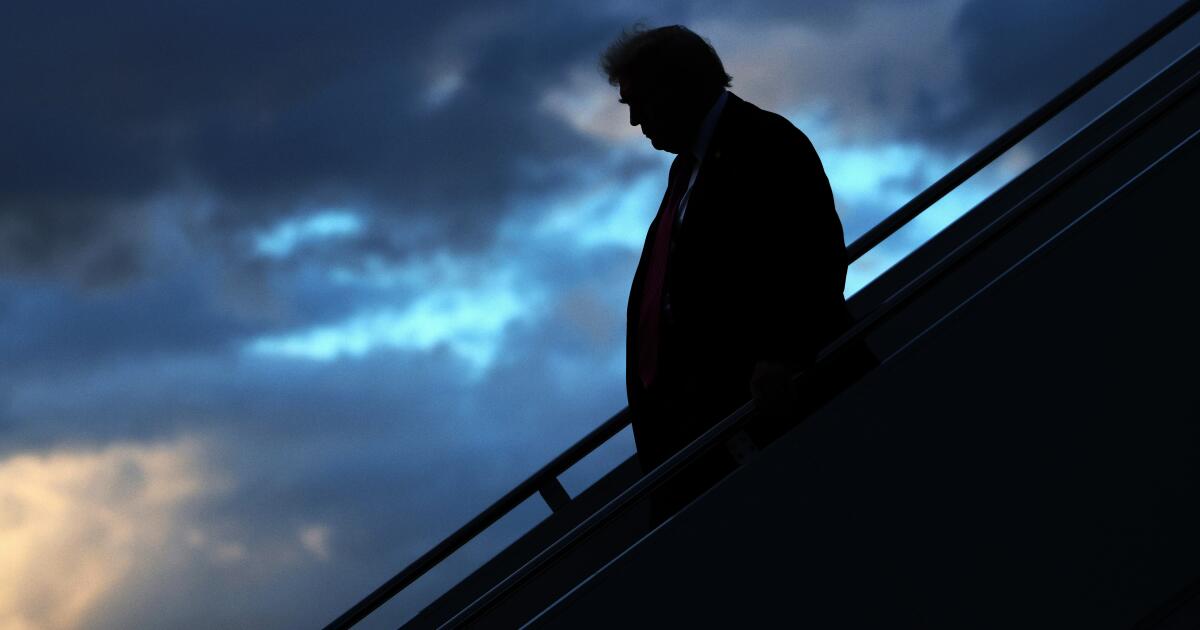
President Trump’s aura of invincibility is starting to vanish. Three new polls — including the usually Trump-hospitable Rasmussen — suggest that Joe Biden did a better job as president.
Worse still (for Trump), he’s underwater on immigration, foreign policy and the economy — the very trifecta that powered his return. An incumbent taking on water like that is no longer steering the ship of state, he’s bobbing in the deep end, reaching for a Mar-a-Lago pool noodle.
To be fair, Democrats have a proud tradition of snatching defeat from the jaws of victory. But suppose — purely hypothetically — that this sticks. Suppose Democrats win the midterms. And suppose a Democrat captures the White House in 2028.
Then what?
Trumpism isn’t a political movement so much as a recurring event. You don’t defeat it; you board up the windows and wait.
Even if Trump does not attempt a third term (a gambit the Constitution frowns upon), he will remain the dominant gravitational force in Republican politics for as long as he is sentient and within Wi-Fi range.
Which means any Democratic administration that follows would be well-advised to consider it is governing on borrowed time. In American politics, you are always one scandal, one recession or one deepfake video away from packing your belongings into a cardboard box.
Trump’s MAGA successor (whoever he or she might be) will inherit millions of ardent believers, now seasoned by experience, backed by tech billionaires and steeped in an authoritarian worldview.
So how exactly does the country “move on” when a sizable slice of its elite class appears to regard liberal democracy as more of an anachronism than a governing philosophy?
This is not an entirely new dilemma. After the Civil War, Americans had to decide whether to reconcile with the rebels or punish them or some mix of the two — and the path chosen by federal leaders shaped the next century through Reconstruction, Jim Crow and the long struggle for civil rights.
At Nuremberg, the Allies opted for trials instead of firing squads. Later, South Africa’s post-apartheid government attempted to achieve reconciliation via truth.
Each moment wrestled with the same problem: How do you impose consequences without becoming the very thing you were fighting in the first place — possibly sparking a never-ending cycle of revenge?
Which brings us to even more specific questions, such as where does Trumpism fit into this historical context — and should there be any accountability after MAGA?
Start with Trump himself. Even if he is legally immune regarding official acts, what about allegations of corruption? Trump and his family have amassed billions since returning to office.
It is difficult to picture a future Democratic administration hauling him into court, especially if Trump grants himself broad pardons and preemptive clemency on his way out of office.
So if accountability comes, it would probably target figures in his orbit — lieutenants, enablers, assorted capos not covered by pardons. But is even this level of accountability wise?
On one hand, it is about incentives and deterrence. If bad actors get to keep the money and their freedom, despite committing crimes, they (and imitators) will absolutely return for an encore.
On the other hand, a Democratic president might reasonably decide that voters would prefer lower grocery bills to more drama.
Trump himself offers a cautionary tale. He devoted enormous energy to retribution, grievance and settling scores. It is at least conceivable that he might have been in stronger political shape had he devoted comparable attention to, say, affordability.
There is also the uncomfortable fact that the past Trump indictments strengthened him politically. Nothing energizes a base like the words “They’re coming for me,” especially when followed by the words “and you’ll be next,” next to a fundraising link. Do Democrats want to create new martyrs and make rank-and-file Americans feel like “deplorables” who are being persecuted for their political beliefs?
So perhaps the answer is surgical. Focus on ringleaders. Spare the small fry. Proceed in sober legal tones. Make it about the law, not the spectacle.
Even this compromise would invite a backlash. Democrats, it seems, are damned if they do and damned if they don’t.
The good news is that smart people are actively debating this topic — far better than trying to improvise a solution on Inauguration Day — just as similar questions were asked after Trump lost in 2020. A few weeks ago, for example, David Brooks and David Frum discussed this topic on Frum’s podcast.
Unfortunately, there is no tidy answer. Too much punishment risks looking like vengeance. Too little risks sparking another sequel.
It may sound melodramatic to say this might be the most important question of our time. But while this republic has endured a lot, it might not survive the extremes of amnesia or revenge.
Choosing the narrow path in between will require something rarer than a landslide victory: justice with restraint.
But do we have what it takes?
Matt K. Lewis is the author of “Filthy Rich Politicians” and “Too Dumb to Fail.”

When is the Undie Run in Detroit?

San Francisco schools chief ripped for ‘crocodile tears’ during strike as her salary and kids’ education revealed

Dallas civil rights leader Juanita Craft’s birthday celebrated at African American Museum

Miami woman accused of pulling knife on supermarket manager after stealing wine

Delta is bringing back direct flights between Boston and Hawaii

Florida High School Football Rankings: Top 25 teams – Oct. 21

Cleary's 21 help Le Moyne down Central Connecticut State 69-64 in OT

How old is Bo Nix? What to know about Oregon quarterback ahead of 2024 NFL Draft

99th annual Pony Swim held in Virginia

Indiana Members Credit Union announced as new anchor tenant at Bottleworks District

Video: Pride Flag Returns to Stonewall, Defying Federal Order

DHS shutdown explained: Who works without pay, what happens to airports and disaster response

More than 5,000 ISIL detainees transferred from Syria, says Iraqi ministry

Second US aircraft carrier is being sent to the Middle East, AP source says, as Iran tensions high

Tim Walz demands federal government ‘pay for what they broke’ after Homan announces Minnesota drawdown
-

 Politics1 week ago
White House says murder rate plummeted to lowest level since 1900 under Trump administration
-

 Alabama6 days ago
Geneva’s Kiera Howell, 16, auditions for ‘American Idol’ season 24
-

 Politics1 week ago
Trump unveils new rendering of sprawling White House ballroom project
-

 San Francisco, CA1 week ago
Exclusive | Super Bowl 2026: Guide to the hottest events, concerts and parties happening in San Francisco
-

 Ohio1 week ago
Ohio town launching treasure hunt for $10K worth of gold, jewelry
-

 Culture1 week ago
Annotating the Judge’s Decision in the Case of Liam Conejo Ramos, a 5-Year-Old Detained by ICE
-

 Culture1 week ago
Is Emily Brontë’s ‘Wuthering Heights’ Actually the Greatest Love Story of All Time?
-

 News1 week ago
The Long Goodbye: A California Couple Self-Deports to Mexico