World
More than 5,000 ISIL detainees transferred from Syria, says Iraqi ministry


Iraq says more than 3,000 Syrians are among the ISIL-linked detainees transferred to one of its prisons by US military.
More than 5,000 ISIL-linked (ISIS) detainees have been transferred from Syrian jails to a prison in neighbouring Iraq so far, according to Iraq’s Ministry of Justice.
In comments to the Iraqi News Agency on Friday, ministry spokesperson Ahmed Laibi said the transfers and ongoing detention of the prisoners had been carried out at the request of an international coalition led by the United States to combat ISIL, of which Iraq is a key member.
Recommended Stories
list of 4 itemsend of list
In separate comments on the sidelines of the Munich Security Conference, Iraqi Foreign Minister Fuad Hussein gave a lower figure, telling Reuters that about 3,000 ISIL-linked detainees had been transferred.
He told the news agency that the process was ongoing and that Baghdad was in discussions with various countries about repatriating their nationals who had been transferred.
Iraq would need more financial assistance to deal with the intake, he said, adding that there had been a recent uptick in ISIL activity in Syria.
The US military has been transporting thousands of ISIL-linked prisoners from jails and detention centres previously run by the Kurdish-led Syrian Democratic Forces (SDF) in northeast Syria.
The transfers have come as control of the prisons has been handed over to the Syrian government, amid a push by Damascus to assert its authority over the full extent of a country still fragmented in the wake of a brutal war.
Deadly clashes with SDF forces broke out amid the Syrian army’s advance in recent weeks, including in and around key prison sites, resulting in some ISIL detainees escaping and raising fears the armed group could exploit any security vacuum to regroup.
A ceasefire has since been struck between the government and the SDF.
Detainees mostly Syrian nationals
Laibi, the Iraqi Justice Ministry spokesperson, said that of the 5,064 ISIL detainees transferred so far, more than 3,000 were Syrian, while at least 270 were Iraqi.
He said the detainees were being held in a single prison, in a section separated from other prisoners.
The detainees would all be investigated and prosecuted under Iraqi law, he said, while the responsibility for feeding the thousands of detainees was being handled by the international coalition, rather than Iraq.
Last month, lawyers for a group of French ISIL suspects who had been transported by the US military from Syria to Iraqi prisons in an earlier series of transfers claimed the inmates had been subjected to “torture and inhumane treatment” there.
Damascus becomes US’s main anti-ISIL partner
The US military has previously said up to 7,000 people with alleged ISIL links could be transferred to Iraqi-controlled facilities.
US Admiral Brad Cooper, the head of US forces in the Middle East, said last month that facilitating the secure transfer of detainees was critical to preventing mass breakouts that could pose a direct threat to the US and regional security.
The statement came shortly after the US special envoy to Syria said that Washington’s main partner against ISIL in Syria would be the Syrian government, rather than the SDF, which had held that position for years.
The shift followed Syria – under new President Ahmed al-Sharaa, the former leader of the armed group Hayat Tahrir al-Sham, who was once deemed a “Specially Designated Global Terrorist” by the US – joining the anti-ISIL coalition in November.
US departs Syrian base
The ongoing transfers of the detainees from Syria have come as the US military reduces its presence in the country, where it has conducted operations against ISIL for years.
On Thursday, Syrian forces announced they had taken control of the al-Tanf military base, a strategic garrison near the border with Iraq and Jordan, following the withdrawal of US forces.
Cooper, the commander of US forces in the Middle East, said the departure was “part of a deliberate and conditions-based transition”, and that US forces remained “poised to respond to any [ISIL] threats that arise in the region as we support partner-led efforts” to prevent the group’s resurgence.
While ISIL was largely defeated in 2017 in Iraq and in Syria two years later, sleeper cells still carry out attacks in both countries.



World
State Department congratulates Keiko Fujimori as Peru’s president-elect following razor-thin vote count

NEWYou can now listen to Fox News articles!
The State Department on Tuesday congratulated conservative candidate Keiko Fujimori after she was declared the winner of Peru’s presidential runoff election by a razor-thin margin.
The statement marked a significant milestone in Latin American relations, with Washington signaling it expects to work closely with Fujimori’s administration on shared priorities.
“The United States congratulates President-Elect Keiko Fujimori of Peru on her important electoral victory,” the department said.
“The Trump Administration looks forward to deepening collaboration with the Fujimori Administration to advance security cooperation and to strengthen bilateral cooperation on investment and trade in our region.”
TRUMP ADMIN WARNS PERU IT COULD LOSE SOVEREIGNTY AS CHINA TIGHTENS GRIP ON NATION
Peru’s presidential candidate for the Fuerza Popular party, Keiko Fujimori, waves to supporters during a closing campaign rally in Lima on June 4, 2026. (Anthony Nino de Guzman/AFP)
Her victory comes as Washington seeks to strengthen ties with pro-market allies in Latin America amid growing Chinese economic influence in the region.
Beijing recently completed the Chancay deepwater port in Peru — a $1.3 billion mega-project that serves as China’s key logistics hub on the Pacific coast.
Fujimori’s tough stance on organized crime also aligns with U.S. efforts to expand regional security and anti-trafficking cooperation.
BIDEN, XI TO MEET ON SATURDAY IN PERU, US OFFICIALS SAY
Secretary of State Marco Rubio looks on during a ceremony at the U.S. embassy in New Delhi on May 23, 2026. (Julia Demaree Nikhinson/AFP)
Fujimori was declared the winner Monday by Peru’s National Office of Electoral Processes (ONPE), the electoral authority responsible for reporting vote count results. The country’s final authority on election matters, the National Jury of Elections (JNE), has yet to issue its official proclamation, according to Reuters.
According to the ONPE, Fujimori secured 50.1% of the vote, winning by fewer than 50,000 votes out of roughly 18 million ballots cast.
Her victory over leftist challenger Roberto Sánchez marks her fourth presidential bid and makes her Peru’s first female president-elect.
The result caps a deeply divisive election cycle in a country that has gone through nine presidents in the past decade.
Fujimori is also the daughter of former Peruvian President Alberto Fujimori, who ruled the country during the 1990s.
TRUMP VICTORY BOOSTS CONSERVATIVES IN LATIN AMERICA, WAKE-UP CALL TO DICTATORS: ‘THERE WILL BE CONSEQUENCES’
Former Peruvian President Alberto Fujimori waves outside his home in Santiago, Chile, on May 18, 2006. (Claudio Santana/AP Photo)
Fujimori’s presidency marks a return of her family’s political brand to Peru’s highest office — a movement that has long carried a complicated relationship with the United States.
While Washington once backed her father for his fight against communist guerrillas and economic reforms in the 1990s, the U.S. later condemned his government over the dismantling of democratic institutions and allegations of human rights abuses.
Keiko Fujimori has since spent more than two decades attempting to reshape “Fujimorismo” into a modern conservative, law-and-order political movement.
CLICK HERE TO DOWNLOAD THE FOX NEWS APP
Peruvians voted in favor of Fujimori amid a surge in violent crime, extortion and years of political instability.
Fujimori campaigned on an “iron fist” approach to security and a pledge to protect Peru’s free-market economy, while her opponent focused on rural economic grievances.
Reuters contributed to this report.

Gas imports from Russia into the European Union increased during the first months of 2026, a new report has revealed, even as the bloc formally begins a historic withdrawal from Russian natural gas.
ADVERTISEMENT

ADVERTISEMENT
The EU banned Russian liquefied natural gas (LNG) from entering the bloc by the beginning of 2027 and mid-2027, albeit with exceptions for Hungary and Slovakia, which were allowed to tap Moscow’s gas in case of supply disruption given their landlocked position.
Yet according to the report from the EU’s agency of energy regulators (ACER), which was published on Wednesday, Russian gas imports have increased rather than declined during the reporting period, with pipeline imports rising 7 percent year-on-year compared to 2025 and LNG imports growing by 11 percent.
LNG imports accelerated further after the ban took effect in March, rising 17 percent against the same period in 2025.
The new release is ACER’s first monitoring report since the law was adopted in March. The agency attributed a rise in imports to companies accelerating deliveries under existing contracts before stricter prohibitions take effect, rather than to a reversal of EU rules.
“LNG authorised contracts for deliveries into the EU account for 20 to 32 billion cubic metres (bcm), entering the EU at the external borders of four member states: Spain, France, Belgium and the Netherlands. In turn, long-term contracts for Russian pipeline gas remain authorised in Hungary, Slovakia and Greece,” reads the report.
New Russian gas contracts have effectively been prohibited since March 2026, while older long-term agreements are being allowed to expire gradually through 2027 to avoid market disruption.
For now, authorised contracts still represent between 45 and 55 bcm of annual supply capacity, ACER said, down from the 150-157 bcm that Moscow used to export to the EU prior to the war in Ukraine.
Not a sanctions failure
ACER argues that this trend does not indicate a growing dependence on Russia, and nor does it mean that the bloc’s sanctions against Russia are failing.
Instead, importers appear to be maximising deliveries before future restrictions and responding to global supply uncertainty after disruptions caused by the war between Israel, the US and Iran affected Middle Eastern LNG trade.
The ban on transhipments of Russian LNG via the EU to other destinations also seems to have contributed, the energy regulators argue, as some of the Russian LNG that had previously been transshipped at selected EU ports until March 2025 may have remained within the EU market.
Ronald Pinto, an LNG analyst at the market intelligence firm Kpler, endorsed ACER’s assessment, noting that Russian LNG imports into the EU reached record highs in both April and May.
“Faced with disruptions to global LNG supply, European market participants relied on other available sources of LNG, likely making full use of the flexibility available within their existing contractual volumes,” Pinto told Euronews.
However, Pinto also pointed out a slight year-on-year decline in Russian pipeline imports into the EU following maintenance in early June, suggesting a commercial reaction to the 17 June deadline banning imports of Russian pipeline gas under short-term contracts.
“This could indicate that market participants are beginning to reduce their exposure in light of the phase-out regulation,” the analyst said.
Remaining dependencies
While Russian gas now accounts for roughly 12 percent of EU gas demand, ACER says that dependence is no longer evenly spread across Europe.
Most EU countries have sharply reduced purchases since Russia’s invasion of Ukraine, except for Hungary, Slovakia and Greece.
These countries, particularly Hungary and Slovakia, continue to receive Russian pipeline gas primarily through the TurkStream corridor and face the greatest challenge in replacing supplies before the 2027 deadline.
“In 2024, Hungary and Slovakia are estimated to source approximately 70–80 percent of their gas from Russia, while Russian gas is deemed representing approximately 50-55 percent of Greek gas imports,” reads the report.
The principal remaining challenge is not overall gas availability, ACEA said, but ensuring sufficient infrastructure to deliver alternative supplies into landlocked Central European markets.
“The remaining dependence on Russian gas remains unevenly distributed across member states; while most countries have significantly reduced their exposure, a small number of countries continue,” reads ACER’s report.
Diversification and new challenges
ACER concludes that Europe is significantly better prepared than during the 2022 energy crisis due to profound diversification in the gas market.
However, such diversification comes at a new cost, as the bloc has developed new dependencies, particularly with the US, Algeria, and Qatar, the latter having suffered a loss in production due to the war against Iran.
These countries are currently pressuring the EU to scrap its methane rules, which would require oil and gas producers to pay for the pollution linked to their production, with the US suggesting that the EU could lose imports.
“If things (methane rules) stay as they are today, they’re almost certain to reduce the energy flows from the United States to Europe,” US Energy Secretary Chris Wright said at a press briefing on 25 June. “I think this leads to very significant problems in the EU, which already suffers from much higher than global average energy prices.”
The EU is also counting on more gas from planned Romanian Black Sea production and increasing imports through Azerbaijan’s Southern Gas Corridor.
Overall, ACER concludes that the real economic consequences of ditching Russian gas have yet to arrive, pointing instead to the complete ban on LNG imports from January 2027 and the end of pipeline imports in September 2027 as the real tests.

Note: Map shows the area with a shake intensity of 3 or greater, which U.S.G.S. defines as “weak,” though the earthquake may be felt outside the areas shown. The New York Times
A strong, 6.0-magnitude earthquake struck in the Gulf of California on Tuesday, according to the United States Geological Survey.
The temblor happened at 1:45 p.m. Mountain time about 47 miles southwest of El Progreso, Mexico, data from the agency shows.
As seismologists review available data, they may revise the earthquake’s reported magnitude. Additional information collected about the earthquake may also prompt U.S.G.S. scientists to update the shake-severity map.
Subsequent quakes have been reported in the same area. Such temblors are typically aftershocks caused by minor adjustments along the portion of a fault that slipped at the time of the initial earthquake.
Aftershocks detected
Quakes and aftershocks within 100 miles
Aftershocks can occur days, weeks or even years after the first earthquake. These events can be of equal or larger magnitude to the initial earthquake, and they can continue to affect already damaged locations.
The New York Times
When quakes and aftershocks occurred
Sources: United States Geological Survey (epicenter, aftershocks, shake intensity); LandScan via Oak Ridge National Laboratory (population density) | Notes: Shaking categories are based on the Modified Mercalli Intensity scale. When aftershock data is available, the corresponding maps and charts include earthquakes within 100 miles and seven days of the initial quake. All times above are Mountain time. Shake data is as of Tuesday, June 30 at 2:02 p.m. Mountain time. Aftershocks data is as of Tuesday, June 30 at 6:01 p.m. Mountain time.
-
Education36 seconds ago
This Little Robot Cleans Windows
-

 Technology6 minutes ago
Comcast’s split could make or break Peacock
-

 World13 minutes ago
State Department congratulates Keiko Fujimori as Peru’s president-elect following razor-thin vote count
-

 Politics15 minutes ago
Mamdani ripped for claiming victory over capitalism after NYC’s multi-billion dollar taxpayer funded bailout
-

 Health21 minutes ago
American vaccines that transformed public health over 250 years: ‘Outweighs harm’
-

 Sports28 minutes ago
Ex-NFL reporter Dianna Russini interaction with police officer to dodge traffic ticket comes to light
-
 Business36 minutes ago
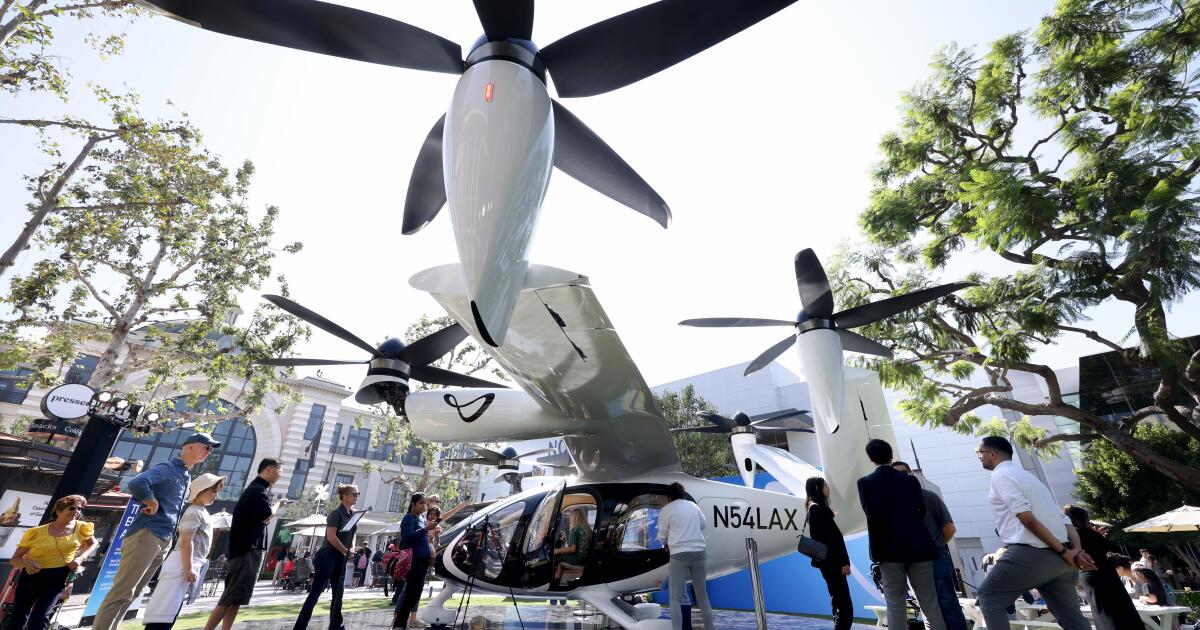
Joby Aviation creates a joint venture with Toyota to build air taxis
-
 Entertainment43 minutes ago
Inside Eddie Huang’s sadboi era and turning a new page with his novel

