Politics
Column: Aaron Rodgers and Donald Trump both represent a dangerous war on accountability

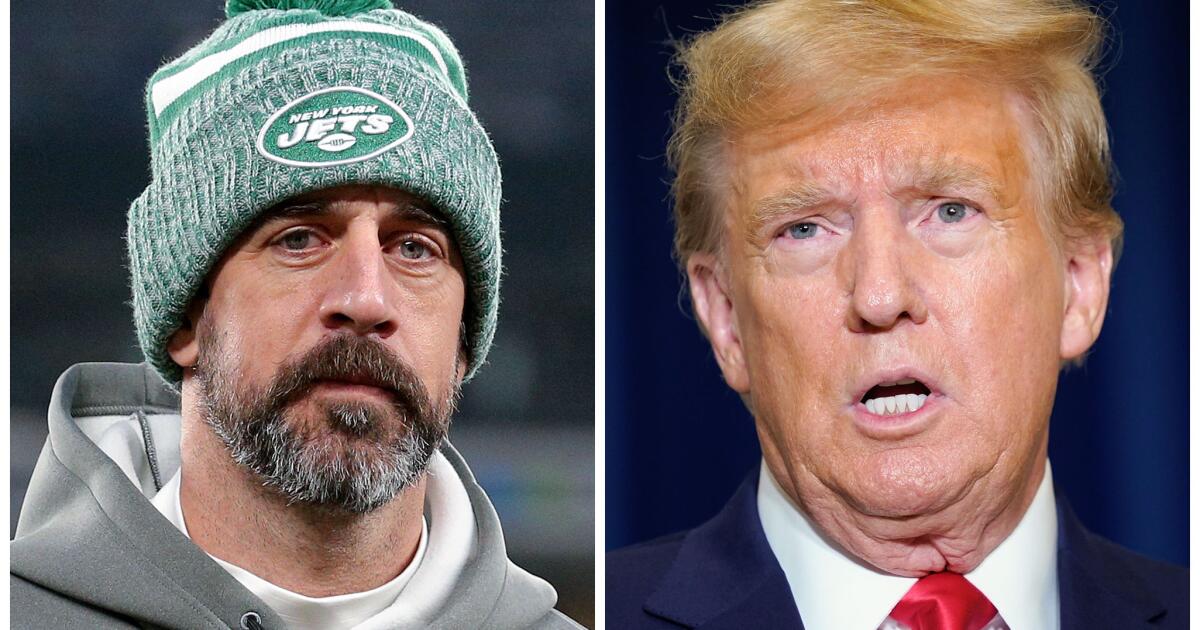
The battle for accountability in a culture of impunity — one in which reality increasingly plays second fiddle to conspiracy theories and disinformation — heated up Tuesday when a football star doubled down on his baseless claims about a late-night host and a federal appeals court judge scrutinized a former president’s claim of immunity from prosecution for his role in a violent insurrection.
It’s not a stretch to mention in the same breath New York Jets quarterback Aaron Rodgers, who has asserted without evidence that Jimmy Kimmel was associated with the late sex offender Jeffrey Epstein, and Donald Trump, who pushed the unfounded narrative that he is immune from criminal charges related to efforts to overturn the 2020 election, a campaign that was itself based on lies. After all, neither of these men have facts on their side. They simply have public platforms, colorful stories and a victim complex — all key ingredients in the art of ignoring the facts to amass a following.
If the first couple weeks of 2024 were turned into a period drama, it’d be called “Lies and Culpability” and it’d be a Shakespearean tragedy, not a Jane Austen romance. The country’s relationship with the truth, or even reasonable doubt, is so eroded that anything is now plausible: The Jan. 6 Capitol attack was a “fedsurrection,” an inside job by the FBI. The folksy site Etsy is really a hub for child pornography, evidenced by photos of — wait for it — pizza. Vice President Kamala Harris breathes through gills (I did not make this up).
Such ludicrous tall tales are easy to laugh at, and dismiss. Less entertaining is a poll released last week showing that a third of the country believes President Biden’s election was illegitimate despite ample evidence to the contrary. Not to mention dangerous fictions spread daily about Jews, Muslims, Asians, transgender people and other groups, provoking increased hate and violence against them as a result.
Which is why the fight for accountability now raging in the courts, and the court of public opinion, is so vital and at times worrying — because it’s unclear who is winning from week to week, hour to hour.
Rodgers is an excellent example of the backslide. In a Jan. 2 appearance on ESPN’s “The Pat McAfee Show,” the conspiracy-minded athlete steered the conversation into a perennial favorite of the QAnon crowd, pedophilia and Epstein. Rodgers said that many high-profile folks were nervous about the unsealing of Epstein’s client list.
“There’s a lot of people, including Jimmy Kimmel, really hoping that doesn’t come out.” His reckless comments drew a swift response from Kimmel on social media, and on Monday, Kimmel dedicated the opening monologue of his late-night show, “Jimmy Kimmel Live!,” to rebutting Rodgers.
“I don’t know Jeffrey Epstein. I’ve never met Jeffrey Epstein,” Kimmel said. “I’m not on a list. I was not on a plane or an island or anything ever, and I suggested that if Aaron wanted to make false and very damaging statements like that, we should do it in court so he can share his proof with, like, a judge.”
But Rodgers appeared unfazed Tuesday on “The Pat McAfee Show” when he doubled down on the Epstein connection in his response to Kimmel’s monologue. “I’m not stupid enough … to accuse you of that with absolutely zero evidence, concrete evidence,” Rodgers said. Yet he produced no proof; his evidence, it appears, is somewhere in the same make-believe vault as Trump’s stolen votes.
The quarterback said he would like to put the issue “to bed, to move forward,” then blamed the media for trying to “cancel” him … the very same media he’s using to discredit Kimmel.
Hours earlier, Trump made a personal appearance in court with his legal team, who sought to convince a panel of judges that former presidents should not be prosecuted for actions taken in office.
Judge Florence Pan was skeptical of the argument. “You’re saying a president could sell pardons, could sell military secrets, could tell SEAL Team Six to assassinate a political rival?” she asked. Trump lawyer John Sauer answered that a former president could be charged only if first impeached by the House of Representatives and convicted in the Senate. After the hearing, Trump warned of “bedlam” should the trial proceed.
The threat of violence was underpinned by a confidence that he’ll win this battle, too. And maybe he will since accountability is such a unicorn in politics and the tribalism of a divided country. It’s not just Trump and his allies, like Rep. Elise Stefanik, who have cultivated an impressive impermeability to the facts (they recently referred to the federal criminal defendants incarcerated in connection with the Jan. 6 attack as “hostages” of the judicial system). It’s a large swath of our fellow Americans.
But accountability is still possible within the law: Dominion Voting Systems won nearly $787 million in a settlement with Fox News Channel and the Fox Corp. in a defamation lawsuit alleging that Fox broadcast false information that Dominion’s voting machines were rigged to tip the election in Biden’s favor. And three years after the Capitol attack, hundreds have been convicted.
Trump’s legal team and his allies have not had the same success in court they have had on social media. The pitched battle to fight off politically engineered untruths and wild conspiracies is frightening, but these legal victories mean that those who care about truth and accountability need to keep up the fight.



Politics
New Jersey Gov Sherrill signs law barring ICE agents from wearing face coverings to shield identities

NEWYou can now listen to Fox News articles!
New Jersey Gov. Mikie Sherrill, a Democrat, signed legislation on Wednesday to limit the use of face coverings for law enforcement, including federal ICE agents,
The law, which requires officers to present identification before detaining someone, comes as some federal agents have sought to hide their identities during immigration raids in communities across the country.
Sherrill, who was sworn into office in January, said the mask restriction is part of an effort to ensure the safety of residents of the Garden State.
“I can’t believe we have to say this, but in the United States of America, we’re not going to tolerate masked roving militias pretending, pretending to be well-trained law enforcement agents,” she said.
NEW JERSEY GOVERNOR TO LAUNCH PORTAL FOR UPLOADING VIDEOS OF ICE TACTICS: ‘THEY HAVE NOT BEEN FORTHCOMING’
New Jersey Gov. Mikie Sherrill signed legislation limiting face coverings for ICE agents. (Michael Nagle/Bloomberg via Getty Images)
The law is part of a package that the governor said will “protect people’s privacy and their rights” and “strengthen trust between law enforcement and our communities.”
Democrats in Congress and in various state legislatures have sought for months to adopt measures that would ban immigration agents from wearing masks to hide their identities, arguing that such legislation is needed to ensure transparency.
Washington Gov. Bob Ferguson, a Democrat, also signed a law earlier this month limiting face coverings for ICE agents.
The Department of Homeland Security has criticized efforts to unmask ICE agents, including calling the new Washington state measure “irresponsible, reckless and dangerous.”
BOSTON’S WU ORDERS RELEASE OF ICE SURVEILLANCE AND BODY CAM FOOTAGE, SAYS FED GOVERNMENT ‘HIDES BEHIND MASKS’
The measure requires officers to present identification before detaining someone. (Eduardo Munoz Alvarez/Getty Images)
“To be crystal clear: we will not abide by this unconstitutional ban,” the department said at the time.
Sherrill’s signature on Wednesday comes as she continues to target the Trump administration’s immigration raids. Earlier this year, she announced a portal to allow residents to upload photos and videos of ICE agents conducting immigration operations.
“If you see an ICE agent in the street, get your phone out, we want to know,” Sherrill said at the time. “They have not been forthcoming. They will pick people up, they will not tell us who they are, they will not tell us if they’re here legally, they won’t check. They’ll pick up American citizens. They picked up a five-year-old child. We want documentation, and we are going to make sure we get it.”
The U.S. Department of Homeland Security has criticized efforts to unmask ICE agents. (Stephen Maturen/Getty Images)
CLICK HERE TO DOWNLOAD THE FOX NEWS APP
“We saw people in the street with masks and no insignia. So not accountable at all, hiding from the population — and we saw again and again an undermining of what law enforcement should do to keep people safe,” she added.
The Trump administration is also suing New Jersey over Sherrill’s executive order last month that prohibits federal immigration agents from making arrests in nonpublic areas of state property, including correctional facilities and courthouses. The order also blocks the use of state property as a staging or processing area for immigration enforcement.
The Associated Press contributed to this report.

REDDING — At a Board of Supervisors meeting in rural Shasta County last month, Clint Curtis dropped a bombshell: A sheriff way down in Riverside was going to confiscate all the ballots from a recent election.
Curtis, the county registrar of voters, was the first to announce the planned ballot seizure. Even the sheriff himself, Chad Bianco, had not publicly revealed his intentions.
Later, as Bianco’s move grabbed headlines — he is a leading Republican candidate for governor — Curtis’ behind-the-scenes maneuvering remained largely unknown. The registrar had worked with the Riverside County citizens group whose fraud allegations had sparked Bianco’s investigation, even traveling 600 miles south to speak on their behalf.
Shasta County Clerk and Registrar of Voters Clint Curtis poses last month in the new election observation room at the elections office in Redding.
In his short time in Shasta County, Curtis, whose claims about rigged voting machines stretch back to the early 2000s, has solidified his position as a torchbearer of the election denialism movement, vowing to take his message about untrustworthy machines and potential fraud across California and beyond.
Critics here say he has steadily disenfranchised voters. He has eliminated nine of the vast county’s 13 ballot drop boxes, telling The Times he did not trust ballots in the hands of “little old ladies running all over” to collect them. And he has advocated for a local ballot initiative that would limit elections to one day, eliminate most voting by mail and require voter ID as well as a hand count of ballots.
Curtis also has accused his predecessors in the registrar’s office, without evidence, of election fraud and has called for federal authorities to raid the office he now runs.
“Do I think ballots were stuffed? Yes. Have I contacted the DOJ? Yes,” Curtis said at the Feb. 24 Shasta County supervisors’ meeting just before announcing Bianco’s planned ballot seizure.
Curtis, a 67-year-old attorney, was appointed by the Shasta County supervisors last April. He lived in Florida then, had no previous ties to the area and had never run an election.
He got the job based largely on two stated qualifications: He wanted to hand-count votes. And he had worked with Mike Lindell, the MyPillow chief executive and pro-Trump conspiracy theorist.
In his public job interview, Curtis promised to grill local elections staffers to “find out what they know.”
Now Curtis is running for election himself, trying to keep his job in this Northern California county where a majority of the supervisors were so swept up in President Trump’s discredited election fraud claims that they ditched their Dominion voting machines in 2023 and opted to hand-count ballots (quickly prompting a new state law that banned them from doing so).

-
Share via
Curtis says he is running to make elections more transparent by questioning the status quo and hanging cameras everywhere to capture election workers’ every move.
“Republicans love me,” Curtis told The Times. “The Democrats are pretty good. And then I have these crazy socialist people that just hate me.”
Beliefs aside, Curtis has quickly become a colorful local character.
He took a lie detector test to attest that he didn’t rig the November election. He chose as his number two a heavy metal guitarist from San Francisco — stage name “Turmoil” — who is a progressive Democrat.
And last September, surveillance cameras captured him pushing an antique metal safe through the Shasta County elections office on a Saturday while his wife assisted with a pulling harness. Curtis wore blue jeans — and no shirt.
He said he moved the safe, which contained odds and ends, on a hot day to make more room for election observers.
Curtis first gained national attention for election skepticism in December 2004, in testimony before Congress.
He had been working as a computer programmer in Florida and was brought in as an expert witness by Democrats on the House Judiciary Committee, who were reeling over President George W. Bush’s defeat of John Kerry a few weeks earlier and furious about an error with an electronic voting machine that gave Bush extra votes in Ohio.
Curtis claimed that he had written “a prototype” of software that would allow cheaters to alter votes using “invisible buttons” on touch-screen balloting machines. His claims were largely dismissed. But he continues to tout his congressional testimony to cast himself as an expert on election malfeasance.

A woman passes by a “Greetings From Redding” mural on Feb. 25.
After testifying, he unsuccessfully ran for office multiple times in Florida. He refused to concede after one loss, alleging the machines were rigged.
In Shasta County, he saw a chance for redemption.
During the COVID-19 pandemic, the Board of Supervisors gained a hard-right majority supported by anti-vaxxers, secessionists, members of a local militia and pro-Trump election deniers.
In 2022, someone hung a trail camera — the kind hunters use to track wildlife — behind the elections office to monitor the staff. Some observers yelled at staffers and got in the face of Cathy Darling Allen, the longtime registrar, who installed a 7-foot metal fence to keep them at bay.

Joanna Francescut, who worked in the elections office for 17 years, is running to be county registrar.
Darling Allen clashed with the supervisors as they pushed to hand-count votes, a process she argued would be slow, expensive and prone to error. She retired in 2024, citing health reasons.
Her successor resigned after less than a year. The supervisors appointed Curtis in a 3-2 vote, passing over Joanna Francescut, who had worked in the elections office since 2008 and was Darling Allen’s number two.
Days later, Curtis fired Francescut. She is now running against him in the June 2 election.
David Becker, executive director of the Center for Election Innovation & Research and a former senior trial attorney overseeing voting enforcement for the U.S. Department of Justice’s Civil Rights Division, called Curtis a “nationally known conspiracy theorist.”
“I can’t imagine bringing in someone who is neither an election administrator nor a Californian for a job like that and basically chasing out experienced election officials whose work had withstood scrutiny for decades,” Becker said. “The voters of Shasta County, unfortunately, are paying the price.”
Curtis has accused Francescut and other elections staffers of stuffing ballots to sabotage conservative Republicans.
“I want to laugh because it’s that ridiculous,” Francescut, 43, said of the allegations.
“People that work in this field, they’re doing this work because they care about elections,” she said. “They want the community to be better. They want what both sides want — transparent and accurate elections.”
During her 17-year tenure, the elections office got little public attention. But “once 2020 hit, people went from completely trusting us to, the day after election day, calling and yelling at our staff so much that we couldn’t get the work done to count ballots,” she said.
Curtis was a favorite of then-board chairman Kevin Crye, a hard-right supervisor who enlisted Lindell to support the county’s crusade against Dominion. Crye had survived a 2024 recall effort by just 50 votes.
1

2

1. Carl Bott, co-owner of KCNR 96.5 FM, interviews Joanna Francescut last month. 2. Joanna Francescut’s campaign manager, Mary Williams, wears an orange button as Francescut waits in the offices of talk radio station KCNR. (Jason Armond / Los Angeles Times)
Citing that close margin, Curtis said he believed recent elections were rigged because Republicans were not winning by large enough margins in a county where registered Republicans greatly outnumber Democrats.
In a letter to the U.S. Justice Department, Curtis said he had learned of lax security and potential ballot stuffing in 2024, the year of the attempted recall against Crye. Curtis sent a copy of the letter to Trump and requested a federal investigation because “the destruction of these ballots is nearing.”
In 2019 and 2024, a Shasta County grand jury investigated local election procedures and found no wrongdoing.
“How does it make me feel? Really angry,” Darling Allen, who is advising Francescut’s campaign, said of Curtis’ allegations. “It calls into question the integrity and character of every single person who worked in the elections department.”
To replace Francescut, Curtis hired Brent Turner, the guitarist from San Francisco. He is a longtime election reform activist who has pushed for nonproprietary open-source voting systems with software code that can be examined by anyone.
Turner described their partnership as: “Republican and Democrat team up to fight outdated software for elections. Oh, my!”
“We have to have the adult conversation in the United States that if the systems are loose enough to allow people — in this case, we’re talking about even people internal to the system — to cheat, they might cheat,” Turner said.
Last October, Secretary of State Shirley Weber wrote to Curtis, asking him to detail planned changes to voting procedures. He responded with a 15-page letter.
Election observers, he wrote, were “treated like invaders … corralled behind spiked fences.” And drivers who picked up ballots from drop boxes sometimes left them in their vehicles. Under his watch, he wrote, “no detours or even bathroom breaks are allowed.”

A woman exits the Cottonwood Post Office in Shasta County.
Curtis told Weber that someone had carved death threats on his vehicle and left “antifa” business cards on his windshield wipers.
Weber’s communications team said in an email that her office “continues to monitor new election processes proposed by Shasta (or any county) County to ensure they do not violate state law.”
In his letter to Weber, Curtis promised to take a lie detector test after each election. Answering pre-written questions he had submitted, Curtis said in a January polygraph test that he did not change the results of the November election and believed a predecessor had rigged previous contests, according to a summary obtained by The Times.
The examiner wrote that he “was likely telling the truth.”
Inside the elections office, Curtis created a large room, decked out with American flags, for citizens to observe the vote-counting process.
More than a dozen large TV monitors display close-up video, also streamed online, of election workers’ hands inserting ballots into machines. On June 2, those workers will sit beneath iPhones hung overhead to record them while observers are positioned on barstools a few inches behind them.

The new public observation room at the Shasta County elections office is decorated with American flags.
Curtis has been traveling across California to tout his methods. He told The Times he has spoken about his video setup in Kern and San Joaquin counties and discussed it with candidates for state office.
And he advised the Riverside County citizens group that claimed to have found an overcount of 45,896 ballots in the November election for Proposition 50, which redrew the state’s congressional districts to favor Democrats.
Art Tinoco, the Riverside County registrar of voters, has refuted that number — saying it was based on a misunderstanding of raw data that had not been fully processed.
After Bianco last week announced that his office had seized more than 650,000 ballots, Curtis appeared on the social media broadcast of a right-wing election integrity advocate who called him “the stealth behind the scenes in making that happen.”
Curtis smiled and repeated what he has been espousing since the early 2000s: “You can’t really trust a computer.”
Politics
White House unleashes on Raskin for clinging to ‘deranged’ Jack Smith ‘lies’ in latest Trump docs flare-up

NEWYou can now listen to Fox News articles!
A new clash erupted Wednesday over records from the dismissed Trump classified documents case after Rep. Jamie Raskin accused the Department of Justice of improperly turning over sensitive material to Congress, drawing sharp rebukes from the White House and DOJ.
“Democrats with zero credibility like Jamie Raskin are still clinging to deranged Jack Smith and his lies in 2026,” White House spokeswoman Abigail Jackson told Fox News Digital when asked about Raskin’s claims.
Raskin, the top Democrat on the House Judiciary Committee, sent a letter on March 24 to Attorney General Pam Bondi alleging that the DOJ may have inadvertently sent his panel previously undisclosed materials showing Trump retained sensitive classified documents tied to his business interests and may have exposed them to others after his first administration.
Trump has denied any wrongdoing in the classified documents case for years, including when FBI agents searched Mar-a-Lago in 2022 for materials he allegedly retained following his exit from the Oval Office, and when then-special counsel Jack Smith brought an indictment against him in 2023 accusing him of willfully retaining national defense information and obstructing efforts to recover it.
JACK SMITH FACES PUBLIC GRILLING ON CAPITOL HILL ABOUT TRUMP PROSECUTIONS
Rep. Jamie Raskin takes a question from a reporter as he introduces legislation at the U.S. Capitol Building on May 8, 2025, in Washington, D.C. (Andrew Harnik/Getty Images)
Raskin accused the DOJ of violating a court order requiring parts of the classified documents case to remain under seal, including Smith’s final report, which Democrats have long demanded the DOJ hand over to Congress.
Raskin’s letter quickly drew pushback from the White House, which called it “pathetic” and pointed out that Smith was forced to drop his case against Trump when he won the 2024 election.
Judge Aileen Cannon, a Trump appointee who presided over the case, had tossed it out in July 2024 after finding Smith’s appointment by Attorney General Merrick Garland was unconstitutional. Smith was appealing her decision but withdrew his appeal after Trump’s victory, citing a DOJ policy that discourages prosecuting sitting presidents.
“President Trump did nothing wrong, which is why he easily defeated the Biden DOJ’s unprecedented lawfare campaign against him and then won nearly 80 million votes in a landslide election victory,” Jackson continued in her statement.
A DOJ spokesperson said Raskin was “blinded by hatred” of Trump and that the DOJ has been the “most transparent in history.” The spokesperson said the accusations leveled by Raskin were “baseless” and also refuted Raskin’s claims that the DOJ violated a court order by releasing the material to Raskin’s committee.
“Judge Cannon’s protective order was not violated, and none of the documents produced by DOJ violated 6e [grand jury rules] as none of them disclosed matters occurring before a grand jury,” the spokesperson said. “The documents marked ‘6e’ contained redactions of any 6e material. As an attorney and law professor, one must assume Raskin understands this, and thus, reveals this letter is nothing more than a cheap political stunt almost as if taking cues from members of the corrupt Jack Smith prosecution team.”
House Judiciary Committee Republicans said in a statement Raskin’s letter was another example of “manufactured outrage from the left.”
“Once again, Democrats are more focused on targeting President Trump than working with Republicans to put America first,” a committee spokesperson said.
JACK SMITH DENIES POLITICS PLAYED ANY ROLE IN TRUMP PROSECUTIONS AT HOUSE HEARING
Aileen Cannon, the Florida judge overseeing former President Donald Trump’s case in an interview. (REUTERS)
In his letter, Raskin alleged that the materials his committee received from DOJ showed that some classified documents in Trump’s possession were so sensitive that only six government officials had access to them and that Trump may have retained materials connected to his business dealings to enrich himself. The Maryland Democrat also cited a memorandum indicating Trump “may have shown” a classified map to individuals while on a private plane.
Raskin also accused the DOJ of cherry-picking information about the case to release to Congress while continuing to withhold other information, including the second volume of Smith’s final special counsel report. Cannon had ordered that portion of Smith’s report to remain permanently sealed, though her order is being appealed.
DEMOCRATS RAMP UP CALLS TO RELEASE JACK SMITH’S SPECIAL COUNSEL REPORT ON TRUMP CLASSIFIED DOCUMENTS CASE
This image, contained in an indictment against Donald Trump, shows boxes of records stored in a bathroom and shower in the Lake Room at Trump’s Mar-a-Lago estate in Palm Beach, Fla. (Justice Department via AP)
The sealed report has become a top focus for Democrats as no final reports produced by DOJ special counsels have been kept from the public before Smith’s. Democrats have claimed the report could shed new light on the case, while Republicans have argued the investigation was politically motivated, that the report is too prejudiced against Trump and that any disclosures at this stage must comply with Cannon’s order.
A spokesperson for committee Democrats accused the DOJ of doing “legal gymnastics” to prevent the release of Smith’s report, accusing the department of wanting to “advance his corrupt business interests.”
In August 2022, the FBI carried out a controversial search in which they seized 33 boxes from Trump’s Mar-a-Lago estate, which included agents scouring Melania Trump’s wardrobe, Trump has previously said. Prosecutors defended the search in court, saying Trump withheld some boxes when they sought his voluntary compliance, leading them to resort to a search warrant.
The president denied any wrongdoing throughout the investigation and prosecution, calling it a “scam” pushed by the Biden administration.
Raskin in his letter demanded DOJ turn over a slate of documents related to the case and answer questions about who may have seen the classified materials.

CASNews faculty spotlight: Dr. Eric Godoy

Record warmth followed by strong storms tonight | March 26, 2026
GoDaddy Security – Access Denied

Kansas felon sold meth to undercover officer multiple times

Key dates and a possible sneak peek for Kentucky Basketball fans

Florida High School Football Rankings: Top 25 teams – Oct. 21

How old is Bo Nix? What to know about Oregon quarterback ahead of 2024 NFL Draft

Cleary's 21 help Le Moyne down Central Connecticut State 69-64 in OT

99th annual Pony Swim held in Virginia

Indiana Members Credit Union announced as new anchor tenant at Bottleworks District

Video: Jury Rules Against Meta and YouTube for Addictive Features

New Jersey Gov Sherrill signs law barring ICE agents from wearing face coverings to shield identities

Escalation in the Middle East – Not Europe’s war? MEPs in the Ring

War with Iran disrupts fertilizer exports as U.S. farmers prepare for planting season

White House unleashes on Raskin for clinging to ‘deranged’ Jack Smith ‘lies’ in latest Trump docs flare-up
-

 Detroit, MI1 week ago
Drummer Brian Pastoria, longtime Detroit music advocate, dies at 68
-
 Science1 week ago
Industrial chemicals have reached the middle of the oceans, new study shows
-

 Movie Reviews1 week ago
‘Youth’ Twitter review: Ken Karunaas impresses audiences; Suraj Venjaramoodu adds charm; music wins praise | – The Times of India
-

 Science1 week ago
How a Melting Glacier in Antarctica Could Affect Tens of Millions Around the Globe
-

 Culture1 week ago
Test Your Memory of Great Lines From Classic Irish Poems
-

 Sports5 days ago
IOC addresses execution of 19-year-old Iranian wrestler Saleh Mohammadi
-

 New Mexico4 days ago
Clovis shooting leaves one dead, four injured
-
 Science1 week ago
I had to man up and get a mammogram