Politics
Cole Allen case reveals Secret Service failures that could have led to tragedy at D.C. gala


According to Acting Atty. Gen. Todd Blanche and other top administration officials, the U.S. Secret Service did a fine job protecting President Trump and Cabinet members from the gunman who breached the White House Correspondents’ Assn. dinner Saturday.
“That horrible act was stopped because of the courage and professionalism of law enforcement — the officers who responded without hesitation and did their jobs as they were trained to do,” Blanche said Monday.
However, according to a detailed accounting filed Wednesday by federal prosecutors in the criminal case against suspect Cole Tomas Allen, the performance of the nation’s preeminent protection agency was marred by inattentiveness and misfires and saved by “extraordinary good fortune” and the gunman falling to the ground.
“The defendant, armed with a 12-gauge shotgun, a .38 caliber pistol, two knives, four daggers, and enough ammunition to take dozens of lives, was apprehended by [Secret Service] officers mere feet away from the ballroom where his primary target was located, along with other members of the Cabinet,” prosecutors wrote Wednesday, in a filing arguing for Allen to be held in detention pending trial on one charge of trying to kill the president and two firearms charges.
Contradicting a prior claim by Blanche that officers had “promptly tackled and detained” Allen, prosecutors wrote that the 31-year-old tutor from Torrance simply “fell to the ground” after blowing past a team of agents just two open flights of stairs from the ballroom.
They wrote that one officer fired at Allen five times, but never hit him.
The same officer saw Allen fire his shotgun “in the direction of the stairs leading down to the ballroom,” prosecutors wrote, and officers later discovered “one spent cartridge in the barrel and eight unfired cartridges in the magazine tube.”
Prosecutors said nothing about the Secret Service officer who Blanche said was shot in his ballistic vest during the incident — adding to speculation that the officer may have been shot not by Allen, but by a fellow officer, or not at all.
Agency critiqued before
In all, the court filing brought further into focus a chaotic Secret Service response that appeared flawed from the start, including in a video Trump posted shortly after the incident in which agents appeared to be idling around an unobstructed entrance when Allen ran past them.
It added to concerns that law enforcement, security experts and members of Congress had raised about the performance of an agency that has been repeatedly called on to improve after previous attempts on Trump’s life. At a 2024 campaign rally in Butler, Pa., a gunman fired a bullet that grazed Trump’s ear, and that same year, another assailant prepared to shoot him from the unsecured perimeter of a Florida golf course.
Robert D’Amico, a former FBI deputy chief of operations for hostage rescue teams who is now a security consultant, said the security failures he saw in the Secret Service’s preparation for Saturday’s dinner — including its failure to set up basic barriers to prevent people from sprinting into the secured area — were stunning, especially given the past threats and the fact the nation is at war with Iran.
“It’s for a person like Trump, who’s had two assassination attempts before and is at war with Iran, which has terrorist training and proxies up, and you still don’t have the basics?” D’Amico said. “It’s unfathomable.”
Other concerns have been voiced by members of Congress, including Republicans.
The House Oversight Committee has requested a briefing from the Secret Service, and Sen. Josh Hawley (R-Mo.) has called for a hearing before the Senate Homeland Security and Governmental Affairs Committee, which also investigated the Butler incident.
In a letter urging the hearing, Hawley said the latest incident “raises questions about presidential security arrangements, potential resource needs, and the degree to which reforms previously proposed by Congress have been adopted.”
House Speaker Mike Johnson (R-La.) told Fox News that from “a layman’s perspective,” event security “looked a little lax in terms of getting into the building,” and that it “doesn’t sound like it was sufficient.”
Sean M. Curran, director of the Secret Service, has been on Capitol Hill in recent days briefing lawmakers.
He told CBS News that agents did a “great job,” but also that the incident remains under review. White House Press Secretary Karoline Leavitt has said that White House Chief of Staff Susie Wiles would be leading discussions on potential updates to Secret Service plans for securing the president.
Fear of graver threats
Blanche has argued that proof of the Secret Service’s effectiveness at the press gala was in the result: Allen was stopped, Trump and other officials were unharmed and no one was killed, despite Allen’s alleged intent.
However, the concerns being raised have to do with the vulnerabilities that were exposed as much as those that were exploited.
Because the dinner was not designated a major “national special security event” — such as a political convention — there were no trained counterassault agents on standby to prevent a breach or to take down a person with a weapon, officials have said.
Law enforcement experts said that was clearly a mistake given so many top officials — Trump, Johnson, Vice President JD Vance, Secretary of State Marco Rubio, Treasury Secretary Scott Bessent and Defense Secretary Pete Hegseth, among others — were in the room.
Such a gathering could have been targeted by foreign adversaries or others with far more experience, less regard for human life and much greater firepower than Allen, experts said.
“Most of my military friends are all saying the same thing,” said D’Amico, who is also a former infantry platoon commander in the U.S. Marines. “If you had had a team of three or four [gunmen], they would have gotten to [Trump].’”
In the initial criminal complaint against Allen, prosecutors included the text of an email Allen sent to family just as he was preparing to rush the security perimeter, in which he allegedly wrote that he had chosen to use buckshot in order to “minimize casualties” and prevent bystanders from being wounded by more powerful bullets penetrating walls.
He also allegedly wrote that he was willing to “go through most everyone” at the event to get to top administration officials, but that guests and hotel staff were “not targets at all.”
In Wednesday’s filing, prosecutors describe Allen’s actions as “premeditated, violent, and calculated to cause death,” and say he was “laden with weapons” as he breached security. But none of those weapons included assault-style rifles that can fire bullets rapidly and have been used to kill civilians in mass shootings across the country for years.
The filing described Allen — a Caltech graduate and high school tutor — not as some trained tactical expert, but as an ideologue who spent part of his Amtrak journey from California to Washington waxing poetic about the landscape around him, describing Pennsylvania’s woods as “vast fairy lands filled with tiny trickling creeks in spring.”
Could have been worse
D’Amico said he and other Marines learned early on in Iraq that entrances to secured locations have to be designed in a “serpentine” fashion, forcing anyone approaching to move more slowly through the area and giving security officers more time to assess their intentions. And at an event the size of the correspondents’ dinner, with so many top officials gathered in a public hotel, you would want to make entrances “even more difficult.”
And yet no barriers seemed to be in place at the event, he said — something anyone trained more than Allen could have capitalized on.
“If they just had come through in a team of three or four who were coordinated and trained, there absolutely would have been penetration into the ballroom,” D’Amico said. “It would have been a gunfight.”
Allen himself questioned the security at the event, according to court records, allegedly writing that he had walked into the Washington Hilton with multiple weapons and no one considered “the possibility that I could be a threat.”
He wrote that if he “was an Iranian agent, instead of an American citizen,” he “could have brought a damn Ma Deuce in here and no one would have noticed” — referring to a powerful machine gun.
“It is fortunate he was only armed with what he had,” said Ed Obayashi, a California law enforcement expert on use of force.



Prosecutors on Monday began laying out their case against the man accused of murdering Charlie Kirk. It was the first day of a weeklong preliminary hearing that will determine whether or not there is enough evidence against the accused killer to stand trial.

NEWYou can now listen to Fox News articles!
Support for embattled Maine Senate candidate Graham Platner is cratering among Democrats, with one of his most prominent supporters calling on him to exit the race following a harrowing rape allegation.
Rep. Ro Khanna, D-Calif., rescinded his endorsement and called on Platner to suspend his campaign following a bombshell Politico report detailing a rape allegation by Maine resident Jenny Racicot, 41, who previously dated the scandal-plagued candidate.
Platner immediately denied Racicot’s account — which alleges that he barged into her home in 2021 and forced her to have unprotected sex — but has said his campaign is determining its next steps.
She also went on CNN Monday evening shortly after the report was published to tell host Jake Tapper that “by dictionary definition” Platner “raped” her.
Rep. Ro Khanna, D-Calif., speaks at a town hall event on Feb. 20, 2026 in Stanford, California. The town hall focused on taxing billionaires and the future of AI. (Benjamin Fanjoy/Getty Images)
DEMOCRATS BREAK WITH SCANDAL-PLAGUED GRAHAM PLATNER, WARN OF ‘CIVIL WAR’ IN PARTY
“I thought, here’s a man who was drunk and who, by dictionary definition, raped me. And he’s blaming drunk women,” Racicot said. “So I just felt like that was a very odd take to have on that. And I also feel like with all of the comments that he made about women, sexual assault, rape, even, um, you know, the comments that he had made that was in The New York Times article about, you know, threatening people with rape, like, why does this person have this issue, like scattered throughout their life, throughout their commentary, like it‘s on their mind?”
“I’ve been very clear that sexual assault or violence against women is a red line,” Khanna said in a post on social media Monday evening. “These allegations are very serious and credible. Graham Platner should drop out from the race. I am withdrawing my endorsement.”
Khanna’s statement preceded Senate Minority Leader Chuck Schumer, D-N.Y., and Sen. Kirsten Gillibrand, D-N.Y., the head of Senate Democrats’ campaign arm, issuing a joint statement calling on Platner to “immediately” leave the race, so the party can choose a new nominee.
The pair said the Democratic Senatorial Campaign Committee (DSCC) would not invest in Maine — a top pick-up opportunity for Democrats in November’s midterm elections — if he continued to seek the battleground seat held by Sen. Susan Collins, R-Maine.
Both Schumer and Gillibrand supported Gov. Janet Mills, D-Maine, in the contentious primary and did not endorse Platner until he won the party’s nomination.
Meanwhile, Khanna, a far-left populist with likely presidential ambitions, had embraced Platner’s insurgent Senate campaign for months amid a patchwork of controversies.
Khanna personally campaigned with the Maine Senate hopeful in June shortly before Platner became the party’s nominee. The campaign stop came just one day after Lyndsey Fifield, a former Platner girlfriend, accused Platner of abuse — an allegation first reported by The New York Times that Platner has fiercely denied.
By that point, Platner was also facing scrutiny for sending sexually explicit messages to at least half a dozen women while married, making a plethora of offensive online statements over the period of a decade and getting a Nazi-linked tattoo that he wore for most of his adult life.
Shannon Watts, a Democratic strategist and founder of the gun control group Mom Demands Action, slammed the timing of Khanna’s statement.
“You flew to Maine to campaign with him AFTER he was accused of assault against another woman,” Watts wrote on social media.
Khanna previously appeared to dismiss the severity of Fifield’s account alongside many Democratic lawmakers, who seized on her background in Republican politics. He also argued that Platner, a combat veteran who has struggled with PTSD, had overcome a dark past and was deserving of redemption.
“Here you have a case of someone who had a dark chapter in his life, was in toxic relationships, was ashamed about it, who served this country, and the Maine voters are saying, ‘Look, let’s give him some grace, and his focus is stopping these wars, and it’s getting national health insurance, and it’s taking on economic inequality,” Khanna told CBS News in an interview.
Democratic U.S. Senate candidate Graham Platner speaks at his primary election event in Blue Hill, Maine, on June 9, 2026. (CJ Gunther/Getty Images)
WATCH: DEM SENATORS EXCUSE PLATNER’S CONDUCT AT CRISIS HUDDLE WITH EMBATTLED MAINE CANDIDATE
And Khanna told Fox News’ Martha MacCallum in June that he asked Platner if there were any credible allegations of sexual assault that had yet to be revealed. He said Platner denied it.
“I made it clear that, for me, is a red line,” the California lawmaker said. “And he said, no, there is not.”
“Now, obviously, he had texts that were allegedly consensual, and while he was married, And that’s a matter for him and his wife. And his wife came out and said that she forgave him. And so that is a different matter for me than abuse or assault or what people did in the Epstein class. It’s a very different matter.”
Khanna was not the only prominent Platner supporter to disavow the Senate hopeful following Monday’s rape allegation.
Sen. Martin Heinrich, D-N.M., an early Platner supporter, was the first prominent Democrat to rescind his endorsement after Politico’s report broke.
Meanwhile, Sen. Ruben Gallego, D-Ariz., rescinded his endorsement Monday evening, but stopped short of calling on Platner to exit the race.
Gallego, a former ally of disgraced ex-Rep. Eric Swalwell, D-Calif., has faced scrutiny over his past treatment of women. The Senate Ethics Committee recently dismissed a complaint brought by Rep. Anna Paulina Luna, R-Fla., in a bipartisan manner.
His Arizona colleague, Sen. Mark Kelly, D-Ariz., who did not endorse Platner, also called on the Senate hopeful to suspend his campaign.
“Character and accountability matter regardless of party,” Kelly wrote on social media. “It’s time for Graham Platner to drop out and allow for someone else to be nominated and give Democrats the best chance to win this seat in November.”
Far-left Twitch streamer Hasan Piker, who has championed socialist candidates across the country, also distanced himself from Platner on Monday.
Sen. Ruben Gallego, D-Ariz., talks to reporters as he heads for a vote at the U.S. Capitol on Jun. 1, 2026 in Washington, D.C. (Chip Somodevilla/Getty Images)
CLICK HERE TO DOWNLOAD THE FOX NEWS APP
“This is beyond red flags. This is irredeemable,” Piker said during his livestream.
Fox News Digital reached out to Platner’s campaign for comment.
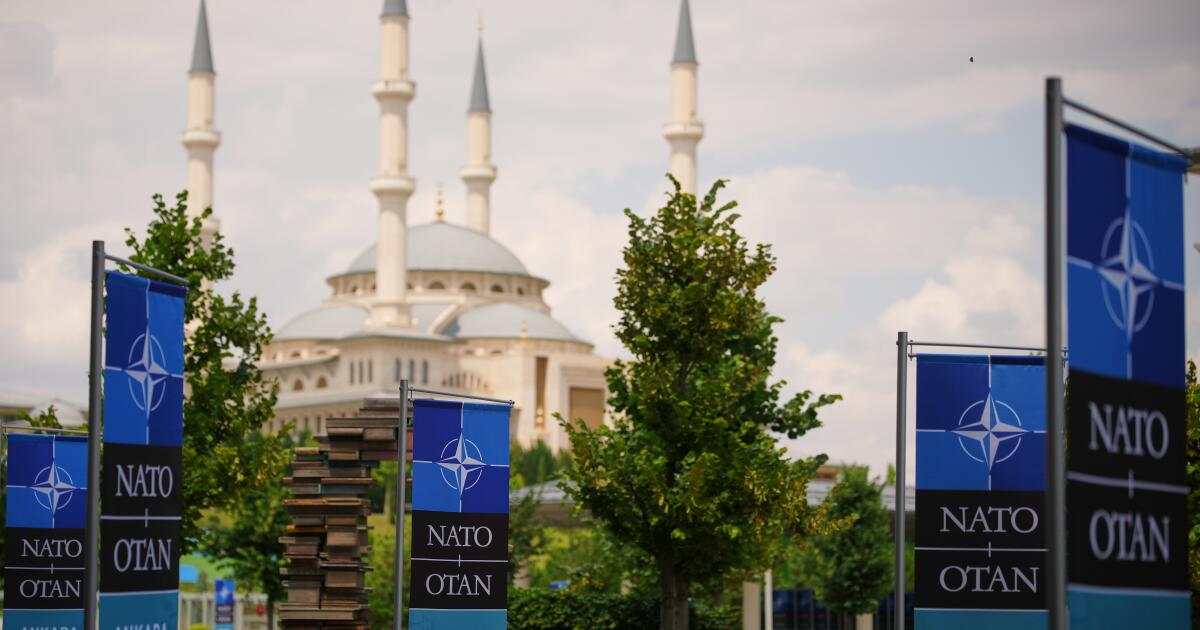
WASHINGTON — The leaders of Europe are bracing for another turbulent summit with President Trump this week as NATO members gather for their annual meeting in the Turkish capital.
European diplomats view Trump’s decision to attend as a positive sign of his continued commitment to the alliance. But the president’s grievances with several European governments over their refusal to join the U.S. war with Iran have cast a pall over a summit already strained by Trump’s wavering support for the continent.
The secretary-general of the transatlantic alliance, Mark Rutte, told reporters on Monday that Trump had aired his resentments in a recent phone call. But Rutte countered with a mix of flattery and countervailing facts that has thus far kept Trump engaged.
While Trump has accused European leaders of denying U.S. forces access to allied bases for takeoffs and refueling during the war, Rutte noted that about 5,000 sorties supporting Operation Epic Fury launched from European airfields. And last Friday, France and Britain committed to a joint military mission with Oman to support freedom of navigation in the Strait of Hormuz — “an extremely important development,” Rutte said.
At last year’s summit, held in The Hague, all NATO member states — with the exception of Spain — agreed to spend 5% of their GDP on defense by 2035, marking a significant increase in historic spending goals for modern Europe. The pledge is divided into two categories, with 3.5% of spending allocated to core military requirements, and the rest committed to a broad set of security-related investments.
Trump’s tough love on the alliance “is, I think, bringing NATO closer together,” the secretary general told reporters.
“You could argue that he is the first president of the U.S. since Eisenhower who was able to come to this situation where the Europeans and the Canadians will spend the same as the Americans” on security, Rutte said. “This equalization was a wish for 50, 60 years, and now it’s happening — I think in large part due to his leadership.”
NATO Secretary-General Mark Rutte speaks to reporters Monday ahead of the NATO summit in Ankara, Turkey.
(Hussein Malla / Associated Press)
In a video message posted on social media Monday, Trump’s ambassador to NATO, Matthew Whitaker, said the summit this week would serve as a “report card” to determine whether countries were beginning to fulfill their commitments from last year.
He offered a note of optimism and suggested the president’s goal is to enhance, rather than undermine, the alliance.
“The United States will be here, but we also need our allies to be here. We cannot do it alone, and the American taxpayer should no longer bear the burden,” Whitaker said.
A White House schedule for Trump’s trip lists bilateral meetings with Rutte and the leaders of Turkey, Syria and Ukraine, in between alliance-wide meals and conferences.
Ukraine will remain at the top of the agenda, Trump told reporters Monday, expressing hope that the war could soon come to an end after four brutal years of fighting.
Russia’s invasion of Ukraine has caused the greatest loss of life in Europe since World War II, resulting in more than 1 million casualties, including an estimated 600,000 dead. Since Russian President Vladimir Putin launched his full-scale invasion in 2022, following his covert invasions of Ukraine’s Crimean peninsula and eastern regions in 2014, Russian forces have captured roughly 12% of Ukraine’s territory.
The war has settled into a deadly stalemate since a 2023 Ukrainian counteroffensive failed to break Russian defensive lines. While Russian forces have occasionally advanced, they have only managed to hold marginal gains along the front, at tremendous cost.
In recent weeks, however, expanded Ukrainian drone and missile capabilities have shifted the dynamic, striking military production sites deep inside Russia and targets near Moscow, bringing the war more directly into the Russian public consciousness and raising questions in the Russian capital whether the war effort is sustainable.
Ukraine’s boldness has impressed the Trump administration, Alexander Stubb, the president of Finland, told the Financial Times this week.
“I think he does feel pressure,” Trump said of Putin, addressing reporters in the Oval Office before departing for Turkey on Monday.
The president referred to an ongoing U.S. effort to end the war, a goal that has remained elusive for Trump since returning to office.
“I think we’re getting much closer than people realize,” he said. “President Putin wants it to end, I will tell you that. Very strongly. Had a good call. And President Zelensky actually wants it to end now.”
“We’re going to be going to NATO, and we’re going to be talking about it,” Trump added. “And I think we’re going to get it ended. It’s been terrible.”
-

 Minnesota2 minutes ago
Minnesota Lynx bested by Connecticut Sun 90-89
-

 Mississippi9 minutes ago
Mississippi Lottery Mississippi Match 5, Cash 3 results for July 6, 2026
-
Missouri12 minutes ago
Missouri teachers push back on governor’s A-F school grading plan
-

 Montana17 minutes ago
The Record is Clear: The Wilderness Society, Greater Yellowstone Coalition, and Montana Wilderness Association have Consistently Undermined the Roadless Rule
-

 Nebraska24 minutes ago
Pine-Richland receiver Khalil Taylor pulls hat trick, picks Nebraska over Penn State
-

 Nevada27 minutes ago
Nevada Youth Sports estimates $250K in damage after Fourth of July firework fire
-

 New Hampshire32 minutes ago
Suspected gunman in Hampton Beach shooting was in U.S. Navy
-

 New Jersey39 minutes ago
I took my kids to this New Jersey hotel and stopped making fun of the state (for now)

