Politics
Can California change a dark culture at Chowchilla women's prison?

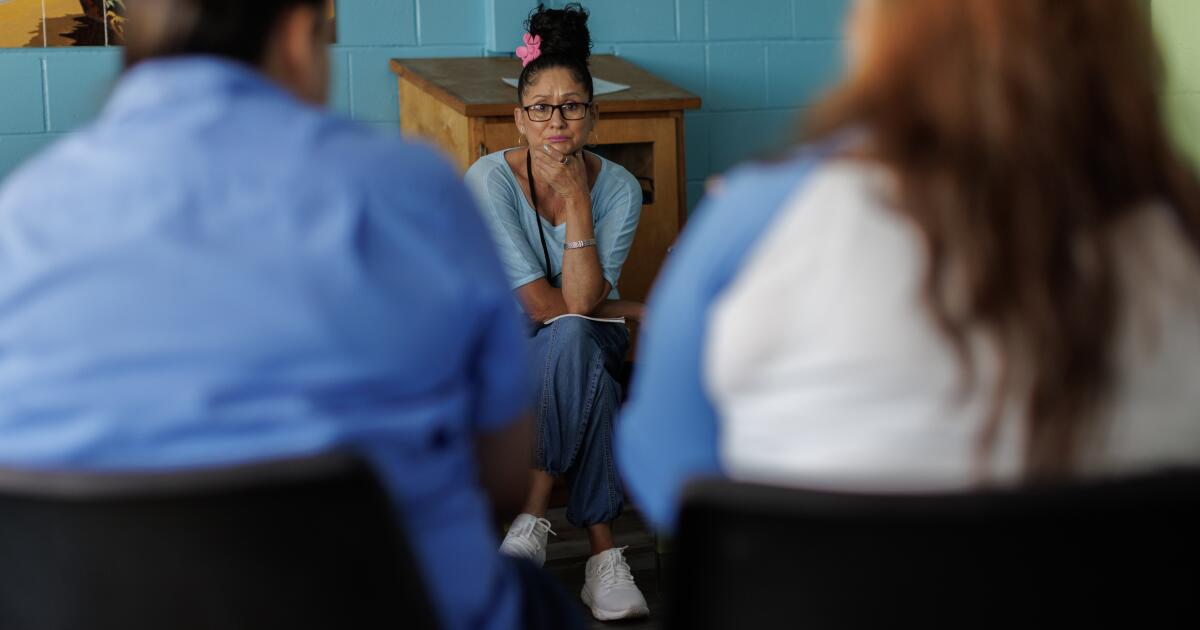
CHOWCHILLA, Calif. — Gazing across the crowd of women, fresh from county jail in their orange prison jumpsuits, Lena Coleman wishes she could save them all.
And it’s her job to try.
In July, after 20 years in prison for attempted murder and a gun enhancement, Coleman, 47, became one of three dozen prisoners at the Central California Women’s Facility in Chowchilla to graduate from a peer support specialist program.
California’s efforts to improve conditions at the women’s prison in Chowchilla are complicated by the deep level of trauma many female prisoners have experienced.
(Gina Ferazzi / Los Angeles Times)
The program is a part of the California Model, an ambitious effort Gov. Gavin Newsom launched in March 2023 to overhaul a prison system built on fear and retribution and replace it with opportunities for more normalized social interaction. The changes are modeled after prison operations in Norway and other Scandinavian countries, where incarceration is considered a tool for rehabilitation rather than harsh punishment.
At Chowchilla, a sprawling campus set in the farm fields of Madera County, the peer support specialists have become the backbone of that transformation.
Every day, they fan out across the prison, serving as something between a therapist and life coach to the roughly 2,100 women incarcerated at the facility, one of two women’s prisons in California.
Coleman works in Building 501, a reception yard that houses new prisoners before they transfer “over the wall” into the general population.

Prisoner Markeisha Dixon is among the trained peer support specialists working to instill a stronger sense of community for women incarcerated at the Chowchilla women’s prison.
(Gina Ferazzi / Los Angeles Times)
Her job is often limited in scope: helping a new arrival find prison garb that fits, or working with the healthcare services team to remind patients to take their medicine or attend an upcoming medical appointment.
Other times, the work requires more intense intervention.
Staff might call a peer support specialist to help de-escalate violence or ease a behavioral crisis. As mandated reporters, they can be the difference between someone dying of suicide or accepting mental health services.
Mostly, Coleman is there for whenever someone needs to talk — or cry — with a trusted confidant.
“I tell them that prison is going to be what you make it,” she said. And then she offers them a piece of advice: “I’m just like you. I’ve been there, done that. Only difference is I have changed my ways.”

Gov. Gavin Newsom launched the California Model reform effort in 2023 at San Quentin, with an aim of expanding job training and rehabilitation programs.
(Robert Gauthier / Los Angeles Times)
Newsom chose San Quentin in Marin County, the state’s oldest prison, to jump-start the California Model last year. At San Quentin, prison officials are focused on improving relations between officers and prisoners, two historically warring factions in a violent system unaccustomed to change.
The California Model looks a bit different at Chowchilla — and it must.
A majority of incarcerated women in the U.S. endured some combination of physical, sexual and emotional abuse before committing the crime that sent them to prison, researchers have found. Often, that abuse was inflicted by a husband or boyfriend. Most are single moms of young children who have lost custody because of their crimes.
At the same time, women’s prisons often lack the mental health services and rehabilitative programming to help address deep trauma, said Alycia Welch, associate director of the Prison and Jail Innovation Lab at the Lyndon B. Johnson School of Public Affairs at the University of Texas at Austin.
“Prisons and jails, when they were built, were not built at all with women in mind,” Welch said.
Compared with male inmates, incarcerated women report higher rates of sexual assault in prison. In September, federal prosecutors announced a civil rights investigation into sexual abuse at both Chowchilla and the California Institution for Women in Chino, citing multiple reports of groping, inappropriate touching and rape by correctional workers.

Officer Josephine Solis opens a dorm room for a prisoner inside C Block at the Central California Women’s Facility in Chowchilla.
(Gina Ferazzi / Los Angeles Times)
Over the last two years, more than 100 formerly incarcerated women have brought lawsuits against the California Department of Corrections and Rehabilitation and current and former correctional officers, alleging graphic incidents of sexual abuse by prison staff dating back a decade.
Corrections officials have said they welcome the investigation. They said that recent reforms have made it easier for women to report misconduct and that staff are now required to wear body cameras at the two women’s prisons. Expanded training to help staff work with prisoners who have dealt with significant trauma is a key pillar of the California Model.
While Coleman appreciates the efforts by Newsom and others in Sacramento to overhaul the state’s dark prison culture, she thinks it’s important for prisoners themselves to help steer the changes. And she views her mission as a peer support specialist as central to that transformation: working to instill a sense of community inside prison walls that was often missing for these women on the outside.
“We all have untreated trauma that contributed to criminalization. So when we come in here, we share our lived experiences with each other,” Coleman said. “We’re more comfortable with each other than we would be with staff.”
Statewide, female inmates make up fewer than 5% of California’s 91,000 prisoners. Of the nearly 51,000 people serving time in state prisons who were convicted of violent crimes, fewer than 2,000 are women.
When women do commit violent offenses, researchers have found the episodes often are tied to self-defense or coercion by an abusive partner. “Sometimes women describe it as something just snapped, and they couldn’t take it anymore. And they acted out as their only means of protection,” Welch said.

Women attending a support group at the Chowchilla prison reflect on the role trauma has played in their lives — and how it helped put them behind bars.
(Gina Ferazzi / Los Angeles Times)
That makes it more crucial for women’s prisons to have the kind of robust rehabilitation and job training envisioned under the California Model, to better prepare them for release, she said.
The peer support specialists are part of that effort, said Affie Tamuno-Koko, chief nurse executive for the state prison system. In addition, providing formal training as certified peer support specialists gives the women who eventually will be released from prison a transferable job skill. The certification, combined with their on-the-job experience while incarcerated, ensures “they’re not coming out as entry level,” Tamuno-Koko said.
Beyond the employment possibilities, the role “has restored their value as people,” Tamuno-Koko said. “I think it’s a very selfless act, to not just care about yourself, but really want to spend your time genuinely helping someone.”

“You’re going to get on the train or get off,” Lt. Monique Williams says of California Model naysayers. “Because we’re moving.”
(Gina Ferazzi / Los Angeles Times)
Lt. Monique Williams, the prison’s public information officer, said the women doing peer support are making a tangible difference. The peer support specialists at Chowchilla have provided more than 10,000 one-on-one counseling sessions and 430 group sessions, according to the corrections department.
“They’re needed,” Williams said. “Women understand women.”
Lynne Acosta, a former prisoner, said she can see the transition unfolding. Acosta was incarcerated for more than 20 years for conspiracy to commit first-degree murder before her 2018 release from Chowchilla. Now she’s back inside on a regular basis running group sessions as a life coach working for the Anti-Recidivism Coalition, a nonprofit that provides reentry and support services for former prisoners.
Huddled in a circle in a drab prison classroom in the middle of June, she led a group of two dozen women who were reflecting on the role trauma had played in their lives — and how it helped put them behind bars.
The women gathered had been locked up for charges including drug and firearms possession, robbery and murder. Nearly half were serving life sentences.

“Emotionally, physically, sexually, we are retraumatized, revictimized everyday in here,” said prisoner Kandice Ortega, a peer support specialist at the Chowchilla women’s prison. “That needs to change.”
(Gina Ferazzi / Los Angeles Times)
“How many of you in here, regardless of your sentence, it’s your first time ever in trouble?” Acosta asked. Almost everyone raised a hand.
How many were survivors of domestic violence? About half.
And how many think they might have avoided their crimes if they had received support for addiction, domestic violence, sexual assault or other traumas? Everyone.
Acosta remembers the years when such support groups were uncommon, and how badly she needed them.
“Women aren’t supposed to commit violent crimes,” was the common notion, Acosta said. Women were “demonized and dehumanized,” as though because of their gender, they should be doubly punished for ending up in prison.

Lynne Acosta, a former prisoner who is now a life coach, pushes a condemned prisoner out of her dorm unit at the Central California Women’s Facility.
(Gina Ferazzi / Los Angeles Times)
Acosta now lives nearby in the Central Valley and visits the prison almost every day to lead sessions. She’s optimistic that the state’s reform efforts are creating opportunities that might make things a little better for her friends who are still inside.
They include Elizabeth Lozano.
Lozano, 49, grew up in a violent neighborhood in Long Beach, where she said she experienced sexual abuse by a family member. She was sentenced to life without parole for her involvement, at age 16, in a 1992 gang shooting that killed a 13-year-old girl. Lozano was convicted of murder, although her boyfriend said he pulled the trigger.
In prison, Lozano received her associate’s degree in behavioral and social sciences, and co-founded an organization for juvenile offenders, along with another group that brings victims, law enforcement officers and prisoners together for discussions.
This year, Lozano became a peer support specialist as another way to make amends, she said. She works with fellow prisoners on coping skills and anger management, and helps them set goals for their time in prison or look up legal cases in the law library. After losing a loved one in prison in 2016 to an apparent suicide, Lozano also counsels women experiencing mental health crises.
Recent changes to state law make it easier for offenders who were imprisoned as youths to be released. Lozano’s next parole hearing is in May.
“I can’t undo the great harm that I have caused,” Lozano said. “I feel like the only thing that I can do is give from the best part of me and help others in their recovery.”

The majority of incarcerated women endured some combination of physical, sexual and emotional abuse before committing the crime that sent them to prison, according to researchers.
(Gina Ferazzi / Los Angeles Times)
Adding to the challenges of overhauling an entire correctional system are the traumas that happen within prison walls.
The allegations of widespread sexual abuse and serial rapes at the Chowchilla and Chino facilities that are the basis for the federal civil rights investigation may have come as a jolt to state corrections officials, but not to the women who came to see it as part of prison life.
“Emotionally, physically, sexually, we are retraumatized, revictimized everyday in here,” said Kandice Ortega, 38, a peer support specialist who has served 15 years for second-degree murder. “That needs to change.”
Williams, the public information officer, said she hopes — and believes — that change is underway.
Williams has worked for the corrections department for 23 years, rising through the ranks to become a lieutenant. She worked for several years in the unit that housed California’s death row for women before the state’s recent efforts to transition condemned prisoners into the general population.
Fellow staffers, as well as prisoners interviewed, said Williams embodied the spirit of the California Model before it had a name. She spends her days in a swirl of energetic motion, defying stereotypes of cold, bullying guards. She addresses prisoners with candor and kindness, stopping frequently to ask about their lives.
Williams has visited Norway twice to learn about prison practices she could bring back to Chowchilla. She’s coordinated barbecues and parties for staff and prisoners to improve relations. During a Juneteenth celebration, she took the stage and sang gospel music for the prisoners.
“You’re going to get on the train or get off,” she said of California Model naysayers. “Because we’re moving.”
Coleman, the peer support specialist, also chooses to believe that progress is possible. Either things can continue as usual, leaving incarcerated women to deteriorate in their isolation and trauma. Or they can grow and heal so they are better citizens when they leave prison — and strengthen the sense of community for those left behind.
“We have each other, we have the peer support specialist program, and we do have some staff that do care,” Coleman said. “Is this going to be make it a perfect setting? … No. Not even the world outside these gates is.”
On a Friday at the end of October, Coleman was working her way through a stack of paper with the names of dozens of women she was supposed to counsel that week. She called one woman over for a check-in.
Brandi Collins was back in prison.
For more than half her life, Collins, 43, has struggled with addiction to crystal meth and crack cocaine. Prison records show she has been incarcerated nearly a dozen times.
“I have a criminal thinking,” Collins said. “This is my home.”
But this time, she has Coleman, someone she can trust and confide in.
“I felt bad about my dang self. So maybe the first week I was here, I said, ‘Can I talk to you?’” Collins said.
“Do we judge you for returning?” Coleman asked.
“No, she didn’t judge. I know they’ve seen me on this yard a thousand times,” Collins responded.
“I want to forgive myself, and I want to change, and I don’t know what it takes,” she said. Then, turning to Coleman, she said, “I look at you and you give me hope.”



new video loaded: U.S. ‘Accelerating’ Military Assault in Iran, Hegseth Says
By Christina Kelso
March 4, 2026

NEWYou can now listen to Fox News articles!
A U.S. submarine sank a prized Iranian warship by torpedo, the first such sinking of an enemy ship since World War II, Secretary of War Pete Hegseth said Wednesday morning.
Hegseth joined Chairman of the Joint Chiefs of Staff Gen. Dan Caine at the Pentagon to provide an update to reporters on “Operation Epic Fury” in Iran.
“An American submarine sunk an Iranian warship that thought it was safe in international waters,” Hegseth said. “Instead, it was sunk by a torpedo. Quiet death. The first sinking of an enemy ship by a torpedo since World War Two. Like in that war, back when we were still the War Department. We are fighting to win.”
Caine said that an Iranian vessel was “effectively neutralized” in a Navy “fast attack” using a single Mark 48 torpedo. He added that the U.S. Navy achieved “immediate effect, sending the warship to the bottom of the sea.”
WATCH HEGSETH’S ANNOUNCEMENT:
Hegseth said that the U.S. Navy sank the Iranian warship, the Soleimani. The flagship was named for Qasem Soleimani, an Iranian military officer who served in the Islamic Revolutionary Guard Corps who the U.S. killed in a January 2020 drone strike during President Donald Trump’s first term.
“The Iranian Navy rests at the bottom of the Persian Gulf. Combat ineffective, decimated, destroyed, defeated. Pick your adjective,” Hegseth said. “In fact, last night we sunk their prize ship, the Soleimani. Looks like POTUS got him twice. Their navy, not a factor. Pick your adjective. It is no more.”
This map shows U.S. and Israeli strikes against Iranian naval forces as of March 1. (Fox News)
Hegseth also told reporters at the briefing that the U.S. and Israel will soon achieve “complete control” over Iranian airspace after Iran’s missile capabilities were drastically diminished in the four days of fighting.
US ‘WINNING DECISIVELY’ AGAINST IRAN, WILL ACHIEVE ‘COMPLETE CONTROL’ OF AIRSPACE WITHIN DAYS, HEGSETH SAYS
“More bombers and more fighters are arriving just today and now, with complete control of the skies, we will be using 500 pound, one thousand pound and 2,000 pound laser-guided precision gravity bombs, of which we have a nearly unlimited stockpile,” he said.
The war has killed more than 1,000 people in Iran and dozens in Lebanon, while U.S. officials said six American troops were killed in a fatal drone strike in Kuwait.
Thousands of travelers have been left stranded across the Middle East.
This map shows security and travel updates for Americans regarding countries in the Middle East region. (Fox News)
CLICK HERE TO DOWNLOAD THE FOX NEWS APP
Caine told reporters that the U.S. military is helping thousands of Americans stranded in the Middle East after the U.S. State Department urged citizens to leave more than a dozen countries.
Fox News Digital’s Ashley Carnahan contributed to this report.
Related Article


Sen. Alex Padilla (D-Calif.) is preparing for President Trump to declare a national emergency in order to seize control of this year’s midterm elections from the states, including by bracing his Senate colleagues for a vote in which they would be forced to either co-sign on the power grab or resist it.
In the wake of reporting last week that conservative activists with connections to the White House were circulating such an order, Padilla sent a letter to his Senate colleagues Friday stating that any such order would be “wildly illegal and unconstitutional,” and would no doubt face “extremely strict scrutiny” in the courts.
“Nevertheless, if the President does escalate his unprecedented assault on our democracy by declaring an election-related emergency, I will swiftly introduce a privileged resolution [and] force a vote in the Senate to terminate the fake emergency,” wrote Padilla, the ranking Democrat on the Senate Committee on Rules and Administration.
Padilla wrote that such an order — which could possibly “include banning mail-in voting, eliminating major voting registration methods, voter purges, and/or new document barriers for registering to vote and voting” — would clearly go beyond Trump’s authority.
“Put simply, no President has the power under the Constitution or any law to take over elections, and no declaration or order can create one out of thin air,” Padilla wrote.
The same day Padilla sent his letter, Trump was asked whether he was considering declaring a national emergency around the midterms. “Who told you that?” he asked — before saying he was not considering such an order.
The White House referred The Times to that exchange when asked Tuesday for comment on Padilla’s letter.
If Trump did declare such an emergency, a “privileged resolution,” as Padilla proposed, would require the full Senate to vote on the record on whether or not to terminate it — forcing any Senate allies of the president to own the policy politically, along with him.
Experts say there is no evidence that U.S. elections are significantly affected or swung by widespread fraud or foreign interference, despite robust efforts by Trump and his allies for years to find it.
Nonetheless, Trump has been emphatic that such fraud is occurring, particularly in blue states such as California that allow for mail-in ballots and do not have strict voter ID laws. He and others in his administration have asserted, again without evidence, that large numbers of noncitizen residents are casting votes and that others are “harvesting” ballots out of the mail and filling them out in bulk.
Soon after taking office, Trump issued an executive order purporting to require voters to show proof of U.S. citizenship before registering and barring the counting of mail-in ballots received after election day, but it was largely blocked by the courts.
Trump’s loyalist Justice Department sued red and blue states across the country for their full voter rolls, but those efforts also have largely been blocked, including in California. The FBI also raided an elections office in Georgia that has been the focus of Trump’s baseless claims that the 2020 presidential election was stolen from him.
Trump is also pushing for the passage of the SAVE Act, a voter ID bill passed by the House, but it has stalled in the Senate.
In recent weeks, Trump has expressed frustration that his demands around voting security have not translated into changes in blue state policies ahead of the upcoming midterm elections, where his shrinking approval could translate into major gains for Democrats.
Last month, Trump wrote on his Truth Social platform, “I have searched the depths of Legal Arguments not yet articulated or vetted on this subject, and will be presenting an irrefutable one in the very near future. There will be Voter I.D. for the Midterm Elections, whether approved by Congress or not!”
Then, last week, the Washington Post reported that a draft executive order being circulated by activists with ties to Trump suggests that unproven claims of Chinese interference in the 2020 election could be used as a pretext to declare an elections emergency granting Trump sweeping authority to unilaterally institute the changes he wants to see in state-run elections.
Election experts said the Constitution is clear that states control and run elections, not with the executive branch.
Democrats have widely denounced any federal takeover of elections by Trump. And some Republicans have expressed similar concerns, including Sen. Mitch McConnell (R-Ky.), who chairs the Senate rules committee.
In the Wall Street Journal last year, McConnell warned against Trump or any Republican president asserting sweeping authority to control elections, in part because Democrats would then be empowered to claim similar authority if and when they retake power.
McConnell’s office referred The Times to that Journal opinion piece when asked about the circulating emergency order and Padilla’s resolution.
Padilla’s office said his resolution would be introduced in response to an emergency declaration by Trump, but hoped it wouldn’t be necessary.
“Instead of trying to evade accountability at the ballot box,” Padilla wrote, “the President should focus on the needs of Americans struggling to pay for groceries, health care, housing and other everyday needs and put these illegal and unconstitutional election orders in the trash can where they belong.”

Andretti family’s popular go karting and gaming facility opening first Illinois location. See inside

Indiana basketball vs. Minnesota score, updates tonight: Start time, where to watch

Man sentenced for killing 4 people appeals his sentence to the Iowa Supreme Court

Arkansas women’s basketball blown out by Kentucky in season-ending loss at SEC Tournament | Whole Hog Sports

State Treasurer John Fleming accuses Jeff Landry of interfering in Louisiana Senate race

Florida High School Football Rankings: Top 25 teams – Oct. 21

Cleary's 21 help Le Moyne down Central Connecticut State 69-64 in OT

How old is Bo Nix? What to know about Oregon quarterback ahead of 2024 NFL Draft

99th annual Pony Swim held in Virginia

Indiana Members Credit Union announced as new anchor tenant at Bottleworks District

US submarine sinks Iranian warship by torpedo in a first since World War II

Which oil and gas facilities in the Gulf have been attacked?

Mojtaba Khamenei, son of former supreme leader, tipped to become Iran’s next head of state

Video: Senators Question Kristi Noem on ICE Immigration Tactics

Combustible Republican Senate primary in Texas heading into overtime
-

 World7 days ago
Exclusive: DeepSeek withholds latest AI model from US chipmakers including Nvidia, sources say
-

 Massachusetts1 week ago
Mother and daughter injured in Taunton house explosion
-

 Denver, CO7 days ago
10 acres charred, 5 injured in Thornton grass fire, evacuation orders lifted
-

 Louisiana1 week ago
Wildfire near Gum Swamp Road in Livingston Parish now under control; more than 200 acres burned
-

 Florida4 days ago
Florida man rescued after being stuck in shoulder-deep mud for days
-

 Wisconsin3 days ago
Setting sail on iceboats across a frozen lake in Wisconsin
-

 Maryland4 days ago
AM showers Sunday in Maryland
-

 Oregon5 days ago
2026 OSAA Oregon Wrestling State Championship Results And Brackets – FloWrestling