Politics
California has a history of racist land seizures. Will reparations bills bring justice?

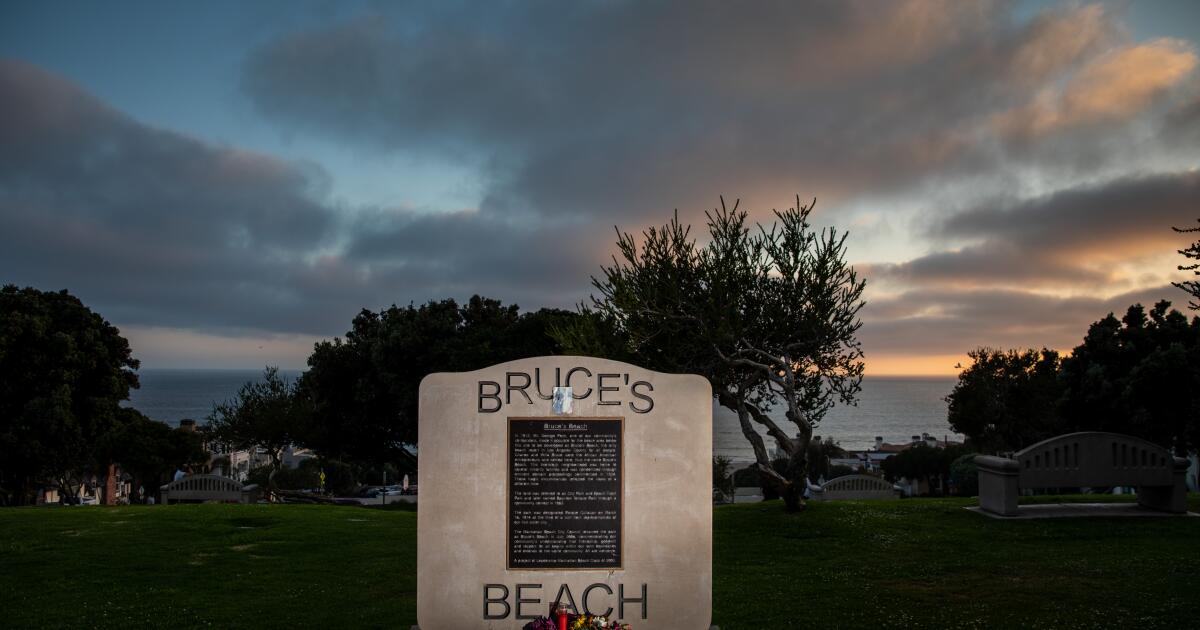
Few governmental practices have caused more rapid disruption or erosion of generational wealth in Black and brown communities than the discriminatory use of eminent domain — the legal tool cities, counties and other official bodies rely on to unilaterally condemn and purchase private land for public use.
Several reparation bills moving through the state Legislature could help Californians of color who believe their land was taken against their will with racist intent to finally get restitution.
The bills turn the spotlight on a phenomenon that is woven into the Golden State’s history, said California state Sen. Steven Bradford, a Democrat from Gardena who authored three of the pending bills.
Under pressure from the Ku Klux Klan, the city of Manhattan Beach used its eminent domain authority in 1924 to drive out a seaside resort for Black guests owned by Willa and Charles Bruce, promising to put a park in its place.
Just as Silas White was about to realize his dream of establishing the Ebony Beach Club as a Black-owned haven free of racism in 1958, Santa Monica used eminent domain to confiscate his property, demolishing it with plans to create public parking. The luxury Viceroy Hotel now sits on the lot.
“There are multiple examples of African American families who were forced off their land, for no other reason than they didn’t want them there anymore,” Bradford said. “And now their homes have been replaced with freeways or parking lots, or as in Manhattan Beach, an alleged park that was 40 years before it even came into development.”
Families that were forced to sell their land for less than it was worth lost out on years of potential gains from their properties, depriving them of the chance to grow and pass down assets to their heirs, Bradford said.
At a recent Senate Judiciary Committee hearing, Bradford sat next to Jessie Johnson as she spoke of a pain that hasn’t abated in the six decades since her grandfather’s land was seized in the largely Black and Latino Bay Area community of Russell City, in what was then unincorporated Alameda County. The land wound up in the hands of a developer and was annexed by the city of Hayward.
“We thought we would have the liberty to build on my grandfather’s land,” Johnson told committee members. “Unfortunately, eminent domain took over.”
Bradford believes that hundreds and perhaps thousands of other California property owners, or their descendants, may seek financial remedies under the proposed law.
“I can’t assign a dollar figure — that’s how big it is,” he said.
Bradford’s reparations legislation would set up the Freedmen Affairs Agency, which among other things would determine the validity of claims brought by families that believe their property was unjustly seized.
The legislation currently defines racially motivated eminent domain as “when the state, county, city, city and county, district, or other political subdivision of the state acquires private property for public use and does not distribute just compensation to the owner at the time of the taking, and the taking, or the failure to provide just compensation, was due, in whole or in part, to the owners ethnicity or race.
The state’s Office of Legal Affairs would be tasked with presenting the offending entities with possible remedies such as the return of the seized lands, publicly owned land of equal present-day value or monetary payments.
Bradford’s bills stem from his participation on the state reparations task force, which spent two years studying how California permitted the enslavement of Africans arriving in the state without formally sanctioning the institution of slavery itself. It also examined public policies, such as the use of eminent domain, that further disadvantaged Black Californians.
The senator said he expects the eminent domain provision, which is part of a package of reparations proposals recommended by the task force and backed by the California Legislative Black Caucus, to reach Gov. Gavin Newsom’s desk by the end of the current legislative session.
Racially biased eminent domain isn’t a problem only in California. One study authored by research psychiatrist Dr. Mindy Thompson Fullilove and published by the nonprofit Institute for Justice looked at cases involving the Federal Housing Act between 1949 and 1973. It found that 2,532 civic projects carried out in 992 cities displaced 1 million people, two-thirds of them Black Americans, making that group “five times more likely to be displaced than they should have been given their numbers in the population.”
But although Black Americans have largely been the focus of state and national reparations efforts, Bradford said his eminent domain proposal applies to members of other racial groups as well.
“I hope people understand the importance of reparations by seeing that other folks were harmed too because of the racially motivated taking of their property,” Bradford said.
Bradford’s Senate bills coincide with AB 1950, a separate reparations measure introduced by state Assemblywoman Wendy Carrillo (D-Los Angeles) on behalf of families from the former Palo Verde, La Loma and Bishop neighborhoods of Chavez Ravine, where Dodger Stadium stands today, who are seeking restitution for their losses.
In the 1950s, Los Angeles officials evicted families on a 315-acre hillside site that encompassed the largely Latino neighborhoods on the premise that public housing would be built there. Harrowing scenes ensued of children sobbing and a woman kicking and screaming as sheriff’s deputies carried her away by her arms and legs.
“The shorthand version of the story is that the homes in these communities were deemed as ‘slums’ by the Los Angeles Housing Authority, so the compensation provided to the families was lower than what the land should have been priced at,” said Carrillo. “For those that refused to leave, eminent domain was used to remove them.”
Carrillo represents parts of northeast and East L.A., home to large Latino communities. In an email, she explained how racist land grabs and redevelopment schemes have disrupted the lives of Angelenos of color.
Aurora Vargas is carried by Los Angeles County Sheriff’s deputies after her family refused to leave their house in Chavez Ravine in May 1959.
(Hugh Arnott/Los Angeles Times Archive/UCLA)
“Restrictive covenants, redlining and segregation by design has always been the housing story of Los Angeles,” said Carrillo, who also noted that the expansion of the 10 Freeway toward Santa Monica destroyed the affluent Black Sugar Hill neighborhood in West Adams.
For Chavez Ravine families, restitution could come in the form of land, cash payments or access to city programs such as affordable-housing assistance, said Alfred Fraijo, an L.A. real estate and land-use attorney who served as an advisor on the legislation.
“The idea is we want to give local government the opportunity to do right,” before cases devolve into protracted courtroom and media spectacles, Fraijo said.
He believes Carrillo’s Chavez Ravine Accountability Act, along with Bradford’s bill, could if successful prompt government entities to more strongly consider racial and economic equity when considering future uses of eminent domain.
Fraijo, 47, grew up in the heavily Latino East L.A. neighborhood of Boyle Heights and remembers feeling hemmed in by a tangle of interchanges connecting the 10 and 5 freeways, whose construction had erased streets lined with Victorian and Craftsman-style homes.
“These freeways were not built in our community by accident — they were intentional,” Fraijo said.
He describes AB 1950 as “the beginning of a reconciliation and a healing process for our communities.”
The restitution bills come as welcome news to activist Kavon Ward too. Ward started the organization Where Is My Land to help Black Americans in California and nationwide fight for their stolen properties.
Her organization has advised families in the Ebony Beach Club, Russell City and Bruce’s Beach cases, as well as survivors of Section 14 in Palm Springs who were evicted from their homes on the Agua Caliente tribal reservation in the 1960s.
Ward and Bradford’s work on Bruces’ Beach helped the family reach a deal in which Los Angeles County returned two parcels to the family, marking the first time that a local government had given back land to a Black family after recognizing that it had been unfairly seized. The family subsequently sold the property back to the county for nearly $20 million.
Ward consulted with Bradford on his land bill to eliminate the standard five-year statute of limitations on eminent domain challenges, because many of the unfair land takings happened decades ago.
“There should be no statute of limitations on stolen land like this,” Ward said. “The policy is extremely important, because it helps everybody.”
Ward said she understands the fraught politics of the Black land return movement, given the current backlash against government equity and inclusion efforts, attacks on Black history education and repeated attempts to enact a national reparations bill into law.
Some Indigenous leaders have sought a greater role in the state reparations debate. Tribal nations, the original stewards of all of California’s lands, are pushing for the return or co-management of their stolen ancestral territories.
Ward said that land-based restitution cases for Black Americans should not be seen as conflicting with the tribal land reclamation.
“When I think about the LandBack movement, I love that movement,” Ward said. “They’re focused on Native land and they should. What I realized with Bruce’s Beach is that this is so widespread, but nobody is focusing on Black people.”
Bradford agrees that it won’t always be easy to persuade local elected officials to spend taxpayers dollars to set up their own task forces, study the potential return of publicly owned parcels, issue payouts for past land seizures and invest in other reparative measures.
Nothing in either Bradford’s legislation or Carrillo’s obligates eminent domain offenders to make families whole, nor do they commit the state to offering compensation for unjustly seized properties with tax dollars instead, Bradford and Fraijo said.
In the case of Chavez Ravine, Carrillo’s bill has come under criticism from survivors in the nonprofit advocacy group Buried Under the Blue, who recently told radio station KCRW that many members are withholding support for Carrillo’s bill until it holds the Dodgers organization more accountable.
The organization has not responded to a request for comment about the bill.
Bradford said he is confident that despite the potential obstacles, more families will have an easier pathway to restitution.
But he acknowledged that “all cases are not going to end successfully like Bruce’s Beach.”



Politics
Pope Leo sends unmistakable message on immigrants during visit honoring America’s first saint

NEWYou can now listen to Fox News articles!
Pope Leo XIV used a visit Saturday honoring St. Frances Xavier Cabrini, the first American saint and patron saint of immigrants, to deliver his latest appeal on behalf of them, asking Catholics to look to her example at a time when migration remains one of the defining issues of his emerging papacy.
The remarks came as Leo continues to make migration a central focus of his public ministry, a position that has sparked months of public friction with President Donald Trump over immigration and foreign policy.
“What could be more relevant today than a missionary charism dedicated to serving migrants?” Leo said during an evening prayer service in Sant’Angelo Lodigiano, the northern Italian town where Cabrini was born.
The American-born pope prayed at Cabrini’s tomb and urged young Catholics to learn from the saint’s life of serving immigrants, many of whom had left their homelands in search of better opportunities.
POPE LEO XIV STRONGLY SUPPORTS US BISHOPS’ CONDEMNATION OF TRUMP IMMIGRATION RAIDS: ‘EXTREMELY DISRESPECTFUL’
Pope Leo XIV presides over a celebration at the parish of Santi Antonio Abate e Francesca Cabrini in Sant’Angelo Lodigiano, Italy, Saturday. The visit was part of his pastoral journey to nearby Pavia and marked the birthplace of Francesca Cabrini, the first U.S. saint and Patroness of Migrants. (Mario Tomassetti/Vatican Media)
But Leo also invoked his predecessor, Pope Francis, whose own papacy was defined in part by calls to welcome migrants.
“Let us ask ourselves: if Mother Francesca were alive today, what would her missionary spirit tell her?” Leo said. “And what would a pope like Francis — who, as the son of Italian immigrants, made service to migrants one of the key priorities of his pontificate — ask of her?”
The comments are the latest in a series of migration-focused appearances that have helped define Leo’s first year as pope.
POPE LEO APPOINTS PRO-IMMIGRATION BISHOP TO DIOCESE HOME TO TRUMP’S MAR-A-LAGO
Pope Leo XIV greets faithful as he leaves the parish of Santi Antonio Abate e Francesca Cabrini in Sant’Angelo Lodigiano, Italy, Saturday. (Mario Tomassetti/Vatican Media)
Last week, Leo traveled to Spain’s Canary Islands, a major destination for migrants departing West Africa, where he met migrants and called for greater efforts to welcome and integrate people fleeing hardship and conflict.
During that trip, Leo urged world leaders to create “legal and safe pathways” for migration and warned against reducing migrants to statistics.
Leo’s migration advocacy has frequently drawn criticism from Trump, who has accused the pontiff of venturing into politics and sharply disagreed with some of his comments on immigration and foreign affairs.
The public disagreements have become one of the most closely watched relationships between the Vatican and Washington during Leo’s papacy.
INCLUSIVE TONE OF NEW POPE ISN’T SITTING WELL WITH SOME IN THE ‘AMERICA FIRST’ MOVEMENT
Pope Leo XIV presides over a celebration at the parish of Santi Antonio Abate e Francesca Cabrini in Sant’Angelo Lodigiano, Italy, Saturday, during his pastoral journey to nearby Pavia. (Mario Tomassetti/Vatican Media)
Earlier this year, Reuters reported that Secretary of State Marco Rubio was expected to meet with Vatican officials and Italian leaders during a period of heightened tensions between the Holy See and the Trump administration.
Leo has rejected suggestions that his remarks are political attacks, arguing instead that his appeals stem from Catholic teaching on human dignity, peace and care for vulnerable people.
Saturday’s visit centered on Cabrini, who became a naturalized U.S. citizen and spent decades serving Italian immigrants through schools, hospitals and orphanages before her death in Chicago in 1917.
US CATHOLIC BISHOPS PRESIDENT SAYS DEPORTATIONS INSTILLING ‘FEAR’ IN ‘WIDESPREAD MANNER’: ‘CONCERNS US ALL’
Pope Leo XIV holds a private audience with Vice President J.D. Vance at the Apostolic Palace in Vatican City, May 19, 2025. (Simone Risoluti/Vatican Media)
The Vatican has also announced that Leo will travel to the Italian island of Lampedusa on July 4, a date likely to draw attention in the United States given the pope’s American roots.
CLICK HERE TO DOWNLOAD THE FOX NEWS APP
Lampedusa has become one of Europe’s most recognizable migration flashpoints because of the thousands of migrants who attempt dangerous crossings from North Africa each year. The island also carries symbolic importance within the Catholic Church because it was the destination of Pope Francis’ first trip outside Rome after becoming pope in 2013.
Fox News Digital’s Eric Mack and Robert McGreevy, and The Associated Press contributed to this report.

For UFC boss Dana White, heavyweight Josh Hokit’s post-fight behavior at UFC Freedom 250 on Sunday crossed a line.
On Monday, the mixed martial arts promotion’s president and chief executive told Time reporter Sean Gregory via text he is “completely against saying nasty and false things about people’s families” in reference to Hokit’s tasteless comment about Michelle Obama. During the White House spectacle in front of President Trump and others, Hokit was interviewed after his technical-knockout victory over Derrick Lewis and propped up a false conspiracy about the former first lady, declaring “Michelle Obama is a man.”
Hokit, who has a history of making tasteless comments after his fights, including the same Obama jab, drew mixed reaction from the UFC Freedom 250 crowd — and also from social media users, with some repeating the false claim in the comments on Hokit’s Instagram page and others chiding it. White, who has panned Hokit’s remarks in the past, did so again.
“Everyone knows my position on free speech but I hate that kind of nonsense,” White’s text added.
Hokit insulted Obama months after Trump faced backlash in February for a racist social media video that depicted President Obama and the former first lady as apes. Amid mounting public criticism, the White House took down the video and blamed an unnamed aide.
Michelle Obama, clearly on Hokit’s mind on Sunday, was busy with other matters over the weekend: preparing with her husband to open their Obama Presidential Center in Chicago. The museum and library hosts its grand opening Thursday and will be open to the public Friday.
Times staff writer Ana Ceballos contributed to this report.
Politics
Trump says Iran missiles ‘aren’t the problem’ after White House made them central to war rationale

NEWYou can now listen to Fox News articles!
For months, senior Trump administration officials argued that Iran’s ballistic missile arsenal helped shield Tehran’s nuclear ambitions and was a key reason the U.S. launched Operation Epic Fury attacks on the country.
Now, President Donald Trump is suggesting Iran having missiles may not be a problem at all.
“If other countries have them, it’s a little bit unfair for them not to have some. If Saudi Arabia and Qatar, and they all have some, I would say that in relative proportion, I think it’s okay,” Trump said at the G7 international forum Wednesday. “Am I going to let Saudi Arabia have missiles, but (Iran) can’t have them? It doesn’t work that way.”
“Missiles aren’t the problem. They hurt a little location, but they don’t blow up the planet.”
“The Gulf nations will address the nonnuclear issues, as we’ll be talking about the ballistic missiles,” the president added. “And we’ll talk, also, about the terrorist proxies that they have that — we don’t want that to happen.”
A map displays the range of ballistic missiles fired from Iran, highlighting areas within reach. (Fox News)
ISRAELI OFFICIALS REPORTEDLY WARN IRAN’S BALLISTIC MISSILES COULD TRIGGER SOLO MILITARY ACTION AGAINST TEHRAN
Trump made the remarks while discussing whether Iran should be permitted to retain missile capabilities in a news conference at the G7 in Évian-les-Bains, France, just as details of the memorandum of understanding between the U.S. and Iran were being released.
The comments strike a much different tone than arguments repeatedly made by senior administration officials in recent months, who described Iran’s ballistic missile force as both a major threat to regional security and a protective shield for Iran’s nuclear program.
“Iran can never have a nuclear weapon, and we will not allow Iran to hide behind the immunity of a massive short-term ballistic missile inventory, or the ability to make them or launch them,” Secretary of State Marco Rubio told reporters in a press conference March 3. “What they are trying to do, and have been trying to do for a very long time, is build a conventional weapons capability as a shield to hide behind.”
TRUMP VOWS TO HIT IRAN ‘VERY HARD’ AFTER OBLITERATING NEARLY ’90 PERCENT’ OF REGIME MISSILES
Other senior officials repeatedly described degrading Iran’s missile capabilities as a central objective of Operation Epic Fury.
In remarks at the White House on March 2, days after the start of the operation, Trump said, “Our objectives are clear. First, we’re destroying Iran’s missile capabilities … and their capacity to produce brand new ones.”
War Secretary Pete Hegseth later said March 4 the mission was “laser-focused” on obliterating Iran’s missiles and the facilities that produce them, while White House Press Secretary Karoline Leavitt said the same day one of the administration’s primary goals was to “destroy the regime’s deadly ballistic missiles and completely raze their missile industry to the ground.”
Heavy weapons, including ballistic missiles, air defense systems and unmanned aerial vehicles, are displayed during the 44th anniversary of the eight-year war with Iraq, known as Holy Defense Week, at Baharestan Square in Tehran, Iran, on Sept. 25, 2024. (Photo by Fatemeh Bahrami/Anadolu via Getty Images)
Rubio repeatedly returned to the theme throughout the operation, arguing that degrading Iran’s missile force was necessary to prevent Iran from using conventional military power as cover for a future nuclear weapons program.
TRUMP SAYS US, ISRAEL SHATTERED IRANIAN MILITARY CAPABILITIES, PRESSES LEADERS TO SURRENDER: ‘CRY UNCLE’
“This is about very specific objectives,” Rubio told reporters on March 30. “The President laid them out on the first night of the operation… Here they are — you should write them down. Number one, the destruction of their air force. Number two, the destruction of their navy. Number three, the severe diminishing of their missile launching capability. And number four, the destruction of their factories so they can’t make more missiles and more drones to threaten us in the future. All of this so that they can never hide behind it to acquire a nuclear weapon. That was our objective from the beginning; that remains our objective now.”
Leavitt made similar comments the same day, saying the objectives of Operation Epic Fury included “destroying their ballistic missiles” and dismantling the infrastructure used to produce them while ensuring Iran never obtains a nuclear weapon.
Trump’s remarks at the G7 also raised questions about the administration’s approach to Iran’s nuclear program, another issue that administration officials had previously described in far less flexible terms.
Trump’s comments also come as the administration pursues a memorandum of understanding with Iran that leaves unresolved one of the central disputes in the nuclear negotiations: the future of Tehran’s enrichment program.
Under the framework agreement unveiled this week, the United States and Iran agreed to spend 60 days negotiating the fate of Iran’s nearly 900-pound stockpile of near-weapons-grade 60% enriched uranium and any future enrichment activities. Administration officials said the minimum outcome under discussion would involve down-blending the material under International Atomic Energy Agency supervision, while acknowledging that key details of a final agreement remain unsettled.
Officials described Iran’s willingness to dilute its stockpile as a significant concession, but also acknowledged that the memorandum does not resolve whether Iran will ultimately be permitted to retain any enrichment capability.
TRUMP REAFFIRMS HARD LINE ON IRAN NUCLEAR DEAL: ‘WILL NOT ALLOW ANY ENRICHMENT OF URANIUM’
President Donald Trump arrives for a gala dinner at the Versailles Palace in Versailles, France. (Nathan Laine/Bloomberg via Getty Images)
Trump appeared to strike a more accommodating tone when discussing Iran’s access to nuclear power at the G7.
“It is a little hard, though, when you say that somebody wants it, other people have it, other, adjoining states have it. And you’re not letting them have it for purposes of electricity and things like that,” Trump said. “It’s always a little tough. You have to use a little common sense.”
CLICK HERE TO DOWNLOAD THE FOX NEWS APP
The administration had previously drawn a much harder line on Iran’s nuclear program. Special envoy Steve Witkoff said the United States could not allow Iran to retain “even 1 percent” enrichment capability, while White House officials repeatedly described the end of Iranian enrichment as a red line.
The White House referred back to Trump’s recent remarks on missiles when asked for additional comment. “
“We are going to let the President’s comments stand,” a State Department spokesperson said when asked for comment.
The Pentagon could not immediately be reached for comment.
-

 New Hampshire2 minutes ago
1 dead, 5 injured in head-on crash in NH – Boston News, Weather, Sports | WHDH 7News
-

 New Jersey5 minutes ago
Did anyone win Powerball? Winning numbers for June 20, 2026
-

 New Mexico10 minutes ago
Video: Roswell police respond to fatal crash involving teens
-
North Carolina17 minutes ago
Oklahoma a win away from national title after roughing up North Carolina ace in Game 1 of CWS finals
-

 North Dakota20 minutes ago
In ‘last chapter,’ North Dakota son who made ultimate sacrifice in World War II comes home
-

 Ohio25 minutes ago
Geauga County plane crash kills 3: Report
-

 Oklahoma32 minutes ago
Crews respond after fireworks stand catches fire in Broken Arrow, no injuries reported
-

 Oregon35 minutes ago
11 Best Small Towns In Oregon For A Crowd-Free Summer

