Politics
California has a history of racist land seizures. Will reparations bills bring justice?

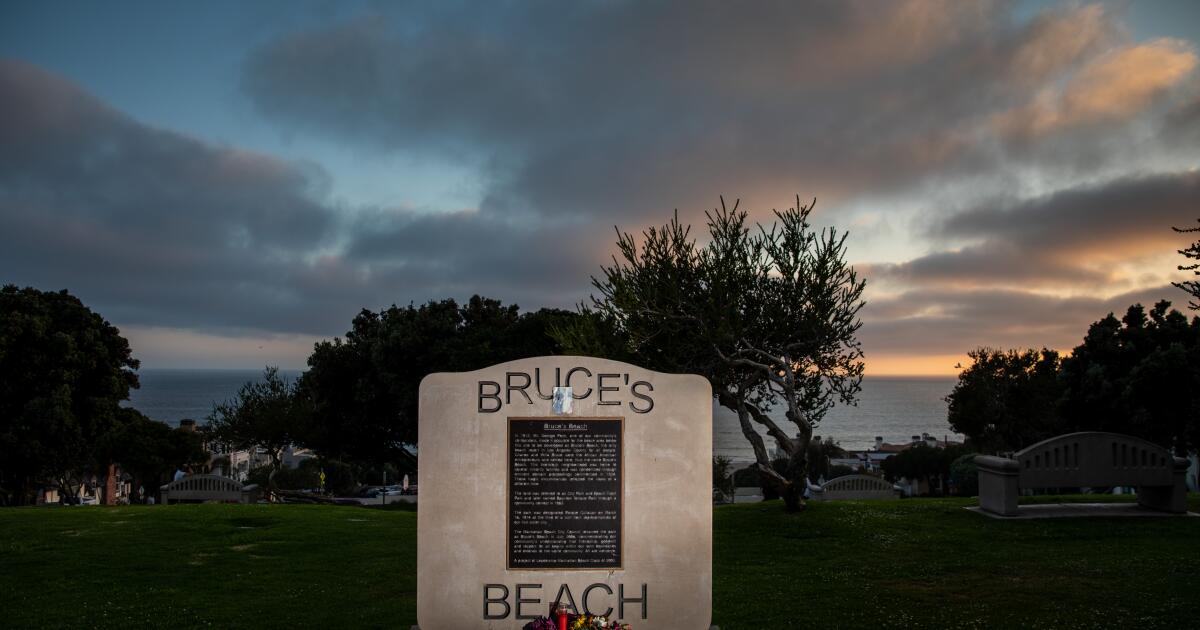
Few governmental practices have caused more rapid disruption or erosion of generational wealth in Black and brown communities than the discriminatory use of eminent domain — the legal tool cities, counties and other official bodies rely on to unilaterally condemn and purchase private land for public use.
Several reparation bills moving through the state Legislature could help Californians of color who believe their land was taken against their will with racist intent to finally get restitution.
The bills turn the spotlight on a phenomenon that is woven into the Golden State’s history, said California state Sen. Steven Bradford, a Democrat from Gardena who authored three of the pending bills.
Under pressure from the Ku Klux Klan, the city of Manhattan Beach used its eminent domain authority in 1924 to drive out a seaside resort for Black guests owned by Willa and Charles Bruce, promising to put a park in its place.
Just as Silas White was about to realize his dream of establishing the Ebony Beach Club as a Black-owned haven free of racism in 1958, Santa Monica used eminent domain to confiscate his property, demolishing it with plans to create public parking. The luxury Viceroy Hotel now sits on the lot.
“There are multiple examples of African American families who were forced off their land, for no other reason than they didn’t want them there anymore,” Bradford said. “And now their homes have been replaced with freeways or parking lots, or as in Manhattan Beach, an alleged park that was 40 years before it even came into development.”
Families that were forced to sell their land for less than it was worth lost out on years of potential gains from their properties, depriving them of the chance to grow and pass down assets to their heirs, Bradford said.
At a recent Senate Judiciary Committee hearing, Bradford sat next to Jessie Johnson as she spoke of a pain that hasn’t abated in the six decades since her grandfather’s land was seized in the largely Black and Latino Bay Area community of Russell City, in what was then unincorporated Alameda County. The land wound up in the hands of a developer and was annexed by the city of Hayward.
“We thought we would have the liberty to build on my grandfather’s land,” Johnson told committee members. “Unfortunately, eminent domain took over.”
Bradford believes that hundreds and perhaps thousands of other California property owners, or their descendants, may seek financial remedies under the proposed law.
“I can’t assign a dollar figure — that’s how big it is,” he said.
Bradford’s reparations legislation would set up the Freedmen Affairs Agency, which among other things would determine the validity of claims brought by families that believe their property was unjustly seized.
The legislation currently defines racially motivated eminent domain as “when the state, county, city, city and county, district, or other political subdivision of the state acquires private property for public use and does not distribute just compensation to the owner at the time of the taking, and the taking, or the failure to provide just compensation, was due, in whole or in part, to the owners ethnicity or race.
The state’s Office of Legal Affairs would be tasked with presenting the offending entities with possible remedies such as the return of the seized lands, publicly owned land of equal present-day value or monetary payments.
Bradford’s bills stem from his participation on the state reparations task force, which spent two years studying how California permitted the enslavement of Africans arriving in the state without formally sanctioning the institution of slavery itself. It also examined public policies, such as the use of eminent domain, that further disadvantaged Black Californians.
The senator said he expects the eminent domain provision, which is part of a package of reparations proposals recommended by the task force and backed by the California Legislative Black Caucus, to reach Gov. Gavin Newsom’s desk by the end of the current legislative session.
Racially biased eminent domain isn’t a problem only in California. One study authored by research psychiatrist Dr. Mindy Thompson Fullilove and published by the nonprofit Institute for Justice looked at cases involving the Federal Housing Act between 1949 and 1973. It found that 2,532 civic projects carried out in 992 cities displaced 1 million people, two-thirds of them Black Americans, making that group “five times more likely to be displaced than they should have been given their numbers in the population.”
But although Black Americans have largely been the focus of state and national reparations efforts, Bradford said his eminent domain proposal applies to members of other racial groups as well.
“I hope people understand the importance of reparations by seeing that other folks were harmed too because of the racially motivated taking of their property,” Bradford said.
Bradford’s Senate bills coincide with AB 1950, a separate reparations measure introduced by state Assemblywoman Wendy Carrillo (D-Los Angeles) on behalf of families from the former Palo Verde, La Loma and Bishop neighborhoods of Chavez Ravine, where Dodger Stadium stands today, who are seeking restitution for their losses.
In the 1950s, Los Angeles officials evicted families on a 315-acre hillside site that encompassed the largely Latino neighborhoods on the premise that public housing would be built there. Harrowing scenes ensued of children sobbing and a woman kicking and screaming as sheriff’s deputies carried her away by her arms and legs.
“The shorthand version of the story is that the homes in these communities were deemed as ‘slums’ by the Los Angeles Housing Authority, so the compensation provided to the families was lower than what the land should have been priced at,” said Carrillo. “For those that refused to leave, eminent domain was used to remove them.”
Carrillo represents parts of northeast and East L.A., home to large Latino communities. In an email, she explained how racist land grabs and redevelopment schemes have disrupted the lives of Angelenos of color.
Aurora Vargas is carried by Los Angeles County Sheriff’s deputies after her family refused to leave their house in Chavez Ravine in May 1959.
(Hugh Arnott/Los Angeles Times Archive/UCLA)
“Restrictive covenants, redlining and segregation by design has always been the housing story of Los Angeles,” said Carrillo, who also noted that the expansion of the 10 Freeway toward Santa Monica destroyed the affluent Black Sugar Hill neighborhood in West Adams.
For Chavez Ravine families, restitution could come in the form of land, cash payments or access to city programs such as affordable-housing assistance, said Alfred Fraijo, an L.A. real estate and land-use attorney who served as an advisor on the legislation.
“The idea is we want to give local government the opportunity to do right,” before cases devolve into protracted courtroom and media spectacles, Fraijo said.
He believes Carrillo’s Chavez Ravine Accountability Act, along with Bradford’s bill, could if successful prompt government entities to more strongly consider racial and economic equity when considering future uses of eminent domain.
Fraijo, 47, grew up in the heavily Latino East L.A. neighborhood of Boyle Heights and remembers feeling hemmed in by a tangle of interchanges connecting the 10 and 5 freeways, whose construction had erased streets lined with Victorian and Craftsman-style homes.
“These freeways were not built in our community by accident — they were intentional,” Fraijo said.
He describes AB 1950 as “the beginning of a reconciliation and a healing process for our communities.”
The restitution bills come as welcome news to activist Kavon Ward too. Ward started the organization Where Is My Land to help Black Americans in California and nationwide fight for their stolen properties.
Her organization has advised families in the Ebony Beach Club, Russell City and Bruce’s Beach cases, as well as survivors of Section 14 in Palm Springs who were evicted from their homes on the Agua Caliente tribal reservation in the 1960s.
Ward and Bradford’s work on Bruces’ Beach helped the family reach a deal in which Los Angeles County returned two parcels to the family, marking the first time that a local government had given back land to a Black family after recognizing that it had been unfairly seized. The family subsequently sold the property back to the county for nearly $20 million.
Ward consulted with Bradford on his land bill to eliminate the standard five-year statute of limitations on eminent domain challenges, because many of the unfair land takings happened decades ago.
“There should be no statute of limitations on stolen land like this,” Ward said. “The policy is extremely important, because it helps everybody.”
Ward said she understands the fraught politics of the Black land return movement, given the current backlash against government equity and inclusion efforts, attacks on Black history education and repeated attempts to enact a national reparations bill into law.
Some Indigenous leaders have sought a greater role in the state reparations debate. Tribal nations, the original stewards of all of California’s lands, are pushing for the return or co-management of their stolen ancestral territories.
Ward said that land-based restitution cases for Black Americans should not be seen as conflicting with the tribal land reclamation.
“When I think about the LandBack movement, I love that movement,” Ward said. “They’re focused on Native land and they should. What I realized with Bruce’s Beach is that this is so widespread, but nobody is focusing on Black people.”
Bradford agrees that it won’t always be easy to persuade local elected officials to spend taxpayers dollars to set up their own task forces, study the potential return of publicly owned parcels, issue payouts for past land seizures and invest in other reparative measures.
Nothing in either Bradford’s legislation or Carrillo’s obligates eminent domain offenders to make families whole, nor do they commit the state to offering compensation for unjustly seized properties with tax dollars instead, Bradford and Fraijo said.
In the case of Chavez Ravine, Carrillo’s bill has come under criticism from survivors in the nonprofit advocacy group Buried Under the Blue, who recently told radio station KCRW that many members are withholding support for Carrillo’s bill until it holds the Dodgers organization more accountable.
The organization has not responded to a request for comment about the bill.
Bradford said he is confident that despite the potential obstacles, more families will have an easier pathway to restitution.
But he acknowledged that “all cases are not going to end successfully like Bruce’s Beach.”


NEWYou can now listen to Fox News articles!
Sen. Lindsey Graham, R-S.C., died Saturday evening following a “brief and sudden” illness, according to a statement from his office.
“On the evening of Saturday, July 11, U.S. Senator Lindsey Graham passed away from a brief and sudden illness,” his office said.
“Senator Graham’s family appreciates prayers at this time and asks for privacy during this incredibly difficult period,” it continued.
CLICK HERE TO DOWNLOAD THE FOX NEWS APP
Sen. Lindsey Graham, R-S.C., speaks with reporters about aid to Ukraine, on Capitol Hill, Wednesday, March 10, 2022, in Washington. (AP Photo/Alex Brandon)
This is a breaking story; check back for updates.

The Trump administration finalized a rollback of the Endangered Species Act on Friday, paving the way for drilling, mining and other human development across protected wildlife habitats.
The move redefines “harm” under the Endangered Species Act, the landmark conservation law that protects threatened and endangered plants and animals. For years, “harm” meant actions that injure or kill wildlife, as well as actions that destroy protected habitats.
Under the new rule, destroying those habitats is no longer illegal.
The decision aligns with the Trump administration’s ongoing effort to slash regulations in the name of economic growth. Interior Secretary Doug Burgum, whose department finalized the move, said the prior definition of harm “interfered with private property rights” and “turned routine activity into a regulatory trap.”
Environmental groups called the decision a disaster, saying it puts protected species on a path to extinction.
The move seems especially poised to hit California, the most biodiverse state in the country, where more than 6,700 species are spread across mountains, forests, deserts and oceans. Of the roughly 2,300 species protected by the Endangered Species Act, nearly 300 are found in California.
These species include amphibians such as tiger salamanders and Yosemite toads; birds such as California condors and northern spotted owls; fish such as Little Kern golden trout and Santa Ana suckers; insects such as Franklin’s bumble bees and Mission blue butterflies; mammals such as gray wolves and Santa Catalina Island foxes; and reptiles such as desert tortoises and green sea turtles.
The Endangered Species Act is widely credited with saving the California condor, which almost went extinct in the 1980s due to several factors, including habitat destruction. Thanks to a recovery program under the act, the condor population has since soared to several hundred. But under the new law, the logging and human development that led to their near demise is now allowed.
A handful of California species recoveries have been championed as success stories under the Endangered Species Act, including southern sea otters, peregrine falcons, humpback whales, bald eagles and green sea turtles.
According to a report from the Center for Biological Diversity, the El Segundo blue butterfly lost 90% of its oceanside habitat due to the construction of LAX and beachfront housing developments. The population dwindled to about 1,000 butterflies in the 1970s, when it was named an endangered species. Now, the population has climbed above 120,000.
In California, the rollback could pave the way for more farming, mining, logging and drilling in areas that were once forbidden due to the potential for wildlife habitat destruction. A report from Earthjustice estimates that expanded oil drilling in California could threaten five marine species including humpback whales, sea otters, leatherback sea turtles, marbled murrelets and wild salmon.
Several environmental groups are planning legal challenges to the ruling.
“For the first time ever, a presidential administration now claims that species protected by the Endangered Species Act shouldn’t be safe from habitat modification that destroys where they live, raise their young, or search for food,” Kristen Boyles, attorney for the environmental nonprofit Earthjustice, said in a statement. “Let’s be clear: there is no support for the Trump administration’s rule — no scientific support, no legal support, no public support. We will see the Trump administration in court.”
Ben Greuel, wildlife campaign manager at the Sierra Club, called the decision “an unlawful attempt to open the door for corporate polluters to degrade vitally important habitats.”
“For more than four decades, the definition of ‘harm’ recognized a simple truth: if you destroy the places wildlife need to survive, you are putting species on a path to extinction,” Greuel said in a statement.
It’s not the first time Trump has taken aim at California environmental regulation.
Earlier this year, Gov. Gavin Newsom, along with the governors of Washington and Oregon, submitted a formal opposition to the Trump administration’s plans to expand drilling off the Pacific Coast, with Newsom saying it leads to “dead wildlife.” In June, the Trump administration ordered a review of the California Coastal Commission, claiming the state’s “environmental extremism” obstructs spaceport development and offshore oil production.
A day before the Endangered Species Act decision, the Trump administration signed off on a controversial plan to use an old oil pipeline to pump water from the Mojave Desert into cities. Environmental groups said the plan threatens springs and local wildlife, since six pumps would need to be built in desert tortoise habitats.
Politics
Trump-aligned House holdouts accused of holding ‘life-saving’ veterans bill ‘hostage’ over SAVE America Act

NEWYou can now listen to Fox News articles!
A sweeping veterans package supporters describe as the largest expansion of veterans’ health care and benefits in more than a decade is expected to return to the House floor when lawmakers come back from the July recess, but backers warn the legislation could once again become collateral damage in the Republican standoff over the SAVE America Act.
The Take Care of America’s Veterans Act rolls roughly 60 veterans bills into a package that would dramatically expand veterans’ health care and benefits. At its core, the legislation would cement veterans’ access to community care outside the VA while increasing benefits for combat-wounded veterans, caregivers and Gold Star families, expanding mental health services and enacting dozens of additional reforms.
House Veterans’ Affairs Committee Chairman Mike Bost, R-Ill., told Fox News Digital he intends to bring the Take Care of America’s Veterans Act back for a vote as soon as the House reconvenes next week.
WASHINGTON, D.C. – MARCH 17: Eugene Simpson, 29, from Dale City, Virginia goes through physical therapy at the Veterans Affairs Medical Center in Washington, D.C. with Michael Minor, a kinesiotherapist with the United States Department of Veterans Affairs on March 17, 2006 in Washington, D.C., USA. (Photo by Jeff Hutchens/Getty Images) (Jeff Hutchens/Getty Images)
HOUSE CONSERVATIVES DERAIL GOP AGENDA IN SAVE AMERICA ACT SHOWDOWN
The legislation was held up last month after a group of House Republicans joined Democrats to defeat a procedural vote, stopping the House from taking up the bill.
“I’m feeling good as long as my members stay with us on the rule,” Bost said. “Right now, there’s some politics being played, not about this bill, but just in general.”
The bill became entangled in a broader House Republican fight over the SAVE America Act, legislation championed by President Donald Trump that would require proof of U.S. citizenship to register to vote in federal elections.
On June 30, the House voted on H. Res. 1398, the procedural rule governing floor consideration of several bills, including the National Defense Authorization Act and the Take Care of America’s Veterans Act. The rule failed after 14 Republicans joined Democrats in opposition, preventing the House from taking up the veterans package and bringing floor business to a standstill. Rep. Anna Paulina Luna, R-Fla., claimed to have voted against the rules vote in protest against House leadership’s handling of the SAVE America Act. As a result, Speaker of the House Mike Johnson sent the members home early.
Bost accused the holdouts of effectively putting veterans legislation on hold.
The US Department of Veterans Affairs building is seen in Washington, DC, on July 22, 2019. (Photo by Alastair Pike / AFP) (Photo credit should read ALASTAIR PIKE/AFP via Getty Images) (Photo credit should read ALASTAIR PIKE/AFP via Getty Image)
‘IT’S A MESS’: GOP TURNS ON HOUSE CONSERVATIVES AS VOTER ID BLOCKADE STALLS TRUMP’S AGENDA
“They’re holding all bills hostage,” Bost said. “They’re not voting for any rule. Any bill that has to pass a rule before it comes to the floor—which this bill does because of its size—can’t move.”
Although Bost said he supports the SAVE America Act and has voted for it three times, he argued the Senate’s failure to act should not stop the House from advancing unrelated legislation.
“I agree with that bill,” Bost said. “But the Senate still has to do their work. We don’t stop our work because the Senate isn’t doing it.”
With 23 legislative days left in the Congressional session, Concerned Veterans for America Strategic Director John Byrnes, a supporter of the bill, said time is of the essence.
“There are lots and lots of things that have to get done,” Byrnes told Fox News Digital. “There’s also the National Defense Authorization Act, which is a must pass every year, so these things eat up time. There’s requirements to have debate on these, which eat up session time.”
Byrnes argued that every procedural delay pushes other legislation further down the calendar.
“This bill will save lives in 2027,” Byrnes said. “If we lose veterans because they could have had faster, better access to health care, we’re never going to get those veterans back.”
Rep. Mike Bost, R-Ill. ( )
TRUMP’S SAVE AMERICA ACT SHOWS SIGNS OF LIFE IN THE SENATE DESPITE REPUBLICAN REVOLT
But Rep. Chip Roy, R-Texas, who also voted no on the procedural vote, told Fox News Digital that he has concerns about how the bill is financed.
“I appreciate what the chairman’s trying to do in some respects, but there’s a few issues,” Roy said.
Among them, Roy pointed to provisions offsetting new spending through changes affecting other veterans.
“You’re taxing certain veterans to provide some sort of benefits and changes to other veterans,” Roy said. “There are concerns about some of the pay-fors.”
Veterans of Foreign Wars has also taken issue with Section 108 of the bill, warning that it would codify changes to future disability ratings for tinnitus and sleep apnea to help finance other veterans priorities.
But Bost said this is inaccurate.
“No veteran is going to have their benefits reduced,” Bost said. “If you’re receiving a benefit right now, that’s not going to be reduced at all.”
Roy, who previously served two years on the House Veterans’ Affairs Committee, said he supported a lot of what the bill was seeking to accomplish; but said other pieces of legislation are priorities, too.
CLICK HERE TO DOWNLOAD THE FOX NEWS APP
“There is a block of us for whom border security, the SAVE Act and demonstrating our leadership on major issues is critical,” Roy said. “Some of these other bills may or may not get hung up based on a desire of many in the conference to see movement on other things.”
Fox News Digital reached out to Luna’s office and the White House for comment.
-

 Augusta, GA4 minutes ago
Augusta urgent care gives away 300 backpacks for back to school
-

 Washington, D.C12 minutes ago
Why a road trip is the best way to see the US Capital Region
-

 Cleveland, OH14 minutes ago
PAUL ANTHONY FORTUNATO Obituary – Cleveland, OH (1941-2026)
-

 Austin, TX19 minutes ago
Suspect killed in officer-involved shooting in downtown Austin
-

 Alabama26 minutes ago
Cullman’s Alabama Strawberry Festival adds another statewide award
-
 Alaska29 minutes ago
Commentary: What’s in a name? A confounding U.S. Senate race
-

 Arizona34 minutes ago
Arizona firefighter killed in wildfire remembered as brainy, ‘goofy’
-

 Arkansas41 minutes ago
Bentonville’s Dave Peel Park to become new downtown entertainment space | Arkansas Democrat Gazette

