Politics
Ardent followers say Jesse Jackson made a world where Kamala Harris could rise

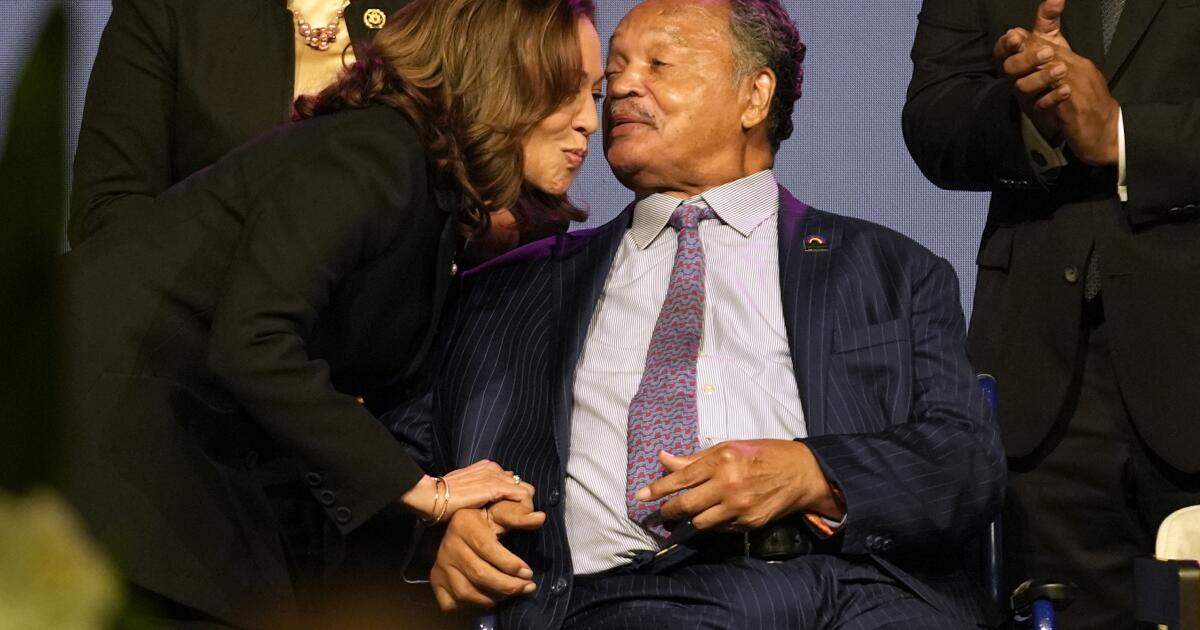
The Democratic National Convention will mark many transitions, not the least of them a generational passing of the torch.
President Biden this week is effectively handing control of the party, and the 2024 presidential nomination, to Vice President Kamala Harris — an 81-year-old with decades in public life ceding the national stage to his 59-year-old protege.
Sunday night, on a less prominent stage, the party’s most ardent progressives stopped to recognize another leader and another transition: Several hundred people streamed into the auditorium at Rainbow PUSH headquarters to rain praise and affirmation on the Rev. Jesse L. Jackson.
Jackson is 82 and living with Parkinson’s disease. A year ago, he appeared frail and spoke only a few words as he formally stepped down as president of the organization he created in the 1970s (the PUSH is for People United to Save Humanity) as a force for civil rights and economic equality.
Sitting in a wheelchair, Jackson soaked in the celebration Sunday night from the front of the auditorium where he had so many times urged on his followers. For more than three hours, he received a constant stream of admirers who said they had been trained and inspired by him over the decades. All the while, prominent Democrats spoke from the stage.
From Sen. Bernie Sanders (I-Vt.), to Rep. Maxine Waters (D-Los Angeles), to the Rev. Al Sharpton, to independent presidential candidate Cornel West, they agreed: Jackson and his work as a groundbreaking Black presidential candidate in 1984 and 1988 sowed the political field for the eventual blossoming of other Black leaders, including Harris.
Rep. Pramila Jayapal (D-Wash.) was the first of half a dozen left-leaning members of the House to say their careers might not have happened but for the inspiration of Jackson, who was born in Greenville, S.C., became a lieutenant to the Rev. Martin Luther King Jr., and launched his rights crusades in Chicago.
“He made sure that every single person had a place to stand. Everybody was somebody,” Jayapal said, echoing Jackson’s signature “I am somebody” refrain. She mentioned all the groups Jackson welcomed into his organization — multiple races, ethnicities, LGBTQ individuals, farmworkers and more. “And don’t forget that civil rights and economic justice were deeply intertwined, and nobody, nobody made that argument better than the Rev. Jesse Jackson.”
“We stand on your shoulders, Rev. Jesse Jackson,” Jayapal said to resounding applause. “For every elected official we will see on that [convention] stage for the next several days, we are here on your shoulders. We are here because you laid the path for us.”
The Nation, a venerable magazine of America’s political left, sponsored the Jackson celebration. Publisher and former editor Katrina vanden Heuvel carried a printed copy of the 1988 editorial in which the magazine endorsed Jackson. She noted that he had been an early voice for decreasing the size of the U.S. military and shifting the savings into domestic programs. Vanden Heuvel called Jackson “a man of peace and a great citizen of the world.”
Many of those on stage, including Rep. Ro Khanna (D-Fremont), spoke of how they had followed Jackson since their youth, galvanized into lives of public service by Jackson’s ringing speeches at the 1984 and 1988 Democratic conventions.
In 1988, Khanna recalled, Jackson had said he would not be content to be a small boat, plying the waters in a safe harbor; that he was intent on being out in a big boat, in the open ocean of the world’s great challenges, like apartheid in South Africa and economic injustice in America.
Jackson accumulated more delegates in the 1988 race than any other candidate except Democratic nominee Michael Dukakis, the governor of Massachusetts, who would go on to a resounding loss to George H.W. Bush. Two opponents who won fewer delegates than Jackson that year: then Sen. Joe Biden and future Vice President Al Gore.
Jackson’s ringing oratory to the delegates at that year’s Democratic convention built with the cadences and rhythm of his years as a Baptist preacher. No one listening that night, at the Omni in Atlanta, would have mistaken what they heard for a concession speech.
“I’m tired of sailing my little boat, far inside the harbor bar,” he said near the end of the address. “I want to go out where the big ships float, out on the deep where the great ones are. And should my frail craft prove too slight for waves that sweep those billows o’er, I’d rather go down in the stirring fight than drowse to death at the sheltered shore.”
“We’ve got to go out, my friends, where the big boats are.”
By the time Jackson concluded, roaring “Keep hope alive!” once, twice … four times, Democratic delegates were rhapsodic. Some wept.
When he spoke, Sharpton described Jackson’s remarkable rise, “born in the Deep South, in the back of the bus, and growing to be a world leader.” He credited Jackson with creating the language still spoken by progressives, particularly Black leaders.
Some might say that Jackson, laid low by disease, “can’t walk like he used to and talk like he used to,” Sharpton said.
His voice rising, the MSNBC commentator suggested those people would be wrong. “I want you to know that every time a Black opens their mouth and talks about hypocrisy, Jesse Jackson is talking!” he shouted, as the crowd jumped to its feet. “Every time we march, Jesse Jackson is marching!”
Applause and shouts of affirmation drowned out Sharpton’s conclusion. A video screen flashed on Jackson, a small smile breaking his lips.
More than 90 minutes later, the crowd had thinned. A moderator from the Nation hinted that Jackson might speak. All eyes trained on the front of the Rainbow PUSH auditorium and a hush fell. But no words came.
Soon, a platoon of Jackson aides pushed his wheelchair to a waiting van, which rolled away slowly into the Chicago night.


NEWYou can now listen to Fox News articles!
Former President Joe Biden appeared to briefly seek directions before exiting the stage after delivering remarks at a Democratic gala Saturday night, capping his speech with an awkward onstage moment.
After delivering a roughly 10-minute keynote speech at the Maryland Democratic Party’s “Fight Back & Win Gala” near Baltimore, the 83-year-old paused onstage and looked toward the wings before pointing in two different directions, seemingly trying to determine where to exit. After receiving guidance, Biden turned and walked off the stage with his back to the audience.
Unlike several other speakers at the gala, who exited on the opposite side of the stage after their remarks, Biden left in a different direction.
EX-DEM INSIDER REVEALS SHE WILL EXPOSE DEMOCRATS WHO COVERED UP BIDEN’S COGNITIVE DECLINE IN NEW BOOK
Former President Joe Biden exits the stage after delivering remarks at the Maryland Democratic Party’s Fight Back and Win Gala near Baltimore on Saturday. (CSPAN)
The moment came after Biden delivered one of his sharpest public critiques of President Donald Trump since leaving office. During his remarks, Biden defended his own administration’s record while accusing the Trump administration of corruption. He also took aim at what he described as Trump’s “vanity projects,” including renovations to the White House, changes at the Kennedy Center and the ongoing saga with the reflecting pool on the National Mall.
“Whoa, what a loser,” Biden said.
After pausing several times to cough throughout his remarks, Biden concluded with a call for Democrats to “fight back,” saying the country could overcome its challenges by acting together.
“Folks, I guarantee we can do this. And we will. We just remember who in the hell we are. We’re the United States of America,” Biden said. “There’s nothing, nothing beyond our capacity if we act together. So let’s get up and fight back, God darn it.”
The latest onstage moment comes just days after another widely shared incident at the opening of the Obama Presidential Center in Chicago.
WATCH: BIDEN LEFT SEARCHING FOR FAMILY AFTER OBAMA PRESIDENTIAL CENTER CEREMONY
The star-studded ceremony brought together former Presidents Barack Obama, Bill Clinton and George W. Bush, along with former Secretary of State Hillary Clinton, former Vice President Kamala Harris and other political leaders and entertainers. At the conclusion of the event, Biden remained onstage after others had exited before calling out, “Where’s my granddaughter?”
Former First Lady Jill Biden then returned to the stage, took his hand and guided him off.
SIGN UP TO GET THE POLITICS NEWSLETTER
Former U.S. President Joe Biden and Former first lady Jill Biden appear on stage during the dedication ceremony for the opening of the Barack Obama Presidential Center in John Lewis Plaza on June 18, 2026 in Chicago, Illinois. (Scott Olson / Getty Images)
Biden has largely stayed out of the public eye since withdrawing from the 2024 presidential race after facing intense pressure from fellow Democrats to end his reelection bid.
CLICK HERE TO DOWNLOAD THE FOX NEWS APP
The former president has since made only occasional public appearances and recently disclosed that he is undergoing treatment for Stage 4 prostate cancer.

WASHINGTON — A spectacular economic upturn is on its way, President Trump promised Americans last week, galvanized in part by a deal brokered this month to end his war with Iran.
“Very soon you’ll be at $2.50 a gallon for gasoline,” Trump told a crowd Wednesday night on the National Mall. The next year, he said, “is set for an economic boom the likes of which no nation has ever seen before.”
Economists are skeptical. The effects of the war and other factors driving inflation are likely to stick around for months, experts say, presenting an ongoing challenge to American households — and to Trump’s party as it seeks to retain control of Congress in November’s midterm elections.
Yesenia De La Torre, 24, from Culver City pumps gas at the Chevron gas station on Sawtelle Boulevard and Culver Boulevard on June 15. Despite an agreement announced Sunday to end the Iran war and open the Strait of Hormuz, high oil, gasoline prices and energy supply problems won’t be solved overnight.
(Kayla Bartkowski / Los Angeles Times)
The war’s end will not create “a complete snap-back,” said Patrick Harker, professor at the University of Pennsylvania Wharton School and former president of the Federal Reserve Bank of Philadelphia.
“Markets are still cautious, and the infrastructure that’s been destroyed [in the Middle East] is going to take a while to re-create,” Harker said. “Inflation’s going to stay elevated for a while.”
Oil prices were dropping last week — falling to their prewar level Friday — and average gas prices fell by 7 cents per gallon over a week ago. But it will take significant time for oil shipping to ramp up through the Strait of Hormuz, infrastructure to be rebuilt and gas prices to drop, said Michael Negron, senior fellow for economic opportunity at the Center for American Progress.
“I would expect there to be a continued inching downward,” Negron said, but “we’re not going to just go back within weeks to $2.90 per gallon.”
That means the prices of gas and of other essentials aren’t likely to improve dramatically before the midterms, in which affordability has become a driving issue. It could heighten challenges for Republicans, who are defending their majorities in the U.S. House and Senate, as Democrats seek to leverage the issue to gain ground.
Positive messaging about the economy from Trump and other officials “doesn’t really resonate” with Americans who are struggling to make ends meet, said Gina Plata-Nino of the Food Research and Action Center, a national anti-hunger advocacy organization.
“When you’re still making the same amount of money but there’s less for you to be able to pay [for] your basic needs — gas is more expensive, food is more expensive — it doesn’t really add up,” she said.

A fruit stand on West 7th Street sells bananas for $2 per bunch.
(Carlin Stiehl / For The Times)
Americans question the costs
The Iran war has cost the average American household between $775 and $1,300 so far in fuel and taxpayer costs, according to an analysis by Roger Pielke, a senior fellow at the American Enterprise Institute.
The national average gas price sat at $3.90 on Friday, according to AAA, and California’s average was $5.48 per gallon, down 13 cents from a week earlier.
The increase in oil prices has also affected diesel and fertilizer prices, creating a ripple effect through several sectors, including agriculture. Consumer prices rose 4.1% in May from a year earlier, putting the inflation gauge at a three-year high.
Trump has leaned on a bullish message about the economy, but he has largely dismissed Americans’ worries about affordability, calling it a “fake word” and a “hoax.” Last week, he undermined the first major progress by Congress on the issue, refusing to sign a bipartisan housing affordability bill after both chambers passed it.

President Donald Trump closes his eyes as Dr. Ben Carson, left, speaks during an event with the White House Religious Liberty Commission in the Oval Office on Friday.
(Anna Moneymaker / Getty Images)
Meanwhile, the president’s approval rating on the economy dropped to 33% last week in an NPR/PBS News/Marist Poll — his lowest ever for that poll and 3 points below former President Biden’s worst reading on the question during his term.
Nearly four-fifths of respondents said that gas prices present some sort of strain, with 34% categorizing it as a major strain and 44% calling it a minor strain. Half of respondents who said they were not vacationing this summer said cost was the reason.
And only 23% of Americans say the war was worth the costs, according to a Reuters/Ipsos poll conducted days after the Trump administration announced the framework agreement to end the conflict earlier this month.
“People [are] just feeling like they’re getting left behind,” Harker said. “That’s a very real, palpable feeling when you go out and talk to people. They’re worried.”
The president and his party need a midterms message that “real economic change” is coming, said Brian Reisinger, a rural policy analyst in Wisconsin and a former GOP strategist.
“It has to be substance behind the sell,” Reisinger said.

Senate Majority Leader John Thune (R-S.D.) speaks to reporters after the weekly Senate policy luncheons at the U.S. Capitol on Tuesday in Washington, D.C. Thune spoke on a meeting with President Trump on the Iran deal.
(Kevin Dietsch / Getty Images)
U.S.-Iran talks on shaky ground
Trump’s boosters have hailed the Iran deal as a victory for the president. And Trump has justified the shock to gas prices as “worth it not to have a nuclear weapon” in Iran, though the war has not achieved the president’s stated aims, which included the elimination of its nuclear program.
“President Trump was clear all along that there would be short-term, temporary disruptions to energy markets, and that oil and gas prices will quickly fall as soon as the Iran situation is resolved,” White House spokesperson Taylor Rogers said Friday.
How rapidly the conflict will be resolved is not yet clear. The U.S.-Iran negotiations were on shaky ground by week’s end, with each country offering diametrically opposed messaging on the status of key points of negotiation.
Analysts say much of the increase in traffic through the strait has been driven by the return of Iranian oil to global markets. Trump agreed in the controversial deal with Iran to lift sanctions on Iranian oil, allowing Tehran to resume trading its most valuable export and breaking with decades of U.S. policy.
The unpredictability of the talks is another factor keeping energy companies, shippers and insurers cautious for now, Negron said.
“Everything is to be negotiated in the next nearly two months,” he said. “It is natural to expect there to be additional risk priced into each barrel of oil, into the insurance people are paying, just because of the volatility and uncertainty of where we are.”

NEWYou can now listen to Fox News articles!
He wasn’t on the ballot, but President Donald Trump was a winner in Louisiana’s GOP Senate runoff election.
That’s because Trump-backed Rep. Julia Letlow defeated state Treasurer John Fleming to capture the Republican nomination, The Associated Press reported on Saturday.
Six weeks after denying Trump-targeted GOP Sen. Bill Cassidy a third six-year term in the Senate, a majority of Republican voters in the solidly red Gulf Coast state backed Letlow. Her victory in the runoff is seen as another victory for Trump as he works to fill the halls of Congress with loyal lawmakers for his final two years in the White House. And it’s another sign of the power of a Trump endorsement in Republican primaries.
Five years after he voted to convict Trump in his second impeachment trial, Cassidy was sent packing.
WATCH: CASSIDY DETAILS NEW BEHIND CLOSED DOORS CLASH WITH TRUMP
Sen. Bill Cassidy of Louisiana fist bumps a supporter during a campaign stop at a gun retailer and firing range in Baton Rouge on May 15, 2026, the eve of the state’s Senate primary. (Paul Steinhauser/Fox News)
Trump reacted to Letlow’s victory in a Truth Social post, calling Saturday’s result “great news.”
“Julia Letlow WON in Louisiana, beating conclusively a very strong and smart opponent,” Trump wrote. “Congratulations to Julia. She will be a truly GREAT Senator!”
Letlow, who was backed by Trump even before she entered the race in January, finished first in the primary, double digits ahead of Fleming, with Cassidy in third place. Since no candidate cracked 50% of the vote, Letlow and Fleming advanced to the runoff for the Republican nomination and Cassidy became the first elected Republican senator to lose renomination since Sen. Richard Lugar of Indiana in 2012.
Trump, celebrating Cassidy’s defeat, said on social media that “it’s nice to see that his political career is OVER!”
Cassidy, in a speech to supporters after conceding, took a jab at Trump, saying, “When you participate in democracy, sometimes it doesn’t turn out the way you want it to. But you don’t pout, you don’t whine. You don’t claim the election was stolen… You don’t manufacture some excuse.”
President Donald Trump stands with Rep. Julia Letlow during the Congressional Ball at the White House Grand Foyer in Washington, D.C., on Dec. 11, 2025. (Alex Wong/Getty Images)
Letlow, who was backed by Louisiana Gov. Jeff Landry, a top Trump ally, won her congressional seat in 2021, after her husband, Luke Letlow, died five days before being sworn into the U.S. House after his 2020 election victory for the seat she now holds. She highlighted her support from Trump throughout her Senate campaign.
Fleming, who spent eight years in Congress before serving as a White House deputy chief of staff during Trump’s first term, argued he was the most conservative candidate in the GOP Senate primary.
DEMOCRACY ’26: STAY UP TO DATE WITH THE FOX NEWS ELECTION HUB
Letlow will be considered the clear frontrunner in the midterm election against either farmer Jamie Davis or Navy veteran Gary Crockett, who are facing off in the Democratic Party runoff.
The brute force of the president’s endorsement power has been on display in GOP primaries over the past two months, with his candidates ousting incumbents he targeted in showdowns in Indiana, Kentucky and Texas, as well as the Louisiana primary.
But Trump’s endorsement streak in statewide and congressional Republican primaries was snapped three weeks ago when his last-minute endorsement of Republican Rep. Randy Feenstra of Iowa in the race to succeed retiring GOP Gov. Kim Reynolds wasn’t enough to propel the three-term congressman to victory.
Feenstra was narrowly edged by Zach Lahn, a businessman, farmer and former political strategist who was backed by the political wings of MAHA — the acronym for the Make America Healthy Again movement aligned with Trump’s Health Secretary Robert F. Kennedy Jr. — and Turning Point USA, the powerful conservative organization co-founded by the late Charlie Kirk.
Zach Lahn raises his fist in celebration after defeating his primary opponent in Iowa’s GOP gubernatorial race on Tuesday, June 2, 2026. (Zach Lahn for Governor via Facebook)
The president rebounded three weeks ago in South Carolina, as Trump-backed Lt. Gov. Pam Evette finished first in the GOP gubernatorial primary and longtime Trump ally Sen. Lindsey Graham won a majority of the vote in the Republican Senate primary, and avoided a runoff.
Graham, who was endorsed by Trump, was facing primary challenges from five candidates, including conservative businessman Mark Lynch, who took aim at the senator over his support for the war in Iran. Lynch was backed by some MAGA leaders who have been critical of the president.
Two weeks ago, Trump-backed candidates won two of the three top races in Georgia and Alabama, with the one setback coming against a billionaire businessman who shelled out over $100 million of his own money to boost his campaign.
Rep. Barry Moore, a House Freedom Caucus member and longtime Trump supporter who was endorsed by the president, comfortably defeated rival Jared Hudson, a former Navy SEAL sniper who was supported by some top names on the right, in solidly red Alabama’s GOP Senate runoff.
In battleground Georgia’s Republican Senate runoff, an 11th-hour endorsement by Trump helped boost Rep. Mike Collins, a MAGA champion, to victory over former college football coach Derek Dooley, who was backed by popular conservative Gov. Brian Kemp.
TRUMP’S ENDORSEMENT FAILS TO SAVE MAGA CANDIDATE AS BILLIONAIRE ADVANCES IN KEY GOVERNOR RACE
Collins will face Democratic Sen. Jon Ossoff in the general election in a race that’s among a handful that will likely decide if the GOP holds its slim majority in the chamber in the midterms.
CLICK HERE TO DOWNLOAD THE FOX NEWS APP
But in Georgia’s GOP gubernatorial runoff, the candidate Trump backed, Lt. Gov. Burt Jones, who was also endorsed by Kemp this past weekend, was defeated by billionaire businessman Rick Jackson, who ran as an outsider.
On Tuesday, Trump-backed first-time candidate Anthony Constantino, a businessman and former boxer, defeated Robert Smullen, a retired Marine Corps colonel and New York Assembly member who had the backing of the state party, in the upstate New York race to succeed retiring GOP Rep. Elise Stefanik.
Meanwhile, in South Carolina’s Republican gubernatorial runoff, Trump couldn’t lose.
That’s because, besides backing Evette, he also gave a last-minute endorsement to state Attorney General Alan Wilson, who ended up winning the showdown in a landslide.
-

 Florida5 minutes ago
Florida woman dies when SUV rolls backward in Port. St. Lucie driveway
-

 Georgia8 minutes ago
What is a Heat Dome and How it’s Impacting South Georgia
-

 Hawaii13 minutes ago
Journey adds second show to final performance in Hawaii | Honolulu Star-Advertiser
-

 Idaho20 minutes ago
Torrential thunderstorms, hail flood suburban streets with ice floats on first full summer weekend in Idaho
-

 Illinois23 minutes ago
Four people hospitalized after Joliet police chase ends in crash: officials
-

 Indiana28 minutes ago
Chicago Bears assess land at Wolf Lake Terminals for possible new stadium site
-

 Iowa35 minutes ago
Iowa State Basketball Has Potential Emerging Star on Their Roster
-

 Kansas38 minutes ago
DOJ sues Kansas over in-state tuition for undocumented immigrants; Governor fights back

