Politics
Activists troll disgraced former Harvard president with 'moving day' sign, U-Haul trucks outside campus home


A group of activists targeted disgraced former Harvard University President Claudine Gay outside her official campus residence Wednesday, trolling her with a “moving day” billboard and U-Haul trucks just one day after her resignation.
“It’s moving day Claudine Gay!” the digital mobile billboard read before changing to another screen that said, “Sponsored by the TENS OF THOUSANDS of Accuracy in Media activists who demanded your RESIGNATION.”
The billboard was accompanied by two U-Haul moving trucks, although it was not immediately clear if she had yet moved from the residence that serves as the official home of Harvard’s president.
CRITICS CHEER RESIGNATION OF ‘ANTISEMITIC PLAGIARIST’ HARVARD PRESIDENT CLAUDINE GAY: ‘BYE FELICIA’
A video board monitor truck drives around the neighborhood of the Harvard University President’s house Wednesday, Jan. 3, 2024. Harvard president Claudine Gay stepped down from her leadership position after plagiarism, antisemitism scandals. (Hans Pennink for Fox News Digital)
Accuracy in Media, the group responsible for the billboards, displayed messages for days outside Gay’s residence prior to her resignation on Tuesday. According to the organization, its mission is to use “citizen activism and investigative journalism to expose media bias, corruption, and public policy failings.”
Gay announced her resignation in a letter to members of the Harvard community, stating she was stepping down as president but would return to the Harvard faculty despite widespread plagiarism allegations against her, as well as the sharp backlash to her response concerning antisemitism on the university’s campus.
The Harvard University President’s house is seen at 33 Elmwood Avenue with a video board monitor Wednesday, Jan. 3, 2024. The home is believed to have been used by embattled Harvard president Claudine Gay before stepping down from her leadership position after plagiarism, antisemitism scandals. (Hans Pennink for Fox News Digital)
LIBERAL COLLEGE PROFESSORS RALLY AROUND HARVARD’S CLAUDINE GAY AFTER RESIGNATION: ‘FASCIST MOUTH-BREATHERS’
Gay, as well as the presidents of MIT and the University of Pennsylvania, faced a line of questioning at a House Education and the Workforce hearing last month over whether calls for intifada, or the genocide of Jews, on campus violated their institutions’ codes of conduct or policies against bullying and harassment.
All three faced harsh backlash for failing to clarify and insisted more context was needed. UPenn’s president also later stepped down from her position.
Former Harvard President Claudine Gay, who recently made headlines for refusing to say if genocide of Jews was against Harvard policy during a congressional hearing, has accused of multiple accounts of plagiarism in recent weeks. (Kevin Dietsch/Getty Images)
According to the Ivy League school’s newspaper, the Harvard Crimson, Gay’s resignation brought an end to the shortest Harvard presidency in the university’s history.
CLICK TO GET THE FOX NEWS APP
Fox News’ Danielle Wallace contributed to this report.

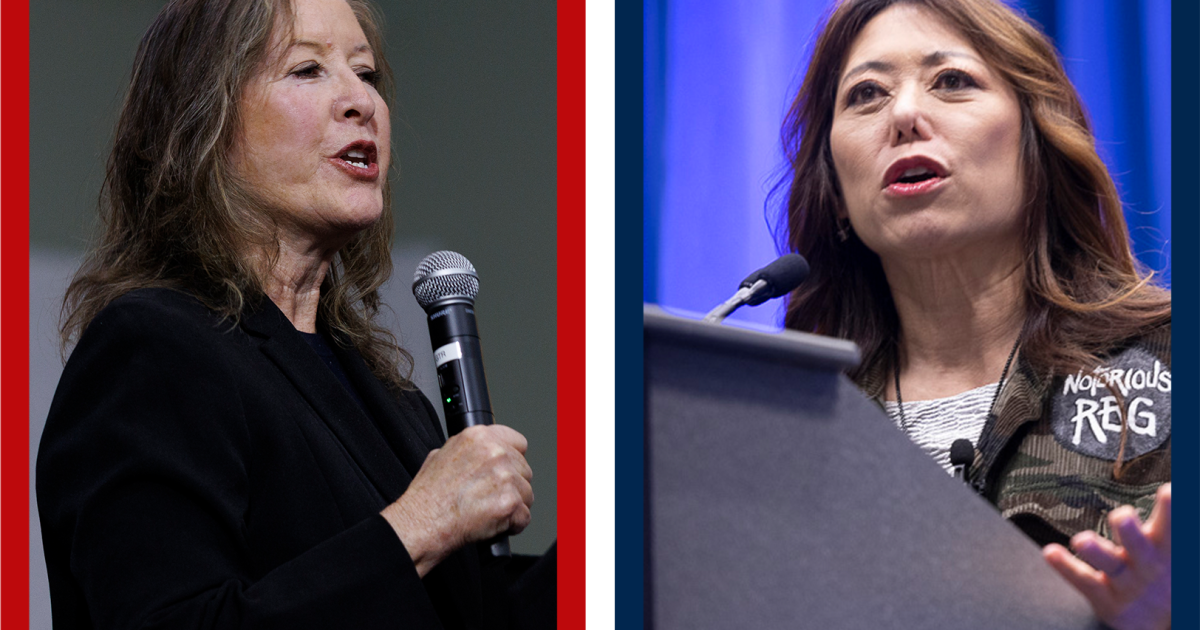
SACRAMENTO — State Treasurer Fiona Ma and former California Senate Majority Leader Gloria Romero have been declared the two winners of a crowded primary election for lieutenant governor, securing themselves spots on the November ballot.
Ma is a Democrat. Romero is a former Democrat who said she registered as a Republican after splitting with Democrats over the push to oust President Biden as the party’s presidential nominee in 2024.
Both were declared as the top-two winners by the Associated Press. Under California’s primary system, the first and second place finisher advances to the November general election, regardless of their political affiliation.
Ma is a certified public accountant serving as state treasurer. She previously sat on the California Board of Equalization and the San Francisco Board of Supervisors. She also served three terms in the California Assembly.
Romero is an adjunct professor at Pepperdine School of Public Policy. She served as a Democrat in the Assembly and state Senate, becoming the Senate’s first woman majority leader in 2005.
Other notable candidates included former Stockton Mayor Michael Tubbs and Josh Fryday, a member of Gov. Gavin Newsom’s cabinet. Both are Democrats.
The position is largely ceremonial. The lieutenant governor serves on various boards that oversee the University of California, California State University and community college systems, and can be called upon to break a tie in the state Senate. If the sitting governor dies, resigns or is removed from office, the lieutenant governor would assume the role.
Ma and Romero have offered some similar viewpoints. Both candidates previously expressed support for the death penalty and opposition to the state’s plan to ban the sale of new gas-powered cars by 2035.
Neither candidate supports the controversial Billionaire’s Tax Act. Romero, however, has further vowed to shun all potential tax increases.
Ma and Romero will now face off in November. The winner will replace Lt. Gov. Eleni Kounalakis, who is finishing her second term and could not seek reelection. Kounalakis instead ran for state treasurer.

Platner delivers primary victory speech
Graham Platner delivered a speech Tuesday acknowledging past shortcomings and criticizing incumbent GOP Sen. Susan Collins. (Credit: Matthew Symons for Fox News Digital)
NEWYou can now listen to Fox News articles!
Senate Republicans are warning that scandal-plagued oysterman Graham Platner could still defeat Sen. Susan Collins, R-Maine, if the party fails to take the race seriously.
Republicans are defending several seats in expectedly close races, including Nebraska, Iowa, North Carolina, Ohio and Texas, while seeking to flip Georgia. Maine is different: Sen. Susan Collins’ seat is the only Republican-held Senate seat in a state won by Kamala Harris in 2024, making it Democrats’ most direct path to returning Sen. Charles Schumer, D-N.Y., to the majority leader’s office, Republicans said in a memo circulated Wednesday.
“It is a fatal mistake to assume Platner is too damaged to win,” the National Republican Senatorial Committee (NRSC) memo obtained by Fox News — addressed to “Interested Parties” — read.
The NRSC agreed that Maine is the “linchpin” of the 35 seats up this year and that despite Platner’s Nazi tattoo, allegations of misogynist violence, arousal from biocide in port-a-johns, and his socialist policy platform, he remains a credible threat to the middle-of-the-road Collins.
SEE IT: MAINE VOTERS SOUND OFF ON PLATNER’S DIVISIVE CAMPAIGN AS CRUCIAL PRIMARY NEARS: ‘HE’S A DISGRACE’
Sen. Bernie Sanders, I-Vt., and Democratic U.S. Senate candidate Graham Platner stood together during a “Fighting Oligarchy” tour stop at the Collins Center for the Arts on the University of Maine campus on May 24, 2026, in Orono, Maine. (Joe Raedle/Getty Images)
“Senator Collins has won tough races before and can win this one, but only if we meet this moment with total urgency,” the NRSC said.
“Because Democrats cannot win the majority without [Collins’ seat], they have fully rallied around Graham Platner, an extremely flawed, far-left candidate who secured the nomination last night. Platner has captured his party’s financial backing, outraising Senator Collins in every quarter since entering the race. We must match both the energy and the money to retain the seat,” the memo said.
The NRSC said Democrats don’t view Platner’s race as being about the flawed candidate but rather about usurping power.
COLLINS SECURES GOP NOD IN MAINE SENATE BATTLE THAT COULD DECIDE GOP MAJORITY
The committee said any one of Platner’s multiple scandals would have ended most campaigns, but Democrats remain united around him. The NRSC reported that after former girlfriend Lyndsey Fifield’s allegations against Platner broke, Platner raised $200,000 in one day in what the campaign said was its best haul of the cycle.
“The political fundamentals in Maine remain challenging, and it is a fatal mistake to assume Platner is too damaged to win,” the NRSC said.
Collins is the last remaining federal Republican in New England and the only Republican in the Senate north or east of Pennsylvania.
The NRSC reported that Platner is beating Harris’ own margins by seven points while noting Collins has won tough races in the past, but this one is different.
Collins won her last race against former Maine House Speaker Sara Gideon by about eight points, and her last electoral loss was way back in 1994 when now-Sen. Angus King Jr., I-Maine, won the governorship in a four-way contest.
Republicans said in the memo that the biggest story in the past week about Platner is not his latest scandal, but the fact that Democrats are circling the wagons around him even more tightly and “propping him up.”
WATCH: DEM SENATORS EXCUSE PLATNER’S CONDUCT AT CRISIS HUDDLE WITH EMBATTLED MAINE CANDIDATE
Graham Platner addresses the crowd at his watch party after winning the Democratic nomination for U.S. Senate at a YMCA in Blue Hill, Maine, on June 9, 2026. Platner will face Republican Sen. Susan Collins in the election for the seat. (Matthew Symons for Fox News Digital)
They cited Silicon Valley Rep. Ro Khanna visiting Maine to hold a gushy interview-slash-ad with Platner and the fact that Democrats keep claiming Collins and Trump are worse than the left-winger.
“Gotta do what you gotta do,” the NRSC quoted former Biden deputy campaign manager Rob Flaherty, while noting that Rhode Island Sen. Sheldon Whitehouse publicly claimed Platner’s foibles are a “lot of nothing.”
They also pointed to one of the most influential Democratic operatives claiming that Platner’s flaws actually bolster his qualifications.
Platner had disparaged former Pennsylvania lieutenant gubernatorial candidate Teddy Daniels after video of the Purple Heart recipient being besieged and gravely wounded by the Taliban surfaced several years ago.
“We’ve got a f—ed up guy who could be 100 times more f—ed up than he is and he’d never be as f—ed up as what we’ve got in Washington,” said 1992 Bill Clinton campaign architect James Carville, who suggested that Platner’s apparent PTSD should be a symbol on the Hill as to why neoconservatives have been wrong about war powers.
“This is not a party abandoning its nominee. This is a party rationalizing, accepting, and preparing to fight,” the NRSC said.
CLICK HERE TO DOWNLOAD THE FOX NEWS APP
“Republicans need to match that urgency immediately. Define Platner. Defend Collins. Resource Maine,” they said. “Senator Collins has proven time and time again, through her work ethic and commitment to the people of Maine and America, that she will prevail.”
“This race can be won, but it will not win itself.”
Fox News Digital reached out to the NRSC, DSCC, Platner campaign and Collins campaign for further comment.

Supporters of a new Los Angeles County half-cent sales tax rallied Wednesday to celebrate what they framed as a historic win for the region’s cash-strapped healthcare system.
After a rocky election night that showed the tax lagging, supporters claimed victory Tuesday after the latest vote tally pushed Measure ER further over the 50% margin needed to pass. The measure would impose a new half-cent sales tax countywide, with the proceeds going toward local hospitals and clinics hit by federal funding cuts.
Jim Mangia, the chief executive of St. John’s Community Health who helped craft the measure, summed up the campaign as “grueling and expensive.”
“We had to ask an already overtaxed community — in the midst of runaway inflation and [an] affordability crisis — to tax themselves yet again,” he told a crowd of supporters Wednesday.
L.A. County already has a sales tax of 9.75%, and some cities add their own on top. Measure ER passing would raise the countywide sales tax to 10.25%, with some individual cities having a sales tax of more than 11%, according to the California Department of Tax and Fee Administration.
Despite a recent winning streak for sales taxes in L.A. County, some political observers had forecast doom for the measure, which came at a time of skyrocketing gas prices and cost-weary voters.
The largely informal opposition had consisted mainly of local cities that warned another sales tax would disproportionately burden the poorest residents and force shoppers across the county border in hopes of finding lower costs. Some city leaders had also dinged the county for misusing homelessness money generated from a previous sales tax and argued this new pot of dollars would be handled no better.
But supporters were able to eke out a narrow victory, according to the latest election returns, by emphasizing looming hospital closures and the temporary nature of the tax, which is set to sunset in five years.
“It’s a lifesaver to carry us through the storm we’re all in,” said county Supervisor Holly Mitchell, who led the push within the Board of Supervisors to get the measure on the ballot.
County leaders in February voted 4-1 to put the tax on the ballot after federal legislation threatened to pull health insurance from the poorest residents, leaving the already cash-strapped county to foot the bill for their care. Officials say cuts in the One Big Beautiful Bill Act are expected to slash more than $2 billion from the county’s budget for health services over the next three years.
“It’s disgusting what’s going to happen to our residents,” said Supervisor Hilda Solis, who championed the measure alongside Mitchell.
The tax, which begins Oct. 1, comes at a time of budget-tightening for the county amid rising labor costs and a $4-billion sex abuse settlement that is set to be paid out over the next five years.
Officials estimate the tax will bring in about $1 billion per year, which will go to clinics, hospitals and Planned Parenthood services that supporters say are at risk of closure without a new source of cash.
A similar proposed healthcare sales tax in Contra Costa County, meant to generate $150 million a year, was soundly rejected with about 57% of voters opposing the measure, according to votes tallied as of Wednesday.
-

 Sports3 minutes ago
Knicks miraculously overcome 29-point deficit to take commanding 3-1 lead in NBA Finals over Spurs
-

 Technology6 minutes ago
Do not click fake ‘account recovery’ Amazon email
-
 Business11 minutes ago
The FBI serves a search warrant at the Garden Grove chemical plant
-
 Entertainment18 minutes ago
Bill Cody, the voice of WSM Radio and the Grand Ole Opry, dies at 67
-

 Lifestyle21 minutes ago
Inside Farfetch’s Strategy for a New Era of Luxury Experience
-
Politics26 minutes ago
Democrat Fiona Ma, Republican Gloria Romero to face off in race for lieutenant governor
-
 Science33 minutes ago
UC Davis favored less qualified Black, Latino med school applicants, Justice Department claims
-
 Sports36 minutes ago
With eyes of world on Mexico City, El Tri kicks off 2026 World Cup against South Africa

