Politics
Abcarian: Why are Republicans making it harder for some people to vote? It's not just partisanship

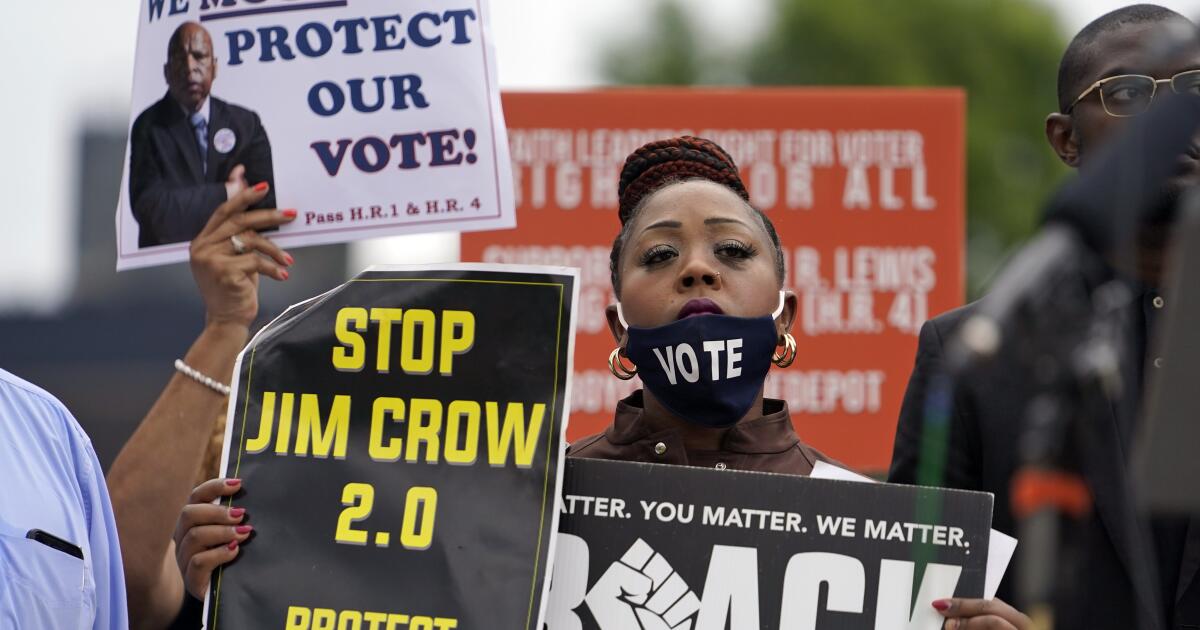
Of all the modern Supreme Court’s incredibly disappointing rulings, gutting the Voting Rights Act of 1965 is near the top, second only to its catastrophic decision to rip away half a century of reproductive rights from American women.
Until the court’s shocking 2013 Shelby County vs. Holder decision, states and counties with histories of racial discrimination were required to get approval from the Justice Department — known as “preclearance” — for redistricting or changes to voting laws. The conservative members of the Supreme Court changed all that with a 5-4 decision.
“There is no denying,” Chief Justice John G. Roberts Jr. wrote, “that the conditions that originally justified these measures no longer characterize voting in the covered jurisdictions.”
That’s because these measures were working, sir.
As the director of the Brennan Center for Justice’s Voting Rights Program, Sean Morales-Doyle, reminded me last week, Justice Ruth Bader Ginsburg acidly noted in her dissent that “throwing out preclearance when it has worked and is continuing to work to stop discriminatory changes is like throwing away your umbrella in a rainstorm because you are not getting wet.”
These days, thanks to our misguided court, it’s raining voter suppression laws.
The Brennan Center has found that at least 29 states have passed 94 restrictive voting laws, only a few of which have been blocked by courts or repealed. Freed from federal oversight, states such as Georgia, Alabama, Texas, Mississippi and South Carolina have gone to town, enacting dozens of new restrictions in a cynical effort to make it more difficult for Black, brown and Indigenous voters and college students, all of whom lean Democratic, to cast ballots.
A handy primer on the issue is the 30-minute documentary “Suppressed and Sabotaged,” by Brave New Films. Released in 2022 and re-released this year, the documentary examines the different ways Republican states have attempted to disenfranchise voters they don’t like. I recommend taking your blood pressure medication before viewing it.
The techniques include reducing the number of polling places in Black precincts, erecting barriers to voter registration, wantonly purging voter rolls, changing the rules for absentee ballots, slashing the number of drop boxes and passing voter ID laws with the pretext of preventing voter fraud, a rare occurrence that MAGA Republicans have become hysterical about.
The documentary focuses on the 2018 Georgia gubernatorial election, which is considered by some voting rights activists to be the proving ground for many of the voter suppression techniques that would later be adopted by other states.
In that race, then-Georgia lawmaker Stacey Abrams came very close to beating Republican Secretary of State Brian Kemp and becoming the country’s first Black female governor. Kemp, who was running for governor while overseeing the election, conducted what many viewed as a reckless purge of the voter rolls. More than half a million people, around 8% of registered voters, were excised by Kemp in 2017. More than 100,000 of them were cut not because they died, moved or went to prison but because they had chosen not to vote in two previous elections.
Black voters encountered unique barriers in Georgia’s 2018 election. As Politico reported, they “waited for hours in lines that wrapped around their voting locations. Some were removed from the voter rolls arbitrarily, forcing them to fill out confusing provisional ballots on election day. Others stayed home altogether.”
Kemp won by fewer than 55,000 votes, or 1.4% of the total votes cast.
Abrams supporter Peggy Xu, now a 28-year-old attorney in Washington, D.C., was among the tens of thousands of Georgia voters who never received the absentee ballots they requested that year. As a student, she had voted absentee in Georgia for years without any trouble.
“I requested the absentee ballot very early, as soon as I knew I was moving,” she told me. “I checked my mailbox every day. It became this horrible ritual.” She was hopeful, then anxious, then demoralized. The ballot never came, and she never discovered why.
“It sowed distrust in me,” she said. “This upcoming election in 2024 is astronomically important. Maybe I should eat the cost and fly back and vote in person?”
The Brennan Center made a fascinating discovery when it analyzed exactly where these restrictive voting laws were concentrated. It’s too simple to say voter suppression laws spring solely from naked Republican partisanship. They also arise from racial animus.
“White racial resentment — and not just party and competitiveness alone — goes a long way toward explaining the phenomenon,” Kevin Morris, a Brennan Center voting policy scholar, wrote in his 2022 report.
As Morales-Doyle put it: “Legislators who represent the whitest districts in the most diverse states are the most likely to introduce restrictive legislation. This is consistent with the idea of ‘racial threat,’ of people responding to the growing political power of communities of color in these places.”
“White racial resentment,” it’s worth noting, is a metric developed in the 1980s by political scientists Donald Kinder and Lynn M. Sanders for the American National Election Studies. The regular national surveys ask respondents whether and how much they attribute socioeconomic disparities between Black and white Americans to slavery and racial discrimination or to a lack of hard work and perseverance. “The more an individual agrees with the general sentiment that Black people’s lack of effort is the primary reason for racial disparities, the higher that individual’s racial resentment score,” wrote the Brennan Center’s Theodore Johnson. “And study after study has shown that people who voted for Donald Trump had higher levels of racial resentment than those who did not.”
Until about 2008, white Republicans and Democrats demonstrated similar rates of racial resentment. But after the election of the first Black president, those rates diverged dramatically. Racial resentment levels among white Democrats plunged, and they rose among white Republicans.
On Thursday, the Supreme Court struck again, ruling that South Carolina could keep using a congressional map that, according to a lower court, unconstitutionally shifts tens of thousands of Black voters to a different district to favor Republicans.
Not all the news is bad, though, as Morales-Doyle pointed out. In 2022, many election deniers ran for office, including to serve as election officials, but none of those candidates prevailed in the battleground states.
“We still live in a democracy,” he said. “It has its flaws, but voters want people to have access to voting. That is my reason for hope.”


NEWYou can now listen to Fox News articles!
A coalition of blue states and jurisdictions is suing the Trump administration over new Medicaid work requirements designed to prevent fraud, arguing the policy unlawfully restricts access to health care coverage.
The lawsuit, filed by at least 25 states and the District of Columbia, alleges the newly implemented Interim Final Rule (IFR) — issued by the Centers for Medicare & Medicaid Services (CMS) — violates federal law and departs from Congress’ original intent and early CMS guidance.
The IFR requires certain individuals to provide documentation proving they are exempt from Medicaid rules requiring enrollees to work, volunteer or attend school due to severe medical conditions.
Before the rule was issued in early June, highly vulnerable Medicaid recipients were set to be automatically exempt from such requirements. Agencies would have granted those exemptions by reviewing existing health records, without requiring individuals to complete additional paperwork ahead of the requirements taking effect in January 2027.
DR. OZ UNVEILS MEDICAID OVERHAUL, CLAMPS DOWN ON $2B FOR ILLEGAL IMMIGRANTS AND MANDATES WORK FOR ABLE-BODIED
Dr. Mehmet Oz, administrator of the Centers for Medicare & Medicaid Services, discussed a number of healthcare topics during a news conference with reporters on Tuesday, June 2, 2026. (Aaron Schwartz/CNP/Bloomberg via Getty Images)
The lawsuit names Dr. Mehmet Oz, administrator of the Centers for Medicare & Medicaid Services (CMS), which issued the IFR, and Robert F. Kennedy Jr., secretary of Health and Human Services (HHS), as defendants.
Oz previously argued that such guardrails are designed to prevent programs from being “defrauded into a turmoil,” adding that able-bodied enrollees receiving American tax dollars should contribute to society.
“If you can work, you should get up and work,” Oz said.
“If we put guardrails around these programs, we’ll allow them to thrive. I’m here because I love Medicaid. The president has already said he loves and cherishes Medicaid and Medicare. … We cannot allow these programs to be defrauded into a turmoil that they cannot pull up from. If we love these programs, we will make the difficult decisions.”
The new rule would require able-bodied individuals to work 20 hours a week, volunteer, or pursue education while enrolled in free healthcare coverage.
Fox News reached out to the White House and HHS for comment.
FED AUDIT, EMERGENCY MEDICAID UNDERCUT DEMS ON ILLEGAL IMMIGRANT HEALTH COVERAGE
Health and Human Services Secretary Robert F. Kennedy Jr. speaks during an interview. ((Photo by Jason Mendez/Getty Images))
The plaintiffs involve California, Connecticut, Delaware, the District of Columbia, Hawaii, Illinois, Maine, Maryland, Massachusetts, New Jersey, New York, Oregon, Rhode Island, Vermont, Washington, Arizona, Colorado, Michigan, Minnesota, Nevada, New Mexico, North Carolina, Pennsylvania, Virginia, Wisconsin and Kentucky.
“People with disabilities, patients in the middle of cancer treatment, or those struggling with another serious or complex health condition, shouldn’t be at risk of losing the care that helps maintain their health,” the suit stated.
REPUBLICANS PRAISE ‘BIG, BEAUTIFUL BILL’S’ WORK REQUIREMENT FOR MEDICAID: ‘WE’VE GOT TO GET BACK TO WORK’
According to the suit, CMS’s own projections estimate that 2.3 million enrollees will lose Medicaid coverage in the first year alone.
The agency also estimates that 7% of enrollees who are working or qualify for an exemption will lose coverage due to confusing paperwork requirements, strict deadlines or missing documentation, according to the document.
Beginning in 2028, enrollees who do not have immediate medical records on file would be limited to a single opportunity to submit a “self-attestation” form declaring, under penalty of perjury, that they are too sick to work.
Under previous guidance, enrollees were allowed to use self-attestation multiple times as their medical needs evolved.
An examination bed sits inside a medical clinic. (AP Photo/Matt York)
CLICK HERE TO DOWNLOAD THE FOX NEWS APP
In addition, plaintiffs said the new rules would force states to abandon automated systems they have already invested in and instead build more complex and costly manual review processes.
As the Aug. 31 deadline to mail notices to Medicaid enrollees approaches, the plaintiffs are seeking a temporary stay and a preliminary injunction to block CMS and HHS from enforcing the rules.

California Democratic senators failed to advance a proposal Tuesday that would have barred registered sex offenders from running for office.
State Sen. Scott Wiener (D-San Francisco) voted against Assembly Bill 2753, while fellow Sens. Tom Umberg (D-Santa Ana) and Ben Allen (D-Santa Monica) abstained from a vote that ultimately failed 2-1-2 in the Senate Elections and Constitutional Committee.
The committee’s lone Republican, Steve Choi (R-Irvine), and Sen. Sabrina Cervantes (D-Riverside) voted in favor of the bill, which is likely dead because it failed to get support from a majority of the five-member panel.
AB 2753 could be reviewed in a floor session Thursday, but staff from the office of Assemblywoman Esmeralda Soria (D-Fresno), who authored the bill, are conceding that’s unlikely.
The defeat comes on the heels of unanimous support, including a 60-0 vote in favor on the Assembly Floor on May 7.
“I am deeply disappointed and disheartened after the Senate Elections Committee has failed to advance AB 2753, a bill that would have prohibited any registered sex offender in the State of California from running for local or state public office,” Soria said in a statement.
The bill’s wording said the legislation would “prohibit a person from being a candidate for, or elected to, any state or local elective office if the person has ever been required to register as a sex offender.”
Inquiries to the offices of Sens. Wiener, Umberg and Allen were not immediately returned.
Sex offenses in California are broken up into three tiers. First-tier offenses call for a minimum of 10 years placement on the sex offender registry. Second-tier offenses call for a minimum of 20 years and third tier crimes could result in a lifetime on the registry.
The types of offenses for each tier vary. Tier 1 offenses range from indecent exposure to misdemeanor child pornography and sexual battery. Tier 2 includes incest and penetration with a foreign object, and Tier 3 includes felony possession of child pornography, rape and pimping and pandering of a minor.
Wiener asked for amendments to the bill during the bill’s review and in the committee meeting, including that the lifetime ban only be applied to Tier 3 members.
He pointed to committee analysis of the bill that could affect so-called “Romeo and Juliet” couples — those close in age, for instance with one partner being 19 and the other being 17. If the younger partner sent sexually explicit digital content to the older partner (a misdemeanor), this law could ban the older partner from public office for life.
There were also concerns listed in the analysis that the registry, which dates back to 1947, could include LGBTQ+ offenders from decades ago who were convicted of offenses that are no longer crimes.
Wiener mentioned in the committee meeting civil rights strategist and fighter Bayard Rustin being placed on the California sex offender’s registry list after being arrested by Pasadena Police for having consensual sex with another man in 1953.
“Without the amendment contained in the analysis, I will be voting ‘no’ on this bill and recommending that the committee vote ‘no,’” Wiener said at the committee hearing.
He added that the sex offender list was “not punishment,” but instead “a tool for law enforcement to monitor who may potentially cause a risk.”
While Soria agreed to one bill amendment, she did not accept other provisions, including the elimination of lifetime bans on Tier 1 or 2 offenses.
“The bottom line is this: I was not willing to make additional amendments to this bill,” she said. “I made a promise to my community that I would do everything in my power to ensure they would never have to go through something like this again. Accepting additional amendments to this bill would have jeopardized that promise.”
Some of the impetus behind her bill revolved around the June 2 Fresno City Council election. Registered sex offender Rene Campos fell short of the necessary votes in his bid to run for Central Valley Council.
He was charged with possession of child pornography in 2018 and hosted his campaign kickoff in front of an elementary school.
Nelson Esparza, Fresno City Council President, spoke at the Senate Elections and Constitutional Committee meeting in favor of AB 2753.
“My office received dozens of calls from our residents asking how this could be allowed,” Esparza said of Campos’ candidacy. “AB 2753 closes this loophole.”
It’s unclear if this bill will be reintroduced next year at least at the Assembly level, as Soria is running for the state senate in November.
Politics
Mamdani ripped for claiming victory over capitalism after NYC’s multi-billion dollar taxpayer funded bailout

NEWYou can now listen to Fox News articles!
New York City’s mayor is again under fire after spewing outlandish claims that his socialist policies are to credit for a balanced budget in the Big Apple, just after the city received a multi-billion dollar bailout from the state.
“In January, our administration inherited a $12 billion budget deficit — a fiscal crisis greater than the Great Recession,” Mayor Zohran Mamdani said in a Tuesday post on X announcing that the debt had been cleared.
“We balanced the budget by taxing the rich and making government more efficient,” Mamdani continued. “We did not balance this budget on the backs of working people, and we never will.”
New York City Mayor Zohran Mamdani speaks during a primary-night watch party for NYC Congressional candidate Claire Valdez at 99 Scott Studio on June 23, 2026 in the East Williamsburg neighborhood of the Brooklyn borough in New York City. (Michael M. Santiago/Getty Images)
MAMDANI ALLOCATES $500K FOR REPARATIONS TALKS AS NYC FACES $5.4B DEFICIT
But the real reason the budget it balanced is because the city was handed $1.5 billion by the state of New York in January — funded by working class taxpayers across the state — as part of a multi-year plan to bail out the fiscally-challenged city. In late May, the city received another $4 billion.
Of the combined $8 billion provided to the city’s bailout fund under former Mayor Eric Adams’ tenure and now Mamdani’s mayorship, $5 billion was directly earmarked for the city to address fiscal measures. This includes allowing city government to defer pension contributions to close the budgetary gap.
Mamdani’s claims about socialist policies producing results — and his failure to mention the massive bailouts provided by taxpayer dollars — did not fly on social media.
New York Gov. Kathy Hochul holds media availability press conference and makes an announcement on abortion rights at the office on 633 3rd Avenue. (Lev Radin/Pacific Press/LightRocket via Getty Images)
MAMDANI ALLOCATES $500K FOR REPARATIONS TALKS AS NYC FACES $5.4B DEFICIT
“This is a lie,” independent journalist Nick Shirley said in a reply to the mayor.
“You balanced the budget by borrowing billions from the NY state government which pushed back pension payments, so you literally took money from ‘the backs of hardworking people.’ Don’t get it twisted,” he added.
Commentator and journalist Nick Sortor also flamed the mayor over the loan and his classification of the bailout.
“Are you saying New Yorkers can ‘balance their budgets’ by taking out massive credit card loans?” he asked sarcastically.
Independent journalist Nick Shirley sat down for an interview with Riley Gaines as part of the launch of Outkick’s “The Riley Gaines Show.” (OutKick)
BROADCAST NETWORKS TOUT MAMDANI’S VICTORIES, PROCLAIM SOCIALISM IS ‘RESONATING’
“Mamdani balanced the budget by taking money from Albany, who in turn taxed Rochester and Buffalo” another social media user said. “That’s who is paying for all of Mamdani’s free crap.”
In a press conference earlier in the day, Mamdani claimed victory over capitalism.
“Throughout this process I have been reminded of the words of the Austrian economist Friedrich Hayek: ‘if socialists understood economics, they wouldn’t be socialists.’”
A man sleeps on the E train, one of the subway lines most utilized by homeless New Yorkers for shelter, in Queens, New York, on Monday, April 7, 2025. (Victor J. Blue for The Washington Post/Getty Images)
After the Republican National Convention (RNC) posted that clip, Mamdani also faced ridicule for that.
“It always looks good at first until the chickens come home to roost,” one person replied.
CLICK HERE TO DOWNLOAD THE FOX NEWS APP
“He’ll soon ‘deliver’ bread lines instead,” said another.
Mamdani’s office did not return Fox News Digital’s request for comment.
-
Missouri3 minutes ago
Missouri Lottery Powerball, Pick 3 winning numbers for July 1, 2026
-

 Montana8 minutes ago
Montana state auditor urges homeowners to review flood, wildfire insurance coverage
-

 Nebraska15 minutes ago
Online sports betting petition heads to Nebraska ballot review as opposition mounts
-

 Nevada18 minutes ago
Nevada Test Site shaped U.S. nuclear history, Southern Nevada’s growth
-

 New Hampshire23 minutes ago
Driver dead, Mass. woman and several children sent to hospital, in 3-vehicle crash in Nashua, N.H. – The Boston Globe
-

 New Jersey30 minutes ago
Empire State Building daredevil couple are New Jersey residents
-

 New Mexico33 minutes ago
Law limiting license plate reader data being shared goes into effect in New Mexico
-

 North Carolina38 minutes ago
Western NC activists push for statewide ban on new data center construction

