Politics
A woman's grisly death inflames debate over how California manages problem black bears


DOWNIEVILLE, Calif. — Patrice Miller, 71, lived by herself in a small yellow house beneath towering mountain peaks on the edge of a burbling river in this Sierra County village. She doted on her cats and her exotic orchids, and was known to neighbors for her delicious homemade bread. One fall afternoon, after Miller had failed for several days to make her customary appearance at the town market, a store clerk asked authorities to check on her.
A short time later, a sheriff’s deputy found Miller’s lifeless body in her kitchen. Her right leg and left arm had been partially gnawed off. On the floor around her were the large paw prints of a bear.
Months after her death, officials would make a stunning disclosure, revealing that an autopsy had determined that Miller had likely been killed by the animal after it broke into her home. It marked the first known instance in California history of a fatal bear attack on a human.
But amid the contentious politics around black bears and other apex predators in California, not everyone accepts the official version of how she died.
“We don’t believe the bear did it,” said Ann Bryant, executive director of the Bear League in the Tahoe Basin. “And I will go on record as saying that. … We’ve never had a bear kill anybody.”
The story of Miller’s grisly end — and the increasingly heated battles around predators in California — have come roaring into the state Capitol this spring. Lawmakers representing conservative rural districts in the state’s rugged northern reaches argue that their communities are under attack, and point to Miller as one example of the worst that can happen. One solution they have pushed is changing the law to allow people to set packs of hunting dogs after bears to haze them. A similar measure has been floated — for now unsuccessfully — to ward off mountain lions considered a threat.
Wildlife conservation advocates are aghast. They say turning dogs on bears is barbaric and won’t make anyone safer. They contend the proposed laws don’t reflect a scientifically backed approach to managing wild populations but instead are pro-hunting bills dressed up in the guise of public safety. The real solution, they say, is for humans living near bears to learn to safely co-exist by not leaving out food or otherwise attracting them.
“These people are using [Miller’s death] to try to start hounding bears again,” said Bryant, who maintains that Miller, who was in poor health, must have died before the bear came into her home and devoured her. “She would roll in her grave if she knew that in her death people would create a situation where people were going to mistreat bears, because she loved bears.”
In a recent report, the Department of Fish and Wildlife estimates there are now 60,000 black bears roaming California and notes a marked increase in reports of human-bear conflicts.
(John Axtell / Nevada Department of Wildlife)
Founded in 1849, Downieville, population 300, is one of California’s oldest towns, and also one of its quaintest. Colorfully painted wooden buildings sit at the junction of two rivers, beneath majestic pines and mountain peaks.
Along with tourists, who flood in in the summer for rafting and mountain biking, the town also receives frequent visits from bears and mountain lions. More recently, wolves have arrived with deadly force, snatching domesticated cattle off the open pastures that stretch across the plains on the other side of the mountains east of town.
Miller wound up here about a decade ago, at the end of a rich, complicated life. She had worked in an oil refinery, and also as a contractor. She was a master gardener, expert at transplanting Japanese maples, according to her neighbor, Patty Hall. She was a voracious reader and a skilled pianist. But she was also in poor health and had struggled with substance abuse, according to neighbors and officials.
Longtime residents in the area were used to the challenges of living among wild animals. But in the summer of 2023, Sierra County Sheriff Mike Fisher said he started getting an overwhelming number of calls about problem bears.
“We had three or four habituated bears that were constantly here in town,” said Fisher. “They had zero fear. I would say, almost daily, we were having to go out and chase these bears away, haze them.”
But bears have a sharp sense of smell, a long memory for food sources and an incredible sense of direction. If a tourist tosses them a pizza crust or the last bits of an ice cream cone, or leaves the lid off a trash can, they will return again and again, even if they are relocated miles away.
That summer, Fisher said, no matter what he did, the bears kept lumbering back into town. It was unlike anything he had experienced, he said, and he had grown up in Downieville. “A police car with an air horn or the siren, we would push the bear up out of the community. Fifteen minutes later, they were right back downtown,” he said.

Founded in 1849, Downieville, population 300, is one of California’s oldest towns and also one of its quaintest.
(Myung J. Chun / Los Angeles Times)
And then there were the bears harassing Miller and her neighbors.
“There were three bears,” recalled Hall, who lives just up the hill from the home Miller rented. “Twice a night they would walk up and down our [porch] stairs. The Ring cameras were constantly going off.”
Fisher said some of Miller’s neighbors complained that she was part of the lure, because she was not disposing of her garbage properly. Some also alleged she was tossing food on her porch for her cats — and that the bears were coming for it. Miller’s daughter later told sheriff’s officials that bears were “constantly trying” to get into her house, and that “her mother had physically hit one” to keep it out. One particular bear, which Miller had nicknamed “Big Bastard,” was a frequent pest.
Fifty miles from Downieville, in the Lake Tahoe Basin, the Bear League was getting calls about Miller, too. The organization, which Bryant founded more than two decades ago, seeks to protect bears by helping residents coexist with them. This includes educating people about locking down their trash and helping to haze bears away from homes.
“We got calls [from her neighbors] that told us she had been feeding the bears, tossing food out to them, and let them come into her house,” Bryant said. She added that some thought, erroneously, that the Bear League was a government organization, and “maybe we had the ability to enforce the law” against feeding bears.
Hall, Miller’s friend, told The Times that Miller was not feeding bears. Still, the problems continued.
Eventually, officials with the California Department of Fish and Wildlife were called and told Miller she could sign a “depredation permit,” after which authorities could kill bears trying to get into her house. But Miller declined to do so, Fisher said.
In early November, Miller stopped showing up around town, prompting calls for a welfare check.
A little before 3 p.m. on Nov. 8, 2023, Deputy Malcolm Fadden approached Miller’s home, which was a short walk from the sheriff’s office. The security bars on the kitchen window had been ripped off. The window itself had been busted from the outside.
“I knocked on the door,” Fadden wrote in his report, but got no answer.

Patrice Miller was found dead in her rental cottage in November 2023. Bear advocates take issue with an autopsy report that said she probably was killed in a bear attack.
(Jessica Garrison / Los Angeles Times)
Through the window, he saw blood streaked across the living room floor. He took out his gun and burst into the house, where he was greeted by a giant pile of bear scat. He found Miller in the kitchen, her half-eaten body surrounded by food and garbage, which, Fadden wrote, had been “apparently scattered by bears.”
Fisher was horrified. Already frustrated at what he saw as the Department of Fish and Wildlife’s lackluster response to the escalating bear incursions that summer, now he wanted the bear that had fed on Miller to be trapped and killed.
He said the department told him that for the bear to be killed, “the person who lives at the house has to sign the [depredation] permit.” Fisher said he responded: “How many times do I have to tell you the person who lives at that house was eaten by the bear?”
This was the start of a long-running conflict between the sheriff and agency officials that would complicate the release of the autopsy findings about Miller’s death, and also convince Fisher that more aggressive steps were needed to protect his community.
Eventually, Fisher managed to get a depredation permit for the bear that had fed on Miller; his deputies tracked down her landlord, who as the homeowner could sign it. Wildlife officials set up a trap near Miller’s house, and in short order, a bear was caught.
But, according to Fisher, officials initially said it wasn’t the same bear. They said DNA tests showed that the bear who had eaten her was male, and the bear they had caught appeared to be female. They intended to release the bear, he said.
Fisher padlocked the cage, and threatened to call the media. In response, he said, wildlife officials sent a biologist, who determined the bear in the trap was male. It was shot that night.
At that point, few people, including Fisher, believed that the bear had actually killed Miller, as opposed to feeding on her after she died of natural causes. Though there are recorded instances of fatal black bear maulings in other U.S. states, they are rare, and there had been no reports of one in California. Fisher issued a news release saying that the death was under investigation, but that “it is believed that Patrice Miller passed away before a bear, possibly drawn by the scent or other factors, accessed the residence.”
After performing an autopsy, however, the pathologist on contract with Sierra County came to a different conclusion. She issued a report that found that Miller had “deep hemorrhage of the face and neck“ as well as “puncture injuries (consistent with claw ‘swipe’ or ‘slap’).” These injuries, she noted, were “characteristics more suggestive of a vital reaction by a living person.” In short: The pathologist found that Miller was probably killed by the bear.
Because of Fisher’s feud with Fish and Wildlife, that autopsy report, dated Jan. 4, 2024, wouldn’t become public for months.
Fisher said the state agency was refusing to provide him with copies of the DNA analysis of the bear that had been trapped in Miller’s yard. He wanted to see for himself that it matched the DNA evidence collected at her home, saying he hated the thought that a bear that had feasted on a person might still be roaming his town.
“I requested DNA from Fish and Wildlife, and they refused to provide it to me,” he said. “So I withheld the coroner’s report. We stopped talking.”
He said he verbally told department officials that the pathologist believed Miller had been killed by the bear — a seemingly noteworthy development. He said that officials responded: “I guess we’ll see when we get the report.”
In an email to The Times, state wildlife officials confirmed that Fisher had verbally shared the results of the autopsy report, but said they felt they needed to see the report to do their “due diligence before making an announcement about the first fatal bear attack in California.” The agency had sent an investigator to the scene after Miller’s death, who like Fisher and his deputies, thought the evidence suggested she had died of natural causes, said agency spokesperson Peter Tira.
By the time Fisher got the autopsy report, it was deep winter in the mountains, and bear activity decreased. Then came spring, and along with the blossoms, the bears came back to Downieville.
Bears were knocking over trash cans and breaking into cars. In May, residents on Main Street reported that a bear had broken into multiple houses, including one incursion that involved a bear standing over 82-year-old Dale Hunter as he napped on his couch.
A few days later, a bear tried to break into the cafeteria at Downieville High School while students were at school.
Fisher declared the bear a threat to public safety. Fish and Wildlife eventually issued a depredation permit, and the bear was shot.
That led to a story in the Mountain Messenger, the local paper. In it, the sheriff dropped a bombshell: “Miller was mauled to death after a black bear entered her home,” the paper reported. The story went on to say that the sheriff had made “numerous attempts” to inform Fish and Wildlife “about Miller’s death and more recent dangerous situations.”
After the story ran, state Sen. Megan Dahle, a Lassen County Republican who at the time served in the Assembly, set up a conciliatory meeting between Fish and Wildlife and Fisher. They have been meeting regularly ever since, Fisher said.
Fisher got his DNA results confirming that the bear trapped in Miller’s yard was the same bear that had eaten her. And Fish and Wildlife officials finally got a copy of the pathology report, which said Miller was probably alive when she encountered the bear.
The revelation made headlines around the state. “We’re in new territory,” Capt. Patrick Foy of Fish and Wildlife’s law enforcement division told the San Francisco Chronicle.
Bryant and other bear advocates found the release of such a significant finding so long after the fact confounding.
“I absolutely do not believe it,” Bryant said. If the bear had killed her, Bryant added, “the evidence should have been so clear, like immediately.”
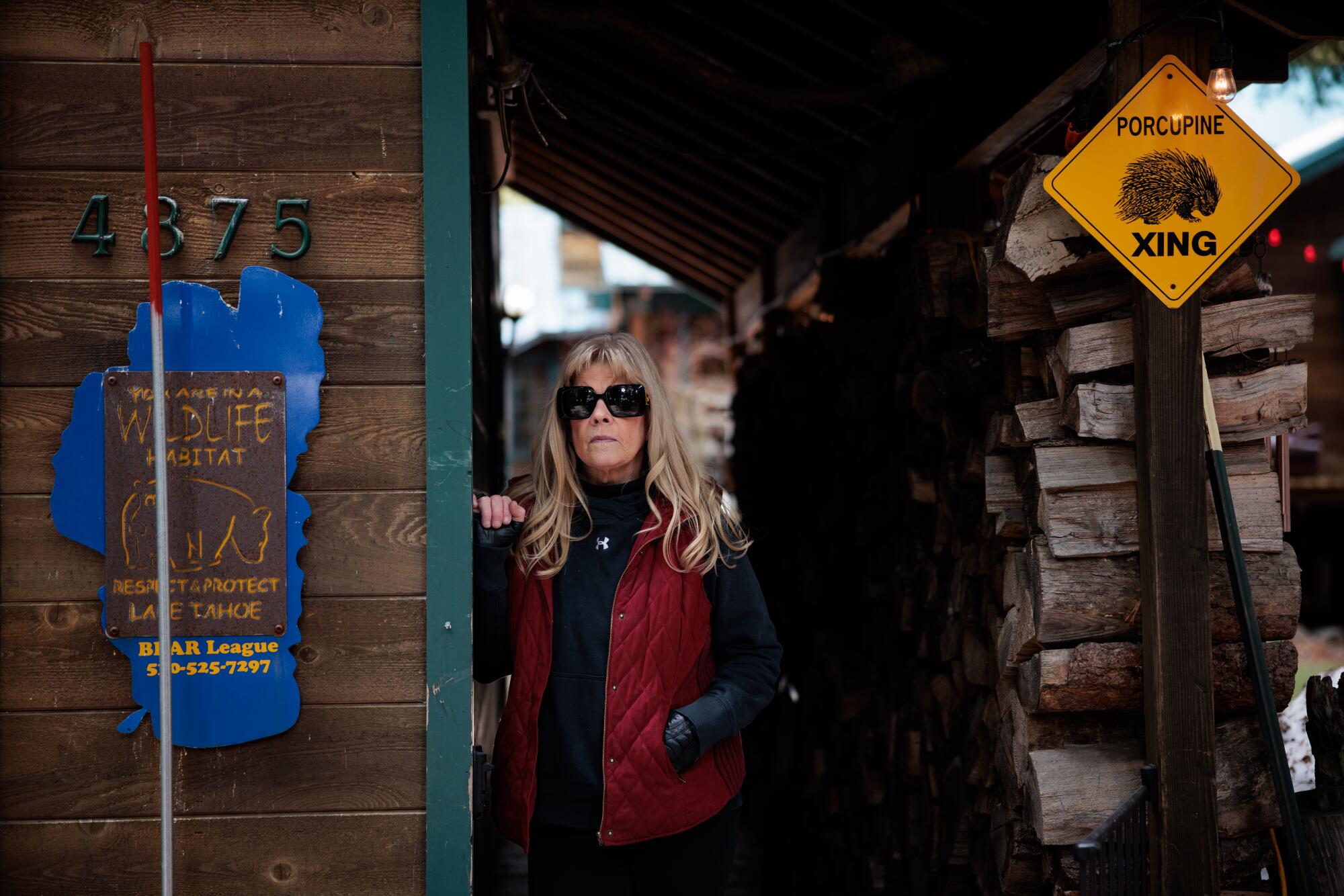
“We don’t believe the bear did it,” Ann Bryant, executive director of the Bear League, says of Patrice Miller’s death. “We’ve never had a bear kill anybody.”
(Max Whittaker / For The Times)
The Downieville saga unfolded as bears seemed to be making news all over California.
To many, it seemed there were just many more bears encroaching on human settlements. A Fish and Wildlife report released last month estimated there are now 60,000 black bears roaming the Golden State, roughly triple the figure from 1998, the last time the department issued a bear management plan. That’s the highest population estimate for anywhere in the contiguous U.S., although the report also suggests that California’s bear population has been stable for the last decade.
In the Lake Tahoe area, where 50,000 people live year-round and tens of thousands more crowd in on busy tourist weekends, bears were breaking into houses and raiding refrigerators; they were bursting into ice cream shops and strolling along packed beaches.
State and local officials went into overdrive, trying to teach residents and tourists how to avoid attracting bears. The state set money aside for distribution of bear-proof trash cans and “unwelcome mats” that deliver a jolt of electricity if bears try to break into homes.

The Bear League will loan Tahoe Basin residents “unwelcome mats” that deliver a little jolt of electricity to bears if they try to break into homes.
(Max Whittaker / For The Times)
The Bear League stepped up its efforts. From a small office on Bryant’s property, the organization’s 24-hour hotline was ringing, and volunteers were rushing out with paintball guns to haze bears and to advise people on how to bear-proof their houses.
The tensions continued to escalate, nonetheless, between people who wanted to protect bears at all costs and those who wanted some problem bears trapped and relocated — or killed. In 2024, after a homeowner in the Tahoe area fatally shot a bear he said had broken into his home, many people were outraged that the Department of Fish and Wildlife declined to file charges.
Advocates also complained that the state has fallen behind in its efforts to help people and bears coexist. In recent years, the state had hired dedicated staff to help people in bear country, but the money ran out and some of those people were laid off, said Jennifer Fearing, a wildlife advocate and lobbyist.
“We have the tools to minimize human-wildlife conflict in California,” Fearing said. “We need the state to invest in using them.”
In Sierra County, the sheriff had come to a different conclusion. “We’ve swung the pendulum too far on the environmental side on these apex predators,” Fisher said.
Earlier this year, Fisher found common cause with newly elected GOP Assemblymember Heather Hadwick. “Mountain lions, bears and wolves are my biggest issue. I get calls every day about some kind of predator, which is crazy,” said Hadwick, who represents 11 northern counties.
In February, she introduced a bill, AB 1038, that would allow hunters to sic trained dogs on bears to chase them through the woods, but not kill them. While California has a legal hunting season for bears, it is strictly regulated; the use of hounds to aid the chase has been banned since 2013.
Hadwick argued that hounding bears would increase their fear of humans, which she said some are starting to lose: “We’re keeping them in the forest, where they belong.”

Bears have a long memory for food sources and an incredible sense of direction. If a tourist tosses them a pizza crust or leaves the lid off a trash can, they will return again and again.
(California Department of Fish and Wildlife)
Wildlife advocates showed up in force last month to oppose Hadwick’s bill in an Assembly committee hearing. Sending hounds after bears is cruel, they said. Plus, hounding bears in the woods would have no impact on the bears knocking over neighborhood trash cans and sneaking into ice cream stores.
Fisher testified in favor of the bill, and spoke of Miller’s death.
Lawmakers listened, some with stricken looks on their faces. But in a Legislature controlled by Democrats, Hadwick did not garner enough votes to send her bill on to the full Assembly; it became a two-year bill, meaning it could come back next year.
Fisher returned to Sierra County, where he has continued to advocate for locals to have more power to go after predators. The current situation, he said, is “out of control.”

President Trump has promoted a chain of newly rebranded gas stations across the Philadelphia area with lower gas prices. The New York Times has not been able to get detailed information about who is behind the stations. The Trump administration says it did not fund or subsidize the company.

NEWYou can now listen to Fox News articles!
Kelley Paul is no stranger to the American political scene. As the wife of Senator Rand Paul (R-Ky.), and the daughter-in-law of longtime former Congressman Ron Paul (R-Texas), she has seen her fair share of the campaign trail, emerging as a powerful surrogate during her husband’s 2016 presidential run.
She is also an accomplished writer, speaker, and public relations professional. As America ushers in its 250th anniversary, Paul saw the perfect opportunity to branch out into the world of children’s literature. Recently she sat down with Fox News Digital in Las Vegas at Freedom Fest to discuss her new book, “Good Night, Young American.”
Kelley Paul is the wife of Sen. Rand Paul and author of two books. (Courtesy Kelley Paul)
Paul credits her family for giving her the inspiration for the new project:
“I have to give a lot of credit to my daughter-in-law, Kate. She and our son were over for dinner last summer with our grandson, who was only six months old at the time. And Kate was like, you know, we need more patriotic books for babies. She wasn’t really happy with a lot of the book options she was seeing. And that night at dinner, we kind of played around with some ideas. And I came up with ‘Good Night Young American.’ And a year later, here it is.”
EXCLUSIVE: RAND AND KELLEY PAUL OPEN UP ABOUT 2016 RACE
“Good Night, Young American,” recommended for children ages 4–8, takes kids on a visually and thematically engaging journey through early and colonial history.
“Well, our revolutionary history is such a great adventure, right? So when I came up with the concept that my little boy would start out on the 4th of July with his parents, asking, what is it all about? I knew we’d be celebrating the 250th. Kids ask, what are we really celebrating?
And his dad describes the Declaration of Independence to him in the signing. So I tried to think what is going to appeal to children in this great adventure of our revolution. So when he falls asleep that night, he’s in the crow’s nest of the Mayflower. He is a pilgrim, he’s a colonist, and then he makes friends with all the great revolutionary heroes that we know. So he makes friends with Sam Adams, he joins the Sons of Liberty, he meets at the Green Dragon. This is so exciting for children, right?
It’s visual stuff. He makes friends with Ben Franklin, and he’s flying the kite. Dramatically rides on the midnight ride with Paul Revere. He and his dog, his little dog, are with him for all the adventures. And of course, he crosses the Delaware with George Washington. And I wanted to make the signing of the Declaration of Independence and the writing of it something that was dynamic and exciting visually. So I have him swinging on the Liberty Bell when the declaration is signed.”
Paul worked closely with the illustrator, Marika Monesi, to bring the events of America’s founding to life in an engaging and visually appealing way for children.
The Liberty Bell, originally saved from the British by Lynnport farmer Frederick Leaser, sits in its Philadelphia shrine. (iStock)
“She really captured the excitement on the little boy’s face, his personality, but I worked very close with her,” Paul said. “I wanted there to be a lot of movement, a lot of dynamic images. So, for example, with the Liberty Bell, for kids, a bunch of men standing around writing a document…I wanted to bring it to life. So I said, let’s have him running up to the top of the bell tower in Philadelphia at Freedom Hall and swinging on the Liberty Bell. And she was just such a great artist. With the George Washington scenes, he’s crossing the Delaware because that, again, is so visual. I wanted drive home to children the incredible bravery and courage of our founders, how cold and miserable and hard that war was.
“Also, I love the illustration that she did of the King of England reading the Declaration of Independence. I have to give my husband Rand a little credit there. On the first couple of drafts that she did, Rand was like, ‘He needs to be fatter. King George was famously fat!’ So it was a lot of fun. It was very collaborative.”
KELLEY PAUL ‘EXHAUSTED AND ANGRY’ THAT THOSE WHO HARASSED HER AND HER HUSBAND FACE NO CHARGES
Part of Paul’s motivation for the book was related to the teaching of American history today, and the controversies therein:
“I do think that we’ve gotten away from really celebrating our founders and our heroes. What they were doing in 1776 was incredibly radical, if you think about it. At that time, everyone accepted the divine right of kings. Everyone accepted hereditary rule. And our founders took Enlightenment ideas from John Locke and philosophers, and they turned it into the framework for a government. The idea of self-government and that our rights come from our Creator, that we have inalienable rights that are given to us by God and not from a king. Those were radical ideas of the time.
Historians say an early draft of the Declaration of Independence offered new insight into how Thomas Jefferson refined the nation’s founding document. (Stock Montage/Stock Montage/Getty Images)
I like to say our founders were the first civil rights heroes, the first civil libertarians. And I think our education system has gotten away from that. They don’t view them in the time that they existed, and suddenly now everything is oppressor versus oppressed narrative. And they are labeled more like colonizers or enslavers, and that’s the only view that they’re looked at, and not as human beings who sacrificed their very lives to write the Declaration of Independence, to form this country…it was an incredible, bold, and courageous act, but it was also an act of moral courage and philosophical courage.”
Ultimately, Paul hopes that her books will stimulate the natural curiosity of America’s youth to learn more about their rich history:
Participants carry the City of Cumberland’s “America 250” parade banner down Baltimore Street during the America 250 parade in downtown Cumberland, Maryland, on June 27, 2026. Spectators line both sides of the street as American and Maryland flags lead the procession. (Fox News Digital/ David Marcus)
“Well, I hope that my books, especially with America’s 250, will spark a lot of questions and that they will give a framework for parents to talk to their kids about the founding of this country. And I hope children from a very, very young age will come away with this idea that they are a part of America’s story, that they as Americans can take pride in the heroism of our revolutionary founders. That as Americans, this is all of our story. So that’s really my goal with the books.”
One of the biggest challenges Paul faced was taking big ideas that may be hard for a four or five-year-old to grasp, like the Declaration of Independence or the Constitution, and distilling them down into an accessible format for kids:
“Well, I try to use language that kids could understand, and very much use simple terms. But if you think about it, it is simple. Our rights come from God. And when he makes friends with Thomas Jefferson, he says, Thomas Jefferson has written this amazing document that says that we can all be free to live our lives the way we choose, and no government can take our rights to, you know, to life, liberty, and the pursuit of happiness away from us.
He also talks about James Madison and the Bill of Rights and the most important right is freedom of speech. That is that no government can tell you what to say or what not to say.”
Rand Paul, who famously puts Constitutional principles front and center in the public square, also played a key role in the book’s thematic development.
Kelley Paul and her husband Kentucky Republican Sen. Rand Paul. (Courtesy Kelley Paul)
“Rand has been incredibly supportive. I’m just so grateful and blessed to have had an amazing, now 36-year marriage to Rand Paul. And he was very involved. He would read over the drafts and gave me a lot of, like I said, good advice about things in history that he thought I should include.
CLICK HERE TO DOWNLOAD THE FOX NEWS APP
And I’m also just very grateful to be the daughter-in-law of Ron Paul. And so, I wanted these books to be there for our little grandson who I call ‘my favorite little American’ and help him from an early age be educated in the legacy that, the Paul family has in this country.”

WASHINGTON — President Trump dismissed all remaining members of the bipartisan U.S. Elections Assistance Commission this week, his latest move to assert control over national elections in the final months before midterm voting.
The White House defended the move as justified by a recent U.S. Supreme Court decision handing the president greater authority to reshape independent government agencies, including by replacing appointed leaders.
Democrats and some independent elections experts blasted it as politically motivated, counter to the interests of voters and foolhardy with the November election so close.
“Purging commissioners just months before the midterm elections and further gutting support for our state and local elections officials is a blatant part of his plan to politicize our elections and enable more unlawful and dangerous election interference,” said Sen. Alex Padilla (D-Calif.), the top Democrat on the Senate Rules Committee, which oversees federal elections.
Padilla alleged the dismissals are an attempt by Trump “to dismantle yet another independent guardrail of our democracy designed to keep elections fair and secure.”
A White House official framed the dismissals in starkly different terms, saying the departing commissioners were “not totally aligned with the important task of securing America’s elections and ensuring every legal vote is counted.” It did not say when the president planned to appoint new commissioners.
The four-member commission was created by Congress in 2002 as part of the Help America Vote Act to help states improve their voting systems and voter access. By law, no more than two commissioners may belong to the same political party.
Historically, it has provided voluntary guidance and best practices for voting systems, and served as a sort of clearinghouse for election performance around the country — so that states and localities can learn from one another.
Since 2018, the panel has also disbursed more than $1 billion in election security grants, according to a report by the Bipartisan Policy Center. Those grants are then used to protect IT systems from foreign and domestic cyberattacks, update voting systems, ensure the accuracy of voter rolls and protect the integrity of ballots after they are cast.
Without leadership, the panel cannot take any official action until new members are nominated and confirmed by the Senate.
Benjamin W. Hovland, one of the Democratic commissioners removed by Trump, told NBC News that taking away a key federal agency designed to help state and local election administrators will have a negative effect on already strained elections officials.
“When you’re asking more and more of people without giving them the necessary resources, you know, mistakes happen,” he said.
California Secretary of State Shirley Weber, in a statement to The Times, said Trump was “injecting unnecessary chaos, confusion and instability into the very systems that Americans rely on to make their voices heard,” but that California “will not be intimidated or deterred” from maintaining elections “in which everyone can fairly and securely participate.”
California Atty. Gen Rob Bonta — whose office has already blocked federal agencies from implementing most of Trump’s election orders in court — called Trump’s firings “deeply troubling,” and said his office “will continue to closely monitor any efforts to weaken our democracy and fight back with every tool at our disposal.”
Gov. Gavin Newsom’s office said on X that “Newsom’s election protection efforts become more important by the day” — a reference to his recent push for state legislation that would make it a felony in California for anyone to seize ballots before a vote has been certified.
Newsom had said Thursday that Trump’s efforts to seize control over elections represented a “five-alarm fire” that must be confronted.
Trump’s dismantling of the commission comes as he wages a much broader campaign to rewrite voting rules. He has sought to place new restrictions on mail ballots, to tighten voter ID and proof of citizenship requirements for voters, to subject state voter rolls to federal oversight and purges, and to assert federal control over how and whether the U.S. Postal Service delivers mail ballots.
Much of that agenda, pushed through executive orders and other administrative actions, has been stymied by the courts, while stalling out in Congress, where it lacks support.
Whether Trump’s move to dismantle and reconstitute the commission will prove an effective path to instituting his election agenda remains unclear, experts said.
David Becker, the executive director of the nonpartisan Center for Election Innovation & Research, said the election commission has always had a “very limited mandate,” can’t dictate policy to the states and has no law enforcement powers — meaning Trump’s dismissals will have little real effect on elections.
Rick Hasen, an election law expert and director of the Safeguarding Democracy Project at UCLA Law, wrote that Trump could try to illegally direct the commission to “do his bidding” by amending the federal voter registration form to require proof of citizenship — though that would also have limited effect and would be challenged in court.
Sen. Adam Schiff (D-Calif.) said Trump’s firing of the commissioners was part of a broader effort by the president to “sow distrust in our voting system so he can contest the results if they are not to his liking.”
Kim Alexander, president of the California Voter Foundation, said California has “the most robust standards” for elections in the country, which won’t change with the removal of the commissioners.
Still, she said word of the firings rocketed around a conference of county elections officials in San Diego on Thursday — with some wondering whether the dismissals would threaten federal election funding, and others lamenting the loss of the ousted commissioners’ deep experience.
Dean Logan, head of the L.A. County Registrar-Recorder/County Clerk’s office, said in a statement to The Times that “any sudden change to the support structure for elections in the middle of an election cycle is concerning,” but that California “has a strong local and state foundation for election administration and voting systems support, and that will minimize any potential disruption caused by this action.”
In recent months, Trump has leveraged federal agencies to overhaul the nation’s voting rules in ways no previous president has attempted.
He has repeatedly pressured Republican lawmakers to pass a federal law that would require voters to provide proof of citizenship when they register, show identification when casting a ballot and force states to send voter data to the Department of Homeland Security.
Republican leaders have said the proposed SAVE America Act does not have enough votes to pass in the Senate. The GOP resistance has angered Trump, who on Friday said he was refusing to sign a bipartisan housing bill in protest.
The housing bill, which Trump called a “big yawn” last month, was to become law at midnight Friday without Trump’s signature.
-

 Texas6 minutes ago
Texas Rangers investigating City of Trinidad after water issues, controversial arrests, firings
-

 Utah9 minutes ago
President Trump expected to reduce the size of Utah monuments
-

 Vermont14 minutes ago
Vermont marks fourth straight year of July flooding as recovery drags on
-

 Virginia21 minutes ago
Vance leasing part of multimillion-dollar Virginia farm as an additional residence | CNN Politics
-

 Washington24 minutes ago
Washington State Democratic Party draws criticism over reparations, antisemitism language
-

 Wisconsin29 minutes ago
What’s new to eat and drink at the 2026 Wisconsin State Fair?
-

 West Virginia36 minutes ago
West Virginia to launch school clothing allowance program
-

 Wyoming39 minutes ago
Election Q&A: Laurie Longtine for Wyoming House District 59

