Politics
A Los Angeles man was denied a green card over his tattoos. The Supreme Court might take up his case

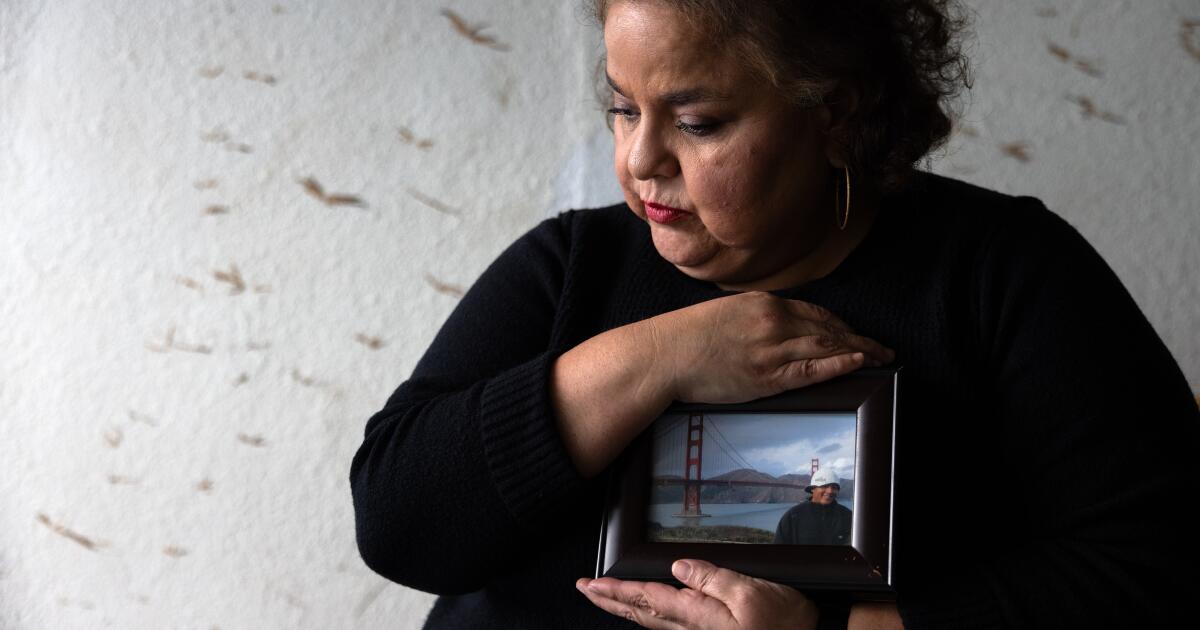
Prominent Los Angeles civil rights attorney Sandra Muñoz spent her eighth Christmas countries apart from her husband, Luis Acensio Cordero, after the federal government denied him a visa, in part, over his tattoos.
The black ink images of La Virgen de Guadalupe, theater masks, a pair of dice and Ace playing cards were throwbacks to his high school days. But to government officials conducting a body search, the tattoos showed he was an MS-13 gang member.
Sandra Muñoz holds a photo of her husband Luis Acensio Cordero.
(Francine Orr / Los Angeles Times)
The couple sued, securing a victory in California’s 9th Circuit Court of Appeals, only to have that decision challenged by the Biden administration. Now the case is headed to the Supreme Court.
On Friday, justices are scheduled to review the case and decide whether to take it up. If they decline, the appeals court decision would stand and Acensio’s lawyers believe he would likely be allowed to return to live in the U.S. for the first time in nine years.
The outcome of the case could have ripple effects for immigrants like Acensio because it’s so rare to win challenges to the government’s visa denials. But his attorneys fear that if the Supreme Court sides with the Biden administration, former President Trump, if reelected, would use the decision, and the underlying authority, to justify blanket bans of people from certain countries, as he did during his first term.
Acensio, now 47, was undocumented when he met Muñoz in 2008 at a wedding. They married two years later and in 2013 he filed for a green card.
In 2015, Acensio returned to El Salvador for what the couple believed was the final security screening and an interview at the U.S. consulate. He expected to be in El Salvador only a few weeks, so Muñoz met him there and booked their return flights back home to L.A. together.
He remembers vividly the day of the interview, being asked to take his clothes off, having photos taken of his tattoos and being asked why he got them. On his chest, one features comedy and tragedy theater masks with a set of dice and three Ace cards. The others are of La Virgen de Guadalupe, a profile of Sigmund Freud and a tribal design with a paw print.
A consular officer asked about his criminal history, and Acensio said he described the only time he’d been arrested, when he and a friend got into a fight. They spent three days in jail and were released without charge.
After the interview, Muñoz spent the rest of the week desperately checking her email. “That email never came and I had to come back alone,” she said. “The first of many trips back alone.”
The government’s denial arrived six months later, saying Acensio would likely engage in unlawful activity if allowed back in the U.S.
A State Department spokesperson declined to comment to The Times because of pending litigation.
In court proceedings, consular officials argued they didn’t owe the family an explanation and there was no way to appeal because of the doctrine of consular non-reviewability, which prevents judicial reviews of visa determinations made by consular officers as long as the decision is “facially legitimate and bona fide.”
Sandra Muñoz is a civil rights attorney in Los Angeles.
(Francine Orr / Los Angeles Times)
In certain cases, a U.S. citizen who proves they were harmed by the denial can challenge the doctrine. Immigration attorney Alan Diamante, Muñoz’s friend from law school, took on the case.
They filed a lawsuit in 2017 in U.S. District Court for the Central District of California challenging the constitutionality of Acensio’s denial. Humberto Guizar, a lawyer and court-approved gang expert who has testified in 50 cases, submitted a declaration stating that he is intimately familiar with gang tattoos and that Acensio had none.
The couple learned in 2018 that the federal government believed Acensio was a member of MS-13, the Salvadoran criminal gang that started in Los Angeles in the ’80s, according to court documents. That determination, lawyers wrote, was based on the in-person interview, a criminal review and a review of his tattoos. Reviews of the visa denial by the consulate and State Department had not “revealed any grounds to change the finding of inadmissibility.”
Eric Lee, their lead attorney, said tattoos are a common reason for visa denials. In Acensio’s case, Lee said he isn’t sure whether the consular officer acted based solely on the tattoos or whether foreign databases had provided erroneous information about his background.
As the case made its way through the courts, Acensio and Muñoz settled into separate lives. He started a business in El Salvador giving electric four-wheeler bike tours. She was named California Lawyer of the Year by the Daily Journal after helping secure a $23-million settlement against Walmart and other companies on behalf of warehouse workers.
She bought a house in Montebello and decorated it with photos of her and Acensio, vowing that one day it would be his home, too.
Acensio was separated not only from his wife, but also from his young daughter, who lives in Las Vegas and whom he would frequently visit. She is now 17, and he has missed seeing her grow up.
Muñoz, 54, has also faced difficulties. She got COVID-19 and suffered from brain fog and fatigue for several months. Her sister and her best friend died in 2021. She fell and tore a quad tendon in 2022, was hospitalized for weeks and still uses a cane to walk. Then her mother’s health began to deteriorate; she died a week before Christmas.
“It was so sad because I had built my life there with her,” Acensio said. “And I’ve never been there as her husband to help her in the most difficult moments. I feel helpless.”
Still, the couple found ways to stay connected. They text throughout the day and frequently do video calls. They traveled to Barcelona together, and her visits to El Salvador deepened her relationship with his family.
Muñoz visited Acensio at least three times a year until the pandemic started. In 2022, he received a Mexican visitor visa and they were able to meet in Tijuana. Their last trip was in May.
El Salvador’s President Nayib Bukele launched a sweeping crackdown against the country’s powerful street gangs, netting more than 70,000 arrests since 2022. Muñoz feared her husband would get caught in the dragnet.
Acensio said police stopped him last year at a checkpoint, looked over his body and let him go. If they believed he was involved with gangs, he said, they would have jailed him.
In October 2022, the 9th Circuit Court of Appeals agreed that the federal government had violated Muñoz’s fundamental right to marriage and due process as a U.S. citizen by denying her husband’s visa without providing an explanation for three years. That decision marked the first time a federal judge had rejected the government’s initial effort to dismiss a lawsuit by citing consular non-reviewability, Lee said.
Lee said he has since advised on similar cases, including four that have resulted in family reunification. Earlier this year, a judge in Arkansas cited Muñoz’s case in a ruling ordering the federal government to provide a better explanation for denying the visa of a U.S. citizen’s foreign husband.
After the appeals court ruling, Acensio applied for humanitarian parole, a form of temporary legal entry, to reunite with his wife. The State Department informed Muñoz’s lawyers that they would not oppose the application. Even so, it was denied last month.
In its petition to the Supreme Court, Biden administration lawyers echoed previous circuit court decisions in arguing that Muñoz’s right to marriage has not been violated because the government “has done nothing more than to say that the residence of one of the marriage partners may not be in the United States.”
Government lawyers argued the 9th Circuit ruling “represents a serious encroachment on the separation of powers. If allowed to stand, it will cause considerable disruption in U.S. consulates.”
Heidi Altman, policy director at the National Immigrant Justice Center, which is co-counsel on the Supreme Court case, said that Acensio and Muñoz’s case is an example of the Biden administration walking away from its commitment to immigrants. It also shows how central family separation is to the U.S. immigration system, she said.
“Fighting this case means really digging in on one particular way that family separation is regularly effectuated by immigration officers,” who ensure there is “no way to correct those mistakes, so that the family separation becomes permanent,” Altman said.
A similar case made its way to the Supreme Court in 2015. A man who had been employed in Afghanistan’s welfare department when the Taliban ruled the country was denied a green card after marrying a U.S. citizen, because the government reasoned he was engaged in terrorist activity.
In that case, the 9th Circuit had also ruled that the government didn’t offer a legitimate enough reason for the denial. But the Supreme Court ultimately ruled against the couple.
The notion that Acensio is a gang member is offensive, Muñoz said. As an attorney, she said, she’s naturally skeptical. And as an officer of the court, she’s sworn to uphold the Constitution.
“It just breaks my heart that this country — that my country — has taken so much from my husband and me,” she said.
Muñoz thinks back to a discrimination case she litigated in which she represented a Latino Los Angeles Sheriff’s deputy who was referred to by supervisors as the “Mexican Mafia.” The county responded by claiming he was in a deputy gang based solely on his tattoo, she recalled.
“A tattoo in and of itself doesn’t mean that somebody is a bad cop, a bad person,” she said. “You can’t simplify it that much. We went to trial in that case. We won.”



Politics
Fugitive illegal alien convict on the run after attempting to strike ICE officer with vehicle: DHS

NEWYou can now listen to Fox News articles!
An illegal alien with a long criminal history remains on the run after he attempted to hit a U.S. Immigration and Customs Enforcement (ICE) officer with his vehicle in California as authorities were trying to arrest him, the Department of Homeland Security (DHS) said Monday.
ICE was attempting to take Xa Lee, a fugitive and Laotian citizen, into custody on March 25 in Sacramento. Lee was driving when he was pulled over, according to DHS.
LEAVITT CALLS ON CONGRESS TO END EASTER RECESS TO WORK ON DHS SHUTDOWN
Xa Lee, a Laotian citizen with a long criminal history, attempted to strike an ICE agents with a vehicle while fleeing from authorities in Sacramento, Calif., the Department of Homeland Security said. (Getty Images; Department of Homeland Security)
During the vehicle stop, Lee attempted to flee and tried to strike an ICE officer with his car.
“The officer, thankfully, did not sustain injuries. During the incident, ICE officers deployed their tasers. He fled the scene and remains at large,” DHS Acting Assistant Secretary Lauren Bis said. “This is just the latest in a disturbing trend of vehicle attacks.”
COLLEGE STUDENT’S ALLEGED MURDER BY ILLEGAL WENT EXACTLY AS DEMS ‘INTENDED,’ HOUSE SPEAKER SAYS
A federal immigration judge issued a deportation order for Lee in 2010. His criminal record includes convictions for vehicle theft, stolen property, conspiracy, petty theft, two DUIs, resisting an officer, battery, and felony possession of a firearm.
DHS noted that Lee’s evasion of arrest came amid a history of webinars by Democratic elected officials who advised undocumented immigrants on how to evade ICE and report encounters with federal immigration authorities.
The agency cited California Gov. Gavin Newsom, Los Angeles Mayor Karen Bass, and U.S. Reps. Alexandria Ocasio-Cortez and Dan Goldman, both Democrats.
CLICK HERE TO DOWNLOAD THE FOX NEWS APP
All four politicians have repeatedly called for the Trump administration to halt its deportation campaign targeting criminal illegal immigrants.
“DHS is once again calling on sanctuary politicians, agitators, and the media to turn the temperature down and stop calling for violence and resistance against ICE law enforcement,” the agency said.
DHS requests that if the public has any information about Lee’s whereabouts, contact the ICE tip line at 866-347-2423 or online.
Politics
Commentary: Will or won’t he? A lot rides on a Trump endorsement in California governor’s race
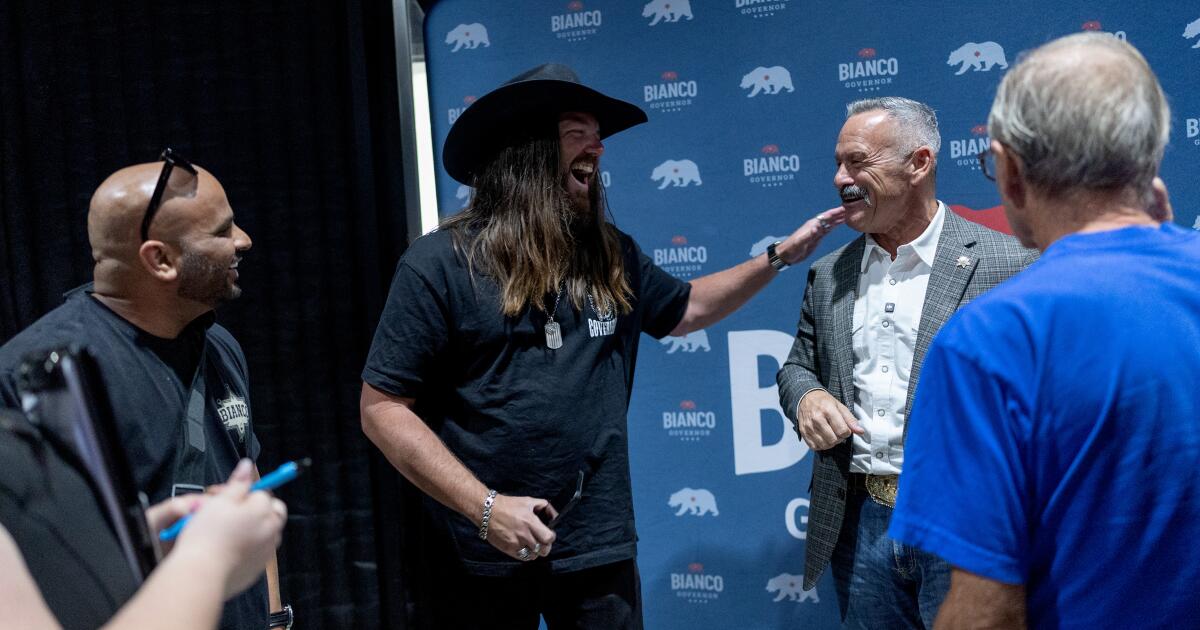
Chad Bianco couldn’t fly to Mar-a-Lago, wreathe President Trump in honeyed words, bestow the Riverside County Peace Prize upon him and hand-feed him his favorite dish — a Big Mac? — from a platter of 24-karat gold.
Security, logistics and all of that.
So the Republican candidate for California governor did the next best thing: He confiscated hundreds of thousands of ballots from last November’s special election in a trumped-up investigation of supposed voting irregularities. Never mind the complete lack of evidence or the fact Proposition 50, the subject of Bianco’s investigation, was approved by a clear-cut majority of voters.
The intent of Riverside County’s grasping sheriff was as transparent as a pane of glass. It’s all about trying to win the endorsement of Trump — he of phantasmagorical election-fraud claims — in California’s neck-and-neck-and-neck gubernatorial contest.
Bianco, fellow Republican Steve Hilton and a passel of Democratic hopefuls are bunched together in a contest that remains utterly wide open just weeks before voters start receiving their ballots in the mail.
“Trump’s endorsement would be huge,” said Jon Fleischman, a conservative strategist and former executive director of the state GOP.
“Actually,” he went on, ‘I think it would be determinative” — virtually guaranteeing either Hilton or Bianco finished in the top two in the June 2 primary, ushering them past the rope line into November’s runoff.
If there’s an inside edge in the Trump Endorsement Sweepstakes, it would seemingly go to Hilton.
He’s familiar to the president as a former Fox News host. He’s interviewed Trump several times and the two occasionally text and talk on the phone. Bianco has no such personal connection, which might explain his ballot-seizing stunt.
Steve Hilton could have the inside track on a Trump endorsement, given their personal relationship.
(Allen J. Schaben / Los Angeles Times)
(The Democrats’ nightmare scenario is both Republicans making the runoff, icing the party out of the governor’s office for the first time since Arnold Schwarzenegger left in January 2011. More on that in a moment.)
A Trump endorsement comes in all sorts of flavors.
As The Downballot recently noted, “His bag of tricks includes dual endorsements, triple endorsements, pre-endorsements, Election Day endorsements, yanking endorsements … belated endorsement of a candidate after initially endorsing just one candidate [and] non-endorsements after promising to endorse.”
There was also the time Trump endorsed “ERIC” when Republicans Eric Schmitt and Eric Greitens faced each other in Missouri’s Senate primary. (Schmitt won and is now the state’s junior U.S. senator.)
Trump’s backing still counts a good deal, even as his approval ratings sink to sub-basement levels. The president remains popular with Republicans and, critically, the kind of GOP loyalists who vote in primary contests, which is why both Hilton and Bianco would welcome a presidential laying on of hands.
There’s good reason, however, to think Trump might pass on endorsing in the governor’s race, or opt to deliver one of his dual he-and-him endorsements.
The GOP’s best — and perhaps only — hope of winning the governorship is the Democratic-freeze-out scenario. So, tactically, Trump’s wisest move may be to bless neither Hilton nor Bianco. Or support both. That would avoid elevating one over the other, which could make it easier for a Democrat to finish among the top two and advance past the June primary.
“I think Trump’s people are smart enough to know that there’s a reason why he may not be served by endorsing a candidate,” Fleischman said. “I wouldn’t be surprised if the prevailing wisdom there is we better not endorse anybody, because we don’t want to tilt this one way or the other.”
If Trump were to back Hilton or Bianco, it’s not hard to imagine Democratic interests seizing upon the president’s benediction and putting significant money behind an ad blitz promoting the president’s favorite in hopes of boosting him — and him alone — into the top two.
The move comes from a well-thumbed political playbook, seeking to elevate a preferred opponent, that was used most recently in California by Democratic Sen. Adam Schiff. He helped lift Republican Steve Garvey into the November 2024 runoff to keep from having to face a tougher opponent, fellow Democrat Katie Porter. Schiff easily defeated Garvey.
In this case, Democrats would aim to tee up one of the two Republicans who would almost certainly go on to lose in the fall.
Which is what happened the first time Gavin Newsom ran for governor.
In 2018, his main rival was fellow Democrat Antonio Villaraigosa. Two major Republicans were also in the race, John Cox and Travis Allen. There was no real concern about those two nabbing both spots in the June primary. Rather, Newsom and Cox had a shared interest in boxing out Villaraigosa.
Newsom ran a TV spot attacking Cox and tying him to Trump, which raised Cox’s profile and boosted him among GOP voters. The Newsom and Cox campaigns opened a private back-channel, trading gossip, swapping insights on the race and even sharing some empirical data. One poll, showing Cox getting a bigger boost from a Trump endorsement than Allen, passed from Democratic hands in hopes it would reach the White House and nudge the president into supporting Cox.
Though there’s no proof the survey ever reached Trump, the president eventually threw his support behind the San Diego County businessman, lifting him past Allen in the primary. Cox went on to lose handily to Newsom in November.
This time, with more than a half dozen plausible candidates and no obvious path to victory for any one, it’s every man and woman for themselves.
The same goes for Trump, who may do himself the most good in California, politically, by doing nothing at all.
If he can only resist.

NEWYou can now listen to Fox News articles!
MANCHESTER, N.H. — Rahm Emanuel is shrugging off the Democratic Party’s identity debate and emphasizing that the showdown for the Democrats’ 2028 presidential nomination should be about ideas and not gender.
The former Chicago mayor and White House chief of staff to President Barack Obama is mulling a White House run of his own in 2028 in the race to succeed term-limited Republican President Donald Trump. But in a party that has made diversity one of its core tenets, Emanuel will have to face the question: will the Democratic Party elect a straight White male to represent it?
Emanuel told Fox News Digital on Monday that Democrats should be asking potential presidential contenders different questions entirely, such as: “Do you have the ideas of how to make sure the American Dream is alive and well, accessible and affordable to another generation?”
POTENTIAL 2028 DEMOCRATIC CONTENDER PROPOSES 75-YEAR-OLD MANDATORY RETIREMENT FOR POLITICIANS
Former First Lady Michelle Obama lamented in a podcast late last year that the U.S. is not ready for a female president. (Tasos Katopodis/Getty)
In the wake of former Vice President Kamala Harris’ defeat to Trump in the 2024 election, former First Lady Michelle Obama made headlines late last year when she emphasized in a conversation posted on YouTube that the U.S. has “a lot of growing up to do” and that the nation is “not ready for a woman” as president.
And former President Joe Biden, in an interview last year on “The View,” argued that Harris lost to Trump because of sexism and racism.
Harris was the second female Democratic presidential nominee to come up short to Trump, following Hillary Clinton’s defeat in the 2016 election.
That’s got some in the Democratic Party suggesting that in order to recapture the White House in 2028, it might be better for the party to nominate a White male as their standard-bearer.
WHITE HOUSE RACE UNDERWAY: WITH 2026 LOOMING, BOTH PARTIES ARE ALREADY PLAYING FOR 2028
While Democrats take pride in their party’s diversity, an Axios article this past weekend, headlined “Some Dems’ 2028 strategy: a straight, White, Christian man,” included quotes from party operatives and strategists suggesting that parts of the American electorate are too biased to back a female or other diverse presidential candidate.
Emanuel disagrees.
“More important is the voters’ take. They’ll make a decision. And so to me, that’s the wrong thing. The question is, do you have the ideas that address the challenges that are facing America, regardless of who’s speaking it,” he said.
Former U.S. ambassador Rahm Emanuel, a former Chicago mayor who previous served as White House chief of staff in then-President Barack Obama’s administration and a former U.S. House member, speaks at the New Hampshire Institute of Politics, on March 30, 2026, in Manchester, N.H. (Paul Steinhauser/Fox News )
Emanuel spoke with Fox News and other news organizations after headlining “Politics and Eggs,” a speaking series at Saint Anselm College’s New Hampshire Institute of Politics that’s a must stop for White House hopefuls visiting the which for a century has held the first presidential primary in the White House race. And hours earlier, on Sunday evening, he was the main attraction at the latest “Stand Up New Hampshire” town hall hosted by top Democratic activists.
Emanuel has been crisscrossing the country in recent months, as he considers a presidential bid, including stops in two other crucial early primary states, Nevada and South Carolina, where he heads later this week.
He said he’ll become a presidential candidate “if I think I have what it takes to answer what I think is ailing the greatest country.”
Emanuel, who hails from the more moderate center-left wing of the party, emphasized that in order to win in 2028, Democrats need to “centralize and ground ourselves in middle class values, tough enforcement at the border, put more police on the beat, and get kids, guns and gangs off the street, and invest in education opportunities.”
“Get to the core of what they expect from us and don’t get caught up in some cultural cul-de-sac that leads nowhere,” he added.
Potential 2028 Democratic presidential contender Rahm Emanuel greets audience members at ‘Politics and Eggs,’ a speaking series at Saint Anselm College’s New Hampshire Institute of Politics, on March 30, 2026, in Manchester. N.H. (Paul Steinhauser/Fox News)
As Democrats look for a fighter in 2028 to win back the White House, Emanuel is showing off his scrappy side.
“These are tough times that require a tough leader that knows how to do tough things and get them done on behalf of the American people. That’s the measure,” he told Fox News Digital.
And Emanuel also repeatedly took aim at Trump and his administration for their handling of the president’s efforts to acquire Greenland and the month-long strikes against Iran.
CLICK HERE TO DOWNLOAD THE FOX NEWS APP
“It’s a war of choice, and it’s a bad choice,” Emanuel said of Trump. “He could have gotten everything he wanted without going to war.”
And taking another shot, he said, “If they ever run a sequel to ‘Dumb and Dumber,’ I have recommendations for the lead roles, and there’s lots of competition in this administration.”

Sheffield sets focus on key issues in first State of City speech. How to watch

Our Trip to San Francisco | Cup of Jo

Mark Cuban has one major regret after selling Dallas Mavericks

Need to Know: Bruins vs. Stars | Boston Bruins

Denver weather: Seasonal with spotty showers

Florida High School Football Rankings: Top 25 teams – Oct. 21

How old is Bo Nix? What to know about Oregon quarterback ahead of 2024 NFL Draft

Cleary's 21 help Le Moyne down Central Connecticut State 69-64 in OT

99th annual Pony Swim held in Virginia

Indiana Members Credit Union announced as new anchor tenant at Bottleworks District
Latino Republicans in South Texas Turn on Trump Over Birthright Citizenship

Fugitive illegal alien convict on the run after attempting to strike ICE officer with vehicle: DHS

EU to urge Israel to scrap death penalty bill as ‘grave regression’
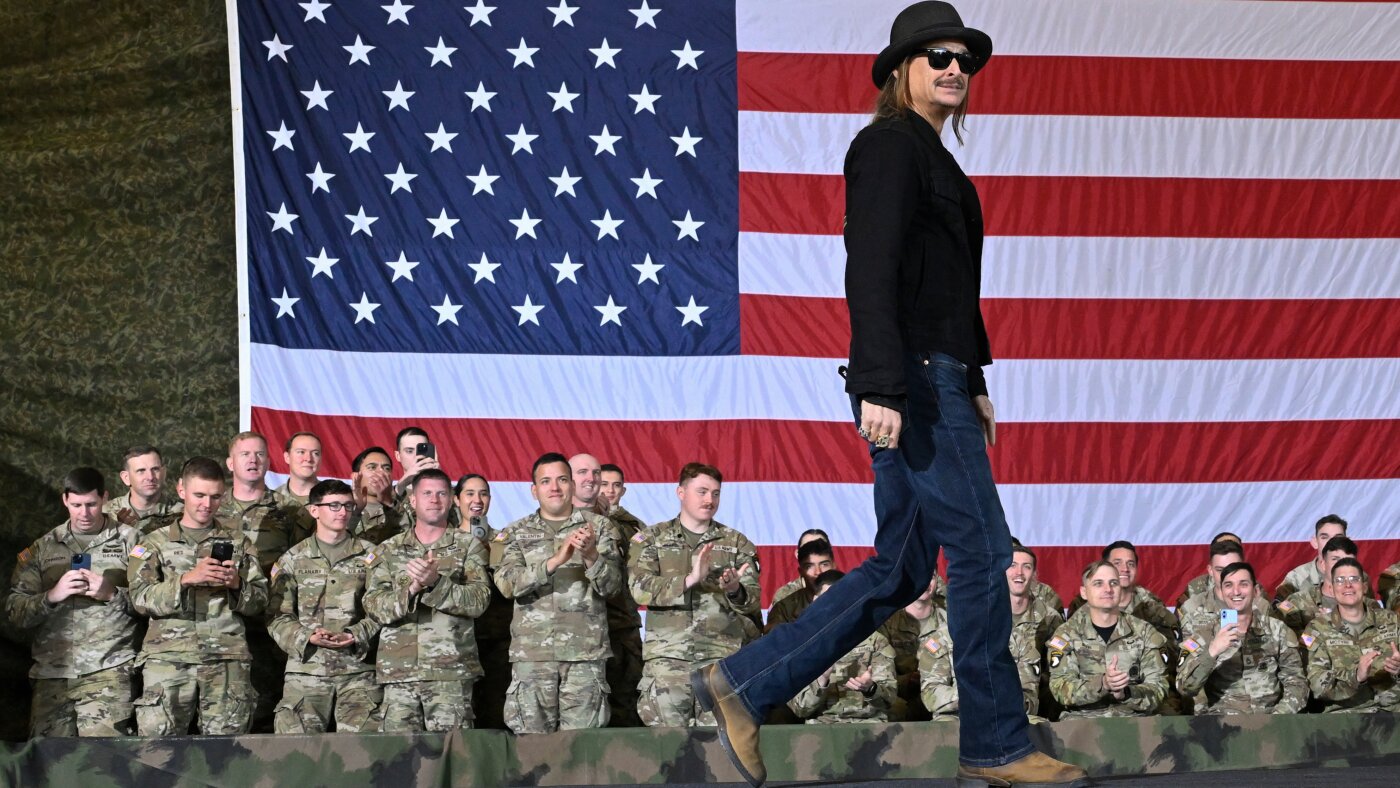
Army reviewing after helicopters hovered alongside Kid Rock’s swimming pool as he saluted

Emanuel pushes back on ‘straight White man’ question, says ideas matter most in 2028
-

 Miami, FL5 days ago
Jannik Sinner’s Girlfriend Laila Hasanovic Stuns in Ab-Revealing Post Amid Miami Open
-

 South-Carolina2 days ago
South Carolina vs TCU predictions for Elite Eight game in March Madness
-

 New Mexico1 week ago
Clovis shooting leaves one dead, four injured
-

 Science1 week ago
Record Heat Meets a Major Snow Drought Across the West
-

 Minneapolis, MN5 days ago
Boy who shielded classmate during school shooting receives Medal of Honor
-

 Tennessee1 week ago
Tennessee Police Investigating Alleged Assault Involving ‘Reacher’ Star Alan Ritchson
-

 Politics1 week ago
Trump gives Iran 48-hour ultimatum to reopen Strait of Hormuz or face strikes on power plants
-

 Movie Reviews1 week ago
Movie Review: “FORBIDDEN FRUITS” – On Wednesdays We Cast Spells – Rue Morgue