Northeast
Window mounted heat pumps in NYC represent 'promising climate solution'

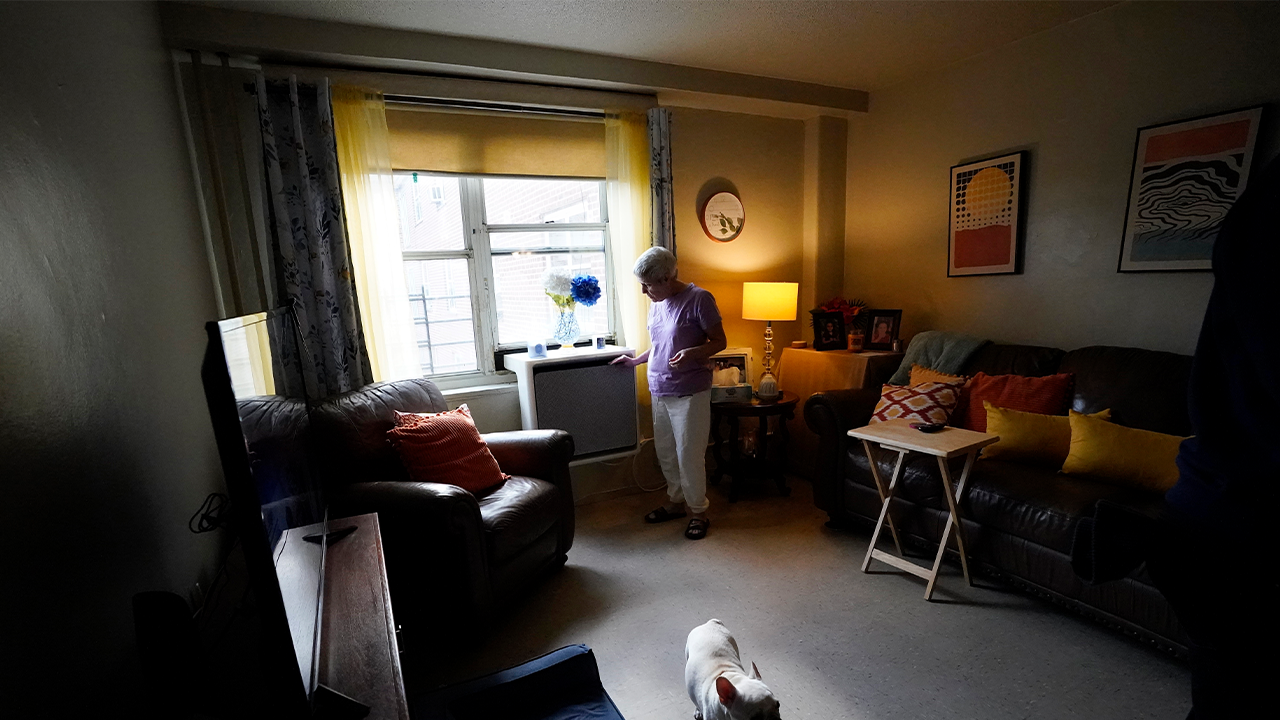
For 27 years, the heat in Regina Fred’s Queens apartment building came from a noisy steam radiator that she couldn’t control and sometimes didn’t come on at all, leaving her shivering. Sometimes, the radiators ran so hot that residents had to keep their windows open in the middle of winter for relief.
That all changed a few months ago, when she got a window-mounted heat pump as part of a pilot project by the New York City Housing Authority aimed at cutting energy costs and lowering emissions. Suddenly, all Fred has to do is touch a dial to bump her temperature up or down, and she found herself enjoying “a very good silence.”
“They did a demonstration for me and I was thrilled,” Fred said. Now, her grown children call the heat pump “the best thing” she has in her apartment, and her neighbors have knocked on her door to check out the unit.
NEW YORK CITY TAKING A SLICE OUT OF ICONIC PIZZA SHOPS WITH NEW GREEN RULE
Heat pumps, a highly efficient technology that has grown in popularity in recent years to rival gas furnaces, have mainly been an option for owners of houses. But new designs are making them practical for apartments, too, which often rely on inefficient centralized steam boilers powered by oil or gas. That represents a promising climate solution for buildings, whose operations account for 26% of global energy-related carbon emissions, according to the International Energy Agency.
The IEA said last year that installing heat pumps in apartment buildings and commercial areas should “be a priority area” to maintain the growth necessary to meet national climate pledges worldwide. The U.S. alone has 23 million apartment units, according to the National Multifamily Housing Council, representing a huge sector of people who could use less energy with heat pumps.
New York law requires buildings to make big cuts in greenhouse gas emissions over the next decades. To comply, NYCHA is targeting heating and cooling, the largest source of emissions for the agency, which houses about 528,000 people across more than 2,400 buildings — or about one in 17 New Yorkers, said Shaan Mavani, the agency’s chief asset and capital management officer.
Centralized steam boilers powered by natural gas or oil typically provide the heat, and they are wasteful — the NYCHA’s climate mitigation roadmap calls steam heat “19th-century technology incompatible with 21st-century needs.” Mavani said between 30% and 80% of heat is lost through old and leaky infrastructure before it reaches apartments. And that doesn’t account for the waste when residents have to open their windows to dissipate excess heat from a system they can’t control.
Queens borough resident Regina Fred touches one of her window-mounted heat pumps. The installation of heat pumps is part of a New York City Housing Authority pilot project, which aims to cut costs and emissions. (AP Photo)
Eric Wilson, a senior research engineer for the Department of Energy’s National Renewable Energy Laboratory, led a team that analyzed heat pump performance in various electric grid scenarios and found even the lowest-efficiency pump would cut greenhouse gas emissions and save on operating costs in every U.S. state. That analysis didn’t include the kind of pump being tested in Queens because it wasn’t yet on the scene, but Wilson said he would expect similar results.
Most heat pumps require ductwork, which isn’t an option for renters in a unit they don’t own. And ductless systems typically require extensive installation that includes wiring, making a hole in a wall and a sizeable external compressor.
Gradient and Midea, the two companies making the units in the pilot project at Woodside House, downsized it all into something that looks a bit like a window air conditioner but with a much lower profile. Exterior and interior halves drape over a sill to leave the window mostly unobscured. Gradient, one of the companies, says its unit installs in 15 minutes and plugs into an ordinary wall outlet.
Wilson said the interior portion of the units “take up more space on the inside than you might be used to” but Fred called it “very beautiful.”
“Look, I even have it for decoration,” she said. Her three window units are usually topped by flowers and decorative candles. In one room on a particularly sunny day, morning light shone on a rose, a jar of rose petals, decorative boxes and a “LOVE” sign atop one of them.
Z Smith, an architect at the firm Eskew Dumez Ripple who isn’t involved in the Queens project, said such retrofitting “is the carbon-smart way to get to better comfort for occupants.” That’s because one of the most effective ways to cut emissions from buildings is to avoid putting up new ones, which result in significant emissions due to all the new concrete, steel and wood.
He called the low-profile heat pumps a “lightweight intervention” because they’re so easy to install.
The NYCHA will evaluate results of the pilot project, with plans to eventually install more than 4,000 heat pumps over two years in the Woodside development if all goes well. The authority expects to save money on operating and maintenance costs with the heat pumps, but is waiting to see for initial results before it projects those savings.
Gradient was founded seven years ago in San Francisco with the ambition to decarbonize buildings with a window unit heat pump that can be easily installed without technicians. Part of their goal was a solution for people just like those at Woodside, CEO Vince Romanin said — people in older multi-family buildings with complaints about their window ACs or aged radiators that don’t have a temperature setting.
“We think that if you’re not building solutions for people who need it most, if you’re not building solutions for people who have insufficient heating (and) cooling today, they’re not really solving climate change,” Romanin said.
Read the full article from Here


On Sept. 17, multi-platinum country music star Luke Bryan will bring his Farm Tour to 1846 Farms near Latrobe.
Westmoreland County is no stranger to large outdoor concerts. Some may remember the Rolling Rock Town Fair in the early 2000s, while others may recall Luke Bryan’s stop at a farm in South Huntingdon Township just two years ago. Now the country music superstar is returning to the area.
The Unity Township farm’s general manager, Aleisha Stas, gave KDKA a tour of the family farm, which dates back to before the Civil War. She says Bryan’s team first reached out after finding the farm on social media, but she says at first, she and her family thought it was too good to be true.
“This was around April Fools, so we thought it was an April Fools prank,” Stas said. “My whole family, we were like, there’s no way this is about to happen. But this has been incredible.”
Stas says Bryan’s team is handling everything logistically from parking and bathrooms to deciding exactly where the concert will be staged.
“If we have it on this side of the property, we can hold 12,000 people,” Stas said. “And if we have it on (the other side) of the property, it can be up to 20,000. But we have not determined that yet.”
Many of those decisions will be made as September gets closer. In the meantime, however, the farm is holding off on planting in certain fields until the final concert location is selected.
And while hosting thousands of people may sound a little intimidating, Stas says her family is excited to welcome fans to the farm for what they hope will be a memorable night.
“Obviously, we’ve never had this many people here before, so it will be a new thing for all of us, but we are not worried,” said Stas. “Luke Bryan’s team are experts with this, and I think it will go great.”
Tickets for this concert are currently on sale, and they will run you about $77 per person, plus tax for general admission.
Connecticut
How a carjacking in Connecticut led back to a man known as the crypto ‘Godfather’ in California

On a leafy Connecticut road in the summer of 2024, would-be kidnappers pulled a couple from their Lamborghini SUV, beat them in broad daylight and threw them into a van, only to be arrested shortly thereafter as multiple witnesses, including a passing off-duty FBI agent, called police.
The investigation would lead police to some sensational findings.
The attack turned out to be linked to a $245 million Bitcoin heist the month before involving the couple’s son. And this week, a California cryptocurrency mogul who authorities say called himself “The Godfather” and had previously hired off-duty sheriff’s deputies to strongarm his enemies admitted to orchestrating the attempted abduction to get a piece of the son’s stolen loot.
The California man, 25-year-old Adam Iza, pleaded guilty Monday to conspiracy to interfere with commerce by robbery. Federal prosecutors are seeking a prison term of at least 14 years when he’s sentenced.
Iza’s lawyer, William Paetzold, didn’t immediately respond to Tuesday phone and email messages seeking comment.
The case is part of an increasing trend worldwide of cryptocurrency theft spilling over to violence.
Nightclub fight spawns kidnapping plot
A month before the abduction attempt, one of Iza’s alleged co-conspirators got into a beef with the couple’s son, Veer Chetal, at a Miami nightclub, according to an FBI affidavit. The man, James Schwab, then told an acquaintance to rob Chetal and his friends at their Miami rental home, authorities said. It’s not clear if the robbery happened.
Schwab’s lawyers didn’t immediately respond to phone messages seeking comment.
Then came the Bitcoin heist. A few weeks after the nightclub fight, Chetal and two other men hatched an elaborate online scheme that involved impersonating technical support staff for Google and a cryptocurrency exchange. They managed to steal 4,100 Bitcoins — worth about $245 million at the time — from a Washington, D.C., resident, according to court documents.
The trio lived large after the theft, spending millions of dollars on cars, clothing, jewelry, rental mansions and nightclub parties before being arrested, prosecutors said. Chetal pleaded guilty last November and awaits sentencing, while the two other men have pleaded not guilty.
Iza and Schwab, meanwhile, came up with the idea to take Chetal’s parents hostage in a bid to snatch some of his ill-gotten riches, the FBI said, citing information from informants. Schwab and Iza’s brother, Saif Faiq, also were charged in the kidnapping attempt and pleaded not guilty.
They recruited six other men to go to Connecticut, paying for their travel and lodging, authorities said. A week after the Bitcoin heist, the group surveilled Chetal’s parents hours before the kidnapping, according to court records.
Abduction quickly goes awry
Sushil and Radhika Chetal were driving in the Lamborghini on Aug. 25, 2024, near Danbury High School when they were rear-ended by a car. A white van then pulled in front of the SUV and several men surrounded them, police said.
The men pulled the Chetals out of the SUV and forced them into their van, beating Sushil Chetal with a baseball bat and dragging Radhika Chetal by her hair. The couple were bound with duct tape and the van drove off, according to court documents.
After witnesses called police, officers soon spotted the van and a chase ensued. The van eventually crashed and four of the men got out and fled on foot but were arrested shortly thereafter. The other two men were later found at a home the group had rented in a nearby town. The Chetals were taken to a hospital and released.
The six men, all from Florida, have pleaded guilty in connection with the kidnapping. Two have been sentenced to 11 years in prison and the others await sentencing.
How the ‘Godfather’ went from a Bel Air mansion to federal charges
Before Iza’s arrest in the Connecticut case, he was under investigation by federal authorities in California for extorting money and property from victims in Los Angeles and elsewhere, court records show. He was charged in that case a month after the kidnapping and later pleaded guilty.
Iza, also known as Ahmed Faiq, was living in a mansion in the Bel Air section of Los Angeles, calling himself The Godfather while running a crypto trading company, Zort. While stealing millions of dollars and funneling it through shell companies, Iza spent freely on luxury cars and other extravagances, including cosmetic surgery to lengthen his legs, prosecutors said.
Beginning in August 2021, Iza paid around $100,000 a month for his personal protection to a private security firm founded by a Los Angeles County sheriff’s deputy that also employed other deputies, prosecutors said.
Iza, authorities said, hired off-duty deputies to act as enforcers against people with whom he had personal and business disputes. He used the deputies to extort, intimidate, set people up for arrest and abuse the legal process, prosecutors said.
The deputies used law enforcement databases to generate information about Iza’s enemies and obtained search warrants under false pretenses, authorities said. On one occasion, two deputies held a victim at gunpoint inside Iza’s home, pressuring the victim to transfer $25,000 to Iza’s bank account, prosecutors said.
When he pleaded guilty in that case in January, Iza also admitted to stealing more than $37 million by fraudulently accessing the business manager accounts of Meta Platforms, owner of Facebook, and their lines of credit from 2020 to 2022. He awaits sentencing after pleading guilty to wire fraud, conspiracy against rights and tax evasion.
His attorney in California, Josef Sadat, declined to comment Tuesday.
Several deputies also were charged in the investigation.

The only notable change in the top-seven of the Varsity Maine baseball poll is that Gorham now has eight first-place votes, two more than last week. The order of the seven teams is identical. In fact, the only change in the top-seven over the past three polls is the swap at the top after Gorham’s win over South Portland on May 19.
Furthermore, Gorham, South Portland, Oxford Hills, Cheverus, Bangor, Mt. Ararat and Fryeburg have been ranked in the top seven for four straight weeks, and six of those squads have been among the top seven in every poll this spring.
Meanwhile, Scarborough is ranked for the first time since May 5, and Ellsworth and Thornton swapped spots.
The Varsity Maine baseball poll is based on games played before June 2, 2026. The top 10 teams are voted on by the Varsity Maine staff, with first-place votes in parentheses, followed by total points.
1. Gorham (8) 89
2. South Portland 79
3. Oxford Hills (1) 75
4. Cheverus 55
5. Bangor 42
6. Mt. Ararat 41
7. Fryeburg Academy 30
8. Ellsworth 27
9. Thornton Academy 25
10. Scarborough 12
Also receiving votes: Washington Academy 8, Monmouth Academy 4, Cony 4, Leavitt 2, Falmouth 2.
-

 Pittsburg, PA4 minutes ago
Luke Bryan concert expected to bring thousands of fans to Pittsburgh-area farm
-

 Augusta, GA7 minutes ago
Finding Solutions: Augusta arts school offers summer music workshop for young students
-

 Washington, D.C12 minutes ago
‘We did not have the votes:’ DC Council does not take up expanded summer curfew
-
 Cleveland, OH19 minutes ago
Leaders in Washington and Cleveland take aim at affordable housing in Northeast Ohio
-

 Austin, TX22 minutes ago
Jane Nelson, Texas’ top election official, stepping down as Secretary of State
-

 Alabama27 minutes ago
Alabama raises income guidelines for WIC program
-

 Alaska34 minutes ago
Photos show Alaska National Guard plane damaged in Iran war theater
-

 Arizona37 minutes ago
Racial equality in education: Arizona ranked 18th – KTAR.com

