Northeast
Wall Street veteran Marty Dolan explains why he's running to unseat AOC: 'Enough is enough'

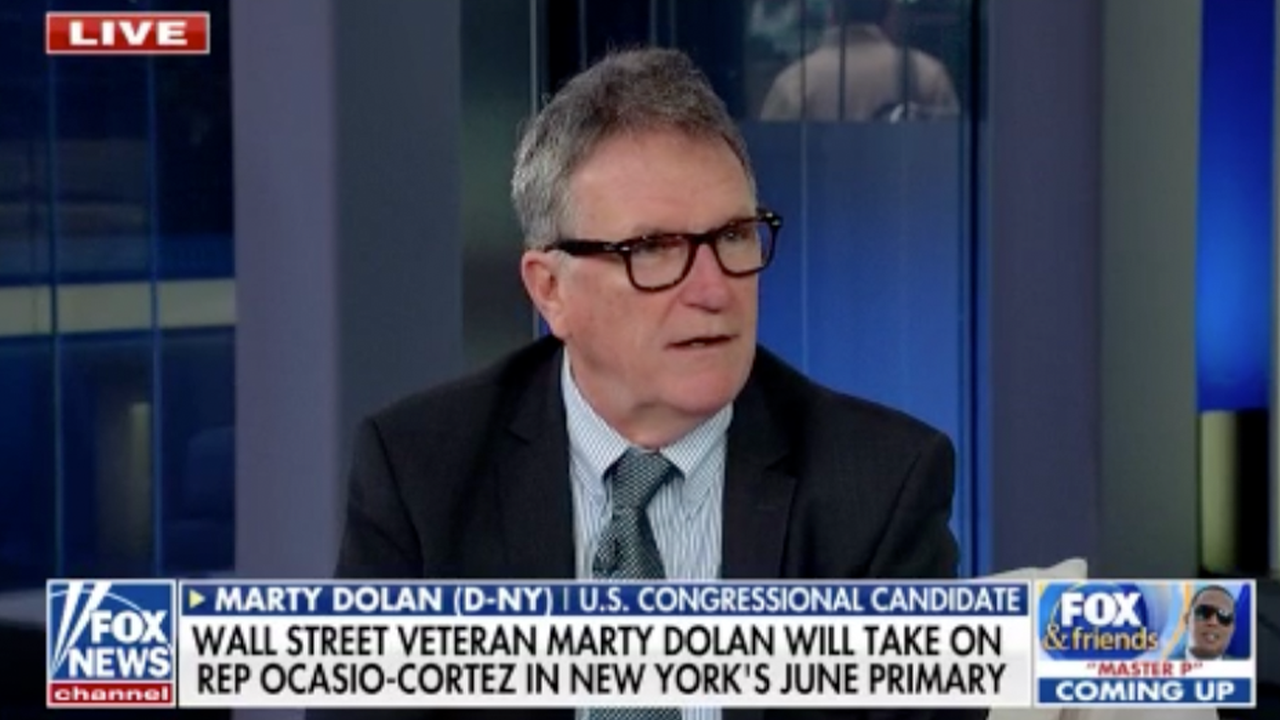
Veteran Wall Street investor Marty Dolan explained to Fox News on Friday why he is running to unseat Rep. Alexandria Ocasio-Cortez, D-N.Y., in her New York district, telling Fox News Channel anchor Lawrence Jones that her policies have led to New Yorkers feeling unsafe.
When asked why he’s running, Dolan held up the cover of the New York Post and read its large letters, “HELL RIDE.”
The article explained how dangerous riding the city’s subway system has become due to rampant crime.
WATCH: MAN WANTED FOR HURLING FLAMING CONTAINERS AT PEOPLE IN NYC SUBWAY STATION
Dolan, who is challenging AOC as a Democrat, added, “This is what you’re getting in the subways. This is what you’re getting in the streets. You’re getting a complete lack of confidence and comfort in what’s supposed to be the best city in the world. So, the standards have just gotten too low, and things have slipped.”
“And enough is enough,” he declared.
Jones followed up by noting the congresswoman’s popularity, asking the candidate about his strategy to beat her.
Dolan replied by noting he’s going to capitalize on residents’ “dissatisfaction” and showcase how AOC looks good in the media, but not so good to everyday people.
“There’s a lot of dissatisfaction in the district,” he said, noting, “a lot of what AOC has done has been very good at the headlines, but not so good in the street.”
“So whether it’s the Green New Deal, whether it’s the Amazon deal, whether it’s the immigrants that are coming in and taking benefits that are intended for constituents, she’s really putting, you know, the headlines first and the constituents second,” he added.
Jones asked Dolan about the “split” in the Democratic Party and what kind of Democrat Dolan considers himself.
BODYCAM VIDEO SHOWS NYPD OFFICERS SPRING INTO ACTION TO PULL MAN FROM SUBWAY TRACKS
Members of the NYPD and National Guard patrol the subway system in New York City on Monday. New York Gov. Kathy Hochul announced a five-point plan earlier this month, deploying 750 members of the National Guard to combat a near 20% rise in crime levels throughout the subways. (Matthew McDermott for Fox News Digital)
He responded by calling himself a “moderate Democrat” and continued, describing how “radicals” seem to have too much power in the party.
Dolan said, “And you hit the nail on the head, which is, the left wing of the left side of the Democratic Party is too far on the left. It’s that simple. So, the airplane is not flying straight. It’s tilted over here. The radicals have outweighed their influence in the party.”
He continued, expressing his belief that his campaign is “going to convert voters” away from AOC and extreme candidates. Dolan added, “I’m not going to say it’s easy, but I think there’s a lot of dissatisfaction in the district with her policies as they apply to the district.”
Jones then asked if Dolan thinks he will get much pushback from protesters and voters. The candidate continued to express confidence, stating, “I’m pretty confident in the voters. I think the voters — you can never underestimate the intelligence of the voters. They do their research. We have about three months before the vote, and I’m confident we’re going to get the result we want.”
When asked what he believes the main issue is for voters, Dolan said, “I think the main issue is quality of life in New York. Jobs, safety — just the feel of the city has gotten out of control, and I think the radicals are entirely responsible for that.”
Read the full article from Here

Powerball, Mega Millions jackpots: What to know in case you win
Here’s what to know in case you win the Powerball or Mega Millions jackpot.
Just the FAQs, USA TODAY
The Vermont Lottery offers several draw games for those willing to make a bet to win big.
Those who want to play can enter the MegaBucks and Lucky for Life games as well as the national Powerball and Mega Millions games. Vermont also partners with New Hampshire and Maine for the Tri-State Lottery, which includes the Mega Bucks, Gimme 5 as well as the Pick 3 and Pick 4.
Drawings are held at regular days and times, check the end of this story to see the schedule.
Here’s a look at July 12, 2026, results for each game:
Winning Pick 3 numbers from July 12 drawing
Day: 9-9-7
Evening: 0-7-4
Check Pick 3 payouts and previous drawings here.
Winning Pick 4 numbers from July 12 drawing
Day: 8-3-1-8
Evening: 7-6-8-2
Check Pick 4 payouts and previous drawings here.
Winning Millionaire for Life numbers from July 12 drawing
12-21-39-46-48, Bonus: 02
Check Millionaire for Life payouts and previous drawings here.
Feeling lucky? Explore the latest lottery news & results
Are you a winner? Here’s how to claim your lottery prize
For Vermont Lottery prizes up to $499, winners can claim their prize at any authorized Vermont Lottery retailer or at the Vermont Lottery Headquarters by presenting the signed winning ticket for validation. Prizes between $500 and $5,000 can be claimed at any M&T Bank location in Vermont during the Vermont Lottery Office’s business hours, which are 8a.m.-4p.m. Monday through Friday, except state holidays.
For prizes over $5,000, claims must be made in person at the Vermont Lottery headquarters. In addition to signing your ticket, you will need to bring a government-issued photo ID, and a completed claim form.
All prize claims must be submitted within one year of the drawing date. For more information on prize claims or to download a Vermont Lottery Claim Form, visit the Vermont Lottery’s FAQ page or contact their customer service line at (802) 479-5686.
Vermont Lottery Headquarters
1311 US Route 302, Suite 100
Barre, VT
05641
When are the Vermont Lottery drawings held?
- Powerball: 10:59 p.m. Monday, Wednesday, and Saturday.
- Mega Millions: 11 p.m. Tuesday and Friday.
- Gimme 5: 6:55 p.m. Monday through Friday.
- Lucky for Life: 10:38 p.m. daily.
- Pick 3 Day: 1:10 p.m. daily.
- Pick 4 Day: 1:10 p.m. daily.
- Pick 3 Evening: 6:55 p.m. daily.
- Pick 4 Evening: 6:55 p.m. daily.
- Megabucks: 7:59 p.m. Monday, Wednesday and Saturday.
- Millionaire for Life: 11:15 p.m. daily
What is Vermont Lottery Second Chance?
Vermont’s 2nd Chance lottery lets players enter eligible non-winning instant scratch tickets into a drawing to win cash and/or other prizes. Players must register through the state’s official Lottery website or app. The drawings are held quarterly or are part of an additional promotion, and are done at Pollard Banknote Limited in Winnipeg, MB, Canada.
This results page was generated automatically using information from TinBu and a template written and reviewed by a Vermont editor. You can send feedback using this form.
Boston, MA
‘More than just a cyclist’: Hundreds mourn Boston transit planner killed while biking – The Boston Globe

“She’s more than just a cyclist and an advocate,” Rose Frank, 36, who became friends with Gag in seventh grade, said. “Those were parts of her identity, but she’s such an amazing person in so many other ways, and we want to celebrate all of those ways.”
Gag, who grew up in Roslindale just minutes from the park, was a joyful and energetic child, said Mark Smith, 66, a neighbor who spoke at the event.
“She was the sweetest little girl with a big wide smile,” Smith said. “Whenever you were in her presence, you felt somehow special.”
Smith said Gag’s passion for giving back to her community likely came from her parents, Steve Gag and Laura Gang, longtime Roslindale residents who contributed greatly to developing the neighborhood. Steve Gag helped bring a farmers market to Adams Park, while Laura Gang was involved in the public library.
Gag’s loved ones said she grew up to become a generous person who cared deeply about her family and friends.
“Louisa showed up for people,” Molly Goodkind, 36, a childhood friend of Gag’s said during Sunday’s event. “We’ll never understand how she had time to be everyone’s go-to person.”
Gag, she said, would eagerly volunteer to cat-sit, even though she didn’t like cats. Another friend said she kept a spreadsheet of the birthdays of all the babies she knew.
“She was the person outside of my biological family who, if I needed something, she would be there in an instant,” Goodkind, who has known Gag since they were 2-years-old, said.
Gag’s friends said she was curious and remained open-minded, even though she held firm beliefs.
“Who do you know that was a vegetarian except for when it inconvenienced others? And of course, except for hot dogs, because according to Louisa, you can’t not have a hot dog at a barbecue,” Gag’s friend Danielle Shaked said, drawing laughs from the crowd, including Laura Gang, who dabbed at her eyes with a crumpled tissue.
Gag also found time for many hobbies, and was always trying new ones, her friends said. Beyond loving outdoor activities such as biking and hiking, she was passionate about sustainability and shopped secondhand or sewed her own clothes. She dabbled in photography, painting, and cooking.

Urban planning was one of Gag’s enduring passions, Goodkind said.
“In college, she created her own major,” she said. “I don’t remember exactly what she called it, but it was something like city and people.”
Gag attended college at the University of Rochester and later earned a master’s degree in urban and environmental planning and policy from Tufts University, according to her LinkedIn.
Before joining the city in 2022, Gag worked for LivableStreets Alliance, a Boston-based nonprofit that advocates for increased safety, equity, and affordability. She also interned for Mayor Michelle Wu when Wu was a city councilor.
Wu attended Sunday’s event, but did not speak. Like many other attendees, she held a yellow sunflower, one of Gag’s favorites, as she tearfully listened to the tributes.
While Gag didn’t like being the center of attention, her friends said she would have been grateful for Sunday’s event.
“She would be completely honored to know that she has impacted so many people,” Frank said, her gaze drifting over the people gathered in the park.
Under a small tent nearby, attendees crowded around a folding table, filling out remembrance cards. Dozens of bikes leaned against the park’s fences while more lay scattered in the grass.
Allyson Chiu can be reached at allyson.chiu@globe.com. Follow her on X @_allysonchiu.
Pittsburg, PA
Pittsburgh Pirates Select Incoming Tennessee Baseball Transfer Outfielder In MLB Draft | Rocky Top Insider

The Pittsburgh Pirates selected Tennessee baseball transfer commit Andrew Duncan with the 558th pick (19th round) in the 2026 MLB Draft on Sunday afternoon. A Wright State outfielder, Duncan committed to Tennessee out of the transfer portal last month.
Duncan is coming off a breakout junior season at Wright State where he slashed .367/.436/.577 with six home runs, 11 doubles, eight triples and 36 RBIs. As the eight triples indicate, speed is a key part of Duncan’s game with the outfielder stealing 19 bases on just 22 attempts.
The Dunedin, Florida native spent his freshman season at Florida State where he played in just 13 games before transferring to Wright State for his sophomore season. Duncan transferred to Tallahassee State College for his sophomore season before moving back up to the division one level at Wright State last season.
More From RTI: Elite Tennessee Baseball Catcher Signee Withdraws From MLB Draft, Will Play for Vols
Duncan played centerfield for the Raiders last season and will likely slide into that same spot at Tennessee next season if he does not sign with Pittsburgh. Outfield was a major point of emphasis for the Vols this offseason after losing Reese Chapman to graduation, Garrett Wright to the MLB Draft and both Jay Abernathy and Nate Eisfelder to the transfer portal.
Losing Duncan would be a real blow because of Tennessee’s need in centerfield for next season. A number of other Vols including Levi Clark, Blake Grimmer and Mercer transfer Braydon Kersey are capable of playing in the outfield but likely could not play centerfield at a high level defensively.
Duncan is one of 11 transfers to commit to Tennessee this offseason along with Air Force infielder Wyatt Hanoian, Cal Baptist shortstop Chris Ramirez, Baylor infielder Travis Sanders, FIU infielder Mario Trivella, Clemson right-handed pitcher Hayden Simmerson, Louisville right-handed pitcher Parker Detmers, South Carolina left-handed pitcher Jake McCoy, Northwestern State left-handed pitcher Brody Trosclair, UC Irvine left-handed pitcher Ricky Ojeda and Mercer two-way Braydon Kersey.
-
Tennessee2 minutes ago
TN Lottery Cash 3 Evening, Cash 4 Evening winning numbers for July 12, 2026
-

 Texas8 minutes ago
Arrest made in death of North Texas teen Daniel Erving found in Lake Ray Hubbard
-
 Utah14 minutes ago
Families fight to stay cool as Salt Lake City reaches record-breaking temperatures
-
Vermont20 minutes ago
VT Lottery Pick 3, Pick 3 Evening results for July 12, 2026
-

 Virginia25 minutes ago
Virginia Lottery Pick 3 Night, Pick 3 Day results for July 12, 2026
-

 Wisconsin38 minutes ago
Wisconsin Lottery Pick 3, Pick 4 results for July 12, 2026
-

 West Virginia44 minutes ago
This week in West Virginia history: July 12 to 18
-

 Wyoming50 minutes ago
First Alert Weather Days through Sat. for excessive heat, possibly through Wednesday for fire danger

