Vermont
Star bartender raised in VT hunts the ‘big shebang’ of a James Beard


Ivy Mix knew only small-town life growing up in Vermont. In 2003, she decided that needed to change.
“I realized the world was a very big place,” she said recently. “I thought I might want to go someplace and see something.”
She left for Guatemala to volunteer and teach photography in an orphanage. She hung out daily in a nearby bar, enjoying the environment at least as much as the imbibements. When she realized she couldn’t pay off the tab she had racked up, Mix started pouring drinks to offset her debts.
A celebrated bartending career began.
The Tunbridge native is a semifinalist in the Outstanding Professional in Cocktail Service category of the James Beard Awards, the top honors in the American food-and-drink industry. The nod recognizes her work at Whoopsie Daisy, the bar she co-owns in Brooklyn. The author and five-time nominee hopes this is the moment she can finally call herself a James Beard winner.
The 20 bartenders in her category include Kate Wise, who grew up in Stowe and works at Juniper at Hotel Vermont in Burlington. Wise said she’s stunned she’s in the same category with a woman she saw give a cocktail-making demonstration years ago at Waterworks Food + Drink in Winooski, the sort of event celebrity bartenders do.
“She is so talented,” Wise said of Mix, who has owned two successful bars.
Catching on to the cocktail boom
Mix spoke with the Burlington Free Press while driving from New York City to Tunbridge. She splits her time living in Brooklyn and her hometown.
“Tunbridge when I was growing up was small and really rural,” Mix said. “It’s still rural, but it was before the demise of the dairy industry.”
Mix and her twin sister, Tess, are the daughters of glass blower Robin Mix and Susan Dollenmaier, founder of the Vermont-based textile company Anichini. They lived off a dirt road with only one house nearby. Mix attended a Waldorf school and then Chelsea High School and became obsessed with horseback riding.
“I horseback rode all the time,” she said. “Before I went to college that’s what I thought I was going to do. Olympic riding was my goal.”
She stayed in Vermont to study philosophy and fine art at Bennington College. While in college she spent time in Guatemala, sowing the seeds of her bartending career.
Mix graduated from Bennington in 2008. She sold her horse and thought she’d become a professor. The economic collapse that year changed her plans. She lived in New York, worked for free at art galleries and hated it. Mix began working at cocktail bars just as that trend was catching on.
“I was like, ‘OK, this is cool,’” she said. “The cocktail revolution was really booming.”
Shining a spotlight on female mixologists
The cocktail revolution, though, felt like it had little room for women.
Mix said the speakeasy “meme” was big then, which meant men in moustaches, arm garters and suspenders. She and friend Lynnette Marrero in 2011 started Speed Rack, which as the movement’s website explains has “been able to shine a spotlight on female mixologists thriving behind bars around the country; and while they are at it, raise money for breast cancer research, education and prevention.”
That’s when her career really took off. She was named one of Food & Wine magazine’s most innovative women in 2015 and honored by Wine Enthusiast as Mixologist of the Year in 2016.
The first time she was up for a James Beard Award was two years later. Her bar, Layenda, was up for the Outstanding Bar Program category. (It would also be a semifinalist in 2019 and last year before closing.) She scored a second Beard nod in 2025 as a media-award nominee for her book “A Quick Drink: The Speed Rack Guide to Winning Cocktails for Any Mood.”
She co-owns the Brooklyn wine shop Fiasco! Wine + Spirits and runs Whoopsie Daisy with Piper Kristensen and Conor McKee. Mix said she used to play Little League baseball against Kristensen, who’s from Strafford.
‘I want to go to the big shebang’
Mix said Vermont helped shape her career because of the sense of community it inspires.
“I can make a good cocktail, but if you’re not having a good time and you don’t feel welcome, it’s not going to taste good,” she said.
The small-town tendency to take good care of people “has really infiltrated my sense of hospitality,” Mix said.
She would love to finally win a James Beard Award after her string of nominations. She said she’s been lucky to have “a mountain of accolades” that she’s proud of. But the Beard honors are different.
“Accolades — it’s such a funny world. Do they matter? Yes. Do they dramatically help your business? Absolutely,” Mix said.
“For me to get a medal around my neck, that’s the one I really want to get,” she said of the James Beard Award. “It kind of puts you on a whole different playing field.”
Finalists will be announced March 31. Winners will be revealed June 15 in a ceremony in Chicago.
“I want to go to the big shebang,” Mix said.
If you go
WHAT: Whoopsie Daisy bar
WHEN: 5-11 p.m. Monday-Thursday; 5 p.m.-midnight Friday; 3 p.m.-midnight Saturday; 3-11 p.m. Sunday
WHERE: 225 Rogers Ave., Brooklyn
INFORMATION: (347) 365-4193, whoopsiedaisybk.com
Contact Brent Hallenbeck at bhallenbeck@burlingtonfreepress.com.



Powerball, Mega Millions jackpots: What to know in case you win
Here’s what to know in case you win the Powerball or Mega Millions jackpot.
Just the FAQs, USA TODAY
The Vermont Lottery offers several draw games for those willing to make a bet to win big.
Those who want to play can enter the MegaBucks and Lucky for Life games as well as the national Powerball and Mega Millions games. Vermont also partners with New Hampshire and Maine for the Tri-State Lottery, which includes the Mega Bucks, Gimme 5 as well as the Pick 3 and Pick 4.
Drawings are held at regular days and times, check the end of this story to see the schedule.
Here’s a look at July 9, 2026, results for each game:
Winning Gimme 5 numbers from July 9 drawing
08-15-26-27-30
Check Gimme 5 payouts and previous drawings here.
Winning Pick 3 numbers from July 9 drawing
Day: 1-5-4
Evening: 6-2-8
Check Pick 3 payouts and previous drawings here.
Winning Pick 4 numbers from July 9 drawing
Day: 5-0-2-1
Evening: 2-6-7-6
Check Pick 4 payouts and previous drawings here.
Winning Millionaire for Life numbers from July 9 drawing
02-15-22-54-58, Bonus: 04
Check Millionaire for Life payouts and previous drawings here.
Feeling lucky? Explore the latest lottery news & results
Are you a winner? Here’s how to claim your lottery prize
For Vermont Lottery prizes up to $499, winners can claim their prize at any authorized Vermont Lottery retailer or at the Vermont Lottery Headquarters by presenting the signed winning ticket for validation. Prizes between $500 and $5,000 can be claimed at any M&T Bank location in Vermont during the Vermont Lottery Office’s business hours, which are 8a.m.-4p.m. Monday through Friday, except state holidays.
For prizes over $5,000, claims must be made in person at the Vermont Lottery headquarters. In addition to signing your ticket, you will need to bring a government-issued photo ID, and a completed claim form.
All prize claims must be submitted within one year of the drawing date. For more information on prize claims or to download a Vermont Lottery Claim Form, visit the Vermont Lottery’s FAQ page or contact their customer service line at (802) 479-5686.
Vermont Lottery Headquarters
1311 US Route 302, Suite 100
Barre, VT
05641
When are the Vermont Lottery drawings held?
- Powerball: 10:59 p.m. Monday, Wednesday, and Saturday.
- Mega Millions: 11 p.m. Tuesday and Friday.
- Gimme 5: 6:55 p.m. Monday through Friday.
- Lucky for Life: 10:38 p.m. daily.
- Pick 3 Day: 1:10 p.m. daily.
- Pick 4 Day: 1:10 p.m. daily.
- Pick 3 Evening: 6:55 p.m. daily.
- Pick 4 Evening: 6:55 p.m. daily.
- Megabucks: 7:59 p.m. Monday, Wednesday and Saturday.
- Millionaire for Life: 11:15 p.m. daily
What is Vermont Lottery Second Chance?
Vermont’s 2nd Chance lottery lets players enter eligible non-winning instant scratch tickets into a drawing to win cash and/or other prizes. Players must register through the state’s official Lottery website or app. The drawings are held quarterly or are part of an additional promotion, and are done at Pollard Banknote Limited in Winnipeg, MB, Canada.
This results page was generated automatically using information from TinBu and a template written and reviewed by a Vermont editor. You can send feedback using this form.
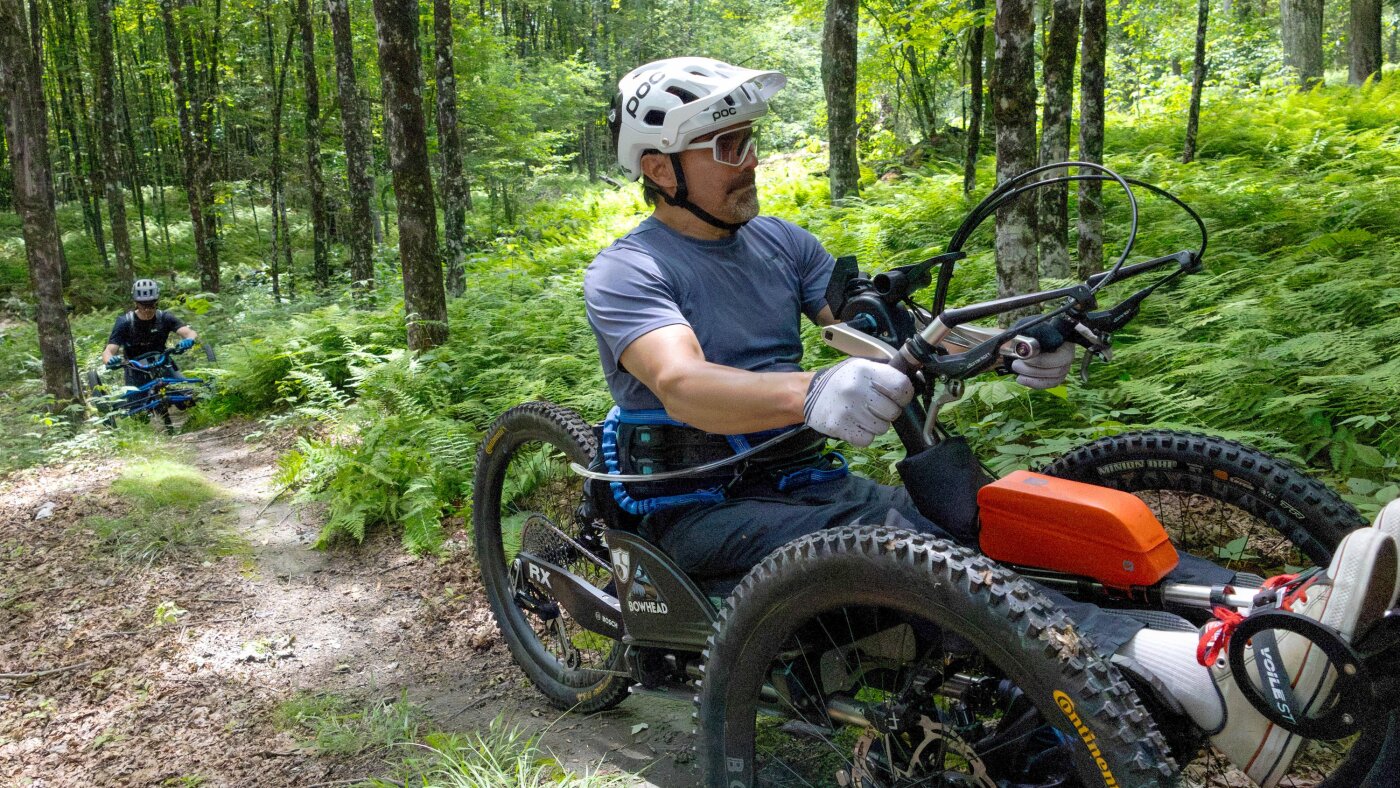
Louis Arevalo rides his adaptive mountain bike through the trails at Randolph Town Forest during an adaptive assessment on Thursday, June 25. Nick Bennette, with the Vermont Mountain Bike Association, rides behind.
Zoe McDonald/Vermont Public
hide caption
toggle caption
Zoe McDonald/Vermont Public
Mountain bike enthusiasts have been working for years on an ambitious 485-mile, multi-use trail called The Velomont that will span the length of the state.
When finished, the collaborative project will knit together existing trail networks, connect 27 communities and include huts and hostels for overnight stays.
New trail construction is finally ramping up after years spent on permits, plans and public input. And organizers say they want to make it as user-friendly as possible.
“For us, it’s not a huge lift to just be mindful when we’re trying to build trail or improve trail to think about the adaptive rider,” said Angus McCusker, the Velomont trail director with the nonprofit Vermont Huts and Trails.
McCusker is referring to the growing number of disabled athletes who mountain bike with specially designed equipment.
“The challenge,” said McCusker, “is we’re connecting to existing trail networks that were never intended for adaptive bikes. So, where we can, we’re trying to do adaptive assessments.”
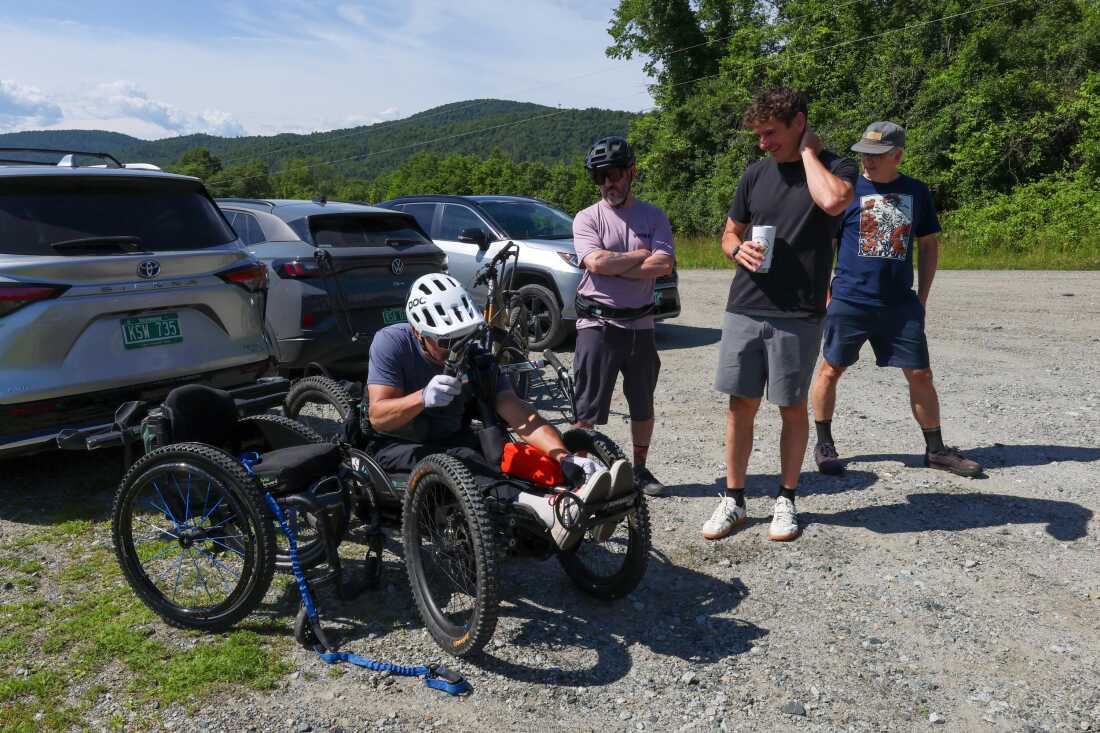
Louis Arevalo, left, straps into his adaptive mountain bike and chats with Jeff Dickson of the Vermont Mountain Bike Association, Angus McCusker with Vermont Huts and Trails, and volunteer Thatcher Hinman (all from left) ahead of a trail accessibility assessment in Randolph, Vermont, on Thursday, June 25, 2026.
Zoe McDonald/Vermont Public
hide caption
toggle caption
Zoe McDonald/Vermont Public
Louis Arevalo of Essex Junction is one of several adaptive athletes helping with that, most recently on some slightly overgrown single track trails in Randolph, a central Vermont town nestled along the eastern edge of the Green Mountains.
Arevalo pedals with his hands. He rides an electric powered recumbent-style three-wheeler that sits low to the ground. His service dog Azul chases along nearby.
“Once you realize what these bikes are capable (of) or this equipment actually opens up, it kind of blows your mind,” he said.
Arevalo was paralyzed in a skiing accident six years ago. Being able to get back on the trails has been a game changer, he said smiling.
“There’s a reason we live in the Green Mountain state. It’s because we like to get outside…you know, seeing the squirrels and chipmunks and birds… I mean, it’s life.”
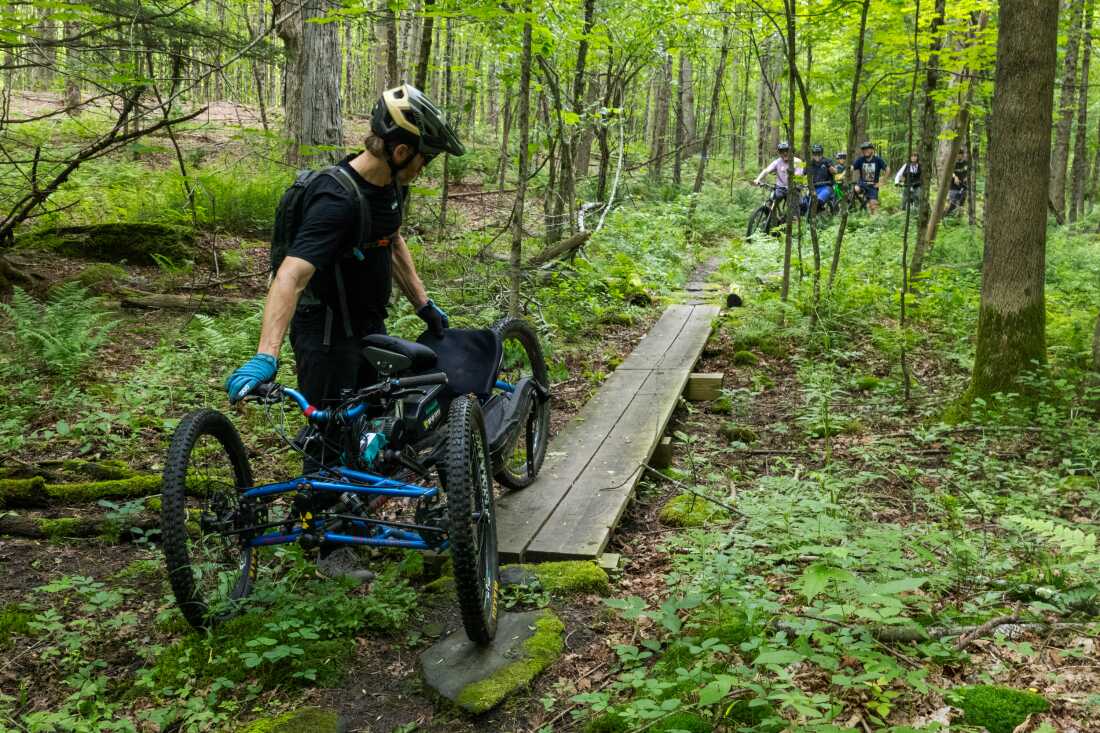
Nick Bennette, of the Vermont Mountain Biking Association, guides an adaptive bike over a narrow bridge, pointing out that other adaptive riders may have trouble getting across.
Zoe McDonald/Vermont Public
hide caption
toggle caption
Zoe McDonald/Vermont Public
But adaptive rigs like Arevalo’s are wider and heavier than regular mountain bikes, and not all trails are user-friendly.
Nick Bennette, who was testing a different type of adaptive bike, got hung up on several tight turns.
“It’s helpful to have different kinds of adaptive bikes on these tests because they all handle a little differently,” he said.
Bennette is executive director of the Vermont Mountain Bike Association, another nonprofit spearheading efforts around the Velomont. He and others involved in the assessment are taking detailed photos and notes on ways to make the trails more accessible.
“Just scalloping out a bit of material on the outside of that corner,” said Bennette, pointing to the area the bike got caught. “That will allow adaptive bikes to make that corner without really changing the way the trail rides.”
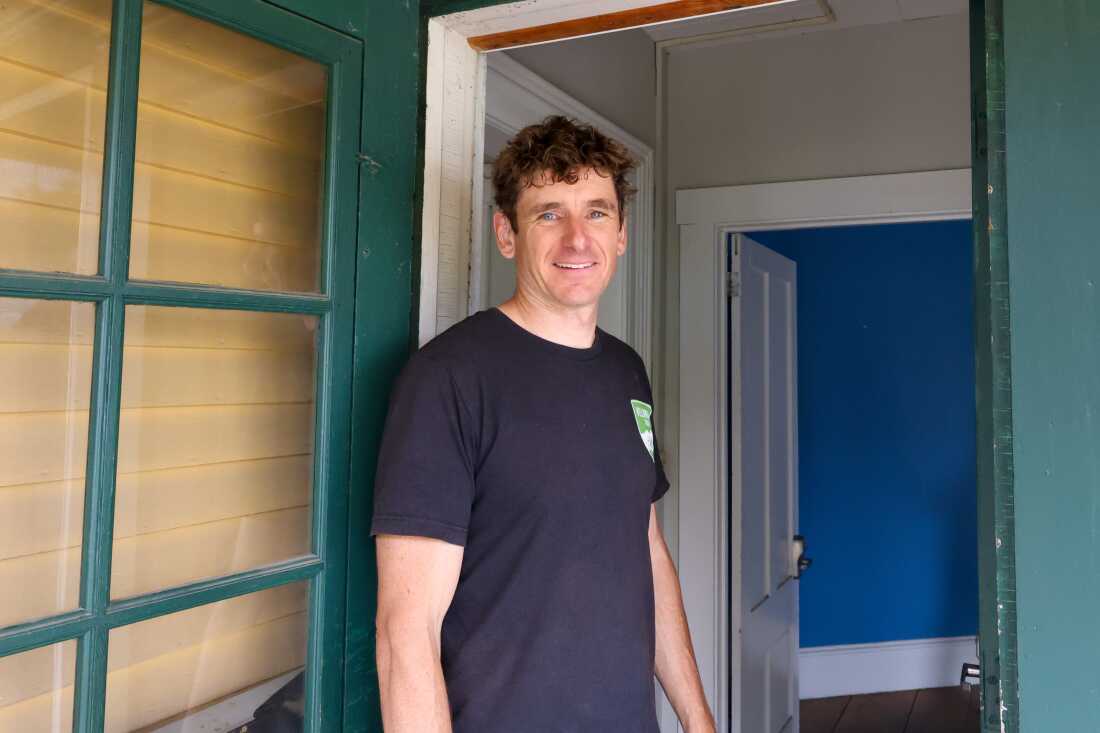
Angus McCusker with Vermont Huts and Trails is working to create accessible accommodations along the Velomont Trail, including a multi-group space in Randolph and a hut in Chittenden that has been outfitted with accessibility in mind.
Zoe McDonald/Vermont Public
hide caption
toggle caption
Zoe McDonald/Vermont Public
Contractors are also trying to reduce barriers at the trail’s overnight accommodations. This summer, contractors are building a new ADA accessible hostel in downtown Randolph.
And two remote huts along the trail will have locked sheds with off-road wheelchairs so bikers don’t have to haul their own.
At the Chittenden Brook Hut, McCusker highlighted a new ramp and wider driveway.
“So if you’re an adaptive rider, you can imagine rolling right up here and you can transfer to your chair that’s available here, and then roll down the ramp and go down to the fireplace, to the privy, to make your meal,” he said.
Louis Arevalo stayed at the hut last summer with other adaptive riders — his first camping trip since his accident.
“There was a babbling brook right there…and it was really refreshing to have easy access to a beautifully built hut that was easy to navigate, and then have these world-class trails right out the door,” he said. “And with these Velomont trails, I can actually plan a hut-to-hut trip with other people.”
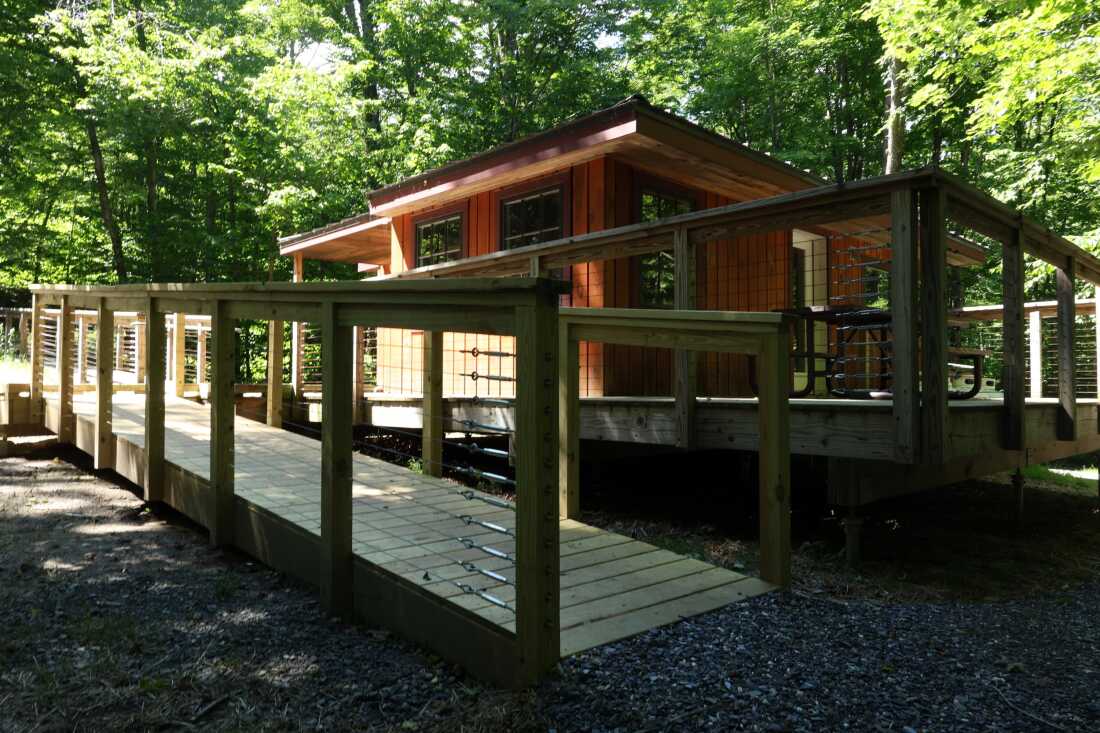
The Chittenden Brook Hut includes accessible ramps, storage for adaptive bikes and specialized off-road wheelchairs for visitors.
Zoe McDonald/Vermont Public
hide caption
toggle caption
Zoe McDonald/Vermont Public
Jeff Alexander is counting on it. He’s director of strategic partnerships with Vermont Adaptive Ski and Sports, a nonprofit that helps people with disabilities access outdoor recreation.
An economic impact analysis the group commissioned estimates their programming generated more than $10 million last year.
“So the adaptive community has money, they travel, they want to travel and they want to play with everybody,” Alexander said. “We just need to level the playing field so that everyone can play together.”
Powerball, Mega Millions jackpots: What to know in case you win
Here’s what to know in case you win the Powerball or Mega Millions jackpot.
Just the FAQs, USA TODAY
The Vermont Lottery offers several draw games for those willing to make a bet to win big.
Those who want to play can enter the MegaBucks and Lucky for Life games as well as the national Powerball and Mega Millions games. Vermont also partners with New Hampshire and Maine for the Tri-State Lottery, which includes the Mega Bucks, Gimme 5 as well as the Pick 3 and Pick 4.
Drawings are held at regular days and times, check the end of this story to see the schedule.
Here’s a look at July 8, 2026, results for each game:
Winning Powerball numbers from July 8 drawing
12-29-37-43-55, Powerball: 18, Power Play: 4
Check Powerball payouts and previous drawings here.
Winning Gimme 5 numbers from July 8 drawing
01-05-23-36-38
Check Gimme 5 payouts and previous drawings here.
Winning Pick 3 numbers from July 8 drawing
Day: 0-1-3
Evening: 2-4-0
Check Pick 3 payouts and previous drawings here.
Winning Pick 4 numbers from July 8 drawing
Day: 3-9-5-9
Evening: 9-2-0-9
Check Pick 4 payouts and previous drawings here.
Winning Megabucks Plus numbers from July 8 drawing
12-15-23-27-40, Megaball: 03
Check Megabucks Plus payouts and previous drawings here.
Winning Millionaire for Life numbers from July 8 drawing
16-18-43-48-50, Bonus: 01
Check Millionaire for Life payouts and previous drawings here.
Feeling lucky? Explore the latest lottery news & results
Are you a winner? Here’s how to claim your lottery prize
For Vermont Lottery prizes up to $499, winners can claim their prize at any authorized Vermont Lottery retailer or at the Vermont Lottery Headquarters by presenting the signed winning ticket for validation. Prizes between $500 and $5,000 can be claimed at any M&T Bank location in Vermont during the Vermont Lottery Office’s business hours, which are 8a.m.-4p.m. Monday through Friday, except state holidays.
For prizes over $5,000, claims must be made in person at the Vermont Lottery headquarters. In addition to signing your ticket, you will need to bring a government-issued photo ID, and a completed claim form.
All prize claims must be submitted within one year of the drawing date. For more information on prize claims or to download a Vermont Lottery Claim Form, visit the Vermont Lottery’s FAQ page or contact their customer service line at (802) 479-5686.
Vermont Lottery Headquarters
1311 US Route 302, Suite 100
Barre, VT
05641
When are the Vermont Lottery drawings held?
- Powerball: 10:59 p.m. Monday, Wednesday, and Saturday.
- Mega Millions: 11 p.m. Tuesday and Friday.
- Gimme 5: 6:55 p.m. Monday through Friday.
- Lucky for Life: 10:38 p.m. daily.
- Pick 3 Day: 1:10 p.m. daily.
- Pick 4 Day: 1:10 p.m. daily.
- Pick 3 Evening: 6:55 p.m. daily.
- Pick 4 Evening: 6:55 p.m. daily.
- Megabucks: 7:59 p.m. Monday, Wednesday and Saturday.
- Millionaire for Life: 11:15 p.m. daily
What is Vermont Lottery Second Chance?
Vermont’s 2nd Chance lottery lets players enter eligible non-winning instant scratch tickets into a drawing to win cash and/or other prizes. Players must register through the state’s official Lottery website or app. The drawings are held quarterly or are part of an additional promotion, and are done at Pollard Banknote Limited in Winnipeg, MB, Canada.
This results page was generated automatically using information from TinBu and a template written and reviewed by a Vermont editor. You can send feedback using this form.
-

 Boston, MA3 minutes ago
Police investigating shooting in Downtown Crossing – Boston News, Weather, Sports | WHDH 7News
-
 Denver, CO10 minutes ago
Denver mayor announces new $100 million plan to bring in 10,000 jobs
-

 San Diego, CA13 minutes ago
WEBTOON Brings Top Creators for San Diego Comic-Con Panels
-

 Seattle, WA13 minutes ago
Husband of pregnant wife killed in Seattle sues King County homeless authority
-

 Milwaukee, WI25 minutes ago
Supervisor calls for referendum on Milwaukee County courthouse revamp
-

 Atlanta, GA28 minutes ago
Critically missing: 11-year-old missing in Atlanta after running away
-

 Minneapolis, MN33 minutes ago
Marilyn Savage, St. Cloud State Educator And Media Pioneer, Remembered July 18 In Cokato
-

 Indianapolis, IN40 minutes ago
Unsettled Friday and Saturday, then summer heat returns early next week | July 10, 2026

