
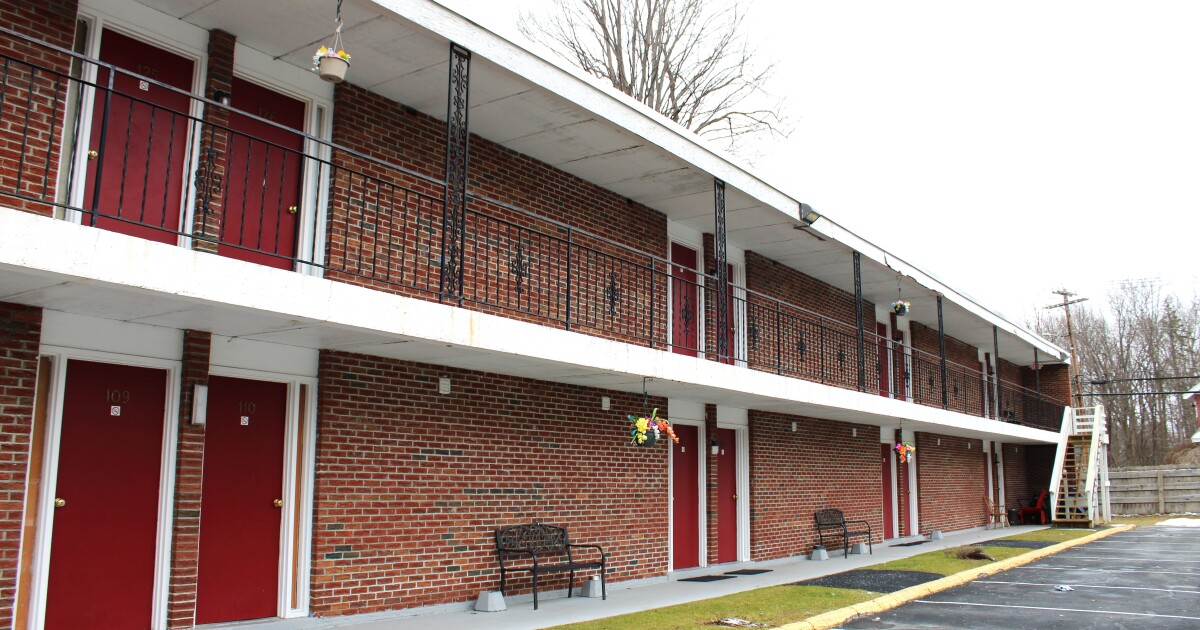
The Vermont Senate approved a mid-year spending bill on Wednesday that would, among other proposals, extend motel housing eligibility for unhoused Vermonters, and allocate millions of dollars of funding to areas hit hardest by last July’s flooding.
Motel housing
The legislation includes nearly $12 million to extend motel housing eligibility for the approximately 1,600 individuals enrolled in the program now.
Waterbury Rep. Theresa Wood, the Democratic chair of the House Committee on Human Services, said the appropriation ensures that families with children, people with disabilities and other vulnerable Vermonters will have access to shelter until at least June 30. The program was previously scheduled to wind down on April 1.
“For the legislative body, we feel it’s imperative that we house people, especially vulnerable populations,” Wood said.
Advertisement
Pete Hirschfeld
/
Vermont Public
House and Senate leaders finalized an agreement this week on a mid-year spending package that includes funding for emergency motel housing and flood relief.
Frank Knaack, executive director of the Housing and Homelessness Alliance of Vermont, said his organization appreciates the extension. And he said the bill includes new procedures for determining disability status that will result in more Vermonters being eligible for emergency housing.
Advertisement
Knaack, however, said he’s “deeply concerned” about a provision in the legislation that sets a new maximum daily rate cap of $80 on motel stays.
More from Vermont Public: Proposal for reining in Vermont’s motel housing costs creates uncertainty, anxiety
“What we’ve heard from our folks on the ground is that a great number of hotels in Vermont have said they will not do this,” Knaack said. “And what this means functionally is that, as of this Friday, when the rate cap would go into effect March 1, that people will be out on the street. And there’s no place for anyone to go. Our shelters are full. Our service providers are maxed out, and so we’re going to have a real crisis on our hands in Vermont starting as soon as this Friday.”
Advocates have been trying to sound the alarm over the rate-cap provision for weeks.
On Monday, the Chittenden County Homeless Alliance sent a letter to lawmakers urging them to shelve the cap. The Alliance said that seven of the 12 hotel owners participating in the shelter program had indicated they would withdraw if the state capped daily rates at $80.
Advertisement
“Those seven motels which may decline to participate in the program beyond this week currently provide 225 rooms for individuals and families who are unhoused,” the letter said.
Republican Gov. Phil Scott said that he’s far more optimistic about compliance with the new cap. He said the Agency of Human Services is enjoying “huge success” in negotiating lower rates with hotel and motel owners.
“We’re making tremendous gains right now,” Scott said.
Scott said the hotel owners who initially balked at the cap have become more amendable to contract renewals once it became clear that the legislature planned to proceed with the $80 limit.
“The closer we got to this reality that the cap is going to be in place … the more agreements we had,” he said. “And I expect we’ll have a few more over the next couple days, so I feel as good as I can feel at this point in time.”
Advertisement
Brenda Siegel, executive director of End Homelessness Vermont, expressed severe concerns about motels withdrawing from the program Tuesday.
“And that means that without any notice, and without any preparation of providers, potentially hundreds, maybe thousands, of people will end up outside,” Siegel said.
By Wednesday afternoon, however, Siegel said she’d talked with two hotel owners on whom the state is particularly reliant for rooms in southern and central Vermont and in Chittenden County. And she said they had both tentatively agreed to remain in the program despite the new cap.
Siegel said their decision was based in part on a provision in the legislation that allows the state to pay hotels additional fees for things like security or space for on-site services.
“So a lot of people who were backing out are now coming back to the table,” she said.
Advertisement
Peter Hirschfeld
/
Vermont Public
Under the spending bill, Barre City will receive a $1 million grant to aid in flood recovery.
Flood relief
City officials in Barre, Montpelier, Ludlow and Johnson are breathing a little easier after lawmakers finalized legislation that includes $3.25 million in aid for the four municipalities hit hardest by the summer floods.
Advertisement
The mid-year spending bill, known in Montpelier as the budget adjustment act, includes $12.5 million in direct aid for towns and cities that experienced flood damage last summer.
Half that money will help towns cover the federal match needed to draw down FEMA assistance to repair road, bridges, municipal buildings and other public infrastructure. The remainder is being doled out in block grants that municipalities can use for whatever flood-related purposes they deem most appropriate.
More from Vermont Public: Which areas in Vermont were hit hardest in the July flooding?
Barre City, which experienced more flood-related losses than any other jurisdiction, will receive a $1 million grant.
Barre City Rep. Jonathan Williams said he attended city council Tuesday evening to deliver news of the aid package.
Advertisement
“The sense of relief in city council chambers was palpable. There was applause. A few people got teary eyed, myself included,” Williams said. “The need … was so great. So many people there have suffered and struggled for so long to figure out how we’re going to move forward as a community that they were very, very, very relieved to hear this information. It was very moving.”
Williams said Barre is poised to use the money to offset a $1.4 million loss in municipal revenues, which would have otherwise required reductions in city services or a substantial increase in local municipal property taxes.
“So many people there have suffered and struggled for so long to figure out how we’re going to move forward as a community that they were very, very, very relieved to hear this information. It was very moving.”
Barre City Rep. Jonathan Williams
Johnson, Ludlow and Montpelier are all slated to receive $750,000 grants. Another 108 municipalities will get grants ranging from $10,000 to $75,000, based on a formula that takes into account the severity of flood-related damage municipalities experienced.
Advertisement
The legislation is set for a final vote in the Vermont House of Representatives later this week.
What’s next?
Gov. Phil Scott said he plans to sign the budget adjustment act into law when it reaches his desk, despite concerns that the bill includes more spending than he proposed.
Scott said the additional allocations mean that lawmakers will have to pare back spending in the fiscal year 2025 budget bill that’s currently in the House Committee on Appropriations.
“These aren’t easy decisions to make, and when you have a finite amount of money that you can’t exceed, from my standpoint, then you have to make choices,” Scott said. “The added cost has got to come out of something.”
Williams said Scott’s approach represents a “scarcity mindset” that lawmakers such as him aren’t inclined to accept. And while the governor might not be willing to consider increases in taxes or fees that would be needed to support state spending beyond next year’s current revenue forecast, Williams said he is.
Advertisement
“I don’t think it’s a zero-sum,” he said. “That’s only true if we’re not willing to consider, for example, a 3% income tax surcharge on those who make $500,000 a year or more.”
Have questions, comments or tips? Send us a message.
Powerball, Mega Millions jackpots: What to know in case you win
Here’s what to know in case you win the Powerball or Mega Millions jackpot.
Just the FAQs, USA TODAY
The Vermont Lottery offers several draw games for those willing to make a bet to win big.
Advertisement
Those who want to play can enter the MegaBucks and Lucky for Life games as well as the national Powerball and Mega Millions games. Vermont also partners with New Hampshire and Maine for the Tri-State Lottery, which includes the Mega Bucks, Gimme 5 as well as the Pick 3 and Pick 4.
Drawings are held at regular days and times, check the end of this story to see the schedule.
Here’s a look at April 20, 2026, results for each game:
Winning Powerball numbers from April 20 drawing
09-17-36-47-64, Powerball: 26, Power Play: 3
Check Powerball payouts and previous drawings here.
Advertisement
Winning Gimme 5 numbers from April 20 drawing
16-17-25-33-36
Check Gimme 5 payouts and previous drawings here.
Winning Pick 3 numbers from April 20 drawing
Day: 0-5-8
Evening: 6-1-9
Check Pick 3 payouts and previous drawings here.
Advertisement
Winning Pick 4 numbers from April 20 drawing
Day: 7-8-3-4
Evening: 0-0-4-9
Check Pick 4 payouts and previous drawings here.
Winning Megabucks Plus numbers from April 20 drawing
04-11-23-32-41, Megaball: 04
Check Megabucks Plus payouts and previous drawings here.
Advertisement
Feeling lucky? Explore the latest lottery news & results
Are you a winner? Here’s how to claim your lottery prize
For Vermont Lottery prizes up to $499, winners can claim their prize at any authorized Vermont Lottery retailer or at the Vermont Lottery Headquarters by presenting the signed winning ticket for validation. Prizes between $500 and $5,000 can be claimed at any M&T Bank location in Vermont during the Vermont Lottery Office’s business hours, which are 8a.m.-4p.m. Monday through Friday, except state holidays.
For prizes over $5,000, claims must be made in person at the Vermont Lottery headquarters. In addition to signing your ticket, you will need to bring a government-issued photo ID, and a completed claim form.
All prize claims must be submitted within one year of the drawing date. For more information on prize claims or to download a Vermont Lottery Claim Form, visit the Vermont Lottery’s FAQ page or contact their customer service line at (802) 479-5686.
Vermont Lottery Headquarters
Advertisement
1311 US Route 302, Suite 100
Barre, VT
05641
When are the Vermont Lottery drawings held?
Powerball: 10:59 p.m. Monday, Wednesday, and Saturday.
Mega Millions: 11 p.m. Tuesday and Friday.
Gimme 5: 6:55 p.m. Monday through Friday.
Lucky for Life: 10:38 p.m. daily.
Pick 3 Day: 1:10 p.m. daily.
Pick 4 Day: 1:10 p.m. daily.
Pick 3 Evening: 6:55 p.m. daily.
Pick 4 Evening: 6:55 p.m. daily.
Megabucks: 7:59 p.m. Monday, Wednesday and Saturday.
Millionaire for Life: 11:15 p.m. daily
What is Vermont Lottery Second Chance?
Vermont’s 2nd Chance lottery lets players enter eligible non-winning instant scratch tickets into a drawing to win cash and/or other prizes. Players must register through the state’s official Lottery website or app. The drawings are held quarterly or are part of an additional promotion, and are done at Pollard Banknote Limited in Winnipeg, MB, Canada.
This results page was generated automatically using information from TinBu and a template written and reviewed by a Vermont editor. You can send feedback using this form.
ESSEX JUNCTION, Vt. (Aging Untold) — For 10 days, the Champlain Valley Fair, a county fair in Vermont, becomes its own little town with thousands of people, hot afternoons and the occasional emergency.
Charlene Phelps, 74, runs the fair’s emergency response team.
“We have a lot of seniors that come and people don’t drink enough water,” Phelps said.
The team handles sprains, bee stings, heat exhaustion and whatever comes through.
Advertisement
“I like taking care of people, I like helping people,” Phelps said.
Living out a childhood dream
It’s also a childhood dream.
Phelps wanted to be a nurse, but college wasn’t possible, so she found another route into care and has been showing up year after year at the fair.
Aging Untold expert Amy O’Rourke said living out your purpose can improve mental and spiritual well-being.
“When you tap into that, you’re tapping in on a place that’s a risk, that’s a challenge that inevitably creates growth inside you, gives you confidence so that if you’re in another situation you can build on that,” O’Rourke said. “Or, if you’re in an everyday situation where you’re a little anxious, it’ll help create stabilization in that place as well.”
Advertisement
Saving lives at the fair
Sometimes it’s bigger than a bandage.
“Over on there near the swings way over there is Gustovo, and we saved his life,” Phelps said.
Gustovo had gone into cardiac arrest at the fair a few years ago.
“I mean he was gone,” Phelps said.
Now he’s back and working the rides.
Advertisement
“Came for my hug, Gustovo,” Phelps said.
O’Rourke said stories like this are also why some people keep working past retirement age. Purpose isn’t a number, it’s a role.
“I’ve seen a 92-year-old still working as a nurse’s aid. I’ve seen people in my neighborhood chilling out and loving it,” O’Rourke said. “So, I think it’s being really self-aware of what you need and making sure that you’re getting those needs met.”
Copyright 2026 Gray Media Group, Inc. All Rights Reserved.
A plan by Gov. Phil Scott’s administration to make all of the state’s lottery games, including scratch-off tickets, available on a person’s phone never got off the ground at the Statehouse this year.
Lottery Commissioner Wendy Knight told lawmakers in January that the plan was a way to modernize the lottery “because you need to keep pace with technology — you need to meet your players where they are.”
Fifteen states have created a “digital” lottery system, and many have discovered there’s a distinct market of people who don’t buy lottery tickets at retail outlets but will do so on their phones, according to Knight. “We’re trying to ensure the future of the Vermont Lottery, ” the commissioner said.
Advertisement
But state lawmakers have not been persuaded.
Vergennes Rep. Matt Birong, the Democratic chair of the House government operations committee, said members of the panel felt this year was not the time to move forward with this plan, especially given the recent legalization of sports betting.
“It is digitizing a current system and after moving forward with the sports wagering — people just wanted to take their time with it — so my committee decided to tap the brakes on further testimony.”
The administration estimated that the plan would have raised roughly $5 million a year for the state’s education fund after two years of implementation.
The prospect of that additional revenue is appealing to lawmakers, and Birong said they may reconsider the plan next year.
