
Vermont
Central Vermont's queer community is on the front line of flood recovery
Plainfield was one of the hardest hit towns by the recent flood, and recovery efforts are ongoing. There’s been a strong showing from the queer community in central Vermont in these efforts.
Reporter Erica Heilman spoke with some members of the queer community about why they come out in such force during crises. This interview was produced for the ear. We highly recommend listening to the audio. We’ve also provided a transcript, which has been edited for length and clarity.
More from Vermont Public: How to help Vermont communities reeling from July 2024 floods
Erica Heilman: OK, so we’re looking at about, I don’t know —
Rylan Sirianni: Well, this shallowest part, kind of gets deeper over there. It was probably like 10 to a foot yesterday and now, I would say, like probably 3 to 6 over there.
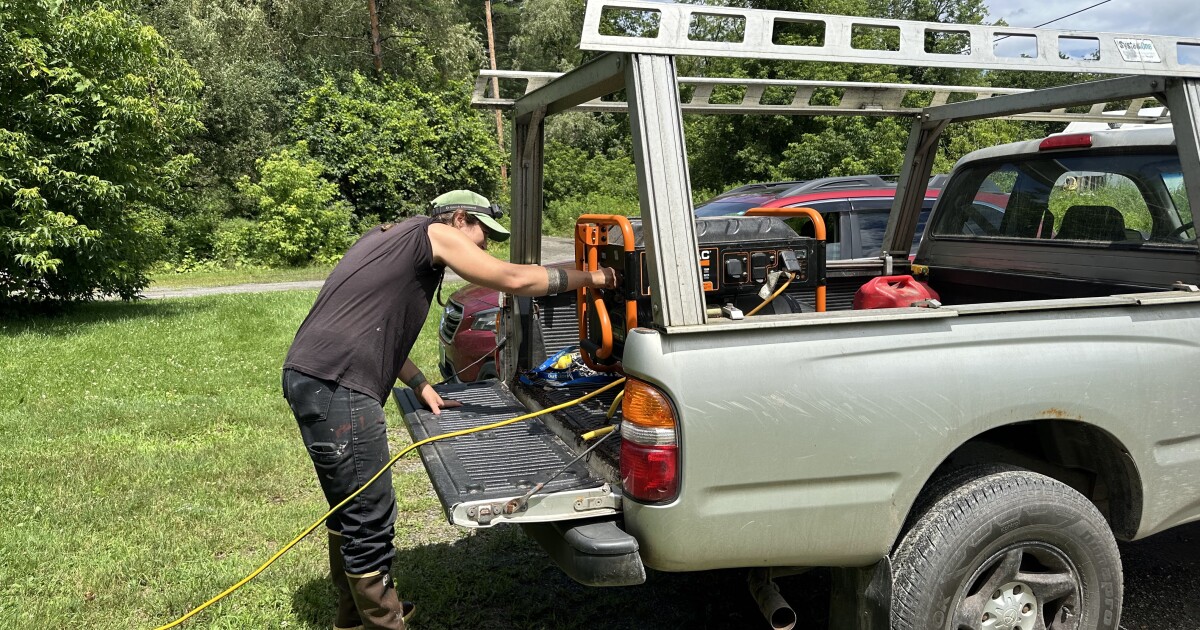
Erica Heilman: That’s Rylan Sirianni, wading through a basement full of water to hook up a generator to a dead sump pump. Rylan is part of a big community of queer people in central Vermont who have been instrumental in flood recovery around here, both this year and last. And this loose confederation of very effective young people has been working closely with town and city flood recovery efforts all over central Vermont.
I went down to Plainfield to talk with some people about why the queer community, in particular, is so responsive in a crisis.
Meg Bolger was mucking out a house in Plainfield, and I pulled her aside for a couple minutes to talk.
Erica Heilman
/
Vermont Public
Meg Bolger: The queer community has channels that are already set up. So, like, there’s a mutual aid thread. There’s specific threads that we already have, preexisting the disaster. And it’s narrow enough, it’s like a small enough group of people, that you can mobilize those people.
And you can also take requests from the general population. Like Dan, who’s been coordinating the Plainfield volunteers, like that request got put onto a queer thread. And then a bunch of queer people showed up today who might not have otherwise, because that was, like, distributed through channels that we were already plugged into.
And I think, like — I don’t know — how does the straight community get their information? Front Porch Forum? Posters? But like, we just have this additional layer of infrastructure that we’re all working with.
Erica Heilman: This is Wren Lansky.
So there could be a Signal channel for people who like to crochet. I mean, why is this community — why is the queer community so responsive?
Wren Lansky: There’s a belief in like, we help each other. Yeah, I guess if we want to, like, get into queer identity and queer politics, like the state has never really been there for queer folks. And so we know that we have to show up for each other … and that includes all of our neighbors. That includes everybody, not just queer people.
And mutual aid is, like, small autonomous groups of people coming together to understand what the needs are and meet each other’s needs. Not like, tit for tat, like, “I’m going to help you so you help me.” But my security and ability to be safe in the world is bound up in your ability to be safe in the world and have your needs met. And so, if I give money to a GoFundMe, I’m not thinking about that as, like, charity or as, “I’m a good person so I’m going to give away my money.” I’m thinking about it as, “I want to build a network and a community and a culture where the expectation is when people need things, their needs are met by each other.”
Because we know, watching FEMA and state response, how slow it is, and how many hoops you have to jump through. And if people can just, yeah, come together and meet those needs more quickly, it’s often better for everyone.
“There’s an understanding that like, we need each other. A lot of queer people, we did not find community where it was first obvious, right? And so like, we needed each other.”
Meg Bolger
Meg Bolger: It’s a little bit of like, believing what goes around comes around. It’s believing that like, there isn’t a scarcity model. Abundance happens when you give.
But I just think that like, when it comes to showing up, like this is showing up for working class people, right? This is showing up for our neighbors and our friends. But also like, the people who are, I don’t know, so lovely and chipper and welcome our help. So I think that some of it is just that there’s an understanding that like, we need each other.
A lot of queer people, we did not find community where it was first obvious, right? And so like, we needed each other. And I think that feeling of like, we inherently need each other — I think capitalism and a lot of current modern society pushes us towards like, monetization, where like, “I don’t need you. I’ll pay someone to look after my kids.” Or, “I don’t need you, I’ll pay someone to fix my car.” And like, we have an understanding that there’s certain things you can’t do without, like human-to-human interaction and human-to-human care. And so I think that translates to a deep understanding of, like, we need each other.
“There’s no other time where you get to walk around the village and just ask people, ‘What do you need?’ Like, that’s such a feeling.”
Wren Lansky
Wren Lansky: It’s hard to pick apart because it just feels obvious to me. Like it just feels like that’s what you have to do. You know, like, Bob down in the village whose basement we were mucking out, the next morning was like, “Thank you guys, so much, like, this is incredible.” And it’s like, yeah, and of course, you’re neighbors. Of course that’s what you have to do.
It’s hard to zoom out because all of my friends feel the same way. And so I don’t think I would hang out with people who didn’t have that orientation to, if there’s a disaster and your neighbors are in trouble, you go down and you muck out their basement.
There’s no other time where you get to walk around the village and just ask people, “What do you need?” Like, that’s such a feeling. And I know so many more names of folks out in the village now than I did before.
Erica Heilman: I want to give people like a taste, like a sensory taste of what it looks like feels like in this part of the woods.
Rylan Sirianni: I mean, it’s changed a lot. So many people have moved here since the pandemic, but I feel like we used to — it’s like glitter wood punks or something. I don’t know. I mean like that’s what it felt like back then. And not that it isn’t now, but it’s just, there’s just so many more queers around and they all bring their different flavor, and I think that’s changing and evolving and taking new shape. But yeah, I think we used to all be, like, glitter wood punks or something.
Have questions, comments or tips? Send us a message.
Vermont
Vermont seeks dynamic pricing for state park access
MONTPELIER, Vt. (WCAX) – The state of Vermont wants more flexibility in how it charges for access to state parks.
Right now, fees are determined by location, size, and type of camping.
However, leaders say parking at state parks and ponds is seeing more foot traffic, and costs of maintaining them have gone up.
The Department of Forest Parks and Recreation wants to be able to price campsites and day-use parks more dynamically.
There’s no proposal to raise fees now, but if approved, some state parks could see increased fees depending on their popularity, the date, and location.
“It is trying to find that balance of covering costs, providing the service parkgoers have come to expect and making sure we aren’t creating unintentional barriers for people who want to enjoy our fabulous state lakes,” said Julie Moore, Vermont Natural Resources Secretary.
She adds that last year’s Vermont ‘Parks Forever’ initiative, which allows for people who receive three squares benefits free entry to parks, meant an additional 30,000 visits last year.
Copyright 2026 WCAX. All rights reserved.
Vermont
Hundreds of housing units in the works at closely-watched project in Burlington’s South End – VTDigger
This story, by Report for America corps member Carly Berlin, was produced through a partnership between VTDigger and Vermont Public.
A long-awaited housing development that could bring hundreds of new apartments to a series of empty lots in Burlington’s South End neighborhood is beginning to come together.
The first phase of the major public-private deal, called the South End Coordinated Redevelopment Project, got official sign-off from the Burlington City Council last month. The project’s backers have also scored key funding commitments from Treasurer Mike Pieciak’s office and state housing funding agencies.
The project on Lakeside Avenue is the beginning of “a neighborhood being born out of a big parking lot,” Burlington Mayor Emma Mulvaney-Stanak told city councilors in May.
City officials and developers hope the project could eventually include over a thousand homes, making it one of the largest developments in Vermont – and putting a considerable dent in the Queen City’s housing shortage. Regional planners estimate that Burlington needs to add between 3,500 and 10,500 homes by 2050 to get the housing market to a healthy state.
The development is possible, in part, because of a 2023 zoning change in the formerly industrial area that allows for some of the densest housing development in the state, according to local planners.
 100vw, 1200px”/><figcaption class=)
The South End project’s backers include Champlain College, Champlain Housing Trust and Ride Your Bike LLC, the investors behind the nearby Hula coworking campus. They have brought on Jonathan Rose Companies, an affordable housing developer with projects from New York to California, as the lead developer. The South End project is the company’s first in Vermont.
The development agreement signed by city councilors in May greenlights the South End project’s first 204 units, estimated to cost roughly $100 million.
Per Burlington’s inclusionary zoning policy and state rules, at least 20% of the first round of apartments will be set aside as affordable. But the developers hope to secure enough funding to allow them to earmark a third of the 204 apartments with income restrictions, said Andrew Foley, director of development at Jonathan Rose Companies, in an interview. The development agreement offers the developers reduced city fees if the affordable units are priced even more modestly than required.
The lion’s share of the new apartments will be studios and one-bedrooms, Foley said. The building would include common social spaces for neighbors to gather, he added.
Like any large-scale housing project, the developers of the South End apartments are piecing together financing from a wide array of sources. They recently scored an $8 million low-interest loan from Pieciak’s 10% for Vermont program, along with a $6.7 million award from the Vermont Housing and Conservation Board to support 67 affordable apartments – including 10 reserved for people experiencing homelessness.
To build out new roads – along with wastewater connections and stormwater infrastructure meant to cut down on sewer overflows into nearby Lake Champlain – city officials are going after funding from a new state program. The Community and Housing Infrastructure Program, a tax-increment financing tool created by the Legislature last year, would allow the city and the developers to borrow the funds needed to build out the infrastructure against the development’s future property tax revenue.
READ MORE
City officials and the developers are working together to submit an application for this CHIP financing. The South End development could be the first project in the state to utilize the program after its launch in January.
“I think a lot of other potential applicants are kind of saying, ‘I wonder how that South End project works out’ – for us to maybe go first,” Foley said.
With an eye toward lowering the project’s carbon footprint, the development will be all-electric, Foley said. The developers are looking to use mass-timber construction techniques, he added – essentially using large, prefabricated wood panels in place of steel or concrete. They also want to construct a rooftop solar array, employ a geothermal heating and cooling system and promote a “car-light” neighborhood in close proximity to bike paths and transit routes.
The developers hope to close on their construction financing by the end of the year.
“Everyone’s eager to see the construction start and housing built, so we’re trying to move as fast as we can,” Foley said.
Vermont
VT Lottery Mega Millions, Gimme 5 results for June 2, 2026
Powerball, Mega Millions jackpots: What to know in case you win
Here’s what to know in case you win the Powerball or Mega Millions jackpot.
Just the FAQs, USA TODAY
The Vermont Lottery offers several draw games for those willing to make a bet to win big.
Those who want to play can enter the MegaBucks and Lucky for Life games as well as the national Powerball and Mega Millions games. Vermont also partners with New Hampshire and Maine for the Tri-State Lottery, which includes the Mega Bucks, Gimme 5 as well as the Pick 3 and Pick 4.
Drawings are held at regular days and times, check the end of this story to see the schedule.
Here’s a look at June 2, 2026, results for each game:
Winning Vermont Mega Millions numbers from June 2 drawing
15-26-43-48-60, Mega Ball: 12
Check Vermont Mega Millions payouts and previous drawings here.
Winning Gimme 5 numbers from June 2 drawing
03-05-16-32-37
Check Gimme 5 payouts and previous drawings here.
Winning Pick 3 numbers from June 2 drawing
Day: 2-5-2
Evening: 5-8-6
Check Pick 3 payouts and previous drawings here.
Winning Pick 4 numbers from June 2 drawing
Day: 6-9-7-0
Evening: 3-4-1-3
Check Pick 4 payouts and previous drawings here.
Winning Millionaire for Life numbers from June 2 drawing
16-33-41-50-52, Bonus: 01
Check Millionaire for Life payouts and previous drawings here.
Feeling lucky? Explore the latest lottery news & results
Are you a winner? Here’s how to claim your lottery prize
For Vermont Lottery prizes up to $499, winners can claim their prize at any authorized Vermont Lottery retailer or at the Vermont Lottery Headquarters by presenting the signed winning ticket for validation. Prizes between $500 and $5,000 can be claimed at any M&T Bank location in Vermont during the Vermont Lottery Office’s business hours, which are 8a.m.-4p.m. Monday through Friday, except state holidays.
For prizes over $5,000, claims must be made in person at the Vermont Lottery headquarters. In addition to signing your ticket, you will need to bring a government-issued photo ID, and a completed claim form.
All prize claims must be submitted within one year of the drawing date. For more information on prize claims or to download a Vermont Lottery Claim Form, visit the Vermont Lottery’s FAQ page or contact their customer service line at (802) 479-5686.
Vermont Lottery Headquarters
1311 US Route 302, Suite 100
Barre, VT
05641
When are the Vermont Lottery drawings held?
- Powerball: 10:59 p.m. Monday, Wednesday, and Saturday.
- Mega Millions: 11 p.m. Tuesday and Friday.
- Gimme 5: 6:55 p.m. Monday through Friday.
- Lucky for Life: 10:38 p.m. daily.
- Pick 3 Day: 1:10 p.m. daily.
- Pick 4 Day: 1:10 p.m. daily.
- Pick 3 Evening: 6:55 p.m. daily.
- Pick 4 Evening: 6:55 p.m. daily.
- Megabucks: 7:59 p.m. Monday, Wednesday and Saturday.
- Millionaire for Life: 11:15 p.m. daily
What is Vermont Lottery Second Chance?
Vermont’s 2nd Chance lottery lets players enter eligible non-winning instant scratch tickets into a drawing to win cash and/or other prizes. Players must register through the state’s official Lottery website or app. The drawings are held quarterly or are part of an additional promotion, and are done at Pollard Banknote Limited in Winnipeg, MB, Canada.
This results page was generated automatically using information from TinBu and a template written and reviewed by a Vermont editor. You can send feedback using this form.
-
Illinois2 minutes agoConsumer advocacy groups oppose Illinois American Water $142.4M rate hike and potential major acquisition
-
Indiana5 minutes agoPHOTOS | Restored fountains at Garfield Park Sunken Garden
-
Iowa10 minutes agoWaukee Northwest beats Urbandale in Iowa boys soccer state semifinal
-
Kansas17 minutes agoKansas City, Missouri, police searching for missing 11-year-old girl
-
Kentucky20 minutes agoKentucky Lottery Cash Ball, Pick 3 Evening winning numbers for June 3, 2026
-
Louisiana25 minutes agoDHS watchdog finds use-of-force issues and safety and sanitation concerns at Louisiana ICE center
-
Maine32 minutes ago‘I could die here’: Photographer recalls Maine wedding stabbing
-
Maryland35 minutes agoFull-length Replay: Maryland | FOX Sports
