Address Newsletter
Our weekly digest on buying, selling, and design, with expert advice and insider neighborhood knowledge.


Real Estate
“Treat yo self” was Retta’s tagline in “Parks and Recreation.”
And that’s just what a New England couple did when they won a $150,000 home renovation from HGTV after their Vermont home was deemed the “ugliest” in America.
Hosted by Retta, HGTV’s “Ugliest House in America” sees the comedian travel across the country to “tour properties nominated by their owners as the ugliest home around,” per the show description. In the finale, HGTV designer Alison Victoria surprises the winners with a total home renovation.
On the season 7 finale, which aired Feb. 4, homeowners Brooklyn and Dylan teared up when they saw their remodeled Vershire, Vermont, home. (HGTV did not provide last names.)

The couple and their three sons were introduced in episode four when Brooklyn explained the house “is our nightmare.”
Retta named the home “Mishmash Hodgepodge.”
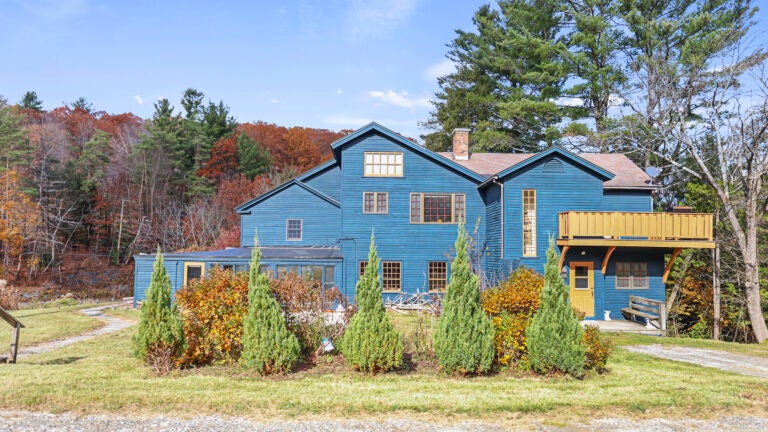
The bright orange and blue house— three stories high, built on stilts, and 3,344 square feet, per the show description — may have been deemed the ugliest in America by HGTV, but the view is gorgeous. It sits on 14 green acres, with panoramic views of the White Mountains.
“Is there a significance to the colors?”Retta asked of the bright exterior.


“At least you never get lost when you’re driving up to it,” Dylan quipped. The family said they had lived in the home for 10 months when they appeared on the show.
As for the chaotic inside, Dylan said, “We definitely want to make it less circus-like.”


There were green monkeys carved into the cabinets and birds carved into the staircase railing. The primary bedroom and bathroom ceiling was thatched. Parts of the interior were painted in blocks of yellow, orange, and blue.
“I feel like I need to center myself,” Retta said.
She pointed out that the living area had built-in couches made of stone and concrete. “I look at your couches and I think: hemorrhoids,” she joked.
After looking into their mirror-filled bathroom, Retta remarked, “This is sensory overload. This is a fifth-grade project.”


Retta pointed to the thatched ceiling in the primary bedroom: “You’re asking for mice.” Walking into the upstairs bathroom, her eyes popped, as she took in another thatched ceiling. The couple shared that spiders kept them out of the bathtub.
At the end of the episode, Retta dubbed the home a “mishmosh hodgepodge color-block animal sanctuary.” She scored the Vermont house a 6 out of 6 for appearance on the “Ugly Meter.”


In last night’s finale, we learned that of the 15 houses Retta toured this season, the Vermont house was “uniquely ugly.”
She and Victoria announced to the New Englanders: “You have the ‘Ugliest House in America!’” as confetti rained down.
Victoria pointed out that the land they sit on is “amazing…This could be very picturesque… The view’s ridiculously beautiful,” the designer said. “I want the outside of your home to be as beautiful as the property it sits on.”
Walking inside, Victoria suggested leveling out “wonky weird” floors in the conversation pit area, taking out the bird carving on the stair handrail, taking down the plastic sheeting wall of the primary bedroom, and redoing and thatched “tiki-hut-kind-of-feel” ceiling, among other things.
“I don’t know where to start,” she told the camera. “This is seriously one of the wildest, craziest, ugliest houses that I’ve ever taken on.”
After demolition and remodeling, the couple was brought blindfolded before the house for the big reveal.

Gone was the orange and blue paint. “It’s like a painting behind your house,” Victoria said of the green woods and hills. “And now your house is part of the painting.”
“This doesn’t even look like the same house,” Brooklyn said touring the interior.
The primary bedroom, totally redone, now boasts sliding glass doors to an outdoor hot tub. They also see a madeover patio area with a new walkway.
“I am blown away,” Dylan said.
“It reminds me of a fairy forest house,” Brooklyn added. “And I love that.”
Lauren Daley is a freelance culture writer. She can be reached at [email protected]. She tweets @laurendaley1, and Instagrams at @laurendaley1. Read more stories on Facebook here.


Our weekly digest on buying, selling, and design, with expert advice and insider neighborhood knowledge.


The Ben & Jerry’s Foundation says it will shut down at the end of the year after its corporate parent cut off funding and evicted its three staffers Wednesday. The move leaves $600,000 a year in grants to Vermont organizations, and 40 years of the ice cream brand’s progressive mission, hanging on a judge’s future ruling.
“This is the other foot dropping in terms of the way Magnum is trying to destroy the social values of Ben & Jerry’s,” said Ben Cohen, co-founder of Ben & Jerry’s Homemade, in an interview Wednesday.
The Vermont-based iconic ice cream brand has been in a legal fight with its parent company, The Magnum Ice Cream Co. — an ice-cream spinoff of the larger corporation Unilever — since November 2024. Ben & Jerry’s alleges that the corporation overreached its control, pushing out the CEO and interfering with the brand’s political views. The question before a judge is whether the corporate parent had the authority to reshape governance and withhold funding from the foundation.
Amid the push-and-pull over governance, Unilever audited the foundation, which is the philanthropic arm of Ben & Jerry’s, in April 2025, finding conflicts of interest and a lack of governance and financial control.
Liz Bankowski, president of the foundation’s board of trustees, said in an interview that Unilever withheld the philanthropy’s funding late last year and ordered foundation staff to vacate its corporate office in South Burlington by July 15 because of governance issues the audit raised. This led the foundation’s leaders to join the ongoing lawsuit, fought by the ice cream brand’s independent board, in an effort to retain funding. The lawsuit is pending in the U.S. District Court for the Southern District of New York.
While the foundation’s leadership is framing the decision to cease operations as the only option after Unilever withheld funding, an unnamed spokesperson for Magnum wrote in a statement to VTDigger that the shuttering is “entirely down to the Trustees and their decision to ignore the findings of an independent audit and failure to put in place basic good governance; much to our dismay.”
Since the audit, the foundation has adopted a conflict of interest policy, but “the bottom line was that unless we changed our board, they were going to continue to withhold funding,” Bankowski said.
Cohen described the audit as “a bunch of trumped-up charges.”
“The foundation has been independently audited every year,” he said. “I think that Magnum was searching in vain for some illegal or unethical activities. I think they found none.”
Since Ben & Jerry’s sold the ice cream business to Unilever in 2000, the corporation has given $60 million to the foundation. The philanthropic arm has operated for 40 years, supporting the ice cream brand’s progressive mission by offering financial backing to social justice organizations across the country. The foundation does not have an endowment and is reliant on the funding its parent company gives annually, outlined in its merger contract.
A chunk of that funding, $600,000 a year, goes to Vermont organizations such as the immigrant farmworker rights organization Migrant Justice and the LGBTQ+ nonprofit Outright Vermont, according to foundation leaders.
“We fill a particular niche that not a lot of other funders fill,” said Rebecca Golden, the foundation’s director of programs, who has worked at the organization for 34 years.
Golden is one of three foundation staffers whose last day in the physical office is Wednesday, following orders from Magnum to vacate. Although Magnum did not directly address its vacate order in its statement to VTDigger, the spokesperson wrote that the foundation’s leaders recently “took the position that its staff are not Ben & Jerry’s employees, despite utilising Ben & Jerry’s offices and systems.”
Golden described the possible shutdown as an “enormous loss” that will not only affect the organizations that the foundation supports but also Ben & Jerry’s employees who “feel very proud of being a part of the foundation.”
“It’s been a really long year, so there’s been a lot of emotions — the whole gamut, as we like to say of the seven stages of grief. But I think at this point we’re sort of in the acceptance phase,” she said.
The Magnum spokesperson indicated that the work of the foundation will continue even if its leaders decide to cease operations at the end of the year, writing that the company is “firmly committed to funding a grant-giving foundation, supported by appropriate governance controls to ensure it is living by its values.”
But Cohen is not confident that Magnum will uphold the values of the Ben & Jerry’s Foundation in the corporation’s continued philanthropic efforts.
“What are they going to fund? I have no idea. My guess is that they would not be looking to fund entities that are opposed to the status quo,” Cohen said.
The foundation’s leaders have pointed to its support of Migrant Justice during a period when the farmworker organization was considering a boycott of Ben & Jerry’s as an example of their commitment to social justice. After immigrant farmworkers raised concerns about working conditions at farms supplying Ben & Jerry’s, the company joined a program that collaborates with farmworkers to strive for fair working conditions.
Political activism has been central to the Ben & Jerry’s brand since its founding. As a part of the ongoing lawsuit, Ben & Jerry’s alleged in a May filing that Magnum has been undercutting its social justice mission in order to “censor, intimidate and purge” the company’s independent board, which Cohen said was created to defend its progressive values.
Three of the board’s members, including one who has been an outspoken critic of Israel, were removed late last year after the parent corporation introduced a new set of governance practices. In its motion to dismiss the lawsuit, Magnum argues that it retains ultimate authority and the brand’s social mission must be nonpartisan.
As the lawsuit awaits a decision, Cohen, who is not a part of the suit, has created a campaign to “free Ben & Jerry’s,” amassing around 160,000 signers for its petition demanding that Magnum sell Ben & Jerry’s to a “group of values-aligned investors.”
“The very values-led business model that built Ben & Jerry’s into this amazing, phenomenal brand is the very thing that Magnum is currently destroying,” Cohen said.

SOUTHERN VERMONT — A thick veil of wildfire smoke high in the atmosphere is transforming the sky over our local Bennington and Windham Counties this week – casting an eerie glow, muting the sun, and leaving air quality in the moderate range – even as temperatures and humidity remain oppressive.
According to federal forecasters, the hazy and particulate-laden sky and unusual colors are the result of smoke from more than 830 active wildfires burning across Canada and northern Minnesota, funneled into New England by the jet stream and trapped over the region by stubborn weather patterns.
Over the course of Wednesday, residents across Southern Vermont reported the sky shifting from orangey‑yellow to umber to violet hues tinged with pink, with a yellow cast over the landscape and a deep red or dark orange sun, especially nearest to sunrise and sunset.
On a normal and clear day in Southern Vermont, tiny molecules in the atmosphere scatter mostly blue light, which is why the sky appears blue.
However, this week, the air is filled with larger particulate matter from wildfire smoke, which scatters longer wavelengths of light – oranges and reds – in a process known as Mie scattering (pronounced “mee,” and named after physicist Gustav Mie who first published the mathematical description of this weird-looking light-scattering phenomenon).
Due to Mie scattering, the sky can appear milky white, with sepia tones, or faintly pink‑violet, instead of blue. The sun may appear like a dark orange or red disk, especially when low to the horizon, and sunlight at ground level feels weaker and more filtered, as if being viewed through rose-tinted glasses. And these are the effects that we are currently experiencing.
Federal agencies have reported that more than 800 wildfires are burning in Canada, with additional fires in northern Minnesota near the Canadian border. Many of these are large, and burning through dense boreal forests with little or no containment.
These blazes have triggered evacuations at their locales and in the surrounding areas, and are attributed to areas experiencing intensive drought.
The smoke created from these wildfires reaches Vermont through a series of atmospheric steps.
The jet stream’s “conveyor belt” of high‑altitude winds scoop up smoke from the Central Canada region and carry it southeast across the Great Lakes and into New England.
A high‑pressure “lid” forms, where a strong high‑pressure system causes air to sink (a process known as subsidence) which then presses some of the elevated smoke closer to the surface.
A stalled weather pattern can occur, where slow‑moving systems over Canada and the Northeast keep the flow of smoke aimed at the region instead of sweeping it quickly away.
These patterns mean that – even though the fires are hundreds of miles away – fine particulate matter (PM2.5) from those blazes is now suspended over Vermont and neighboring states.
On Wednesday, air quality in Bennington and Windham Counties sat in the “moderate” category, with the Air Quality Index (AQI) fluctuating roughly between the low‑50s and high‑90s. This was driven primarily by PM2.5 from the presence of wildfire smoke.
In practical terms, most healthy adults can go about their normal routines outdoors. However, more sensitive groups – older adults, children, people with asthma, COPD, or heart disease – are advised to limit prolonged or heavy exertion outside, especially during the haziest periods.
Those with prolonged exposure may notice throat irritation, mild coughing, or even eye discomfort – particularly during intense exercise.
Residents can track real‑time conditions using the federal AirNow “Fire and Smoke Map” and Vermont‑specific dashboards, which show localized AQI readings as plumes shift during the day on Thursday.
The same smoke that is changing the sky’s color is also subtly reshaping the weather over Southern Vermont.
Forecasters note several key effects. These include solar dimming, where smoke particles in the upper atmosphere scatter and absorb sunlight, acting as a partial sunblock. This can shave a few degrees off daytime highs, compared with what might otherwise occur under clear skies.
It can also include “capping inversion.” By warming the air aloft, the smoke can create a “cap” – a warm layer that suppresses rising air. This can weaken thunderstorms, even when surface heat and humidity are high.
Another key effect is cloud microphysics, where extra smoke particles provide millions of tiny surfaces for water vapor to cling to, producing many “very tiny” droplets rather than fewer larger raindrops. These smaller droplets don’t fall as easily, which can reduce heavy rainfall and the actual structure of a storm.
For example, on Tuesday night, Southern Vermont sat under extremely high humidity fueled by warm southerly winds pulling tropical moisture up the East Coast ahead of a cold front. Under normal conditions, that setup could have produced stronger thunderstorms. Instead, wildfire smoke likely muted the intensity of those expected storms, leaving the region with more of a muggy “soupy” feeling than the explosive severe weather that many expected.
Through Wednesday and into Thursday, forecasters expect the following for our Southern Vermont region:
By Friday, higher pressure and drier air are expected to build in from the west, bringing more seasonable temperatures in the upper 70s to mid‑80s, lower humidity, and improved air quality – though some high‑level haze may linger.
For now, we will continue to look at our landscape through our “rose-colored” glasses.


Trump’s ‘American Flag Blue’ in the Lincoln Memorial pool is already gray — and the Olympic canoer ‘vandal’ is fighting his arrest | Fortune


Water main break floods West Hollywood streets, traps cars


Detroit’s air quality early Thursday ranked as hazardous, worst in the world


‘It was a scene from the Titanic’: Fishermen recall rescuing passengers from sinking boat in SF Bay


Big picture takeaways from the Dallas Mavericks first week at Summer League


“We’re going to be champions”. Argentina fans in Miami Beach celebrate team’s win against England


4 Red Sox Trade Targets to Solidify Boston’s Push for a Playoff Spot


RTD considers ending Denver’s 16th Street FreeRide shuttle due to budget issues

